 [][1]
[][2]
[][3]
[][4]
[][5]
`@elementumjs/component` is the simplest tiny framework to work with vanilla WebComponents. Vue.js inspired syntax.
- [📝 How to use it][6]
- [Component registration][7]
- [Component definition][8]
- [Component information: `data` & `attrs`][9]
- [Watch for component information][10]
- [Component structure: `template` & `styles`][11]
- [Component life-cycle: `created`, `rendered` & `destroyed`][12]
- [Communication between nested components][13]
- [🧪 Full example][14]
- [⚙️ Installation][15]
- [Import from CDN as ES Module][16]
- [Or install the package locally][17]
- [Other import methods][18]
---
[][1]
[][2]
[][3]
[][4]
[][5]
`@elementumjs/component` is the simplest tiny framework to work with vanilla WebComponents. Vue.js inspired syntax.
- [📝 How to use it][6]
- [Component registration][7]
- [Component definition][8]
- [Component information: `data` & `attrs`][9]
- [Watch for component information][10]
- [Component structure: `template` & `styles`][11]
- [Component life-cycle: `created`, `rendered` & `destroyed`][12]
- [Communication between nested components][13]
- [🧪 Full example][14]
- [⚙️ Installation][15]
- [Import from CDN as ES Module][16]
- [Or install the package locally][17]
- [Other import methods][18]
---
 ## How to use it
### Component registration
The new component definition should extend the `Component` class and use the `attach` static function to register the component with a associated HTML tag to use them on HTML files:
```javascript
class AwardComponent extends Component {
// ...
}
Component.attach("award-component", AwardComponent);
```
Or using shorter syntax:
```javascript
Component.attach("award-component", class extends Component {
// ...
});
```
### Component definition
#### Component information
There are two ways to initialize component information. Both of them implements [`@elementumjs/listenable-data`](https://github.com/elementumjs/listenable-data):
* `Component.data`: That defines the component initial data.
* `Component.attrs`: That defines the component attributes and allows to the component to receive information reactively from parent.
##### Component data
`Component.data` getter function defines component initial data. It is accesible from other component methods using `Component.data` as an `Object`.
*Parent component*
```javascript
class AwardComponent extends Component {
static get data() {
return {
points: 0
}
}
// ...
}
```
##### Component attributes
`Component.attrs` getter function defines component attributes and allows to receive information reactively from parent component. The initial definition of `Component.attrs` also defines the type of the data that it contains. It is accesible from other component methods using `Component.attrs` as an `Object`. It must be a `static` getter:
*Child component*
```javascript
class GetPointsComponent extends Component {
static get attrs() {
return {
currentPoints: 0
}
}
// ...
}
```
*Parent component*
```javascript
class AwardComponent extends Component {
// ...
template() {
return html`
## How to use it
### Component registration
The new component definition should extend the `Component` class and use the `attach` static function to register the component with a associated HTML tag to use them on HTML files:
```javascript
class AwardComponent extends Component {
// ...
}
Component.attach("award-component", AwardComponent);
```
Or using shorter syntax:
```javascript
Component.attach("award-component", class extends Component {
// ...
});
```
### Component definition
#### Component information
There are two ways to initialize component information. Both of them implements [`@elementumjs/listenable-data`](https://github.com/elementumjs/listenable-data):
* `Component.data`: That defines the component initial data.
* `Component.attrs`: That defines the component attributes and allows to the component to receive information reactively from parent.
##### Component data
`Component.data` getter function defines component initial data. It is accesible from other component methods using `Component.data` as an `Object`.
*Parent component*
```javascript
class AwardComponent extends Component {
static get data() {
return {
points: 0
}
}
// ...
}
```
##### Component attributes
`Component.attrs` getter function defines component attributes and allows to receive information reactively from parent component. The initial definition of `Component.attrs` also defines the type of the data that it contains. It is accesible from other component methods using `Component.attrs` as an `Object`. It must be a `static` getter:
*Child component*
```javascript
class GetPointsComponent extends Component {
static get attrs() {
return {
currentPoints: 0
}
}
// ...
}
```
*Parent component*
```javascript
class AwardComponent extends Component {
// ...
template() {
return html`${ this.data.points >= 3 ? "Winner!" : "" }
 ## Full example
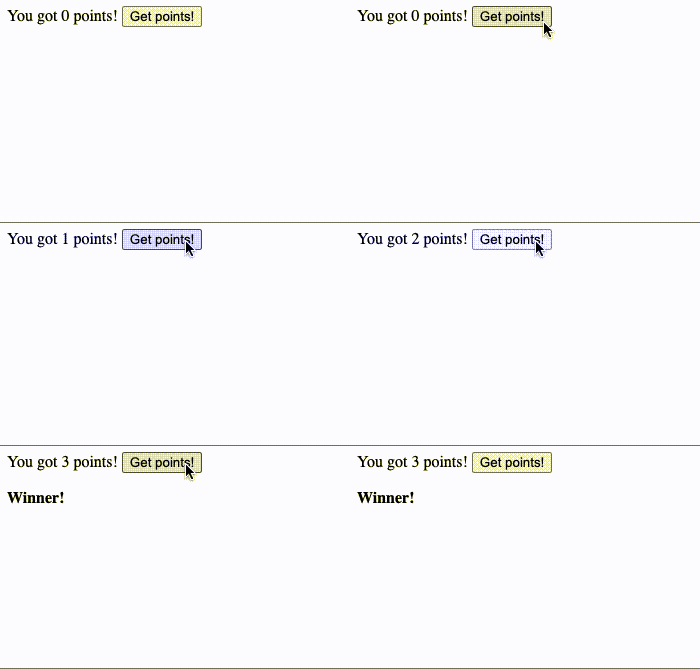 Parent component definition: `award-component.js`.
```javascript
import { Component, html } from '@elementumjs/component';
import './get-points-component.js';
Component.attach('award-component', class extends Component {
static get data() {
return {
points: 0,
}
}
styles() {
return `
p {
font-weight: bold;
font-size: 26px;
}
`;
}
template() {
return html`
Parent component definition: `award-component.js`.
```javascript
import { Component, html } from '@elementumjs/component';
import './get-points-component.js';
Component.attach('award-component', class extends Component {
static get data() {
return {
points: 0,
}
}
styles() {
return `
p {
font-weight: bold;
font-size: 26px;
}
`;
}
template() {
return html`${ this.data.points >= 3 ? "Winner!" : "" }
 ## Installation
### Import from CDN as ES Module
Import from [jsDelivr CDN](https://www.jsdelivr.com/):
```javascript
import Component from "https://cdn.jsdelivr.net/gh/elementumjs/component/dist/component.esm.js";
```
### Or install the package locally
#### Download the package
Install via `npm`:
```sh
npm install @elementumjs/component
```
#### Import as ES Module
[ES Module](http://exploringjs.com/es6/ch_modules.html) builds are intended for use with modern bundlers like [webpack 2](https://webpack.js.org) or [rollup](http://rollupjs.org/). Use it with ES6 JavaScript `import`:
```javascript
import Component from '@elementumjs/component';
```
### Other import methods
Checkout other import methods in [`dist/README.md`](./dist/README.md).
[1]: https://cdn.jsdelivr.net/gh/elementumjs/component/dist/component.umd.js
[2]: https://www.npmjs.com/package/@elementumjs/component
[3]: https://github.com/elementumjs/component/actions?query=workflow%3Aproduction
[4]: docs/modules.md
[5]: LICENSE
[6]: #how-to-use-it
[7]: #component-registration
[8]: #component-definition
[9]: #component-information
[10]: #watch-for-component-information
[11]: #component-structure
[12]: #component-life-cycle
[13]: #communication-between-nested-components
[14]: #full-example
[15]: #installation
[16]: #import-from-cdn-as-es.module
[17]: #or-install-the-package-locally
[18]: #other-import-methods
---
_Source: https://npm.io/package/@elementumjs/component · Machine-readable twin of the npm.io package page. Health data is recomputed on every publish._
## Installation
### Import from CDN as ES Module
Import from [jsDelivr CDN](https://www.jsdelivr.com/):
```javascript
import Component from "https://cdn.jsdelivr.net/gh/elementumjs/component/dist/component.esm.js";
```
### Or install the package locally
#### Download the package
Install via `npm`:
```sh
npm install @elementumjs/component
```
#### Import as ES Module
[ES Module](http://exploringjs.com/es6/ch_modules.html) builds are intended for use with modern bundlers like [webpack 2](https://webpack.js.org) or [rollup](http://rollupjs.org/). Use it with ES6 JavaScript `import`:
```javascript
import Component from '@elementumjs/component';
```
### Other import methods
Checkout other import methods in [`dist/README.md`](./dist/README.md).
[1]: https://cdn.jsdelivr.net/gh/elementumjs/component/dist/component.umd.js
[2]: https://www.npmjs.com/package/@elementumjs/component
[3]: https://github.com/elementumjs/component/actions?query=workflow%3Aproduction
[4]: docs/modules.md
[5]: LICENSE
[6]: #how-to-use-it
[7]: #component-registration
[8]: #component-definition
[9]: #component-information
[10]: #watch-for-component-information
[11]: #component-structure
[12]: #component-life-cycle
[13]: #communication-between-nested-components
[14]: #full-example
[15]: #installation
[16]: #import-from-cdn-as-es.module
[17]: #or-install-the-package-locally
[18]: #other-import-methods
---
_Source: https://npm.io/package/@elementumjs/component · Machine-readable twin of the npm.io package page. Health data is recomputed on every publish._