


 @worker-manager/nestjs
[NestJS](https://nestjs.com/) module for Worker Manager.
@worker-manager/nestjs
[NestJS](https://nestjs.com/) module for Worker Manager.
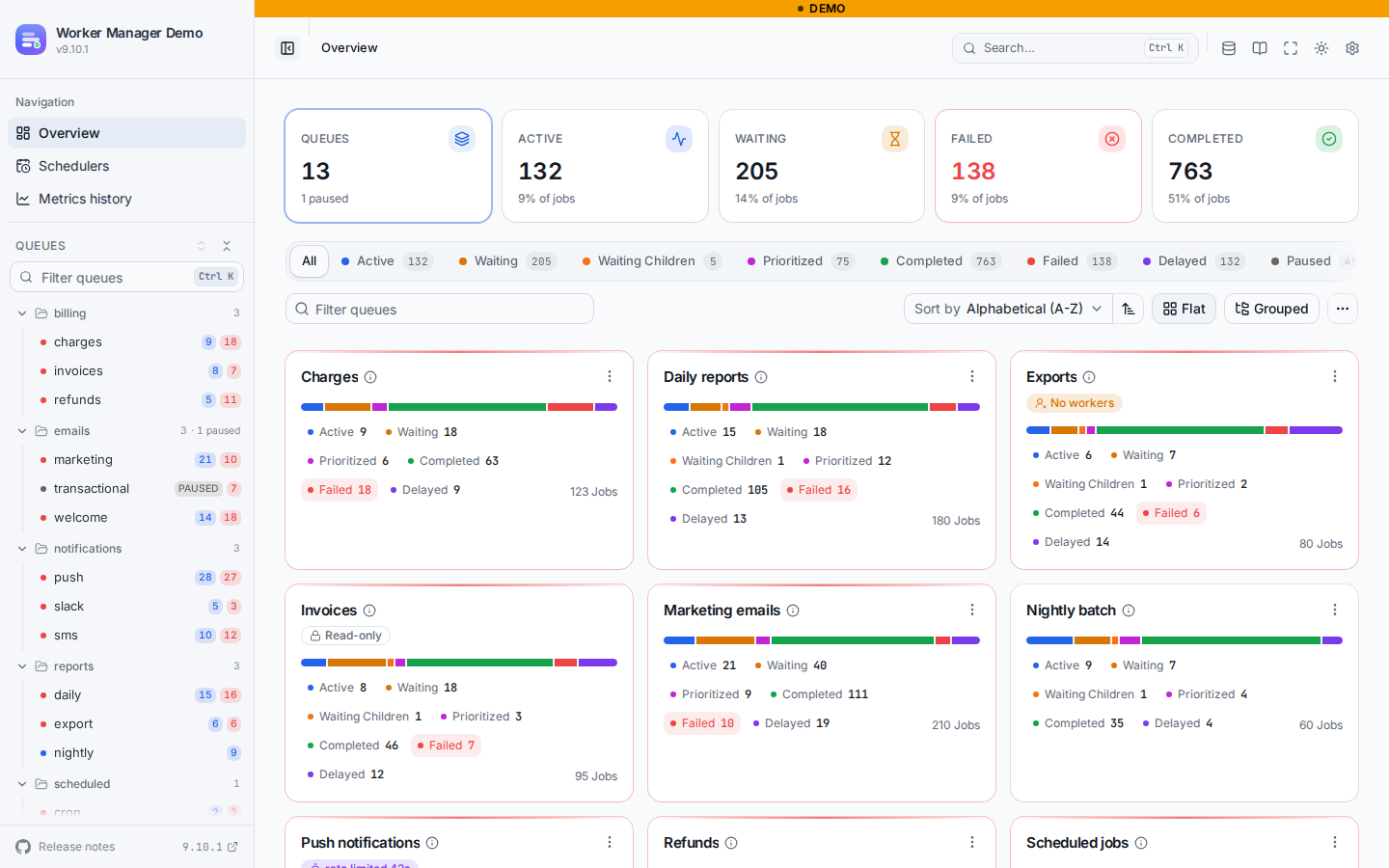 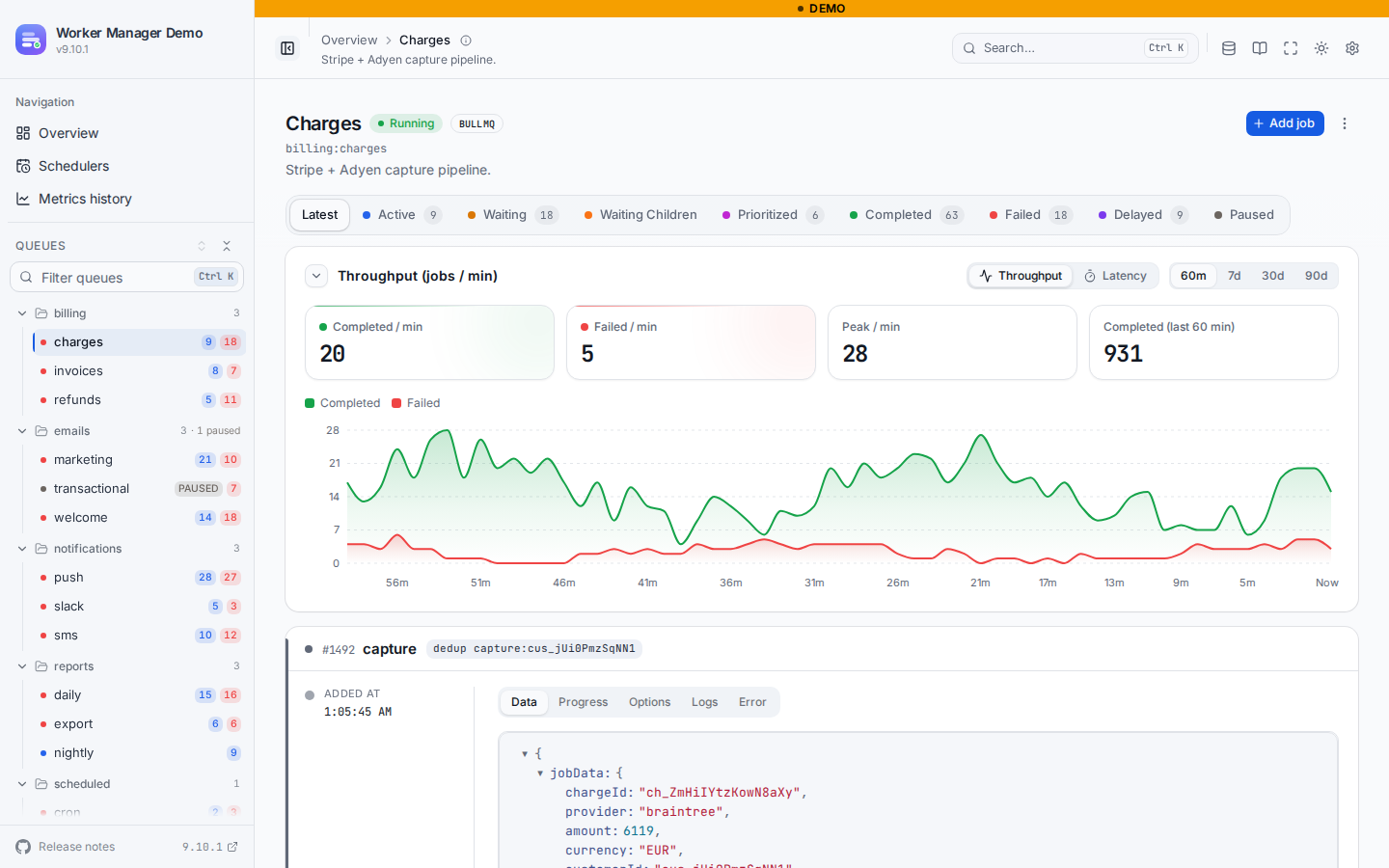 ## Installation Install both @worker-manager/api and this module. ```bash $ npm install --save @worker-manager/nestjs @worker-manager/api ``` Install the Express or Fastify adapter depending on what you use in NestJS (default is Express) ```bash $ npm install --save @worker-manager/express //or $ npm install --save @worker-manager/fastify ``` ## Register the root module Once the installation is completed, we can import the `WorkerManagerModule` into your rootmodule e.g. `AppModule`. ```typescript import { Module } from '@nestjs/common'; import { WorkerManagerModule } from "@worker-manager/nestjs"; @Module({ imports: [ BullModule.forRoot({ // your bull module config here. }), // Served at /queues, with the adapter matching your Nest platform (Express or Fastify). WorkerManagerModule.forRoot(), ], }) export class AppModule { } ``` The `forRoot()` method registers the Worker Manager instance and allows you to pass several options to both the instance and module. The following options are available, all optional. | Option | Default | | |---|---|---| | `route` | `'/queues'` | Base route of the board, relative to the Nest global prefix. | | `adapter` | auto-detected | `ExpressAdapter` (`@worker-manager/express`) or `FastifyAdapter` (`@worker-manager/fastify`). When omitted, the module reads the platform from `HttpAdapterHost` and loads the matching package. | | `auth` | none | Built-in authentication, see [Authentication](#authentication). | | `enabled` | `true` | `false` registers nothing: no routes, no middleware, `forFeature` becomes a no-op and the injected instance is `null`. | | `readOnly` | `false` | Read-only mode for every queue registered through `queues` or `forFeature`, unless the queue sets `options.readOnlyMode` itself. | | `queues` | `[]` | Queues to register at the root, same shape as `forFeature` entries. | | `uiConfig` | | Merged into `boardOptions.uiConfig`. | | `title` / `logo` / `theme` | | Shortcuts for `uiConfig.boardTitle`, `uiConfig.boardLogo`, `uiConfig.theme`. | | `boardOptions` | | Options as provided by the Worker Manager package, such as `uiBasePath` and `uiConfig`. | | `middleware` | | Nest middleware applied to the board route, after `auth` on Express. | ```typescript WorkerManagerModule.forRoot({ route: '/ops/queues', title: 'Ops queues', readOnly: process.env.NODE_ENV === 'production', enabled: process.env.QUEUE_BOARD !== 'off', queues: [{ name: 'emails', adapter: BullMQAdapter }], }), ``` ### Async configuration `forRootAsync()` accepts `useFactory` + `inject`, `useClass` or `useExisting`, with `imports`: ```typescript WorkerManagerModule.forRootAsync({ imports: [ConfigModule], inject: [ConfigService], useFactory: (config: ConfigService) => ({ route: '/queues', enabled: config.get('QUEUE_BOARD_ENABLED') !== 'false', auth: { strategy: 'keycloak', url: config.getOrThrow('KEYCLOAK_URL'), realm: config.getOrThrow('KEYCLOAK_REALM'), clientId: config.getOrThrow('KEYCLOAK_CLIENT_ID'), clientSecret: config.get('KEYCLOAK_CLIENT_SECRET'), requiredRoles: ['wm-admin'], cookie: { secret: config.getOrThrow('SESSION_SECRET') }, }, }), }), ``` ```typescript @Injectable() class BoardConfig implements WorkerManagerOptionsFactory { constructor(private readonly config: ConfigService) {} createWorkerManagerOptions(): WorkerManagerModuleOptions { return { auth: { strategy: 'basic', users: [{ username: 'admin', password: this.config.getOrThrow('BOARD_PASSWORD') }] } }; } } WorkerManagerModule.forRootAsync({ imports: [ConfigModule], useClass: BoardConfig }), ``` ## Authentication The `auth` option protects every board route (page, API, assets) with [`@worker-manager/auth`](https://www.npmjs.com/package/@worker-manager/auth), on Express and Fastify alike, and honours the Nest global prefix. ### Basic ```typescript WorkerManagerModule.forRoot({ auth: { strategy: 'basic', users: [{ username: 'admin', password: process.env.BOARD_PASSWORD, roles: ['admin'] }], }, }), ``` ### Keycloak ```typescript WorkerManagerModule.forRoot({ auth: { strategy: 'keycloak', url: 'https://sso.example.com', realm: 'ops', clientId: 'worker-manager', clientSecret: process.env.KEYCLOAK_CLIENT_SECRET, publicUrl: 'https://api.example.com/queues', // the board's external URL, base path included requiredRoles: ['wm-admin'], cookie: { secret: process.env.SESSION_SECRET }, }, }), ``` Browsers are sent through the OIDC authorization code flow (PKCE), API clients may send an `Authorization: Bearer` access token. Register `https://api.example.com/queues/auth/callback` as a redirect URI on the Keycloak client. The board serves `GET /queues/auth/me` (the signed-in user) and `GET /queues/auth/logout`. ### Custom middleware `middleware` still takes any Nest middleware, e.g. `express-basic-auth`. On Express it runs after `auth`. On Fastify it is applied as Nest middleware to the exact `route`, before the board's own hooks. ```typescript import basicAuth from "express-basic-auth"; WorkerManagerModule.forRoot({ route: "/queues", middleware: basicAuth({ challenge: true, users: { admin: "passwordhere" }, }), }), ``` ## Register your queues To register a new queue, you need to register `WorkerManagerModule.forFeature` in the same module as where your queues are registered. ```typescript import { Module } from '@nestjs/common'; import { WorkerManagerModule } from "@worker-manager/nestjs"; import { BullMQAdapter } from "@worker-manager/api/bullMQAdapter"; import { BullModule } from "@nestjs/bullmq"; @Module({ imports: [ BullModule.registerQueue( { name: 'my_awesome_queue' } ), WorkerManagerModule.forFeature({ name: 'my_awesome_queue', adapter: BullMQAdapter, //or use BullAdapter if you're using bull instead of bullMQ }), ], }) export class FeatureModule {} ``` The `forFeature` method registers the given queues to the Worker Manager instance. The following options are available. - `name` the queue name to resolve from the Nest DI container. - `queue` a queue instance to register directly, instead of resolving it by `name`. - `adapter` either `BullAdapter` or `BullMQAdapter` depending on which package you use. - `options` queue adapter options as found in the Worker Manager package, such as `readOnlyMode`, `description` etc. Provide either `name` or `queue`. ### PostgreSQL-backed queues (BullMQ v6) A BullMQ v6 queue stored in PostgreSQL has no Redis connection and is usually not in the Nest container, so hand the instance over directly: ```typescript import { Queue, createPostgresBackend } from 'bullmq'; // bullmq@6, plus `pg` const invoices = new Queue('invoices', { connection: process.env.POSTGRES_URL }, createPostgresBackend); WorkerManagerModule.forRoot({ queues: [{ queue: invoices, adapter: BullMQAdapter }], }), ``` Redis and PostgreSQL queues can share one board. ### Registering queue instances directly `@nestjs/bullmq` generates the DI token for a queue from its `name` only, ignoring the `prefix`. Two queues that share a name but use different prefixes therefore collapse onto a single DI token, and a `name`-based lookup cannot tell them apart. Pass the queue instances directly via `queue` to register them as distinct board entries: ```typescript @Module({ imports: [ WorkerManagerModule.forFeature( { queue: emailsTenantA, adapter: BullMQAdapter, options: { prefix: 'tenant-a:' } }, { queue: emailsTenantB, adapter: BullMQAdapter, options: { prefix: 'tenant-b:' } }, ), ], }) export class FeatureModule {} ``` ## Using the Worker Manager instance in your controllers and/or services. The created Worker Manager instance is available via the `@InjectWorkerManager()` decorator. For example in a controller: ```typescript import { Controller, Get } from "@nestjs/common"; import { WorkerManagerBoard, InjectWorkerManager } from "@worker-manager/nestjs"; @Controller('my-feature') export class FeatureController { constructor( @InjectWorkerManager() private readonly boardInstance: WorkerManagerBoard ) { } //controller methods } ``` # Usage examples 1. [Simple NestJS setup](https://github.com/naldomadeira/worker-manager/tree/main/examples/with-nestjs) For more info visit the main [README](https://github.com/naldomadeira/worker-manager#readme) --- _Source: https://npm.io/package/@worker-manager/nestjs · Machine-readable twin of the npm.io package page. Health data is recomputed on every publish._