# react-konva
> React components for the Konva 2d canvas library. Build interactive graphics, design editors, and whiteboards with JSX.
Latest version **19.2.7** (published 2026-09-08) · MIT license · 0 weekly downloads
## Install
```sh
npm install react-konva
pnpm add react-konva
yarn add react-konva
bun add react-konva
```
## Health
**Score 55/100 (C)** — status: active.
Positive: no vulnerabilities; recently updated; high maintenance score.
Warnings: low downloads; no types; no esm support.
## Facts
| | |
|---|---|
| Version | 19.2.7 |
| Published | 2026-09-08 |
| First published | 2015-04-22 |
| Weekly downloads | 0 |
| License | MIT |
| TypeScript types | none |
| Module format | CommonJS |
| Dependencies | 0 |
| Known vulnerabilities | 0 |
| Install scripts | no |
| GitHub stars | 6412 |
| Maintainers | lavrton |
| Keywords | react, canvas, jsx, konva, graphics, design-editor, canvas-editor, whiteboard, transformer |
## Links
- npm: https://www.npmjs.com/package/react-konva
- Repository: https://github.com/konvajs/react-konva
- Homepage: https://konvajs.org/docs/react/index.html
- Issues: https://github.com/konvajs/react-konva/issues
- Funding: https://www.patreon.com/lavrton
- npm.io page: https://npm.io/package/react-konva
## Alternatives
- [mobx-react](https://npm.io/package/mobx-react.md) — 2.8M weekly downloads
- [rc-tree](https://npm.io/package/rc-tree.md) — 2.6M weekly downloads
- [@react-oauth/google](https://npm.io/package/@react-oauth/google.md) — 1.3M weekly downloads
- [@wagmi/connectors](https://npm.io/package/@wagmi/connectors.md) — 877.0K weekly downloads
- [vee-validate](https://npm.io/package/vee-validate.md) — 836.4K weekly downloads
## Recent versions
- 19.2.7 (latest) — 2026-09-08
- 18.2.16 (legacy) — 2026-05-12
- 19.2.0-3 (next) — 2025-10-24
- 19.0.0-1 (beta) — 2024-08-12
- 19.2.6 — 2026-09-04
- 19.2.5 — 2026-06-09
- 18.2.15 — 2026-05-11
- 19.2.4 — 2026-05-08
- 19.2.3 — 2026-02-28
- 19.2.2 — 2026-02-03
- 19.2.1 — 2025-11-26
- 19.2.0 — 2025-10-24
- 19.2.0-2 — 2025-10-24
- 19.2.0-1 — 2025-10-24
- 19.2.0-0 — 2025-10-24
- … 142 more at https://npm.io/package/react-konva/versions
## README

# React Konva
[](https://opencollective.com/konva)
[](http://badge.fury.io/js/react-konva)
[](https://github.com/konvajs/react-konva/actions/workflows/test.yml)
React Konva provides declarative React components for the [Konva](https://konvajs.org/) 2D canvas scene graph. Use it to build design editors, whiteboards, diagrams, annotations, and other interactive graphics.
React Konva is MIT licensed. It supports Konva shapes and events. It does not support React Native.
- [React tutorial](https://konvajs.org/docs/react/index.html)
- [Live demos](https://konvajs.org/docs/sandbox.html)
- [Konva API](https://konvajs.org/api/Konva.html)
- [Star the project](https://github.com/konvajs/react-konva)
[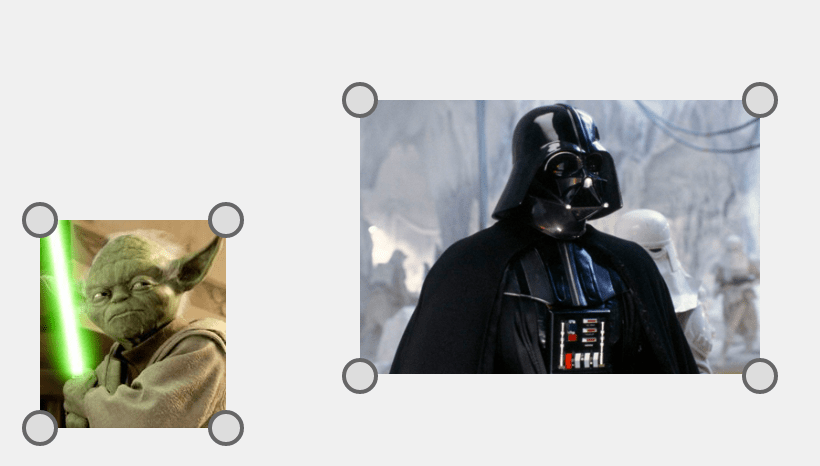](https://konvajs.org/docs/react/Transformer.html)
## Install
React Konva 19 requires React and React DOM `^19.2.0`. For React 18, install the latest React Konva 18 release.
```bash
npm install react-konva konva
```
## Quick example
```javascript
import {useState} from 'react';
import {Stage, Layer, Rect} from 'react-konva';
export default function App() {
const [color, setColor] = useState('#00a8e8');
return (
setColor(color === '#00a8e8' ? '#ff7a00' : '#00a8e8')}
/>
);
}
```
> **Building a full design editor?** [Polotno](https://polotno.com/?utm_source=konvajs&utm_medium=readme&utm_content=react-konva) is a commercial design editor SDK built on Konva by the Konva maintainers. It ships templates, text editing, and export, so you integrate an editor instead of building one: `npm install polotno`.
To get more info about `Konva` you can read
[Konva Overview](https://konvajs.org/docs/overview.html).
`react-konva` follows the Konva API. Learn the Konva scene graph, properties, and events before you add framework-specific patterns.
## Core API
`react-konva` supports Konva shapes with the same names. Event props use React names such as `onClick`, `onTouchMove`, and `onDragEnd`.
### Getting reference to Konva objects
To get reference of `Konva` instance of a node you can use `ref` property.
```javascript
import React, { useEffect, useRef } from 'react';
const MyShape = () => {
const circleRef = useRef();
useEffect(() => {
// log Konva.Circle instance
console.log(circleRef.current);
}, []);
return ;
};
```
### Strict mode
By default `react-konva` works in "non-strict" mode. If you changed a property **manually** (or by user action like `drag&drop`) properties of the node will be not matched with properties from `render()`. `react-konva` updates ONLY properties changed in `render()`.
In strict mode `react-konva` will update all properties of the nodes to the values that you provided in `render()` function, no matter changed they or not.
You should decide what mode is better in your actual use case.
To enable strict mode globally you can do this:
```javascript
import { useStrictMode } from 'react-konva';
useStrictMode(true);
```
Or you can enable it only for some components:
```javascript
```
Take a look into this example:
```javascript
import { Circle } from 'react-konva';
import Konva from 'konva';
const Shape = () => {
const [color, setColor] = React.useState();
return (
{
setColor(Konva.Util.getRandomColor());
}}
/>
);
};
```
The circle is `draggable` and it changes its color on `dragend` event. In `strict` mode position of the node will be reset back to `{x: 0, y: 0}` (as we defined in render). But in `non-strict` mode the circle will keep its position, because `x` and `y` are not changed in render.
### Minimal bundle
By default `react-konva` imports full `Konva` version. With all the shapes and all filters. To minimize bundle size you can use minimal core version of `react-konva`:
```javascript
// load minimal version of 'react-konva`
import { Stage, Layer, Rect } from 'react-konva/lib/ReactKonvaCore';
// minimal version has NO support for core shapes and filters
// if you want import a shape into Konva namespace you can just do this:
import 'konva/lib/shapes/Rect';
```
Demo: [https://codesandbox.io/s/6l97wny44z](https://codesandbox.io/s/6l97wny44z)
## Usage with Next.js
Konva 10+ works with Next.js without extra canvas setup. Use a
[Client Component](https://nextjs.org/docs/app/api-reference/directives/use-client) (`'use client'`).
Konva 9 and earlier need extra setup, such as installing `canvas` or
[disabling SSR](https://nextjs.org/docs/app/guides/lazy-loading#skipping-ssr) for the canvas component.
### Usage with React Context
Components inside `Stage` receive React contexts from its parent tree automatically. This behavior is available since `react-konva@18.2.2`.
```jsx
import React from 'react';
import { Stage, Layer, Rect } from 'react-konva';
const ThemeContext = React.createContext('red');
function ThemedRect() {
const fill = React.useContext(ThemeContext);
return ;
}
function App() {
return (
);
}
```
## Event synchronization
With Konva 10.5+, native input batches ordinary React state updates per Konva
listener and commits them before that listener returns, keeping DOM and canvas in sync.
This includes drag and transform events. To batch MobX reactions too, pass `runInAction`:
```tsx
import { runInAction } from 'mobx';
{/* Existing layers, shapes, and handlers */}
```
The wrapper must call its callback exactly once, synchronously. Older Konva versions
use normal React scheduling and ignore this prop. See the [release notes](RELEASE_NOTES.md)
for performance and compatibility details.
## Development and tests
Run `npm install` and `npx playwright install chromium` before the tests.
- `npm test` runs browser tests with development and production React, performance counts, package builds, server rendering, and TypeScript checks.
- `BROWSER=firefox npm test` and `BROWSER=webkit npm test` select other installed Playwright browsers.
- `npm run test:performance` runs commit and calculation limits with production profiling builds.
- `npm run test:ssr` checks all built entry points without a DOM or native canvas backend, including imports when the optional event hook is absent.
- `npm run test:typings` checks the source and consumer examples.
- `npm run bench:events -- HEAD` compares elapsed interaction time against a commit. See [the benchmark guide](https://github.com/konvajs/react-konva/blob/master/benchmarks/README.md).
All tests use the latest published Konva. Compatibility tests disable its optional
hook; they do not install historical versions. CI runs the full suite in Chromium,
Firefox, and WebKit. A separate job checks minimum React with latest Konva.
Run development, production, and
profiling suites sequentially because they share Vite's dependency cache.
All interaction regressions run in the regular suite. There is no separate
expected-failure command.
## [CHANGELOG](https://github.com/konvajs/react-konva/releases)
See the [Konva demos](https://konvajs.org/docs/sandbox.html) for more complete examples.
---
_Source: https://npm.io/package/react-konva · Machine-readable twin of the npm.io package page. Health data is recomputed on every publish._