# react-native-system-setting
> provide some system setting APIs. Volume, brightness, wifi, location, bluetooth, airplane...
Latest version **1.7.6** (published 2020-10-11) · MIT license · 0 weekly downloads
## Install
```sh
npm install react-native-system-setting
pnpm add react-native-system-setting
yarn add react-native-system-setting
bun add react-native-system-setting
```
## Health
**Score 25/100 (F)** — status: abandoned.
Positive: has types; no vulnerabilities; high quality score.
Warnings: low downloads; no esm support.
Negative: abandoned; low maintenance score.
## Facts
| | |
|---|---|
| Version | 1.7.6 |
| Published | 2020-10-11 |
| First published | 2017-05-30 |
| Weekly downloads | 0 |
| License | MIT |
| TypeScript types | bundled |
| Module format | CommonJS |
| Dependencies | 0 |
| Unpacked size | 105 KB |
| Known vulnerabilities | 0 |
| Install scripts | no |
| GitHub stars | 448 |
| Author | Ninty |
| Maintainers | ninty |
| Keywords | react-native, system, setting, volume, wifi, brightness, location, bluetooth, airplane |
## Links
- npm: https://www.npmjs.com/package/react-native-system-setting
- Repository: https://github.com/c19354837/react-native-system-setting
- Issues: https://github.com/c19354837/react-native-system-setting/issues
- npm.io page: https://npm.io/package/react-native-system-setting
## Alternatives
- [jsforce](https://npm.io/package/jsforce.md) — 851.2K weekly downloads
- [react-native-qrcode-svg](https://npm.io/package/react-native-qrcode-svg.md) — 693.5K weekly downloads
- [@salesforce/plugin-data](https://npm.io/package/@salesforce/plugin-data.md) — 394.9K weekly downloads
- [@backstage/plugin-search-common](https://npm.io/package/@backstage/plugin-search-common.md) — 308.5K weekly downloads
- [@chain-registry/types](https://npm.io/package/@chain-registry/types.md) — 38.4K weekly downloads
## Recent versions
- 1.7.6 (latest) — 2020-10-11
- 1.8.0-alpha.0 (alpha) — 2022-02-16
- 1.7.5 — 2020-09-04
- 1.7.4 — 2020-01-30
- 1.7.3 — 2019-10-03
- 1.7.2 — 2019-02-14
- 1.7.1 — 2018-12-30
- 1.7.0 — 2018-09-29
- 1.6.0 — 2018-09-20
- 1.5.3 — 2018-08-20
- 1.5.2 — 2018-08-05
- 1.5.1 — 2018-08-02
- 1.5.0 — 2018-07-10
- 1.4.6 — 2018-06-20
- 1.4.5 — 2018-06-06
- … 23 more at https://npm.io/package/react-native-system-setting/versions
## README
## react-native-system-setting
It provides some system setting APIs for you. Support iOS and Android both.
### Support
* Volume ( with listener)
* Brightness
* Wifi switch
* Location
* Bluetooth
* Airplane
### Note
**[Example](https://github.com/c19354837/react-native-system-setting/tree/master/examples/SystemSettingExample) only work in the real device**
### Change Log
[Change Log](https://github.com/c19354837/react-native-system-setting/blob/master/CHANGELOG.md)
breaking change for permission since V1.5.0, see [Android Permission](https://github.com/c19354837/react-native-system-setting#android-permission)
## Look like
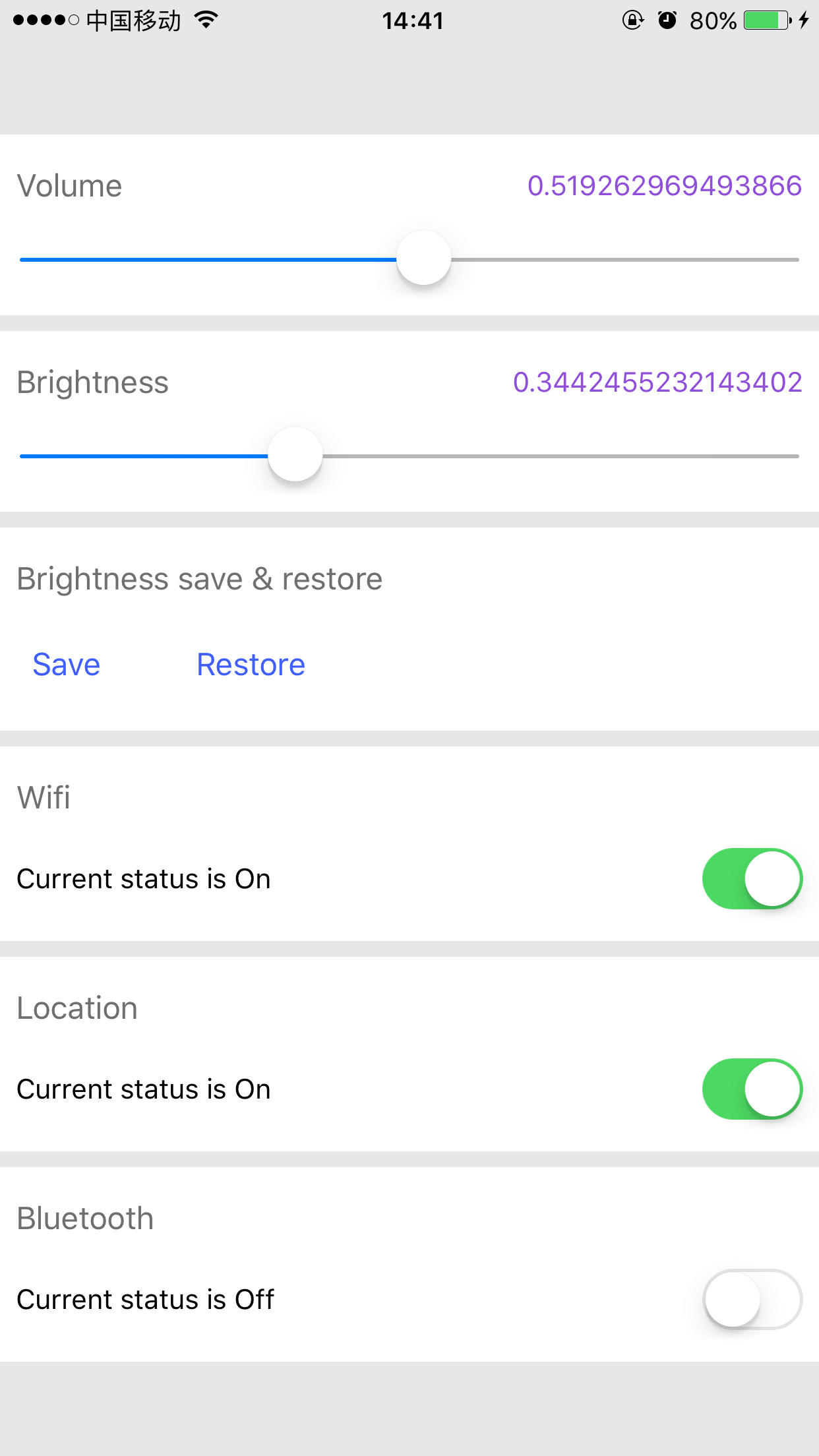
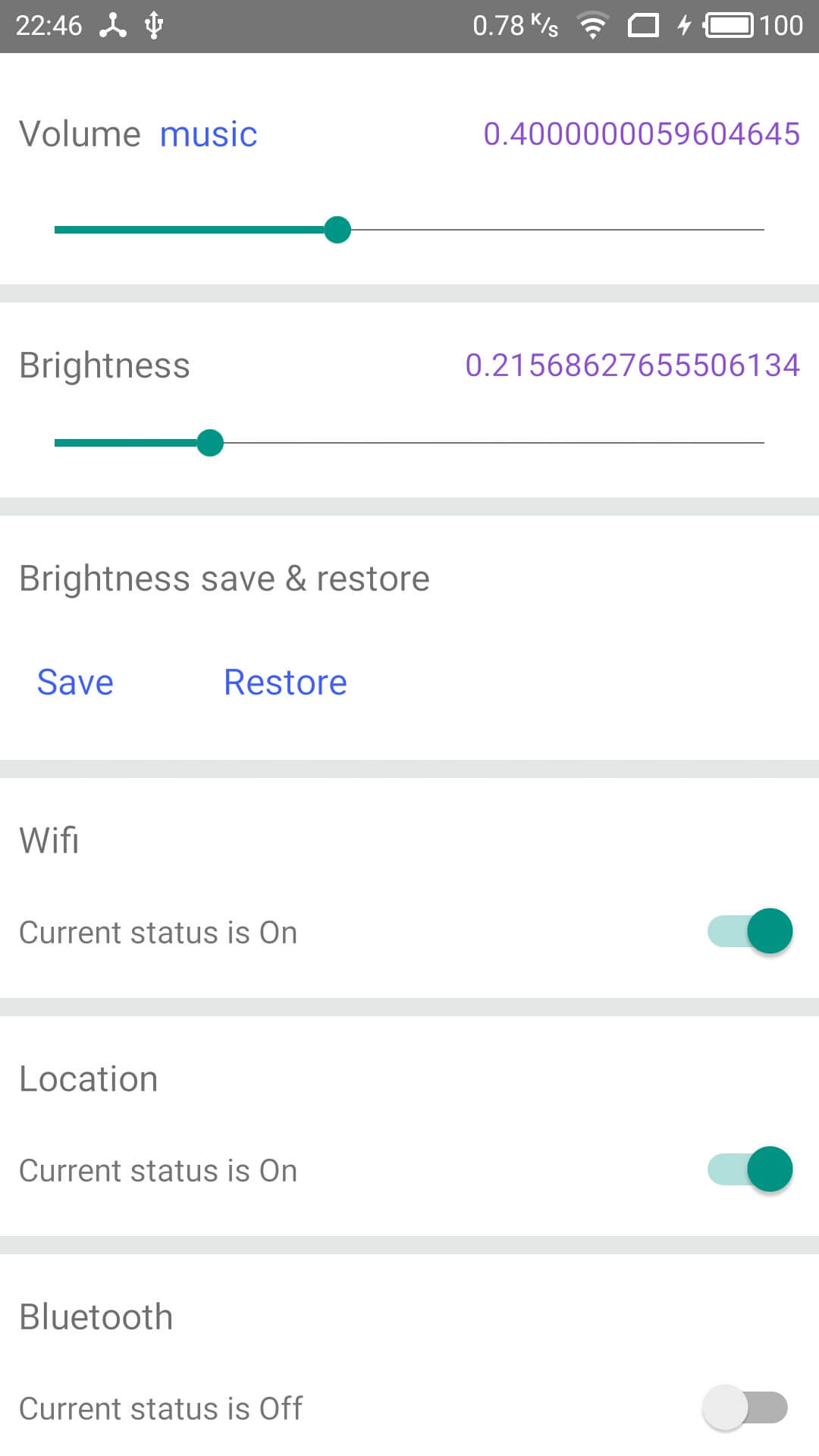
I really want to show the .gif, while it has no difference with .jpg for some system limit.
I strongly recommend you to run the example in real device to see how it works.
 ## Install
Run `npm i -S react-native-system-setting`
**Note: if your project was created by [Create React Native App](https://github.com/react-community/create-react-native-app), you should [Eject](https://github.com/react-community/create-react-native-app/blob/master/EJECTING.md) before link it.**
#### iOS
Run `react-native link` to link this library.
Or add `pod 'RCTSystemSetting', :path => '../node_modules/react-native-system-setting'` in `Podfile` for Cocoapods.
If link does not work, you can do it [manually](https://facebook.github.io/react-native/docs/linking-libraries-ios.html).
#### Android
Run `react-native link` to link this library.
That's all.
If link does not work, you can do it manually. Just follow this way:
**android/settings.gradle**
```gradle
include ':react-native-system-setting'
project(':react-native-system-setting').projectDir = new File(rootProject.projectDir, '../node_modules/react-native-system-setting/android')
```
**android/app/build.gradle**
```gradle
dependencies {
...
compile project(':react-native-system-setting')
}
```
**android/app/src/main/java/..packageName../MainApplication.java**
On top, where imports are:
```java
import com.ninty.system.setting.SystemSettingPackage;
```
Add the `SystemSettingPackage` class to your list of exported packages.
```java
@Override
protected List getPackages() {
return Arrays.asList(
new MainReactPackage(),
new SystemSettingPackage()
);
}
```
## Usage
**Common import**
```javascript
import SystemSetting from 'react-native-system-setting'
```
**volume**
```javascript
//get the current volume
SystemSetting.getVolume().then((volume)=>{
console.log('Current volume is ' + volume);
});
// change the volume
SystemSetting.setVolume(0.5);
// listen the volume changing if you need
const volumeListener = SystemSetting.addVolumeListener((data) => {
const volume = data.value;
console.log(volume);
});
//remove listener when you need it no more
SystemSetting.removeVolumeListener(volumeListener)
```
> `setVolume` can do more, [more detail](https://github.com/c19354837/react-native-system-setting/blob/master/API.md)
**brightness**
```javascript
//get the current brightness
SystemSetting.getBrightness().then((brightness)=>{
console.log('Current brightness is ' + brightness);
});
//change the brightness & check permission
SystemSetting.setBrightnessForce(0.5).then((success)=>{
!success && Alert.alert('Permission Deny', 'You have no permission changing settings',[
{'text': 'Ok', style: 'cancel'},
{'text': 'Open Setting', onPress:()=>SystemSetting.grantWriteSettingPermission()}
])
});
// save the value of brightness and screen mode.
SystemSetting.saveBrightness();
// restore the brightness and screen mode. you can get the old brightness value.
SystemSetting.restoreBrightness().then((oldVal)=>{
//if you need
})
// change app's brightness without any permission.
SystemSetting.setAppBrightness(0.5);
SystemSetting.getAppBrightness().then((brightness)=>{
console.log('Current app brightness is ' + brightness);
})
```
> `setBrightness()` & `saveBrightness()` need [permission](https://github.com/c19354837/react-native-system-setting#android-permission) for Android
**Wifi**
```javascript
SystemSetting.isWifiEnabled().then((enable)=>{
const state = enable ? 'On' : 'Off';
console.log('Current wifi is ' + state);
})
SystemSetting.switchWifi(()=>{
console.log('switch wifi successfully');
})
```
> `isWifiEnabled()` need [permission](https://github.com/c19354837/react-native-system-setting#android-permission) for Android
>
> `switchWifi()` is disabled by default for iOS since V1.7.0, [enable it](https://github.com/c19354837/react-native-system-setting/blob/master/iOS.md#ios)
**Location**
```javascript
SystemSetting.isLocationEnabled().then((enable)=>{
const state = enable ? 'On' : 'Off';
console.log('Current location is ' + state);
})
SystemSetting.switchLocation(()=>{
console.log('switch location successfully');
})
```
> `switchLocation()` is disabled by default for iOS since V1.7.0, [enable it](https://github.com/c19354837/react-native-system-setting/blob/master/iOS.md#ios)
**Bluetooth**
```javascript
SystemSetting.isBluetoothEnabled().then((enable)=>{
const state = enable ? 'On' : 'Off';
console.log('Current bluetooth is ' + state);
})
SystemSetting.switchBluetooth(()=>{
console.log('switch bluetooth successfully');
})
```
> `isBluetoothEnabled()` need [permission](https://github.com/c19354837/react-native-system-setting#android-permission) for Android
>
> All bluetooth-function are disabled by default for iOS since V1.7.0, [enable it](https://github.com/c19354837/react-native-system-setting/blob/master/iOS.md#ios)
**Airplane**
```javascript
SystemSetting.isAirplaneEnabled().then((enable)=>{
const state = enable ? 'On' : 'Off';
console.log('Current airplane is ' + state);
})
SystemSetting.switchAirplane(()=>{
console.log('switch airplane successfully');
})
```
> `isAirplaneEnabled()` will always return `true` for iOS if your device has no SIM card, see [detail](https://github.com/c19354837/react-native-system-setting/issues/37)
>
> `switchAirplane()` is disabled by default for iOS since V1.7.0, [enable it](https://github.com/c19354837/react-native-system-setting/blob/master/iOS.md#ios)
**Other**
```javascript
// open app setting page
SystemSetting.openAppSystemSettings()
```
## API
[API](https://github.com/c19354837/react-native-system-setting/blob/master/API.md)
## Run example
```
$ cd example/SystemSettingExample
$ npm install
// if android
$ react-native run-android
// else
$ react-native run-ios
```
## iOS
To be more friendly to app store, I disable some APIs for iOS since V1.7.0, You can [enable it](https://github.com/c19354837/react-native-system-setting/blob/master/iOS.md#ios) in a few steps.
## Android permission
### API
Default permissions are removed since V1.5.0, see [this PR](https://github.com/c19354837/react-native-system-setting/pull/44). You need to declare the corresponding permissions in your app's AndroidManifest.xml, see [example AndroidManifest.xml](https://github.com/c19354837/react-native-system-setting/blob/master/examples/SystemSettingExample/android/app/src/main/AndroidManifest.xml)
**`android/app/src/main/AndroidManifest.xml`**
```xml
...
```
> There are some different APIs that end with `silence`. They can do the job programmatically without direct user consent. These APIs maybe useful when you develop a system management app. Or, you should call `switchWifi()` & `switchBluetooth()` to get a better user experience
### Do Not Disturb
`setVolume()` may cause a crash: **Not allowed to change Do Not Disturb state**. See [detail](https://github.com/c19354837/react-native-system-setting/issues/48).
### Runtime permission for Android 6+
Change *brightness* and *screen mode* need `android.permission.WRITE_SETTINGS` which user can disable it in phone Setting. When you call `setScreenMode()`, `setBrightness()` or `setBrightnessForce()` , it will return false if the app has no permission, and you can call `SystemSetting.grantWriteSettingPermission()` to guide user to app setting page. see [example](https://github.com/c19354837/react-native-system-setting/tree/master/examples/SystemSettingExample)
> If you just want to change app's brightness, you can call `setAppBrightness(val)`, and it doesn't require any permission. see [API](https://github.com/c19354837/react-native-system-setting/blob/master/API.md)
## In the end
Feel free to open issue or pull request
## License
[**MIT**](https://github.com/c19354837/react-native-system-setting/blob/master/LICENSE.md)
---
_Source: https://npm.io/package/react-native-system-setting · Machine-readable twin of the npm.io package page. Health data is recomputed on every publish._