# react-object-inspector
> Simple object inspector styled similarly to Chrome DevTools
Latest version **0.2.1** (published 2016-01-06) · MIT license · 0 weekly downloads
> **Deprecated.** This package is deprecated.
## Install
```sh
npm install react-object-inspector
pnpm add react-object-inspector
yarn add react-object-inspector
bun add react-object-inspector
```
## Health
**Score 10/100 (F)** — status: deprecated.
Negative: deprecated.
## Facts
| | |
|---|---|
| Version | 0.2.1 |
| Published | 2016-01-06 |
| First published | 2015-08-07 |
| Weekly downloads | 0 |
| License | MIT |
| TypeScript types | none |
| Module format | CommonJS |
| Dependencies | 0 |
| Known vulnerabilities | 0 |
| Install scripts | no |
| GitHub stars | 191 |
| Author | Xiaoyi Chen |
| Maintainers | xyc |
| Keywords | react, reactjs, object, object-inspector, object-inspector, treeview, tree-view, tree, view, inspector, react-component, ui |
## Links
- npm: https://www.npmjs.com/package/react-object-inspector
- Repository: https://github.com/xyc/react-object-inspector
- Issues: https://github.com/xyc/react-object-inspector/issues
- npm.io page: https://npm.io/package/react-object-inspector
## Alternatives
- [mobx-react](https://npm.io/package/mobx-react.md) — 2.8M weekly downloads
- [rc-tree](https://npm.io/package/rc-tree.md) — 2.6M weekly downloads
- [@react-oauth/google](https://npm.io/package/@react-oauth/google.md) — 1.3M weekly downloads
- [@wagmi/connectors](https://npm.io/package/@wagmi/connectors.md) — 877.0K weekly downloads
- [vee-validate](https://npm.io/package/vee-validate.md) — 836.4K weekly downloads
## Recent versions
- 0.2.1 (latest) — 2016-01-06
- 0.2.0 — 2015-11-27
- 0.1.6 — 2015-10-27
- 0.1.5 — 2015-09-11
- 0.1.4 — 2015-08-07
- 0.1.3 — 2015-08-07
- 0.1.2 — 2015-08-07
- 0.1.1 — 2015-08-07
- 0.1.0 — 2015-08-07
## README
react-object-inspector
=====================
[](https://travis-ci.org/xyc/react-object-inspector)
[](https://www.npmjs.com/package/react-object-inspector)
Simple object inspector made with [React](http://facebook.github.io/react/) styled similarly to [Chrome DevTools](https://developer.chrome.com/devtools). You can use this tool to inspect Javascript Objects as an alternative to `JSON.stringify(data, null, 2)
`. Check out the playground [here](http://xyc.github.io/react-object-inspector/)
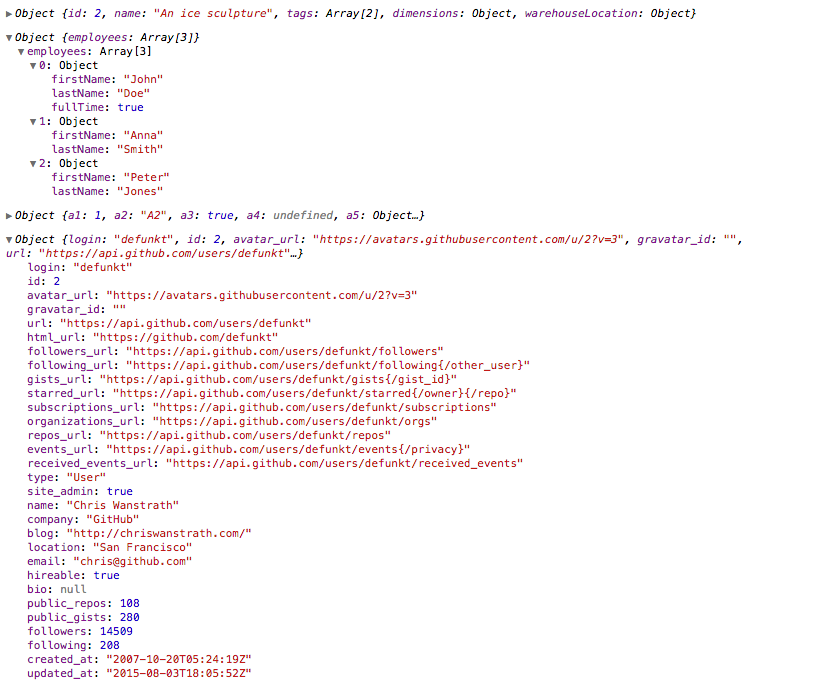
Tree state is saved at root. If you click to expand some elements in the hierarchy, the state will be preserved after the element is unmounted.
### Install
NPM:
```sh
npm install react-object-inspector
```
Starting from 0.2.0, react-object-inspector uses inline styles and you don't need to include any additional CSS files.
## API
#### <ObjectInspector />
The component accepts the following props:
#### `data`: the Javascript object you would like to inspect
#### `name`: specify the name of the root node, default to `undefined`
#### `initialExpandedPaths`: an array containing all the paths that should be expanded when the component is initialized.
- A path is a dot separated string like `root.foo.bar`
- By default you can refer to root's path as `'root'`, or the name prop if name is defined
- For example, `['root']` expands the first level nodes
- `['myCustomName']` can also expand the first level nodes if the component is setup as ``.
- `['root.foo.bar']` expands the path `root.foo.bar` if `root.foo.bar` is an existing property
- You can use wildcard to expand all paths on a specific level
- For example, to expand all first level and second level nodes, use `['root', 'root.*']`
### Usage
```js
import ObjectInspector from 'react-object-inspector';
let data = { /* ... */ };
React.render(
,
document.getElementById('objectInspector')
);
```
One common usage is embedding this in a component's render() method to provide a view for its props/state.
### Install the example
```sh
npm install && npm start
```
Open http://localhost:3000/example/index.html
---
_Source: https://npm.io/package/react-object-inspector · Machine-readable twin of the npm.io package page. Health data is recomputed on every publish._