# reimport
> Containerizable utility to import Mongo data into Redis.
Latest version **0.1.5** (published 2017-02-26) · ISC license · 0 weekly downloads
## Install
```sh
npm install reimport
pnpm add reimport
yarn add reimport
bun add reimport
```
## Health
**Score 15/100 (F)** — status: abandoned.
Positive: no vulnerabilities.
Warnings: low downloads; no types; no esm support; pre 1.0.
Negative: abandoned; low maintenance score.
## Facts
| | |
|---|---|
| Version | 0.1.5 |
| Published | 2017-02-26 |
| First published | 2017-02-25 |
| Weekly downloads | 0 |
| License | ISC |
| TypeScript types | none |
| Module format | CommonJS |
| Dependencies | 2 |
| Known vulnerabilities | 0 |
| Install scripts | no |
| GitHub stars | 0 |
| Author | @evanxsummers |
| Maintainers | evanx |
## Links
- npm: https://www.npmjs.com/package/reimport
- Repository: https://github.com/evanx/reimport
- Homepage: https://github.com/evanx/reimport#readme
- Issues: https://github.com/evanx/reimport/issues
- npm.io page: https://npm.io/package/reimport
## Dependencies (2)
- [app-bin](https://npm.io/package/app-bin.md) ^0.1.1
- [redis-app-rpf](https://npm.io/package/redis-app-rpf.md) ^0.6.8
## Recent versions
- 0.1.5 (latest) — 2017-02-26
- 0.1.4 — 2017-02-25
- 0.1.3 — 2017-02-25
- 0.1.2 — 2017-02-25
## README
# reimport
Containerizable utility to import Mongo data into Redis.
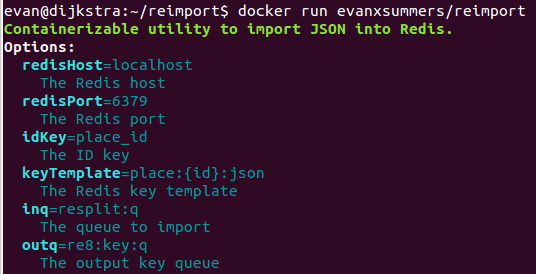 ## Use case
We use `mongoexport` to export a collection from MongoDB into a file, where each line is a JSON object.
We stream each line into a Redis list using https://github.com/evanx/resplit
This service then pops each line, extracts a required unique ID field for the Redis key, and sets the JSON document in Redis.
For example we have `place_id` in the JSON object, and wish to store the document using the key `place:${id}:j`
This JSON is intended to be exported to disk using https://github.com/evanx/refile, and served using Nginx.
## Config spec
See `lib/spec.js` https://github.com/evanx/reimport/blob/master/lib/spec.js
```javascript
module.exports = {
description: 'Containerizable utility to import JSON into Redis.',
required: {
redisHost: {
description: 'the Redis host',
default: 'localhost'
},
redisPort: {
description: 'the Redis port',
default: 6379
},
idName: {
description: 'the ID property name',
example: 'place_id'
},
namespace: {
description: 'the Redis key namespace',
example: 'place'
},
inq: {
description: 'the queue to import',
example: 'resplit:q'
},
busyq: {
description: 'the pending list for brpoplpush',
example: 'reimport:busy:q'
},
outq: {
description: 'the output key queue',
example: 'refile:key:q'
},
popTimeout: {
description: 'the timeout for brpoplpush',
unit: 'seconds',
default: 10
},
loggerLevel: {
description: 'the logging level',
default: 'info',
example: 'debug'
}
}
}
```
### Appication archetype
Incidently `lib/index.js` uses the `redis-app-rpf` application archetype.
```
require('redis-app-rpf')(require('./spec'), require('./main'));
```
where we extract the `config` from `process.env` according to the `spec` and invoke our `main` function.
This provides lifecycle boilerplate reused across similar applications.
See https://github.com/evanx/redis-app-rpf
## Docker
You can build as follows:
```
docker build -t reimport https://github.com/evanx/reimport.git
```
using https://github.com/evanx/reimport/blob/master/Dockerfile
```
FROM node:7.5.0
ADD package.json .
RUN npm install
ADD lib lib
ENV NODE_ENV production
CMD ["node", "--harmony", "lib/index.js"]
```
See `test/demo.sh` https://github.com/evanx/reimport/blob/master/test/demo.sh
Builds:
- isolated network `reimport-network`
- isolated Redis instance named `reimport-redis`
- this utility as `reimport-instance`
#### Isolated test network
First we create the isolated network:
```shell
docker network create -d bridge reimport-network
```
#### Disposable Redis instance
Then the Redis container on that network:
```
redisContainer=`docker run --network=reimport-network \
--name $redisName -d redis`
redisHost=`docker inspect $redisContainer |
grep '"IPAddress":' | tail -1 | sed 's/.*"\([0-9\.]*\)",/\1/'`
```
where we parse its IP number into `redisHost`
#### Setup test data
We push an item to the input queue:
```
redis-cli lpush resplit:q '{
"place_id": "ChIJV3iUI-PPdkgRGA7v4bhZPlU",
"formatted_address": "Blenheim Palace, Woodstock OX20 1PP, UK"
}'
```
#### Build and run
We build a container image for this service:
```
docker build -t reimport https://github.com/evanx/reimport.git
```
We interactively run the service on our test Redis container:
```
docker build -t reimport https://github.com/evanx/reimport.git
docker run --name reimport-instance --rm -i \
--network=reimport-network \
-e redisHost=$redisHost \
-e idName=place_id \
-e namespace=place \
-e inq=resplit:q \
-e busyq=busy:q \
-e outq=refile:key:q \
reimport
```
#### Verify results
We check the lengths of the various queues:
```
redis-cli -h $redisHost llen resplit:q |
grep ^0$
redis-cli -h $redisHost llen busy:q |
grep ^0$
redis-cli -h $redisHost llen refile:key:q |
grep ^1$
redis-cli -h $redisHost lindex refile:key:q 0 |
grep '^place:ChIJV3iUI-PPdkgRGA7v4bhZPlU:j$'
redis-cli -h $redisHost get 'place:ChIJV3iUI-PPdkgRGA7v4bhZPlU:j' |
grep 'Blenheim Palace'
```
We check that the key is pushed to the output queue:
```
+ redis-cli -h 172.27.0.2 lindex refile:key:q 0
place:ChIJV3iUI-PPdkgRGA7v4bhZPlU:j
```
```
evan@dijkstra:~/reimport$ sh test/demo.sh
...
+ redis-cli -h 172.27.0.2 get place:ChIJV3iUI-PPdkgRGA7v4bhZPlU:j
+ grep formatted_address
"formatted_address": "Blenheim Palace, Woodstock OX20 1PP, UK"
```
#### Teardown
```
docker rm -f reimport-redis
docker network rm reimport-network
```
## Implementation
See `lib/main.js`
```javascript
while (true) {
logger.debug('brpoplpush', config.inq, config.busyq, config.popTimeout);
const item = await client.brpoplpushAsync(config.inq, config.busyq, config.popTimeout);
logger.debug('popped', config.inq, config.busyq, item);
if (!item) {
break;
}
if (item === 'exit') {
await client.lrem(config.busyq, 1, item);
break;
}
const object = JSON.parse(item);
const id = object[config.idName];
asserto({id});
const key = config.keyTemplate.replace(/{id}/, id);
logger.debug({id, key});
await multiExecAsync(client, multi => {
multi.set(key, item);
multi.lpush(config.outq, key);
multi.lrem(config.busyq, 1, item);
});
}
```
### Appication archetype
Incidently `lib/index.js` uses the `redis-app-rpf` application archetype.
```
require('redis-app-rpf')(require('./spec'), require('./main'));
```
where we extract the `config` from `process.env` according to the `spec` and invoke our `main` function.
This provides lifecycle boilerplate to reuse across similar applications.
See https://github.com/evanx/redis-app-rpf.
## Use case
We use `mongoexport` to export a collection from MongoDB into a file, where each line is a JSON object.
We stream each line into a Redis list using https://github.com/evanx/resplit
This service then pops each line, extracts a required unique ID field for the Redis key, and sets the JSON document in Redis.
For example we have `place_id` in the JSON object, and wish to store the document using the key `place:${id}:j`
This JSON is intended to be exported to disk using https://github.com/evanx/refile, and served using Nginx.
## Config spec
See `lib/spec.js` https://github.com/evanx/reimport/blob/master/lib/spec.js
```javascript
module.exports = {
description: 'Containerizable utility to import JSON into Redis.',
required: {
redisHost: {
description: 'the Redis host',
default: 'localhost'
},
redisPort: {
description: 'the Redis port',
default: 6379
},
idName: {
description: 'the ID property name',
example: 'place_id'
},
namespace: {
description: 'the Redis key namespace',
example: 'place'
},
inq: {
description: 'the queue to import',
example: 'resplit:q'
},
busyq: {
description: 'the pending list for brpoplpush',
example: 'reimport:busy:q'
},
outq: {
description: 'the output key queue',
example: 'refile:key:q'
},
popTimeout: {
description: 'the timeout for brpoplpush',
unit: 'seconds',
default: 10
},
loggerLevel: {
description: 'the logging level',
default: 'info',
example: 'debug'
}
}
}
```
### Appication archetype
Incidently `lib/index.js` uses the `redis-app-rpf` application archetype.
```
require('redis-app-rpf')(require('./spec'), require('./main'));
```
where we extract the `config` from `process.env` according to the `spec` and invoke our `main` function.
This provides lifecycle boilerplate reused across similar applications.
See https://github.com/evanx/redis-app-rpf
## Docker
You can build as follows:
```
docker build -t reimport https://github.com/evanx/reimport.git
```
using https://github.com/evanx/reimport/blob/master/Dockerfile
```
FROM node:7.5.0
ADD package.json .
RUN npm install
ADD lib lib
ENV NODE_ENV production
CMD ["node", "--harmony", "lib/index.js"]
```
See `test/demo.sh` https://github.com/evanx/reimport/blob/master/test/demo.sh
Builds:
- isolated network `reimport-network`
- isolated Redis instance named `reimport-redis`
- this utility as `reimport-instance`
#### Isolated test network
First we create the isolated network:
```shell
docker network create -d bridge reimport-network
```
#### Disposable Redis instance
Then the Redis container on that network:
```
redisContainer=`docker run --network=reimport-network \
--name $redisName -d redis`
redisHost=`docker inspect $redisContainer |
grep '"IPAddress":' | tail -1 | sed 's/.*"\([0-9\.]*\)",/\1/'`
```
where we parse its IP number into `redisHost`
#### Setup test data
We push an item to the input queue:
```
redis-cli lpush resplit:q '{
"place_id": "ChIJV3iUI-PPdkgRGA7v4bhZPlU",
"formatted_address": "Blenheim Palace, Woodstock OX20 1PP, UK"
}'
```
#### Build and run
We build a container image for this service:
```
docker build -t reimport https://github.com/evanx/reimport.git
```
We interactively run the service on our test Redis container:
```
docker build -t reimport https://github.com/evanx/reimport.git
docker run --name reimport-instance --rm -i \
--network=reimport-network \
-e redisHost=$redisHost \
-e idName=place_id \
-e namespace=place \
-e inq=resplit:q \
-e busyq=busy:q \
-e outq=refile:key:q \
reimport
```
#### Verify results
We check the lengths of the various queues:
```
redis-cli -h $redisHost llen resplit:q |
grep ^0$
redis-cli -h $redisHost llen busy:q |
grep ^0$
redis-cli -h $redisHost llen refile:key:q |
grep ^1$
redis-cli -h $redisHost lindex refile:key:q 0 |
grep '^place:ChIJV3iUI-PPdkgRGA7v4bhZPlU:j$'
redis-cli -h $redisHost get 'place:ChIJV3iUI-PPdkgRGA7v4bhZPlU:j' |
grep 'Blenheim Palace'
```
We check that the key is pushed to the output queue:
```
+ redis-cli -h 172.27.0.2 lindex refile:key:q 0
place:ChIJV3iUI-PPdkgRGA7v4bhZPlU:j
```
```
evan@dijkstra:~/reimport$ sh test/demo.sh
...
+ redis-cli -h 172.27.0.2 get place:ChIJV3iUI-PPdkgRGA7v4bhZPlU:j
+ grep formatted_address
"formatted_address": "Blenheim Palace, Woodstock OX20 1PP, UK"
```
#### Teardown
```
docker rm -f reimport-redis
docker network rm reimport-network
```
## Implementation
See `lib/main.js`
```javascript
while (true) {
logger.debug('brpoplpush', config.inq, config.busyq, config.popTimeout);
const item = await client.brpoplpushAsync(config.inq, config.busyq, config.popTimeout);
logger.debug('popped', config.inq, config.busyq, item);
if (!item) {
break;
}
if (item === 'exit') {
await client.lrem(config.busyq, 1, item);
break;
}
const object = JSON.parse(item);
const id = object[config.idName];
asserto({id});
const key = config.keyTemplate.replace(/{id}/, id);
logger.debug({id, key});
await multiExecAsync(client, multi => {
multi.set(key, item);
multi.lpush(config.outq, key);
multi.lrem(config.busyq, 1, item);
});
}
```
### Appication archetype
Incidently `lib/index.js` uses the `redis-app-rpf` application archetype.
```
require('redis-app-rpf')(require('./spec'), require('./main'));
```
where we extract the `config` from `process.env` according to the `spec` and invoke our `main` function.
This provides lifecycle boilerplate to reuse across similar applications.
See https://github.com/evanx/redis-app-rpf.
https://twitter.com/@evanxsummers
---
_Source: https://npm.io/package/reimport · Machine-readable twin of the npm.io package page. Health data is recomputed on every publish._