# tslog

> Extensible TypeScript Logger for Node.js and Browser.

Latest version **5.2.0** (published 2026-09-11) · MIT license · 0 weekly downloads

## Install

```sh
npm install tslog
pnpm add tslog
yarn add tslog
bun add tslog
```

Provides the command `tslog`.

## Health

**Score 65/100 (B)** — status: active.

Positive: has types; esm support; no vulnerabilities; recently updated; high maintenance score.

Warnings: low downloads.

## Facts

| | |
|---|---|
| Version | 5.2.0 |
| Published | 2026-09-11 |
| First published | 2020-04-22 |
| Weekly downloads | 0 |
| License | MIT |
| TypeScript types | bundled |
| Module format | ESM |
| Node | >=22 |
| Dependencies | 0 |
| Unpacked size | 961 KB |
| Known vulnerabilities | 0 |
| Install scripts | no |
| GitHub stars | 1741 |
| Author | Eugene |
| Maintainers | eterehov |
| Keywords | logger, typescript, log level, json, stacktrace, Error.stack, call location, debug, pretty, log, log4j, log4js, log4ts, print, logging, stack, trace, pretty print, prettify, format, human, callsites, callsite, show error, handling exceptions, pretty log, pretty json, pretty-error, sourcemap |

## Links

- npm: https://www.npmjs.com/package/tslog
- Repository: https://github.com/fullstack-build/tslog
- Homepage: https://tslog.js.org
- Issues: https://github.com/fullstack-build/tslog/issues
- Funding: https://github.com/fullstack-build/tslog?sponsor=1
- npm.io page: https://npm.io/package/tslog

## Alternatives

- [@mapbox/jsonlint-lines-primitives](https://npm.io/package/@mapbox/jsonlint-lines-primitives.md) — 5.3M weekly downloads
- [reftools](https://npm.io/package/reftools.md) — 3.5M weekly downloads
- [@hey-api/openapi-ts](https://npm.io/package/@hey-api/openapi-ts.md) — 3.5M weekly downloads
- [@mapbox/geojson-rewind](https://npm.io/package/@mapbox/geojson-rewind.md) — 2.4M weekly downloads
- [turbo-stream](https://npm.io/package/turbo-stream.md) — 1.7M weekly downloads

## Recent versions

- 5.2.0 (latest) — 2026-09-11
- 5.0.0-rc.0 (next) — 2026-07-14
- 5.1.0 — 2026-07-16
- 5.0.2 — 2026-07-16
- 5.0.1 — 2026-07-16
- 5.0.0 — 2026-07-14
- 4.11.0 — 2026-07-07
- 4.10.2 — 2025-09-30
- 4.10.1 — 2025-09-30
- 4.10.0 — 2025-09-28
- 4.9.3 — 2024-06-08
- 4.9.2 — 2023-08-23
- 4.9.1 — 2023-08-08
- 4.9.0 — 2023-08-07
- 4.8.7 — 2023-08-07
- … 119 more at https://npm.io/package/tslog/versions

## README

# Beautiful logging experience for TypeScript

[![lang: Typescript](https://img.shields.io/badge/Language-Typescript-Blue.svg?style=flat-square)](https://www.typescriptlang.org) ![License: MIT](https://img.shields.io/npm/l/tslog?logo=tslog&style=flat-square) [![npm version](https://img.shields.io/npm/v/tslog?color=76c800&logoColor=76c800&style=flat-square)](https://www.npmjs.com/package/tslog) ![CI: GitHub](https://github.com/fullstack-build/tslog/actions/workflows/ci.yml/badge.svg) [![codecov.io](https://codecov.io/github/fullstack-build/tslog/coverage.svg?branch=master)](https://codecov.io/github/fullstack-build/tslog?branch=master) [![code style: biome](https://img.shields.io/badge/code_style-biome-60a5fa.svg?style=flat-square)](https://biomejs.dev) [![](https://img.shields.io/static/v1?label=Sponsor&message=%E2%9D%A4&logo=GitHub&color=%23fe8e86)](https://github.com/sponsors/fullstack-build) [![GitHub stars](https://img.shields.io/github/stars/fullstack-build/tslog.svg?style=social&label=Star)](https://github.com/fullstack-build/tslog)



> Powerful, fast and expressive logging for TypeScript and JavaScript
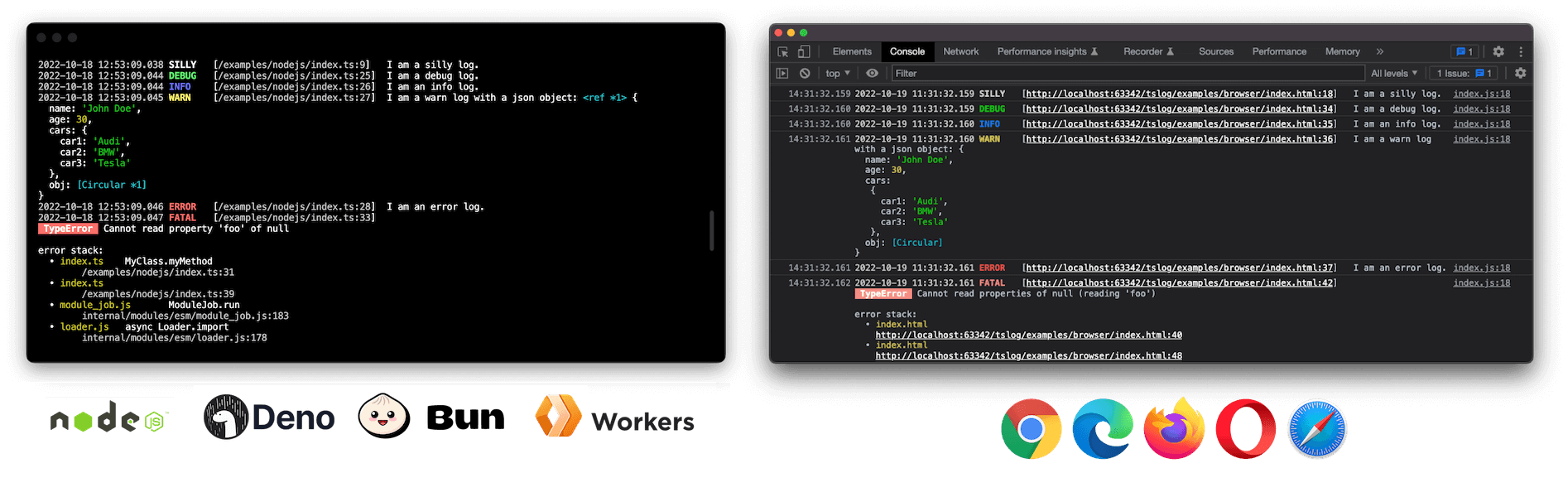
![tslog pretty output](https://raw.githubusercontent.com/fullstack-build/tslog/master/docs/public/assets/tslog.png "tslog pretty output in browser and Node.js")

> [!NOTE]
> **This is `tslog` v5.** It is a deliberate, breaking redesign — ESM-only, grouped settings, a new fields-first JSON shape, and middleware instead of `overwrite.*`. **If you are on the 4.x line, `4.11.0` is a safe place to stay** — most of the v5 performance wins were back-ported there with zero breaking changes. Upgrade when you want the new capabilities. See **[Upgrading from v4?](#upgrading-from-v4)**.


## Highlights

- 🏗 **Universal** — one logger for Node.js, browser, Deno, Bun, workers and React Native
- 🧱 **Structured, fields-first JSON** — flat, observability-ready output that drops straight into log pipelines
- 🧭 **Pretty by default, JSON optional** — colored in your terminal, uncolored when piped/CI; structured JSON is one opt-in away
- 🤖 **First-class support for agents & LLMs** — fields-first calls, agent/session correlation, an `llms.txt`, and OTel-GenAI presets; used by [OpenClaw](https://openclaw.ai) for agent logging
- 🌳 **Tree-shakeable subpaths** — transports, presets and helpers ship as opt-in modules, `sideEffects: false`
- 🪶 **Zero runtime dependencies** — nothing pulled into your bundle but `tslog` itself
- 👮 **Fully typed** — written in TypeScript 7, native ESM, accurate source-mapped line numbers
- 🙊 **Secret masking** — keys, JSONPath-lite paths, regex, and a hashing censor for correlation
- 👨‍👧‍👦 **Sub-loggers with inheritance** — `child()` / `getSubLogger()` with merged settings and accumulated names
- 🔌 **Pluggable transports & middleware** — per-transport level/format, a `use()` pipeline, `flush()` and disposal
- 🖥 **Interactive browser objects** — `pretty.passObjectsNatively` (on by default in browsers) keeps logged objects collapsible in DevTools
- 🤓 **Pretty errors & stack traces** — structured, fully serializable, captured only when needed (`"auto"` for pretty, `"off"` for JSON)


## Example

```typescript
import { Logger } from "tslog";

// `new Logger()` is pretty everywhere: colorized in an
// interactive terminal, uncolored when piped/redirected/CI.
// Omit `type` for pretty; set "pretty" | "json" | "hidden".
const log = new Logger({ minLevel: "INFO" });

// Fields-first OR string-first — both work:
log.info({ port: 3000 }, "server started");
log.info("server started");

// A child logger per request or agent — name, settings and
// fields are inherited. `child(...)` aliases `getSubLogger(...)`:
const requestLog = log.getSubLogger({ name: "agent:planner" });
requestLog.info({ tool: "search", tokens: 318 }, "tool call done");
// JSON → {"message":"tool call done","level":"INFO","levelId":3,
//         "time":"…","tool":"search","tokens":318,
//         "_logMeta":{"v":5,"name":"agent:planner",…}}

// Keep secrets, PII and prompts out of your logs (grouped under `mask`):
const safeLog = new Logger({
  type: "json",
  mask: {
    keys: ["password", "apiKey", "token", "prompt"],
    paths: ["user.password", "*.token"],
  },
});
safeLog.info({ user: { name: "Ada", password: "hunter2" } });
// → {"user":{"name":"Ada","password":"[***]"},"level":"INFO", …} (a lone object spreads its fields — no message key)
```


## [Become a Sponsor](https://github.com/sponsors/fullstack-build)
Donations help me allocate more time for my open source work.

[![](https://img.shields.io/static/v1?label=Sponsor&message=%E2%9D%A4&logo=GitHub&color=%23fe8e86)](https://github.com/sponsors/fullstack-build)


## Install

`tslog` is published to npm as a single ESM package. **How you pull it in depends on the runtime** — npm for Node.js, `bun add` for Bun, an `npm:` specifier (or import map) for Deno, and a CDN URL for the browser:

| Runtime     | Install / import                                                  |
|-------------|-------------------------------------------------------------------|
| **Node.js** | `npm install tslog` → `import { Logger } from "tslog";`           |
| **Bun**     | `bun add tslog` → `import { Logger } from "tslog";`               |
| **Deno**    | no install step — `import { Logger } from "npm:tslog";`           |
| **Browser** | no install step — `import { Logger } from "https://esm.sh/tslog";`|

The per-runtime details are below.

> [!IMPORTANT]
> **tslog v5 is ESM-only and requires Node.js ≥ 22** (5.0–5.1 also ran on Node 20; stay on **`tslog@5.1.0`** if you are still on it). There is no CommonJS build and no `require("tslog")`. If you cannot move to ESM or off Node 16/18 yet, stay on **`tslog@4.11.0`** — it keeps CJS, Node 16+ and the v4 JSON shape. See **[Upgrading from v4?](#upgrading-from-v4)**.

### Node.js

```bash
npm install tslog
```

Set `"type": "module"` in your `package.json` and run Node with source maps for accurate line numbers:

```json5
{
  "name": "NAME",
  "version": "1.0.0",
  "type": "module",
  "scripts": {
    "build": "tsc -p .",
    "start": "node --enable-source-maps dist/index.js"
  },
  "dependencies": {
    "tslog": "^5"
  }
}
```

After building (`npm run build`), start your app with `npm start`.

To run TypeScript directly, use a current ESM-aware runner, e.g. `node --enable-source-maps --import tsx src/index.ts`.

### Deno

There is no install step in Deno — the `npm:` specifier pulls `tslog` from npm and caches it on first run (or add it to an import map / `deno add npm:tslog` if you prefer a bare `"tslog"` import):

```ts
// main.ts
import { Logger } from "npm:tslog";

const logger = new Logger();
logger.info("Hello from Deno");
```

```bash
deno run main.ts
# grant optional metadata access: deno run --allow-env main.ts
```

### Bun

Add the package with Bun's own installer, then import it by name:

```bash
bun add tslog
```

```ts
// main.ts
import { Logger } from "tslog";

const logger = new Logger();
logger.info("Hello from Bun");
```

```bash
bun run main.ts
```

### Browser

```html
<script type="module">
  import { Logger } from "https://esm.sh/tslog";
  const logger = new Logger();
  logger.silly("I am a silly log.");
</script>
```

A prebuilt IIFE bundle is also published for `<script src="tslog.js">` usage, exposing the global `window.tslog`. In the browser, the default output renders pretty logs with CSS styling.

**Bundle-size sensitive?** `import { Logger } from "tslog/slim"` ships the same structured-JSON pipeline at less than half the size (~9.8KB gzip vs ~20.7KB) by leaving out masking, pretty output, and stack capture — `mask` settings and `type: "pretty"` throw there instead of silently degrading. Both sizes are enforced by a CI budget (`npm run check-bundle-size`).

**Enable TypeScript source-map support** so `tslog` can point at the correct line in your source:

```json5
// tsconfig.json
{
  compilerOptions: {
    // <!-- here
    "inlineSourceMap": true,
    "target": "es2022",
  },
}
```

### React Native

```bash
npm install tslog
```

Works out of the box on Hermes and JSC — Metro resolves the `react-native` entry automatically. `tslog` detects React Native (`_logMeta.runtime: "react-native"`, with the Hermes engine version when available), parses Hermes/JSC stack frames correctly, and defaults to pretty output in the Metro console.


## Which build should I use?

One package, purpose-built distributions. For most apps the answer is simply `tslog`: the main entry adapts to where it runs (colorized pretty output in your terminal or devtools, uncolored pretty when piped, and opt-in flat JSON for production — see [Default type and colorization](#default-type-and-colorization)), so the same import covers development *and* production without config. The other builds exist for the situations where the default trade-offs don't fit:

| Situation | Import | Why |
|-----------|--------|-----|
| **Development** (server, browser, RN) | `tslog` | Zero config: colorized pretty output on an interactive TTY / in the devtools console, code positions via stack capture, config validation with did-you-mean hints. |
| **Production** (services, containers, CI) | `tslog` | The very same import: pretty stays uncolored when piped/non-TTY; opt into flat fields-first JSON with `type: "json"`. Add `mask` for secrets/PII, `bindings` + `runInContext` for correlation, and transports to ship logs. |
| **Production, size-critical bundles** (browser apps, edge workers) | `tslog/slim` | The same JSON pipeline at less than half the size (~9.8KB vs ~20.7KB gzip) by leaving out masking, pretty output, and stack capture — and it throws on `mask` / `type: "pretty"` instead of silently degrading. Develop against `tslog`, ship `tslog/slim`. |
| **Testing** | `tslog/testing` | `createTestLogger()` captures every record and rendered line for assertions — no console noise, no spies. (Any build also accepts `type: "hidden"` to mute the console while still returning records.) |
| **Browser debugging with native line numbers** | `tslog/lite` | Thin `console` wrappers with zero processing, so devtools still shows the *caller's* file:line instead of the logger's. |
| **Reading production logs as a human** | `tslog` CLI | Pipe NDJSON into the bundled bin and get the local pretty rendering: `kubectl logs api \| npx tslog -l warn`. |

All of them speak the same settings language and emit the same JSON shape, so switching between builds is an import change, not a rewrite.


## Comparison with other loggers

How `tslog` compares to the most popular JavaScript loggers. **This table looks only at what each library does in its core package, out of the box** — because most of these can be extended with plugins, and a fair comparison has to draw the line somewhere. The line is "what you get from a fresh `install` with no extra packages."

**Legend:** ✅ built-in / on by default · ⚪ available, but only by adding a separate plugin or package · 🟡 partial / manual / needs hand-rolling · ❌ not available

| Feature<small><br>(core feat only)</small> | **tslog** | pino | winston | bunyan | consola |
|:---|:---:|:---:|:---:|:---:|:---:|
| Runtime dependencies | **0** | many | many | heavy (native) | 0 (bundled) |
| Universal (Node + browser + Deno/Bun) | ✅ | 🟡<br>polyfill | ❌<br>Node-only | ❌<br>Node-only | ✅ |
| First-class TypeScript types | ✅ | ✅ | 🟡<br>loose | 🟡 | ✅ |
| Pretty output **in-process** | ✅ | ⚪<br>`pino-pretty` | ✅ | ⚪<br>CLI pipe | ✅ |
| Structured, fields-first JSON | ✅ | ✅ | 🟡<br>via formats | ✅ | ❌ |
| Env-aware colorization (color ↔ plain) | ✅ | ❌ | ❌ | ❌ | 🟡<br>fancy↔basic |
| Secret masking / redaction | ✅<br>keys · paths · regex | ✅<br>paths | 🟡<br>manual format | ❌ | ❌ |
| Pretty errors + stack traces | ✅ | 🟡 | 🟡 | 🟡 | 🟡 |
| Source-mapped call-site line numbers | ✅ | ❌ | ❌ | 🟡<br>`src` (slow) | 🟡 |
| Sub-loggers with inherited settings | ✅ | 🟡<br>bound fields | 🟡<br>child fields | 🟡<br>bound fields | ❌ |
| Per-transport level / format | ✅ | 🟡<br>per-target | ✅ | 🟡<br>per-stream | ❌ |
| `flush()` / disposal | ✅ | ✅ | ❌ | ❌ | ❌ |
| Async-context correlation (ALS) | ✅ | ⚪<br>`pino-http` | ⚪ | ❌ | ❌ |
| OpenTelemetry / GenAI presets | ✅ | ⚪ | ⚪ | ❌ | ❌ |
| File / HTTP / ring-buffer transports | ✅<br>subpaths | ✅<br>targets | ⚪<br>transports | 🟡<br>streams | ❌ |
| Off-event-loop (worker-thread) sink | ✅<br>subpath | ✅<br>thread-stream | ❌ | ❌ | ❌ |

> [!NOTE]
> A ⚪ does **not** mean a library "can't" do something — pino, winston and the rest have rich plugin ecosystems, and a ⚪ is often a one-line `install` away. The point of comparing core packages is that `tslog` aims to give you <b>universal</b> runtime support, pretty **and** structured output, masking, error formatting and correlation **from a single zero-dependency batteries included install**, with transports/presets opting in as tree-shakeable subpaths only when you need them.
>
>`tslog` is built for the case where one logger has to be great in the browser *and* the server, readable in dev *and* machine-parseable in prod.

**Ready to switch?** Step-by-step guides: [Migrating from pino, winston, or consola](#migrating-from-pino-winston-or-consola).


## Core concepts

### Log levels

`tslog` ships seven default levels (the exported `LogLevel` enum):

| id | name  | method        |
|----|-------|---------------|
| 0  | SILLY | `log.silly()` |
| 1  | TRACE | `log.trace()` |
| 2  | DEBUG | `log.debug()` |
| 3  | INFO  | `log.info()`  |
| 4  | WARN  | `log.warn()`  |
| 5  | ERROR | `log.error()` |
| 6  | FATAL | `log.fatal()` |

```typescript
import { Logger } from "tslog";

const log = new Logger({ name: "myLogger" });
log.silly("I am a silly log.");
log.trace("I am a trace log.");
log.debug("I am a debug log.");
log.info("I am an info log.");
log.warn("I am a warn log with an object:", { foo: "bar" });
log.error("I am an error log.");
log.fatal(new Error("I am a pretty Error with a stacktrace."));
```

Use `minLevel` to suppress everything below a threshold (number or name). The `LogLevel` enum avoids magic numbers:

```typescript
import { Logger, LogLevel } from "tslog";

// or minLevel: "WARN"
const log = new Logger({ minLevel: LogLevel.WARN });
log.info("hidden");
log.warn("visible");

// change at runtime
log.setMinLevel("DEBUG");
```

**Custom levels** declared with `customLevels` (or added at runtime with `addLevel`) install real level methods named after the lower-cased level. Use `createLogger` to get them fully typed, and level names resolve case-insensitively everywhere (`minLevel`, `isLevelEnabled`):

```typescript
import { createLogger } from "tslog";

const log = createLogger({ customLevels: { AUDIT: 8, METRIC: 9 } });
// typed method
log.audit({ actor: "ada" }, "deleted account");
// runtime registration, chainable
log.addLevel("NOTICE", 3.5).notice("heads up");

// any casing works
const quiet = new Logger({ customLevels: { AUDIT: 8 }, minLevel: "audit" });
```

The generic `log(levelId, levelName, ...args)` dispatch still works; a call whose id drifts from the registered one warns in development. Names that collide with a logger member (`log`, `flush`, …), a canonical level, or another registered level in a different casing are rejected at construction.

### Sub-loggers — `child()` / `getSubLogger()`

A sub-logger inherits the parent's settings (group-merged) and default `logObj`. Names accumulate into `_logMeta.parentNames`, so you can trace which module or request produced a line. `child()` is an alias for `getSubLogger()`.

Bind static fields with `bindings`: they land on every JSON record, merge down the child chain, always lose to per-call fields on a collision, and are masked once with the logger's `mask` settings.

```typescript
const main = new Logger({ name: "app", bindings: { service: "checkout" } });
const db = main.getSubLogger({ name: "db" });
const query = db.child({ name: "query", minLevel: "DEBUG", bindings: { pool: "primary" } });
query.info("slow query", { ms: 812 });
// → {"message":"slow query","ms":812,"service":"checkout","pool":"primary",…}

query.debug("select 1");
// _logMeta.name = "query", _logMeta.parentNames = ["app", "db"]
```

You can override the default `logObj` per child by passing a second argument: `main.getSubLogger({ name: "worker" }, { tenant: "acme" })`.

### Settings are grouped

v5 settings are organized into **groups** — there are no flat keys like `prettyLogTemplate`, `maskValuesOfKeys`, or `hideLogPositionForProduction` anymore. Top-level keys cover identity and routing; the groups cover everything else.

**Top-level:** `type` (`"pretty" | "json" | "hidden"` — omit for pretty everywhere, colored on a TTY), `name`, `parentNames`, `minLevel`, `argumentsArrayName`, `prefix` (string args prepended to every call and concatenated down the child chain — use `bindings` for JSON fields, `prefix` for message text), `bindings` (static bound fields — merged down the child chain, per-call fields win, masked once at construction), `attachedTransports`, `middleware`, `customLevels`, `persistLevel` / `persistLevelKey` (browser-only — persist runtime `setMinLevel()` changes in `localStorage` and restore on reload), `contextStorage` (bring-your-own `AsyncLocalStorage` for `runInContext` — the Cloudflare Workers seam), `clock` (injectable `() => Date` — deterministic tests, offset/monotonic stamping), `strictConfig` (throw a typed `TslogConfigError` on bad config — including unknown/typo'd keys and carried-over v4 flat keys, which otherwise warn in development with a did-you-mean suggestion).

| Group     | Keys |
|-----------|------|
| `pretty`  | `template`, `errorTemplate`, `errorStackTemplate`, `errorParentNamesSeparator`, `errorLoggerNameDelimiter`, `style` (boolean), `timeZone` (`"UTC" \| "local"`), `styles`, `levelMethod`, `passObjectsNatively` (boolean), `inspectOptions`, `enabled` |
| `json`    | `messageKey` (`"message"`), `levelKey` (`"level"`), `levelIdKey` (`"levelId"`), `timeKey` (`"time"`), `time` (`"iso" \| "epoch" \| false \| fn`), `errorKey` (`"error"`), `numericLevel` (`true`), `stableKeyOrder` (`false`) |
| `mask`    | `keys` (`[]`), `caseInsensitive`, `regex` (`RegExp[]`), `placeholder` (`"[***]"`), `paths` (JSONPath-lite), `censor` (`string \| "remove" \| "hash" \| fn`), `hashLabel` (`"hash"`) |
| `stack`   | `capture` (`"off" \| "lazy" \| "auto" \| "full"`), `internalFramePatterns` (`RegExp[]`) |
| `meta`    | `property` (`"_logMeta"`), `attachContext` |

```typescript
const log = new Logger({
  type: "json",
  name: "api",
  minLevel: "INFO",
  json: { messageKey: "msg", timeKey: "ts" },
  mask: { keys: ["password"], censor: "hash" },
  stack: { capture: "lazy" },
});
```

### Default type and colorization

When `type` is omitted, `tslog` defaults to `pretty` **everywhere** — a pipe, a redirect, CI, or `docker logs` are still read by a human most of the time, so that is what you get by default. Only the *coloring* is environment-aware:

- **Interactive TTY** → `pretty`, colorized
- **Piped / redirected / CI** (non-TTY) → `pretty`, *uncolored* (no ANSI escapes leak into your file or log collector)
- **Browser / React Native** → `pretty` (CSS styling in the browser)

Structured `json` is a deliberate production choice, so it is **opt-in** — set `type: "json"`, run with `TSLOG_TYPE=json` (via `Logger.fromEnv()`), or attach a JSON transport/sink. `NO_COLOR` follows [no-color.org](https://no-color.org) semantics: it switches colors off, never the format. `FORCE_COLOR` forces colorized pretty. Both apply to `new Logger()` and the ready-made `log` export. `Logger.fromEnv(overrides?)` additionally reads `TSLOG_LEVEL` / `TSLOG_TYPE` / `TSLOG_NAME` (overrides win).

### Source-mapped error positions (Node, Bun & Deno)

When you log an `Error` thrown from transpiled or bundled TypeScript (`tsc`, esbuild, webpack, Rollup, Next.js — including Turbopack — TanStack Start, etc.), tslog resolves the reported `file`/`line`/`column` back through that file's source map, so `_logMeta.path` and the pretty error stack point at your original `.ts` source instead of the compiled output — the same thing your browser devtools already do for `console.log`, that Node's own V8 stack rewriting only does when the process is started with `--enable-source-maps`, and that Bun does not do at all for its own stack traces.

Resolution runs automatically outside production (`NODE_ENV !== "production"`) on Node, Bun, and Deno — never in the browser, where devtools already own it. Both flat and indexed (`sections`) maps are supported — the format Turbopack and other concatenating bundlers emit, including per-section external sub-maps — and bundler-virtual source paths (`webpack://_N_E/./src/x.ts`, `[project]/src/x.ts`) are reduced to clean project-relative paths. Each resolved file's source map is parsed once and cached; a file with no `//# sourceMappingURL=` comment costs one failed read, then nothing. Override the default with `TSLOG_SOURCE_MAPS=on` or `TSLOG_SOURCE_MAPS=off` when you need it forced independent of `NODE_ENV` (e.g. to keep it on in a staging deploy, or off during a benchmark).

## First-class support for agents & LLMs

`tslog` treats LLM apps and coding agents as a primary use case — it's used by [OpenClaw](https://openclaw.ai), an AI agent platform, for its agent logging:

- **`llms.txt`** ships in the package, giving agents an accurate, condensed API surface to work from.
- **Fields-first calls** make structured, queryable logs the natural default for tool calls and traces.
- **`isLevelEnabled(level)`** guards expensive payloads (token counts, large prompts) without building them:

  ```typescript
  if (log.isLevelEnabled("DEBUG")) {
    log.debug({ prompt: buildExpensivePrompt() });
  }
  ```

- **`defineConfig(...)`** gives a typed, validated settings object you can share across loggers.
- **Request / agent correlation** via `runInContext(ctx, fn)` (Node ALS). Context fields attach to `_logMeta` by default (`meta.attachContext`; set it to `false` to keep them out of the output), so every log inside the callback carries the same correlation id:

  ```typescript
  const log = new Logger();

  await log.runInContext({ requestId: "abc123" }, async () => {
    // _logMeta carries requestId
    log.info("handling request");
    await doWork();
  });

  // read active context fields (e.g. for OTel span correlation)
  const { requestId } = log.getContext();
  ```

  `runInContext` propagates on Node, Deno, and Bun automatically. On runtimes where `AsyncLocalStorage` cannot be auto-resolved — most notably Cloudflare Workers — inject one via the `contextStorage` setting (requires the `nodejs_als` or `nodejs_compat` compatibility flag):

  ```typescript
  import { AsyncLocalStorage } from "node:async_hooks";

  const log = new Logger({ contextStorage: new AsyncLocalStorage() });
  ```

  Where neither is available (browsers), `runInContext` still runs the function — it just propagates nothing, and warns once in development.


## Structured JSON output

`tslog`'s JSON is **flat and fields-first** — message, level and time at the top, your fields spread next to them, and runtime metadata nested under `_logMeta` with a schema version (`v: 5`).

```typescript
const log = new Logger({ type: "json" });
log.info({ userId: 42 }, "hi");
```

```json
{
  "message": "hi",
  "level": "INFO",
  "levelId": 3,
  "time": "2026-06-29T22:37:07.599Z",
  "userId": 42,
  "_logMeta": {
    "v": 5,
    "runtime": "node",
    "runtimeVersion": "24.15.0",
    "hostname": "api-7f9c4",
    "date": "2026-06-29T22:37:07.599Z",
    "logLevelId": 3,
    "logLevelName": "INFO"
  }
}
```

How arguments map to output:

| Call | Result |
|------|--------|
| `log.info("hi")` | `message: "hi"` |
| `log.info({ a: 1 })` | fields spread top-level: `a: 1` |
| `log.info({ a: 1 }, "hi")` | fields spread + `message: "hi"` |
| `log.info("a", "b")` | `message: "a"`, `"1": "b"` |
| `log.error(new Error("x"))` | serialized under `error` (cause chain preserved) |

`name` / `parentNames` only appear when set (no `[undefined]` noise). Every key name is configurable via the `json` group, so you can match an existing schema:

```typescript
new Logger({
  type: "json",
  json: { messageKey: "msg", levelKey: "severity", timeKey: "@timestamp", errorKey: "err" },
});
```

### Timestamps & the clock seam

The top-level timestamp representation is configurable via `json.time` (the `_logMeta.date` inside the
runtime block always stays a UTC ISO string), and the clock itself is injectable:

```typescript
// "time": 1751191872000 (pino-style ms)
new Logger({ type: "json", json: { time: "epoch" } });

// no top-level time key (diff-friendly)
new Logger({ type: "json", json: { time: false } });

// ns for Loki
new Logger({ type: "json", json: { time: (d) => String(BigInt(d.getTime()) * 1_000_000n) } });

// frozen clock — deterministic tests
new Logger({ clock: () => new Date(0) });
```

A throwing/invalid `clock` or `time` function never breaks logging (the runtime date / ISO string is
kept). Sub-loggers inherit the parent's clock.

### Batched stdout on Node

On the Node entry, `type: "json"` lines are written through a **buffered stdout sink**: a whole
event-loop turn's lines are batched into one `process.stdout.write` (flushing early past ~8 KB), which
removes the per-line `console.log` overhead that dominates logger throughput. Delivery is safeguarded:
`await logger.flush()` (and `await using`) resolves only after stdout accepted everything, and
`process.exit()` / uncaught exceptions trigger a synchronous drain via exit hooks. Note that code
intercepting `console.log` will no longer see JSON output on Node — spy on `process.stdout.write`, or
use `type: "hidden"` plus a transport. Browser/universal (Deno, Bun, workers) builds keep `console.log`.


## Masking secrets

One of the most common ways secrets leak is through logs. Configure masking once on the logger and it applies recursively to every log. All masking lives under the `mask` group.

```typescript
const log = new Logger({
  type: "json",
  mask: {
    // mask by key name
    keys: ["password", "apiKey", "token"],
    // also match Password, TOKEN, …
    caseInsensitive: true,
    // mask by value pattern
    regex: [/Bearer\s+[A-Za-z0-9._-]+/],
    // JSONPath-lite, "*" wildcard
    paths: ["user.password", "*.token"],
    // replacement (default)
    placeholder: "[***]",
  },
});
```

Masking is leak-proof by construction:

- `regex` patterns are always applied **globally**: every occurrence in a string is redacted, whether or not you wrote the `g` flag.
- Shared references and circular structures resolve to the same *masked* clone, so a secret can never escape through a second reference to the same object.
- `keys` and `regex` also apply **inside `Map` and `Set`** contents (`paths` does not descend into them).
- **Errors are masked like any other object.** A logged `Error`, top-level or nested, is replaced by a masked clone and the caller's instance stays untouched. `regex` covers the `message` and the `<name>: <message>` header of a V8-style stack, but never the frames, so a broad pattern cannot corrupt `line:col` positions. `keys`, `regex` and `paths` cover every other own property (`code`, `extensions`, ...) and the `cause` chain. `keys` skips `name`, `message` and `stack`, so `keys: ["name"]` does not blank every error, while `paths` can still target them (`paths: ["message"]`).

The `censor` option controls *how* a **`paths`-matched** value is replaced (`keys`- and `regex`-matched values always use `placeholder`, with one exception below):

- a **string** — replace with that literal
- `"remove"` — drop the key entirely
- a **function** — custom logic returning the replacement
- `"hash"` — replace with a fast, synchronous, non-cryptographic correlation token (e.g. `"[hash:1a2b3c4d]"`, label configurable via `hashLabel`) so you can correlate a redacted value across logs without ever storing it. `"hash"` is the one censor that **also applies to `keys` matches**, so `mask.keys` and `mask.paths` hash alike

```typescript
const log = new Logger({ mask: { keys: ["ssn"], censor: "hash", hashLabel: "hash" } });
```


## Transports

A transport receives every (level-permitted) log record and decides where it goes — a file, an HTTP endpoint, an in-memory buffer, Slack, anything. `tslog` ships file, HTTP, ring-buffer and worker-thread transports as tree-shakeable subpaths, and you can write your own against the `Transport` contract.

```ts
interface Transport<LogObj> {
  name?: string;
  // per-transport level
  minLevel?: number | TLogLevelName;
  // per-transport format
  format?: "pretty" | "json" | LogFormatter<LogObj>;
  write(record, line): void | Promise<void>;
  flush?(): Promise<void>;
  [Symbol.asyncDispose]?(): Promise<void>;
}
```

`line` is the record rendered in the transport's `format` (the logger's `type` when unset; `json` for `hidden`). A `"pretty"` line is always plain text: the ANSI colors a TTY console gets never reach a file, HTTP or buffer sink.

`attachTransport` accepts a full `Transport` object **or** a bare function, and **returns a detach function**:

```typescript
const log = new Logger();

const detach = log.attachTransport((record) => {
  myQueue.push(record);
});

// later
detach();
```

Transports are isolated (a throwing transport cannot break logging) and inherited by sub-loggers. Flush buffered transports and dispose cleanly:

```typescript
await log.flush();

// or scoped disposal:
await using scoped = new Logger({ /* ... */ });
```

Delivery guarantees: `log.flush()` awaits in-flight **async transport writes** as well as each transport's own `flush()`. Disposing a sub-logger flushes shared transports but only disposes the ones the child itself attached. The built-in transports register guarded exit hooks by default: the file transport drains synchronously even on `process.exit(...)` or an uncaught exception (and never crashes the process on fs errors — they are contained, reported via `onError`, and the open is retried); the http transport bounds every request with a timeout, retries with backoff, caps its buffer (oldest lines drop first), and flushes on `beforeExit`/`pagehide`; the worker transport keeps its thread unref'd so it never blocks process exit, drains on `beforeExit`, and survives a dead worker by respawning (then falling back to inline writes).

### Built-in transport subpaths

```typescript
// Node, non-blocking
import { fileTransport } from "tslog/transports/file";
// batched fetch
import { httpTransport } from "tslog/transports/http";
// in-memory
import { ringBufferTransport } from "tslog/transports/ringbuffer";
// Node, off-thread sink I/O
import { workerTransport } from "tslog/transports/worker";

const log = new Logger();
log.attachTransport(fileTransport({ path: "app.log", append: true }));
log.attachTransport(httpTransport({ url: "https://logs.example.com", batchSize: 50, flushIntervalMs: 1000 }));

const ring = ringBufferTransport({ size: 200 });
log.attachTransport(ring);
// ring.dump(); ring.clear();

// Run the destination write on a worker thread so slow sink I/O doesn't block the event loop under high volume. 
// Note: this does NOT speed up `log.info()` —
// the record is still built and serialized on the main thread; only the file/stream write moves
// off-thread. `flush()` drains the worker; `await using` (or attachTransport's detach) cleans it up.
log.attachTransport(workerTransport({ destination: "file", path: "app.log", format: "json" }));
```


## Middleware & pipeline

> [!IMPORTANT]
> v4's `overwrite.*` hooks (`mask`, `toLogObj`, `addMeta`, `formatMeta`, `formatLogObj`, `transportFormatted`, `transportJSON`, `addPlaceholders`) are **removed in v5.** Use `use()` middleware for log mutation/dropping and per-transport `format` for custom output shapes.

`logger.use(middleware)` appends a middleware to the pipeline. A middleware receives the log context (`args`, `meta`, `settings`, `logLevelId`, `logLevelName`), and can mutate it or drop the log by returning `null` / `false`:

```typescript
const log = new Logger();

// enrich every log (meta is free-form scratch space attached under _logMeta)
log.use((ctx) => {
  ctx.meta.env = process.env.NODE_ENV;
  return ctx;
});

// drop noisy health checks (args holds the log call's arguments)
log.use((ctx) => (ctx.args[0] === "/health" ? null : ctx));
```

For custom output formatting, set `format` on a transport (a `"pretty" | "json"` string or a `LogFormatter` function) rather than overriding a global transport.


## Presets

Presets are tree-shakeable subpaths that emit logs in a foreign schema, so `tslog` drops into existing tooling. They are off by default — import and wire them explicitly.

### pino — `tslog/presets/pino`

`pinoFormat()` produces pino-compatible NDJSON (integer `level` 10–60, `time` epoch ms, `msg`), so `pino-pretty` and pino transports keep working. `pinoTransport()` wires it up in one call; `toPinoLevel(id)` maps a tslog level id to its pino number.

```typescript
import { pinoFormat, pinoTransport } from "tslog/presets/pino";

const log = new Logger();
// or attach a transport with { format: pinoFormat() }
log.attachTransport(pinoTransport((line) => process.stdout.write(line + "\n")));
```

Errors are emitted in pino's serializer shape — `err: { type, message, stack }` with `stack` as the
raw multi-line string (what `pino-pretty`, Datadog, GCP Error Reporting, and Sentry parse), `cause`
chain recursed. Prefer tslog's structured frame arrays instead? `pinoFormat({ errorShape: "tslog" })`.

### OpenTelemetry — `tslog/otel`

`otlpFormat()` / `toOtlpJson()` emit **real OTLP/JSON** — the `resourceLogs[].scopeLogs[].logRecords[]`
envelope with camelCase proto3 fields, typed attributes, `exception.*` semconv mapping for logged
errors, and correct `severityNumber`s — so batches POST straight to a collector's `/v1/logs`:

```typescript
import { otelTraceContext, otlpBatchBody, otlpFormat } from "tslog/otel";
import { httpTransport } from "tslog/transports/http";

const log = new Logger({ type: "hidden" });
log.attachTransport(
  httpTransport({
    url: "http://collector:4318/v1/logs",
    format: otlpFormat({ resource: { "service.name": "checkout" } }),
    // merges each batch into ONE OTLP envelope per POST
    encodeBody: otlpBatchBody,
  }),
);
// trace correlation (`trace` from @opentelemetry/api)
log.use(otelTraceContext({ getSpanContext: () => trace.getActiveSpan()?.spanContext() }));
```

`otelFormat()` / `toOtelRecord()` additionally emit the *data-model prose shape* (`Timestamp`, `Body`,
`Attributes`, ...) for custom pipelines — note that shape is not a wire format and collectors will not
ingest it directly.

### GenAI / agents — `tslog/presets/genai`

`genai()` / `genaiAttributes()` / `genaiSummary()` build OTel-GenAI semantic-convention attributes (`gen_ai.*`: model, tokens, tool calls) for LLM and agent apps.

```typescript
import { genai } from "tslog/presets/genai";

log.info(genai({ model: "claude", inputTokens: 318, outputTokens: 142 }), "completion");
```


## Integrations: Next.js/TanStack Start, Sentry & Better Stack

### Next.js, TanStack Start (and other full-stack frameworks)

Use the full `Logger` on the server and `tslog/lite` in `"use client"` components — two files, no other setup:

```typescript
// lib/logger.server.ts — route handlers, server components, server actions
import "server-only"; // optional guard: importing this from client code fails the build
import { Logger } from "tslog";

export const log = new Logger({
  name: "app",
  type: process.env.NODE_ENV === "production" ? "json" : "pretty",
});
```

```typescript
// lib/logger.client.ts — "use client" components
import { createLiteLogger } from "tslog/lite";

export const log = createLiteLogger({
  name: "app",
  minLevel: process.env.NODE_ENV === "production" ? "WARN" : "SILLY",
});

// per-area sub-loggers work here too, labeling lines "app:cart":
export const cartLog = log.getSubLogger({ name: "cart" });
```

Server-side you get the full pipeline — pretty output with original `.ts` positions in dev (Turbopack source maps work out of the box), structured JSON for collectors in production. Client-side, `tslog/lite`'s level methods **are** the bound native `console.*` methods, so the file:line badge devtools attaches to each log points at *your component* (source-mapped by devtools) and logged objects stay live and collapsible. `getSubLogger()` keeps that property — it binds the name onto the native method instead of wrapping it. One trade-off of that binding: the label occupies the console's format-string slot, so printf-style specifiers (`%d`, `%s`, `%c`) in messages print literally on a *named* lite logger — see [RECIPES.md](RECIPES.md) for details. The same split works for TanStack Start and other Vite-SSR frameworks.

Retrofitting a codebase that already imports one shared logger module everywhere: keep that single entrypoint and let a `browser` conditional `imports` subpath pick the half, so no call site changes. Don't reach for the `react-server` condition — it covers only Server Components, and silently hands route handlers and server actions the client logger. That variation, plus client-side sub-loggers and shipping client logs to Sentry, in [RECIPES.md](RECIPES.md).

Error trackers and log platforms plug in as transports — no vendor-specific logger needed. Two worked examples follow; the same two patterns (a `write` function for SDK-based services, `httpTransport` for HTTP ingestion APIs) cover Datadog, Loki, Axiom and friends.

### Sentry

[Sentry](https://sentry.io) has two ingestion paths: **issues** (error tracking) and **[Sentry Logs](https://docs.sentry.io/platforms/javascript/guides/node/logs/)** (structured logs, searchable next to your traces). A tslog transport covers each — run one or both.

**Errors → Sentry issues.** Forward `ERROR`/`FATAL` records while keeping your normal console/JSON output. The record a transport receives still carries the **native `Error` instance** (as `nativeError` on the serialized error), so Sentry gets the real exception — full stack and `cause` chain, proper issue grouping — not a stringified copy. With `mask` configured, `nativeError` is the masked clone: still a real `Error` with the same stack and `cause` chain, so grouping works and secrets stay out of Sentry too:

```typescript
import * as Sentry from "@sentry/node";
import { Logger } from "tslog";

Sentry.init({ dsn: process.env.SENTRY_DSN });

const log = new Logger();

log.attachTransport({
  name: "sentry",
  // only errors and fatals leave the process
  minLevel: "ERROR",
  // `line` becomes the flat JSON record, independent of the console output
  format: "json",
  write(record, line) {
    const { _logMeta, ...fields } = JSON.parse(line);
    const level = _logMeta.logLevelName === "FATAL" ? "fatal" : "error";
    const nativeError = [record, ...Object.values(record)]
      .map((value) => (value as { nativeError?: unknown } | null)?.nativeError)
      .find((candidate): candidate is Error => candidate instanceof Error);
    if (nativeError) {
      Sentry.captureException(nativeError, { level, extra: fields });
    } else {
      Sentry.captureMessage(String(fields.message ?? line), { level, extra: fields });
    }
  },
});

// → console output + a Sentry issue, logged fields as `extra`
log.error(new Error("payment failed"));
```

**Everything → Sentry Logs.** Enable logs in `Sentry.init` (`enableLogs: true`, current `@sentry/node`) and forward every record through `Sentry.logger.*` — the seven tslog levels map one-to-one, with `SILLY` joining `trace`:

```typescript
import * as Sentry from "@sentry/node";
import { Logger } from "tslog";

Sentry.init({ dsn: process.env.SENTRY_DSN, enableLogs: true });

const log = new Logger();
const toSentry = { SILLY: "trace", TRACE: "trace", DEBUG: "debug", INFO: "info", WARN: "warn", ERROR: "error", FATAL: "fatal" } as const;

log.attachTransport({
  name: "sentry-logs",
  // `line` is the flat JSON record; its fields become Sentry log attributes
  format: "json",
  write(_record, line) {
    const { _logMeta, message, ...attributes } = JSON.parse(line);
    const method = toSentry[_logMeta.logLevelName as keyof typeof toSentry] ?? "info";
    Sentry.logger[method](String(message ?? ""), attributes);
  },
});

// → console output + a Sentry log with a `userId` attribute
log.info({ userId: 42 }, "user logged in");
```

Run both transports side by side: every record becomes a searchable Sentry log, and `ERROR`/`FATAL` additionally become issues. Because transports are inherited, every sub-logger reports to Sentry too — and transport isolation means a Sentry outage can never break your logging.

### Better Stack (Logtail)

[Better Stack](https://betterstack.com/logs) ingests JSON over HTTP, so the built-in `httpTransport` is all you need. It reads the timestamp from a `dt` field and the message from `message` — the first is one `json` setting away, the second is tslog's default:

```typescript
import { Logger } from "tslog";
import { httpTransport } from "tslog/transports/http";

const log = new Logger({
  type: "json",
  // Better Stack reads the timestamp from "dt"
  json: { timeKey: "dt" },
});

log.attachTransport(
  httpTransport({
    // use the ingesting host shown on your source's settings page
    url: "https://in.logs.betterstack.com",
    headers: { authorization: `Bearer ${process.env.BETTER_STACK_SOURCE_TOKEN}` },
    format: "json",
    // Better Stack accepts a JSON array of events per request
    bodyFormat: "array",
    batchSize: 50,
    flushIntervalMs: 2000,
  }),
);

log.info({ userId: 42 }, "user logged in");
// → stdout JSON + batched POSTs; "userId" lands as a queryable column

// drain the buffer before shutdown (await using does this automatically)
await log.flush();
```

The transport batches, retries with exponential backoff, bounds every request with a timeout, caps its buffer, and flushes on `beforeExit`/`pagehide` — see [Transports](#transports). Field names are yours to shape if your dashboards expect different columns, e.g. `json: { levelKey: "severity" }`.


## Pretty output & templates

Pretty output is configured entirely under the `pretty` group. Templates use `{{placeholder}}` tokens and per-placeholder styles.

```typescript
const log = new Logger({
  type: "pretty",
  pretty: {
    template: "{{dateIsoStr}}\t{{logLevelName}}\t[{{filePathWithLine}}{{name}}]\t",
    errorTemplate: "\n{{errorName}} {{errorMessage}}\nstack:\n{{errorStack}}",
    errorStackTemplate: "  • {{fileName}}\t{{method}}\n\t{{filePathWithLine}}",
    style: true,
    timeZone: "UTC",
    styles: {
      logLevelName: {
        "*": ["bold", "black", "bgWhiteBright", "dim"],
        SILLY: ["bold", "white"],
        DEBUG: ["bold", "green"],
        INFO: ["bold", "blue"],
        WARN: ["bold", "yellow"],
        ERROR: ["bold", "red"],
        FATAL: ["bold", "redBright"],
      },
      name: ["white", "bold"],
    },
  },
});
```

Route levels to specific console methods with `pretty.levelMethod`:

```typescript
new Logger({
  type: "pretty",
  pretty: {
    levelMethod: { WARN: console.warn, ERROR: console.error, FATAL: console.error, "*": console.log },
  },
});
```

On Node.js, object formatting uses native `util.inspect`; tune it with `pretty.inspectOptions`. For example, `pretty.inspectOptions.breakLength` controls when inspected objects wrap onto multiple lines — set it high (e.g. `Infinity`) to keep an object on a single line while preserving color, which is handy in log aggregators (CloudWatch, Datadog) that treat each line as one entry.

### Interactive objects in the browser console (`pretty.passObjectsNatively`)

In a real browser (`window` + `document` present), pretty output hands non-`Error` arguments to the console method **by reference** — the styled meta prefix is still printed, but objects and arrays stay live, so DevTools renders them as the collapsible, clickable trees you'd get from a raw `console.log(obj)`. This is `pretty.passObjectsNatively`, and it is **on by default in browsers** (best DX out of the box) and off everywhere else — Node, workers/edge runtimes, and React Native typically capture console output as text, where a raw reference degrades to `[object Object]`.

```typescript
new Logger({
  type: "pretty",
  pretty: {
    // on by default in browsers — pair with levelMethod so warn/error use the
    // console methods that attach an expandable stack group:
    levelMethod: { WARN: console.warn, ERROR: console.error, FATAL: console.error },
  },
});

log.info("user loaded", { id: 42, roles: ["admin"] }); // object is collapsible in DevTools
```

While it's on, `inspectOptions` does not apply to those arguments (the console owns the rendering); logged `Error`s are still formatted through the pretty error template.

**When to switch it off** (`pretty: { passObjectsNatively: false }`) — the rendered-string mode has two properties the native mode gives up:

- **Log-time snapshots.** DevTools renders a raw reference *lazily*: if the object mutates after the log call, expanding it shows the **current** state, not what you logged — the classic `console.log` gotcha. Rendering into the string freezes the value at log time. (With `mask` configured, arguments are masked clones, so they're frozen either way.)
- **Text-matchable logs.** The DevTools filter box and any console-capturing harness (test runners, screenshot-based tooling) only match the rendered string — field values inside natively-passed objects are invisible to them.

### Conditional logging (`log.if(condition)`)

`log.if(condition)` returns the logger when `condition` is truthy and a no-op stand-in when it is falsy, so a per-call condition reads as a fluent chain instead of an `if` statement or a throwaway helper:

```typescript
log.if(!ok).info("action failed", { id });
log.if(retries > maxRetries).warn("giving up", { retries });
```

The falsy stand-in still evaluates its arguments, so to skip *expensive* payload construction use `isLevelEnabled` instead — it short-circuits before the arguments are built. `if()` gates a single call; it isn't meant to be chained ahead of `getSubLogger`/`child`.


## Other subpaths

| Import | What it gives you |
|--------|-------------------|
| `tslog/lite` | `lite` (ready instance), `LiteLogger`, `createLiteLogger(opts?)` — minimal console wrappers with named `getSubLogger`/`child`, no mask/stack/clone, preserves native console line numbers |
| `tslog/slim` | `Logger`, `createLogger` — the smallest structured-JSON build: the full pipeline (levels, sub-loggers, bindings, custom levels, middleware, `runInContext`, transports) at less than half the bundle size, minus masking/pretty/stack capture (`mask` and `type: "pretty"` throw instead of silently degrading) |
| `tslog/testing` | `createTestLogger(settings?, { now?, normalize? })` → `{ logger, logs, lines, clear }`, plus `mockLogger(settings?)` and `normalizeMeta(recordOrLine)` for snapshot-stable output |
| `tslog/throttle` | `throttle({ windowMs, key?, now? })` middleware (off by default), `defaultThrottleKey` |
| `tslog/serializers` | `stdSerializers` `{ err, req, res, user }`, the `serialize(map)` middleware helper, and the individual serializers |
| `tslog/pretty/box` | `box(content, opts?)`, `tree(node, opts?)` for boxed / tree-rendered output |
| `tslog/console` | `wrapConsole(logger)`, `restoreConsole()`, `isConsoleWrapped()` — route `console.*` through tslog |
| bin `tslog` (`tslog/cli`) | NDJSON pretty-printer for stdin, with a `-l/--level` filter |

```typescript
import { createTestLogger } from "tslog/testing";

const { logger, logs, lines, clear } = createTestLogger({ type: "json" });
logger.info({ ok: true }, "tested");
// logs[0] is the captured record: logs[0]._logMeta.logLevelName === "INFO"
// lines[0] is the rendered line and contains the fields: lines[0].includes('"ok":true')
```


## Performance

The defaults are tuned for a great developer experience; for hot production paths, the biggest lever is stack capture.

- **Batched stdout by default (Node).** JSON lines are buffered and written to stdout once per event-loop turn instead of one `console.log` per line, with flush/exit-hook safeguards (see *Batched stdout on Node* above).
- **Stack capture only when it's needed.** Pretty output defaults to `stack: { capture: "auto" }` — frames are captured only when the rendered template actually shows a code position — and `type: "json"` defaults to `"off"`, so production JSON pays nothing.
- **The stack lever.** Set `stack: { capture: "off" }` to skip code-position capture entirely on hot paths, `"lazy"` to capture cheaply and defer parsing until something reads the frames, or `"full"` when you want complete frames for debugging.
- **Tree-shakeable everything.** Presets, transports and helpers are opt-in subpaths with `sideEffects: false`, so unused features never reach your bundle.

Benchmarks are run internally against pino, winston, bunyan, and consola, but the raw numbers aren't published — they vary too much by machine and workload to be a fair, stable comparison to share.


## Migrating from pino, winston, or consola

Switching loggers is mostly a mapping exercise, and tslog's call signature is deliberately forgiving: a two-argument call pairing a message string with a plain fields object spreads the fields at the top level **in either order**, so pino-style `log.info({ userId: 42 }, "hi")` and winston-style `log.info("hi", { userId: 42 })` produce the same flat JSON. Most call sites survive a migration untouched — the work is in the constructor. (Coming from tslog v4? See [Upgrading from v4](#upgrading-from-v4) instead.)

### From pino

pino and tslog v5 share the fields-first call shape and the flat-JSON philosophy, so call sites carry over as-is:

```typescript
// ── pino ──
import pino from "pino";
const logger = pino({
  level: "info",
  redact: { paths: ["user.password", "*.token"], censor: "[Redacted]" },
});
logger.info({ userId: 42 }, "user logged in");
const db = logger.child({ module: "db" });

// ── tslog v5 ──
import { Logger } from "tslog";
const logger = new Logger({
  minLevel: "INFO",
  mask: { paths: ["user.password", "*.token"], placeholder: "[Redacted]" },
});
// unchanged
logger.info({ userId: 42 }, "user logged in");
const db = logger.child({ name: "db", bindings: { module: "db" } });
```

| pino | tslog v5 |
| --- | --- |
| `level: "info"` | `minLevel: "INFO"` — names resolve case-insensitively |
| numeric levels `trace(10)`…`fatal(60)` | `SILLY(0)`…`FATAL(6)`; the pino preset maps them back to 10–60 on the wire |
| `redact: { paths, censor }` | `mask: { paths, placeholder }` — same `*` wildcard, plus `keys` and `regex` matching pino doesn't have |
| `redact` with `remove: true` | `mask: { censor: "remove" }` |
| `child({ module: "db" })` | `child({ bindings: { module: "db" } })` — children inherit *settings* too, not just bound fields |
| `messageKey` / `timestamp` options | `json: { messageKey, time }` (`"epoch"`, `"iso"`, or a function) |
| `pino-pretty` for dev | built in — omit `type` and you get pretty output everywhere, TTY or not; set `type: "json"` when you want structured output |
| `transport: { target: "pino/file" }` | `fileTransport(...)` from `tslog/transports/file`; off-thread sink I/O via `tslog/transports/worker` |
| `pino.stdSerializers.err/req/res` | `stdSerializers` from `tslog/serializers` |
| `logger.flush(cb)` | `await logger.flush()` |

**Keep your pipeline running while you switch.** If dashboards, shippers or `pino-pretty` expect pino's exact wire shape (`level: 30`, epoch-ms `time`, `msg`, `err`), attach the preset instead of reshaping by hand — the output stays pino-compatible while tslog becomes the producer:

```typescript
import { pinoTransport } from "tslog/presets/pino";

const logger = new Logger({ type: "hidden" });
logger.attachTransport(pinoTransport((line) => process.stdout.write(line + "\n")));
```

### From winston

winston call sites keep working — `logger.info("payment accepted", { orderId: 7 })` spreads the fields object in tslog too. What disappears is the `format.combine()` pipeline: output shape, timestamps and colors are settings, not composed formats.

```typescript
// ── winston ──
import winston from "winston";
const logger = winston.createLogger({
  level: "info",
  format: winston.format.combine(winston.format.timestamp(), winston.format.json()),
  defaultMeta: { service: "checkout" },
  transports: [
    new winston.transports.Console(),
    new winston.transports.File({ filename: "error.log", level: "error" }),
  ],
});
logger.info("payment accepted", { orderId: 7 });

// ── tslog v5 ──
import { Logger } from "tslog";
import { fileTransport } from "tslog/transports/file";

const logger = new Logger({
  // or omit for pretty everywhere (JSON is opt-in)
  type: "json",
  minLevel: "INFO",
  bindings: { service: "checkout" },
});
logger.attachTransport(fileTransport({ path: "error.log", format: "json", minLevel: "ERROR" }));
// unchanged
logger.info("payment accepted", { orderId: 7 });
```

| winston | tslog v5 |
| --- | --- |
| npm levels `error(0)`…`silly(6)` — priority, descending | `SILLY(0)`…`FATAL(6)` — severity, ascending; stick to names and the direction never bites |
| `http` / `verbose` levels | closest built-in for `verbose` is `trace`; add your own via `customLevels: { HTTP: 2.5 }` |
| `defaultMeta` | `bindings` (also per child: `child({ bindings })`) |
| `format.json()` + `format.timestamp()` | `type: "json"` + the `json` group (`messageKey`, `timeKey`, `time`, …) |
| `format.colorize()` + `format.simple()` | `type: "pretty"` — or omit `type`; pretty is the default (colored on a TTY, uncolored when piped) |
| `format.printf(...)` / custom formats | `use()` middleware to mutate or drop records; per-transport `format` for custom rendering |
| `transports: [...]` with per-transport `level` / `format` | `attachTransport({ minLevel, format, write })` — same idea, and it returns a detach function |
| custom `Transport` subclass (stream machinery) | a plain object or a bare function: `attachTransport((record) => …)` |
| `logger.child({ requestId })` | `child({ bindings: { requestId } })` — or skip per-request children: `runInContext({ requestId }, fn)` |
| flushing on shutdown (long-standing footgun) | `await logger.flush()`, `await using`, and built-in exit-hook drains |

**Gotchas.** `%s`-style splat interpolation is not supported — log fields instead of format strings. `handleExceptions` / `handleRejections` have no equivalent — register `process.on("uncaughtException", (err) => logger.fatal(err))` yourself. And winston's default logger silently drops everything until a transport is added; tslog always has working output, so if you relied on that silence, use `type: "hidden"`.

### From consola

consola and tslog agree that dev logs should be beautiful; tslog adds the production half — structured JSON, masking, transports, correlation. The mechanical mapping:

```typescript
// ── consola ──
import { consola } from "consola";
const logger = consola.create({ level: 4 }).withTag("build");
logger.start("building…");
logger.success("done");
logger.error(new Error("boom"));

// ── tslog v5 ──
import { createLogger } from "tslog";
const logger = createLogger({
  name: "build",
  minLevel: "DEBUG",
  // installs a typed logger.success()
  customLevels: { SUCCESS: 3.5 },
});
logger.info("building…");
logger.success("done");
// pretty error, parsed stack, cause chain
logger.error(new Error("boom"));
```

| consola | tslog v5 |
| --- | --- |
| `level: 0…5` (higher = more verbose) | `minLevel` by name: consola `3` (default) ≈ `"INFO"`, `4` ≈ `"DEBUG"`, `5` ≈ `"TRACE"`; `-999` (silent) ≈ `type: "hidden"` |
| `withTag("build")` | `child({ name: "build" })` — names accumulate in `_logMeta.parentNames` |
| `success` / `ready` / `start` / `fail` types | map onto `info` / `error`, or install real levels via `customLevels` |
| `consola.box("…")` | `box()` / `tree()` from `tslog/pretty/box`: `logger.info("\n" + box("Deployed!", { title: "release" }))` |
| reporters | transports: `attachTransport({ format, write })`, with per-transport `format` |
| `consola.wrapConsole()` | `wrapConsole(logger)` from `tslog/console` (undo with `restoreConsole()`) |
| fancy ↔ basic auto-detect | pretty everywhere, env-aware color — colored on a TTY, uncolored when piped/CI; structured JSON is opt-in via `type: "json"` |
| `consola.prompt()` | out of scope for a logger — keep consola or a prompt library for interactive prompts |

Whichever logger you come from, `createTestLogger` from `tslog/testing` captures records and rendered lines, so you can assert the migrated output still matches what your pipeline expects before flipping the switch.


## <a name="upgrading-from-v4"></a>Upgrading from v4?

> [!IMPORTANT]
> **`tslog@4.11.0` is the safe staying point.** Most of the v5 performance wins (faster lazy stack capture, transport isolation, masking fixes) were back-ported to **4.11.0 with zero breaking changes**. If you are on the 4.x line and just want the wins, `npm install tslog@4.11.0` keeps your existing settings, CJS `require`, Node 16+, and the v4 JSON shape exactly as they are. There is no deprecation pressure.

Move to **v5** when you actually want its new capabilities: opt-in structured JSON output, the flat fields-first JSON shape, grouped settings, `use()` middleware, per-transport level/format, the presets, and the AI/agent DX. v5 is ESM-only and requires Node ≥ 22 (≥ 20 up to 5.1).

👉 **Full guide: [MIGRATION_v4_to_v5.md](./MIGRATION_v4_to_v5.md)** — it maps every removed v4 setting (`stylePrettyLogs`, `prettyLogTemplate`, `maskValuesOfKeys`, `metaProperty`, `hideLogPositionForProduction`, the whole `overwrite.*` family, …) to its v5 replacement.


## License

[MIT](./LICENSE)

---
_Source: https://npm.io/package/tslog · Machine-readable twin of the npm.io package page. Health data is recomputed on every publish._
