@moxer/vscode-theme-generator v1.21.0
Visual Studio Code Theme Generator
The Problem
- New themes are typically forked from other themes, carrying the bugs with them
- .tmThemes are overly verbose and difficult to maintain
- Themes are difficult to write from scratch
The Solution
What if all you needed to do to generate a theme was specify a few colors and everything else was handled for you? Well that's what this module aims to accomplish. All you need to do is specify a set of "base colors" (background, foreground and 4 accent colors) and you have a reasonably good looking theme.
All other VS Code theme colors are then derived from those base colors, with the option to tweak each underlying color as well.
Example
This is all that's needed to generate a great looking theme:
import { generateTheme, IColorSet } from 'vscode-theme-generator';
const colorSet: IColorSet = {
  base: {
    background: '#12171F',
    foreground: '#EFEFEF',
    color1: '#399EF4',
    color2: '#DA6771',
    color3: '#4EB071',
    color4: '#FFF099',
  }
};
generateTheme('My Theme', colorSet, path.join(__dirname, 'theme.json'));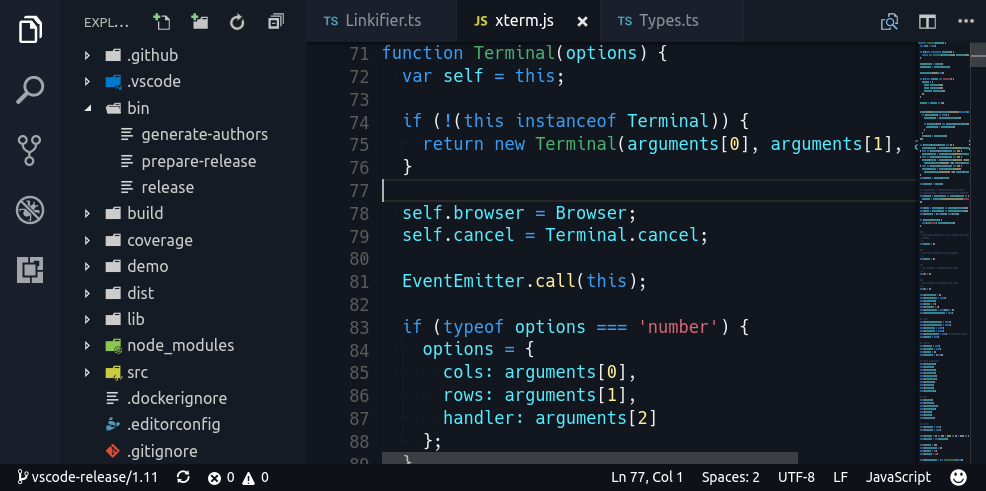
Getting started
yarn add @moxer/vscode-theme-generatorThen import the generator and call it to generate a theme
In addition to the base colors, IColorSet provides more options for syntax, ui, and terminal. There is also an overrides property, which allows you to set any color key from the Theme Color Reference directly.
Since the theme is defined in TypeScript, you can create an object to give names to colors you want to re-use.
import { generateTheme, IColorSet } from '@moxer/vscode-theme-generator';

const colors = {
  red: '#DA6771',
  green: '#4EB071',
  yellow: '#FFF099',
  blue: '#399EF4',
  blueLight: '#9FCFF9'
}

const colorSet: IColorSet = {
  base: {
    // Determines the overall background color
    background: '#12171F',
    // Determines the overall text foreground color
    foreground: '#EFEFEF',
    // Determines boolean, identifier, keyword, storage, and cssClass
    color1: colors.blue,
    // Determines string, stringEscape, and cssId
    color2: colors.red,
    // Determines function, class, classMember, type, and cssTag
    color3: colors.green,
    // Determines functionCall and number
    color4: colors.yellow
  },
  /**
    * Overrides specific syntax groups provided
    * by the theme generator (see above comment lines)
    */
  syntax: {
    identifier: colors.blueLight,
    string: colors.red
  },
  ui: {
    cursor: '#FFFFFF'
  },
  terminal: {
    blue: colors.blue,
    brightBlue: colors.blueLight
  },
  workbench: {
    'editorGutter.modifiedBackground': colors.green,
    'editorGutter.addedBackground': colors.blue,
    'editorGutter.deletedBackground': colors.red
  },
  customTokens: [
    {
      name: 'String',
      scope: [
        'string',
      ],
      settings: {
        fontStyle: 'normal',
        foreground: '#00ff00'
      }
    }
  ]
};

generateTheme('My Theme', colorSet, path.join(__dirname, 'theme.json'));
The syntax properties present a simplified set of token types. If not set, these will be derived from the base colors:
color1determinesboolean,identifier,keyword,storage, andcssClasscolor2determinesstring,stringEscape, andcssIdcolor3determinesfunction,class,classMember,type, andcssTagcolor4determinesfunctionCallandnumber
By default, comment is derived from the background color, and modifier and markdownQuote are not set.
The ui properties allow you to set colors for various highlights and a few other things:
cursor: the cursor colorinvisibles: used for visible whitespace (see theeditor.renderWhitespaceVS Code setting)guide: indentation guidelines in the editor panelineHighlight: colors the line your cursor is on, in place of the boundary linesfindMatchHighlightandcurrentFindMatchHighlight: highlights matches from the find widgetfindRangeHighlight: highlights the selected area for "find in selection"rangeHighlight: background for a selected range of linesselection: highlights text selected with the cursorselectionHighlight: highlights text which matches the selected textwordHighlight: when the cursor is on a symbol, highlights places that symbol is readwordHighlightStrong: when the cursor is on a symbol, highlights places that symbol is writtenactiveLinkForeground: color of hyperlinks when clicked
By default, invisibles and guide are derived from the background color, and the rest are not set.
The terminal properties include each of the standard 16 ANSI colors (black, red, green, yellow, blue, magenta, cyan, and white, plus their "bright" counterparts). To set the background color, add the terminal.background key under overrides.
Support
Support below means that the standard VS Code grammar has explicit support for the languages, ie. the colors should match their meanings. Other languages will probably still look alright but there is no guarantee that they will.
- :white_check_mark: C#
- :white_check_mark: CSS
- :white_check_mark: SASS
- :white_check_mark: PostCSS
- :white_check_mark: HTML
- :white_check_mark: Java
- :white_check_mark: JavaScript (+ JSX)
- :white_check_mark: TypeScript (+ TSX)
- :white_check_mark: Markdown
- :white_check_mark: Python
- :white_check_mark: Perl
- :white_check_mark: C++
- :white_check_mark: C#
Development
npm run watchThen in VS Code press F5 to build demo and launch the debugger with the generated themes available to switch to.
4 years ago
6 years ago
6 years ago
6 years ago
6 years ago
6 years ago
6 years ago
6 years ago
6 years ago
6 years ago
6 years ago
6 years ago
6 years ago
6 years ago
6 years ago
6 years ago
6 years ago
6 years ago
6 years ago
6 years ago
6 years ago
6 years ago
6 years ago
6 years ago
6 years ago
6 years ago
6 years ago
6 years ago
6 years ago
6 years ago
6 years ago
6 years ago
6 years ago
6 years ago
6 years ago
6 years ago
6 years ago
6 years ago
6 years ago
6 years ago
7 years ago
7 years ago
7 years ago
7 years ago
7 years ago
7 years ago
7 years ago