@nichoth/debug v0.6.7
debug




A tiny JavaScript debugging utility that works in Node.js and browsers. Use environment variables to control logging, so there are no ridiculous console log statements in production.
This is based on debug. It's been rewritten to use contemporary JS.
Featuring:
- Use exports field in
package.jsonto choose node JS or browser version - ESM only
install
npm i -D @nichoth/debugUse this with vite in the browser or in node.
example
browser
This is ergonomic with the vite bundler. This module will look for an env variable prefixed with VITE_:
VITE_DEBUG=foooIf you initialize this without a namespace, then it checks import.meta.env.DEV:
import Debug from '@nichoth/debug'
const debug = Debug()
debug('debug works')   // check if `import.meta.env.DEV`
a third config option
You can pass in an env variable of VITE_DEBUG_MODE, and then debug will
check for that mode in vite.
For example, in the staging environment:
VITE_DEBUG_MODE=staging vite build --mode stagingIf you are in production (import.meta.env.PROD) and there is no VITE_DEBUG env var, then this exports a noop, so debug will do nothing, and your bundle will be smaller.
Use a namespace
In your JS code:
import { createDebug } from '@nichoth/debug'
const debug = createDebug('fooo')
debug('debug works')
You would start that script with a VITE_DEBUG=fooo env var to see the log statements.
Don't use a namespace
If you call this without a namespace argument, it will look at the value of import.meta.env.DEV. If you are in DEV mode, then it will log things in a random color:
const debugTwo = createDebug()
// this is only logged if `import.meta.env.DEV` is true
debugTwo('testing debug 2')

setTimeout(() => {
    debug2('log again')
}, 1000)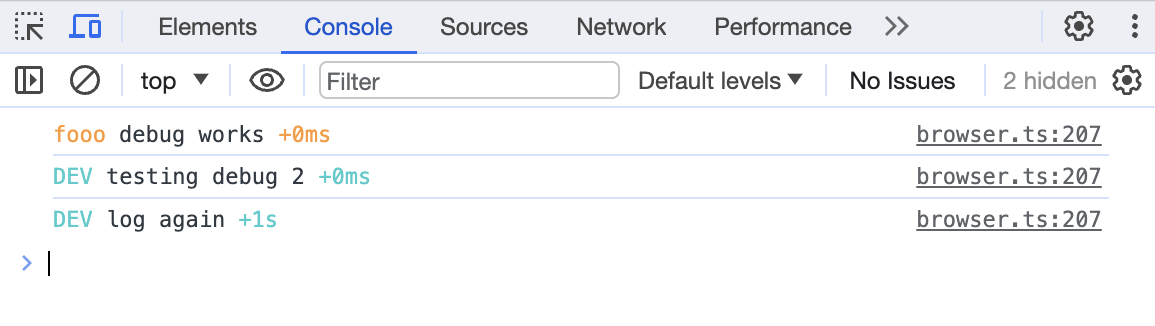
node JS
Run your script with an env variable, DEBUG.
// in node JS
import createDebug from '@nichoth/debug/node'
const debug = createDebug('fooo')
debug('testing')
Call this with an env var of DEBUG=fooo
DEBUG=fooo node ./test/fixture/node.jsNODE_ENV
If you are in dev mode (process.env.NODE_ENV === 'development'), then this will log things in a random color if you don't initialize it with a namespace --
import createDebug from '@nichoth/debug'
const debug = createDebug()
debug('hello')
Run the script like this:
NODE_ENV=development node ./my-script.jsConfigure the environment value
Configure what NODE_ENV value will trigger logging by overriding the shoudlLog function:
// in node only
import Debug from '@nichoth/debug'

Debug.shouldLog = function (NODE_ENV) {
    return NODE_ENV === 'example'
}
const debug = Debug()
// this will log iff we start this like
// NODE_ENV="example" node my-program.js
debug('testing')
develop
browser
Start a vite server and log some things. This uses the example directory.
npm startnode
Run tests:
npm run build-testsDEBUG=test node ./test/index.jsrun examples in node
2 years ago
2 years ago
2 years ago
2 years ago
2 years ago
2 years ago
2 years ago
2 years ago
2 years ago
3 years ago
3 years ago
3 years ago
3 years ago
3 years ago
3 years ago
3 years ago
3 years ago
3 years ago
3 years ago
3 years ago
3 years ago
3 years ago
3 years ago
3 years ago
3 years ago
3 years ago
3 years ago
3 years ago
3 years ago
3 years ago
3 years ago
3 years ago
3 years ago
3 years ago
3 years ago
3 years ago
3 years ago
3 years ago
3 years ago
3 years ago
3 years ago
3 years ago
3 years ago
3 years ago
3 years ago
3 years ago
3 years ago
3 years ago