affise-attribution-lib v1.6.30
Affise Attribution React Native Library
| Package | Version |
|---|---|
affise-attribution-lib |  |
- Affise Attribution React Native Library
- Description
- Features
- ProviderType identifiers collection
- Event send control
- Events tracking
- Custom events tracking
- Predefined event parameters
- Events buffering
- Advertising Identifier (google) tracking
- Open Advertising Identifier (huawei) tracking
- Install referrer tracking
- Push token tracking
- Reinstall Uninstall tracking
- APK preinstall tracking
- Links
- Offline mode
- Disable tracking
- Disable background tracking
- Get random user Id
- Get random device Id
- Get providers
- Is first run
- Get referrer
- Get referrer value
- Referrer keys
- Get module state
- Platform specific
- SDK to SDK integrations
- Debug
- Troubleshoots
Description
Affise SDK is a software you can use to collect app usage statistics, device identifiers, deeplink usage, track install referrer.
Quick start
SDK compatibility
Xcode14.2+iOS12+Android21+
Integration
Integrate npm package
This is a Node.js module available through the npm registry.
Installation using npm
npm install affise-attribution-libInstallation using yarn
yarn add affise-attribution-libModules
If module start type is manual, then call:
Affise.module.moduleStart(AffiseModules.ADVERTISING)Get list of installed modules:
Affise.module.getModulesInstalled().then((modules) => {
    console.log(`Modules: ${modules}`);
});
Android
Add modules to Android project
| Module | Version | Start |
|---|---|---|
ADVERTISING |  | Auto |
ANDROIDID |  | Auto |
LINK |  | Auto |
NETWORK |  | Auto |
PHONE |  | Auto |
STATUS |  | Auto |
SUBSCRIPTION |  | Auto |
RUSTORE |  | Auto |
HUAWEI |  | Auto |
Example example/android/app/build.gradle
final affise_version = '1.6.54'

dependencies {
    // Affise modules
    implementation "com.affise:module-advertising:$affise_version"
    implementation "com.affise:module-androidid:$affise_version"
    implementation "com.affise:module-link:$affise_version"
    implementation "com.affise:module-network:$affise_version"
    implementation "com.affise:module-phone:$affise_version"
    implementation "com.affise:module-status:$affise_version"
    implementation "com.affise:module-subscription:$affise_version"
    // implementation "com.affise:module-rustore:$affise_version"
    // implementation "com.affise:module-huawei:$affise_version"
}
iOS
Add modules to iOS project
| Module | Version | Start |
|---|---|---|
ADVERTISING | 1.6.47 | Manual |
LINK | 1.6.47 | Auto |
PERSISTENT | 1.6.47 | Auto |
STATUS | 1.6.47 | Auto |
SUBSCRIPTION | 1.6.47 | Auto |
Example example/ios/Podfile
target 'YourAppProject' do
  # ...

  affise_version = '1.6.47'
  # Affise Modules
  pod 'AffiseModule/Advertising', affise_version
  pod 'AffiseModule/Link', affise_version
  pod 'AffiseModule/Persistent', affise_version
  pod 'AffiseModule/Status', affise_version
  pod 'AffiseModule/Subscription', affise_version
end
Warning
🟥🟥🟥🟥🟥🟥🟥🟥🟥🟥🟥🟥🟥🟥🟥
Module Advertising requires
NSUserTrackingUsageDescriptionkey ininfo.plistApplication will crash if key not present
🟥🟥🟥🟥🟥🟥🟥🟥🟥🟥🟥🟥🟥🟥🟥
Open info.plist and add key NSUserTrackingUsageDescription with string value. For more information read requirements
Module Advertising
iOS
This module required to Use IDFA (Identifier for advertisers)
Warning
🟥🟥🟥🟥🟥🟥🟥🟥🟥🟥🟥🟥🟥🟥🟥
Module Advertising requires
NSUserTrackingUsageDescriptionkey ininfo.plistApplication will crash if key not present
🟥🟥🟥🟥🟥🟥🟥🟥🟥🟥🟥🟥🟥🟥🟥
Open info.plist and add key NSUserTrackingUsageDescription with string value. For more information read requirements
Module Link
Return last url in chan of redirection
🟥Support MAX 10 redirections🟥
Affise.module.linkResolve("SITE_WITH_REDIRECTION", (redirectUrl) => {
    // handle redirect url
});
Module Status
Warning
🟥🟥🟥🟥🟥🟥🟥🟥🟥🟥🟥🟥🟥🟥🟥
If
getStatusreturn an error or working more than 2 minutesPlease see section validation credentials
🟥🟥🟥🟥🟥🟥🟥🟥🟥🟥🟥🟥🟥🟥🟥
Affise.module.getStatus(AffiseModules.STATUS, (response) => {
    // handle status response
});
Module Subscription
Get products by ids:
const ids = ["exampple.product.id_1", "exampple.product.id_2"];

Affise.module.fetchProducts(ids, (result) => {
    if (result.isSuccess) {
        const value = result.asSuccess;
        const products: AffiseProduct[] = value.products;
        const invalidIds: string[] = value.invalidIds;
    } else {
        const error: string = result.asFailure;
    }
});
Purchase product:
// Specify product type for correct affise event
Affise.module.purchase(product, AffiseProductType.CONSUMABLE, (result) => {
    if (result.isSuccess) {
        const purchasedInfo: AffisePurchasedInfo = result.asSuccess;
    } else {
        const error: string = result.asFailure;
    }
});
AffiseProductType
CONSUMABLENON_CONSUMABLERENEWABLE_SUBSCRIPTIONNON_RENEWABLE_SUBSCRIPTION
Initialize
After dependency is added, and project is sync with npm install and initialize.
Demo app App.tsx
import {
  Affise,
  AffiseInitProperties
} from 'affise-attribution-lib';


export default function App() {

    React.useEffect(() => {
        Affise
            .settings({
                affiseAppId: 'Your appId', //Change to your app id
                secretKey: 'Your SDK secretKey', //Change to your SDK secretKey
            })
            .start(); // Start Affise SDK
    });

    return (
        <SafeAreaView>
        </SafeAreaView>
    );
}
Check if library is initialized
Affise.isInitialized();Before application is published
Warning
🟥🟥🟥🟥🟥🟥🟥🟥🟥🟥🟥🟥🟥🟥🟥
Please make sure your credentials are valid
Visit section validation credentials
🟥🟥🟥🟥🟥🟥🟥🟥🟥🟥🟥🟥🟥🟥🟥
Domain
Set SDK server domain:
Affise
    .settings({
        affiseAppId: 'Your appId',
        secretKey: 'Your SDK secretKey',
    })
    .setDomain("https://YoureCustomDomain/") // Set custom domain
    .start(); // Start Affise SDK
Requirements
Android
Minimal Android SDK version is 21
For a minimal working functionality your app needs to declare internet permission:
<manifest>
    <uses-permission android:name="android.permission.INTERNET"/>
</manifest>
OAID certificate in your project (Optional)
example/android/app/src/main/assets/oaid.cert.pem
iOS
Affise Advertising module uses AppTrackingTransparency framework to get advertisingIdentifier
For working functionality your app needs to declare NSUserTrackingUsageDescription permission:
Open XCode project info.plist and add key NSUserTrackingUsageDescription with string value
Example info.plist:
<plist version="1.0">
<dict>
    ...
	<key>NSUserTrackingUsageDescription</key>
	<string>Youre permission text</string>
</dict>
Features
ProviderType identifiers collection
To match users with events and data library is sending, these ProviderType identifiers are collected:
Attribution
AFFISE_APP_IDAFFISE_PKG_APP_NAMEAFF_APP_NAME_DASHBOARDAPP_VERSIONAPP_VERSION_RAWSTORETRACKER_TOKENTRACKER_NAMEFIRST_TRACKER_TOKENFIRST_TRACKER_NAMELAST_TRACKER_TOKENLAST_TRACKER_NAMEOUTDATED_TRACKER_TOKENINSTALLED_TIMEFIRST_OPEN_TIMEINSTALLED_HOURFIRST_OPEN_HOURINSTALL_FIRST_EVENTINSTALL_BEGIN_TIMEINSTALL_FINISH_TIMEREFERRER_INSTALL_VERSIONREFERRAL_TIMEREFERRER_CLICK_TIMEREFERRER_CLICK_TIME_SERVERREFERRER_GOOGLE_PLAY_INSTANTCREATED_TIMECREATED_TIME_MILLICREATED_TIME_HOURUNINSTALL_TIMEREINSTALL_TIMELAST_SESSION_TIMECPU_TYPEHARDWARE_NAMEDEVICE_MANUFACTURERDEEPLINK_CLICKDEVICE_ATLAS_IDAFFISE_DEVICE_IDAFFISE_ALT_DEVICE_IDANDROID_IDANDROID_ID_MD5REFTOKENREFTOKENSREFERRERUSER_AGENTMCCODEMNCODEREGIONCOUNTRYLANGUAGEDEVICE_NAMEDEVICE_TYPEOS_NAMEPLATFORMSDK_PLATFORMAPI_LEVEL_OSAFFISE_SDK_VERSIONOS_VERSIONRANDOM_USER_IDAFFISE_SDK_POSTIMEZONE_DEVAFFISE_EVENT_NAMEAFFISE_EVENT_TOKENLAST_TIME_SESSIONTIME_SESSIONAFFISE_SESSION_COUNTLIFETIME_SESSION_COUNTAFFISE_DEEPLINKAFFISE_PART_PARAM_NAMEAFFISE_PART_PARAM_NAME_TOKENAFFISE_APP_TOKENLABELAFFISE_SDK_SECRET_IDUUIDAFFISE_APP_OPENEDPUSHTOKENAFFISE_EVENTS_COUNTAFFISE_SDK_EVENTS_COUNTAFFISE_METRICS_EVENTS_COUNTAFFISE_INTERNAL_EVENTS_COUNTIS_ROOTEDIS_EMULATOR
Advertising
GAID_ADIDGAID_ADID_MD5OAIDOAID_MD5ADIDALTSTR_ADIDFIREOS_ADIDCOLOROS_ADID
Network
MAC_SHA1MAC_MD5CONNECTION_TYPEPROXY_IP_ADDRESS
Phone
NETWORK_TYPEISP
Event send control
There are two ways to send events
- Cache event to later scheduled send in batch
AddToCartEvent()
.send();- Send event right now
AddToCartEvent()
    .sendNow(() => {
        // handle event send success
    }, (status) => {
        // handle event send failed
        // 🟥Warning🟥: event is NOT cached for later send
    });
Events tracking
Demo app DefaultEventsFactory.ts
For example, we want to track what items usually user adds to shopping cart. To send event first create it with following code
import { Affise, AddToCartEvent } from 'affise-attribution-lib';

class Presenter {
  onUserAddsItemsToCart(item: string) {
    const items = {
      items: 'cookies, potato, milk',
    };

    new AddToCartEvent({
        userData: item,
        timeStampMillis: Date.now()
    })
        .addPredefinedString(PredefinedString.DESCRIPTION, 'groceries')
        .addPredefinedObject(PredefinedObject.CONTENT, items)
        .send();
  }
}
With above example you can implement other events:
AchieveLevelAddPaymentInfoAddToCartAddToWishlistAdRevenueClickAdvCompleteRegistrationCompleteStreamCompleteTrialCompleteTutorialContactContentItemsViewCustomizeProductDeepLinkedDonateFindLocationInitiateCheckoutInitiatePurchaseInitiateStreamInviteLastAttributedTouchLeadListViewLoginOpenedFromPushNotificationOrderOrderItemAddedOrderItemRemoveOrderCancelOrderReturnRequestOrderReturnRequestCancelPurchaseRateReEngageReserveSalesScheduleSearchShareSpendCreditsStartRegistrationStartTrialStartTutorialSubmitApplicationSubscribeTravelBookingUnlockAchievementUnsubscribeUpdateViewAdvViewCartViewContentViewItemViewItemsInitialSubscriptionInitialTrialInitialOfferConvertedTrialConvertedOfferTrialInRetryOfferInRetrySubscriptionInRetryRenewedSubscriptionFailedSubscriptionFromRetryFailedOfferFromRetryFailedTrialFromRetryFailedSubscriptionFailedOfferiseFailedTrialReactivatedSubscriptionRenewedSubscriptionFromRetryConvertedOfferFromRetryConvertedTrialFromRetryUnsubscription
Custom events tracking
Use any of custom events if default doesn't fit your scenario:
CustomId01CustomId02CustomId03CustomId04CustomId05CustomId06CustomId07CustomId08CustomId09CustomId10
If above event functionality still limits your usecase, you can use UserCustomEvent
new UserCustomEvent({eventName: "MyCustomEvent"})
    .send();
Predefined event parameters
To enrich your event with another dimension, you can use predefined parameters for most common cases. Add it to any event:
import {
  Affise,
  AddToCartEvent,
  PredefinedString,
  PredefinedObject,
} from 'affise-attribution-lib';

class Presenter {
  onUserAddsItemsToCart(item: string) {
    const items = {
      items: 'cookies, potato, milk',
    };

    new AddToCartEvent({
        userData: item,
    })
        .addPredefinedString(PredefinedString.DESCRIPTION, 'best before 2029')
        .addPredefinedObject(PredefinedObject.CONTENT, items)
        .send();
  }
}
In examples above PredefinedString.DESCRIPTION and PredefinedObject.CONTENT is used, but many others is available:
| PredefinedParameter | Type |
|---|---|
| PredefinedString | string |
| PredefinedLong | bigint |
| PredefinedFloat | number |
| PredefinedObject | Record<string, unknown> |
| PredefinedListObject | Array<Record<string, unknown>> |
| PredefinedListString | Array<string> |
PredefinedString
ACHIEVEMENT_IDADREV_AD_TYPEBRANDBRICKCAMPAIGN_IDCATALOGUE_IDCHANNEL_TYPECITYCLASSCLICK_IDCONTENT_IDCONTENT_NAMECONTENT_TYPECONVERSION_IDCOUNTRYCOUPON_CODECURRENCYCUSTOMER_SEGMENTCUSTOMER_TYPECUSTOMER_USER_IDDEEP_LINKDESCRIPTIONDESTINATION_ADESTINATION_BDESTINATION_LISTEVENT_NAMENEW_VERSIONNETWORKOLD_VERSIONORDER_IDPARAM_01PARAM_02PARAM_03PARAM_04PARAM_05PARAM_06PARAM_07PARAM_08PARAM_09PARAM_10PAYMENT_INFO_AVAILABLEPIDPLACEMENTPREFERRED_NEIGHBORHOODSPRODUCT_IDPRODUCT_NAMEPURCHASE_CURRENCYRECEIPT_IDREGIONREGISTRATION_METHODREVIEW_TEXTSEARCH_STRINGSEGMENTSOURCESTATUSSUBSCRIPTION_IDSUCCESSSUGGESTED_DESTINATIONSSUGGESTED_HOTELSTUTORIAL_IDUNITUTM_CAMPAIGNUTM_MEDIUMUTM_SOURCEVALIDATEDVERTICALVIRTUAL_CURRENCY_NAMEVOUCHER_CODE
PredefinedLong
AMOUNTDATE_ADATE_BDEPARTING_ARRIVAL_DATEDEPARTING_DEPARTURE_DATEHOTEL_SCORELEVELMAX_RATING_VALUENUM_ADULTSNUM_CHILDRENNUM_INFANTSPREFERRED_NUM_STOPSPREFERRED_STAR_RATINGSQUANTITYRATING_VALUERETURNING_ARRIVAL_DATERETURNING_DEPARTURE_DATESCORETRAVEL_STARTTRAVEL_ENDUSER_SCOREEVENT_STARTEVENT_END
PredefinedFloat
PREFERRED_PRICE_RANGEPRICEREVENUELATLONG
PredefinedObject
CONTENT
PredefinedListObject
CONTENT_LIST
PredefinedListString
CONTENT_IDS
Events buffering
Affise library will send any pending events with first opportunity, but if there is no network connection or device is disabled, events are kept locally for 7 days before deletion.
Advertising Identifier (google) tracking
Advertising Identifier (google) tracking is supported automatically, no actions needed
Open Advertising Identifier (huawei) tracking
Open Advertising Identifier is supported automatically, no actions needed
Install referrer tracking
Install referrer tracking is supported automatically, no actions needed
Push token tracking
To let affise track push token you need to receive it from your push service provider, and pass to Affise library. First add firebase integration to your app completing these steps: Firebase Docs
After you have done with firebase integration, add to your cloud messaging service onNewToken method Affise.addPushToken(token)
import { Affise } from 'affise-attribution-lib';
import messaging from '@react-native-firebase/messaging';

const getToken = async () => {
  const token = await messaging().getToken();
  if (token) {
    Affise.addPushToken(token);
  }
};
Reinstall Uninstall tracking
Affise automatically track reinstall events by using silent-push technology, to make this feature work, pass push token when it is recreated by user and on you application starts up
Affise.addPushToken(token);APK preinstall tracking
SDK is also supports scenario when APK is installed not from one of application markets, such as google play, huawei appgallery or amazon appstore
To use this feature, create file with name partner_key in your app assets directory, and write unique identifier inside, this key will be passed to our backend so you can track events by partner later in your Affise console.
Links
Deeplinks
Warning
🟥🟥🟥🟥🟥🟥🟥🟥🟥🟥🟥🟥🟥🟥🟥
Deeplinks support only CUSTOM scheme NOT
httporhttpsFor
httporhttpsread how to setup AppLinks🟥🟥🟥🟥🟥🟥🟥🟥🟥🟥🟥🟥🟥🟥🟥
To integrate deeplink support you need:
Register deeplink callback right after
Affise.settings({affiseAppId, secretKey}).start()
Affise.registerDeeplinkCallback((value) => {
    // full uri "scheme://host/path?parameters"
    const deeplink = value.deeplink;

    // separated for convenience
    const scheme = value.scheme;
    const host = value.host;
    const path = value.path;
    const queryParametersMap = value.parameters;

    if((queryParametersMap["<your_uri_key>"] || []).includes("<your_uri_key_value>")) {
        // handle value
    }
});
Test Android DeepLink via terminal command:
adb shell am start -a android.intent.action.VIEW -d "YOUR_SCHEME://YOUR_DOMAIN/somepath?param=1\&list=some\&list=other\&list="Test iOS DeepLink via terminal command:
xcrun simctl openurl booted "YOUR_SCHEME://YOUR_DOMAIN/somepath?param=1&list=some&list=other&list=1"Android
To integrate deeplink support in android you need:
Add intent filter to one of your activities
AndroidManifest.xml exampleAdd custom scheme (NOT
httporhttps) and host to filter
Example: YOUR_SCHEME://YOUR_DOMAIN
Example: myapp://mydomain.com
<intent-filter android:autoVerify="true">
    <action android:name="android.intent.action.VIEW" />

    <category android:name="android.intent.category.DEFAULT" />
    <category android:name="android.intent.category.BROWSABLE" />

    <data
        android:host="YOUR_DOMAIN"
        android:scheme="YOUR_SCHEME" />
</intent-filter>
iOS
To integrate deeplink support in iOS you need:
- Add deeplink handler React Docs.
example AppDelegate.mm
- (BOOL)application:(UIApplication *)application openURL:(NSURL *)url
  sourceApplication:(NSString *)sourceApplication annotation:(id)annotation
{
  return [RCTLinkingManager application:application openURL:url
                      sourceApplication:sourceApplication annotation:annotation];
}- Add key
CFBundleURLTypestoInfo.plistexample Info.plist
Example: YOUR_SCHEME://YOUR_DOMAIN
Example: myapp://mydomain.com
<key>CFBundleURLTypes</key>
<array>
    <dict>
        <key>CFBundleTypeRole</key>
        <string>Editor</string>
        <key>CFBundleURLName</key>
        <string>YOUR_DOMAIN</string>
        <key>CFBundleURLSchemes</key>
        <array>
            <string>react</string>
        </array>
    </dict>
</array>
AppLinks
Warning
🟥🟥🟥🟥🟥🟥🟥🟥🟥🟥🟥🟥🟥🟥🟥
You must owne website domain.
And has ability to add file
https://yoursite/.well-known/apple-app-site-associationfor iOS supportAnd has ability to add file
https://yoursite/.well-known/assetlinks.jsonfor Android support🟥🟥🟥🟥🟥🟥🟥🟥🟥🟥🟥🟥🟥🟥🟥
Android
To integrate applink support in android you need:
Add intent filter to one of your activities
AndroidManifest.xml exampleAdd
httpsorhttpscheme and host to filter
Example: https://YOUR_DOMAIN
Example: https://mydomain.com
<intent-filter android:autoVerify="true">
    <action android:name="android.intent.action.VIEW" />

    <category android:name="android.intent.category.DEFAULT" />
    <category android:name="android.intent.category.BROWSABLE" />

    <data
        android:host="YOUR_DOMAIN"
        android:scheme="https" />
</intent-filter>
Associate your app with your website. Read Google instructions
After setting up URL support for your app, the App Links Assistant generates a Digital Assets Links file you can use to associate your website with your app.
As an alternative to using the Digital Asset Links file, you can associate your site and app in Search Console.
If you're using Play App Signing for your app, then the certificate fingerprint produced by the App Links Assistant usually doesn't match the one on users' devices. In this case, you can find the correct Digital Asset Links JSON snippet for your app in your Play Console developer account under Release > Setup > App signing.
To associate your app and your website using the App Links Assistant, click Open Digital Asset Links File Generator from the App Links Assistant and follow these steps:
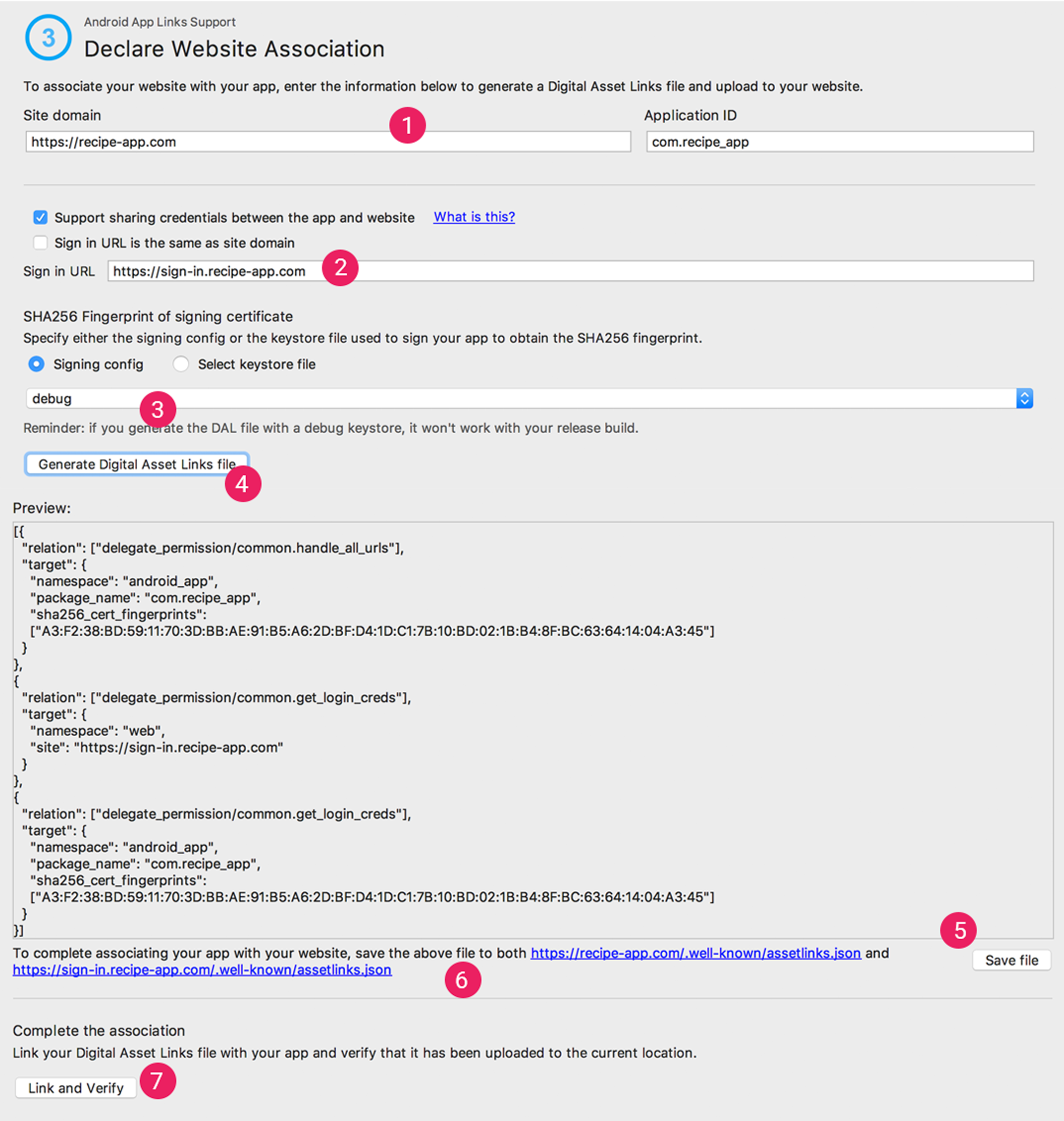 Figure 2. Enter details about your site and app to generate a Digital Asset Links file.
Enter your Site domain and your Application ID.
To include support in your Digital Asset Links file for One Tap sign-in, select Support sharing credentials between the app and the website and enter your site's sign-in URL.This adds the following string to your Digital Asset Links file declaring that your app and website share sign-in credentials:
delegate_permission/common.get_login_creds.Specify the signing config or select a keystore file.
Make sure you select the right release config or keystore file for the release build or the debug config or keystore file for the debug build of your app. If you want to set up your production build, use the release config. If you want to test your build, use the debug config.
- Click Generate Digital Asset Links file.
- Once Android Studio generates the file, click Save file to download it.
- Upload the
assetlinks.jsonfile to your site, with read access for everyone, athttps://yoursite/.well-known/assetlinks.json.
Important
The system verifies the Digital Asset Links file via the encrypted HTTPS protocol. Make sure that the assetlinks.json file is accessible over an HTTPS connection, regardless of whether your app's intent filter includes https.
- Click Link and Verify to confirm that you've uploaded the correct Digital Asset Links file to the correct location.
Learn more about associating your website with your app through the Digital Asset Links file in Declare website associations.
iOS
To integrate deeplink support in iOS you need:
Follow how to set up applink in the official documentation.
Associate your app with your website. Supporting associated domains
Add key
com.apple.developer.associated-domainstoInfo.plist
Example: https://YOUR_DOMAIN
Example: https://mydomain.com
<key>com.apple.developer.associated-domains</key>
<array>
    <string>applinks:YOUR_DOMAIN</string>
</array>
Get deferred deeplink
Note
Requires Affise Status Module
Use the next public method of SDK to get deferred deeplink from server
Affise.getDeferredDeeplink((deferredDeeplink) => {
    // handle deferred deeplink
});
Get deferred deeplink value
Note
Requires Affise Status Module
Use the next public method of SDK to get deferred deeplink value from server
Affise.getDeferredDeeplinkValue(ReferrerKey.CLICK_ID, (deferredDeeplinkValue) => {
    // handle deferred deeplink value
})
Offline mode
In some scenarios you would want to limit Affise network usage, to pause that activity call anywhere in your application following code after Affise start:
Affise.settings({affiseAppId, secretKey}).start(); // Start Affise SDK
Affise.setOfflineModeEnabled(true); // to enable offline mode
Affise.setOfflineModeEnabled(false); // to disable offline mode
While offline mode is enabled, your metrics and other events are kept locally, and will be delivered once offline mode is disabled. Offline mode is persistent as Application lifecycle, and will be disabled with process termination automatically. To check current offline mode status call:
Affise.isOfflineModeEnabled().then((enabled) => {
    // returns true or false describing current offline Mode state
});
Disable tracking
To disable any tracking activity, storing events and gathering device identifiers and metrics call anywhere in your application following code after Affise start:
Affise.settings({affiseAppId, secretKey}).start(); // Start Affise SDK
Affise.setTrackingEnabled(true); // to enable tracking
Affise.setTrackingEnabled(false); // to disable tracking
By default, tracking is enabled.
While tracking mode is disabled, metrics and other identifiers is not generated locally. Keep in mind that this flag is persistent until app reinstall, and don't forget to reactivate tracking when needed. To check current status of tracking call:
Affise.isTrackingEnabled().then((enabled) => {
  // returns true or false describing current tracking state
});
Disable background tracking
To disable any background tracking activity, storing events and gathering device identifiers and metrics call anywhere in your application following code after Affise start:
Affise.settings({affiseAppId, secretKey}).start(); // Start Affise SDK
Affise.setBackgroundTrackingEnabled(true); // to enable background tracking
Affise.setBackgroundTrackingEnabled(false); // to disable background tracking
By default, background tracking is enabled.
While background tracking mode is disabled, metrics and other identifiers is not generated locally. Background tracking mode is persistent as Application lifecycle, and will be re-enabled with process termination automatically. To check current status of background tracking call:
Affise.isBackgroundTrackingEnabled().then((enabled) => {
  // returns true or false describing current background tracking state
});
Get random user Id
Affise.getRandomUserId();Get random device Id
Note
To make
device idmore persistent on application reinstalluse Affise
PersistentModule foriOSuse Affise
AndroidIdModule forAndroid
Affise.getRandomDeviceId();Get providers
Returns providers map with ProviderType as key
As Promise:
Affise.getProviders().then((providers) => {
    const key = ProviderType.AFFISE_APP_TOKEN;
    const value = providers[key];
    // handle provider value
});
As async / await:
const fetchData = async () => {
    const providers = await Affise.getProviders();
    const key = ProviderType.AFFISE_APP_TOKEN;
    const value = providers[key];
    // handle provider value
};

fetchData()
    .catch(console.error);
Is first run
Affise.isFirstRun().then((isFirstRun) => {
  // handle
});
Get referrer
Use the next public method of SDK
To get Install referrer by installing from
AndroidRuStoreinclude moduleRuStoreTo get Install referrer by installing from
AndroidAppGalleryinclude moduleHuawei
Affise.getReferrerUrl().then((referrer) => {
  // handle referrer
});
Get referrer value
Use the next public method of SDK to get referrer value by
To get Install referrer by installing from
AndroidRuStoreinclude moduleRuStoreTo get Install referrer by installing from
AndroidAppGalleryinclude moduleHuawei
Affise.getReferrerUrlValue(ReferrerKey.CLICK_ID, (value) => {
  // handle referrer
})
Referrer keys
In examples above ReferrerKey.CLICK_ID is used, but many others is available:
AD_IDCAMPAIGN_IDCLICK_IDAFFISE_ADAFFISE_AD_IDAFFISE_AD_TYPEAFFISE_ADSETAFFISE_ADSET_IDAFFISE_AFFC_IDAFFISE_CHANNELAFFISE_CLICK_LOOK_BACKAFFISE_COST_CURRENCYAFFISE_COST_MODELAFFISE_COST_VALUEAFFISE_DEEPLINKAFFISE_KEYWORDSAFFISE_MEDIA_TYPEAFFISE_MODELAFFISE_OSAFFISE_PARTNERAFFISE_REFAFFISE_SITE_IDAFFISE_SUB_SITE_IDAFFISE_SUB_1AFFISE_SUB_2AFFISE_SUB_3AFFISE_SUB_4AFFISE_SUB_5AFFCPIDSUB_1SUB_2SUB_3SUB_4SUB_5
Get module state
Warning
🟥🟥🟥🟥🟥🟥🟥🟥🟥🟥🟥🟥🟥🟥🟥
If
getStatusreturn an error or working more than 2 minutesPlease see section validation credentials
🟥🟥🟥🟥🟥🟥🟥🟥🟥🟥🟥🟥🟥🟥🟥
Affise.module.getStatus(AffiseModules.STATUS, (response) => {
    // handle status response
});
Platform specific
GDPR right to be forgotten
Android Only
Under the EU's General Data Protection Regulation (GDPR): An individual has the right to have their personal data erased. To provide this functionality to user, as the app developer, you can call
Affise.settings({affiseAppId, secretKey}).start(); // Start Affise SDK
Affise.android.forget(); // to forget users data
After processing such request our backend servers will delete all user's data. To prevent library from generating new events, disable tracking just before calling Affise.forget:
Affise.settings({affiseAppId, secretKey}).start(); // Start Affise SDK
Affise.setTrackingEnabled(false);
Affise.android.forget(); // to forget users data
StoreKit Ad Network
iOS Only
For ios prior 16.1 first call
Affise.ios.registerAppForAdNetworkAttribution((error) => {
  // Handle error
});
Updates the fine and coarse conversion values, and calls a completion handler if the update fails. Second argument coarseValue is available in iOS 16.1+
Affise.ios.updatePostbackConversionValue(1n, SKAdNetwork.CoarseConversionValue.medium, (error) => {
  // Handle error
});
Configure your app to send postback copies to Affise:
Add key NSAdvertisingAttributionReportEndpoint to Info.plist
Set key value to https://affise-skadnetwork.com/
Example: example/ios/AffiseAttributionLibExample/Info.plist
<key>CFBundleURLTypes</key>
<array>
    <dict>
      <key>NSAdvertisingAttributionReportEndpoint</key>
      <string>https://affise-skadnetwork.com/</string>
    </dict>
</array>
SDK to SDK integrations
// Send AdRevenue info
new AffiseAdRevenue(AffiseAdSource.ADMOB)
        .setRevenue(2.5, "ImpressionData_Currency")
        .setNetwork("ImpressionData_Network")
        .setUnit("ImpressionData_Unit")
        .setPlacement("ImpressionData_Placement")
        .send();
Debug
Validate credentials
Warning
🟥🟥🟥🟥🟥🟥🟥🟥🟥🟥🟥🟥🟥🟥🟥
Debug methods WON'T work on Production
🟥🟥🟥🟥🟥🟥🟥🟥🟥🟥🟥🟥🟥🟥🟥
Validate your credentials by receiving ValidationStatus values:
VALID- your credentials are validINVALID_APP_ID- your app id is not validINVALID_SECRET_KEY- your SDK secretKey is not validPACKAGE_NAME_NOT_FOUND- your application package name not foundNOT_WORKING_ON_PRODUCTION- you using debug method on productionNETWORK_ERROR- network or server not available (for exampleAiroplane modeis active)
Affise
    .settings({
        affiseAppId: 'Your appId',
        secretKey: 'Your SDK secretKey',
    })
    .setProduction(false) //To enable debug methods set Production to false
    .start(); // Start Affise SDK

Affise.debug.validate((status) =>
{
    // Handle validation status
});
Troubleshoots
iOS
Warning
🟥🟥🟥🟥🟥🟥🟥🟥🟥🟥🟥🟥🟥🟥🟥
This app has crashed because Affise Advertising Module is attempted to access privacy-sensitive data without a usage description.
The app's
Info.plistmust contain anNSUserTrackingUsageDescriptionkey with a string value explainingto the user how the app uses this data.
🟥🟥🟥🟥🟥🟥🟥🟥🟥🟥🟥🟥🟥🟥🟥
Open info.plist and add key NSUserTrackingUsageDescription with string value. For more information read requirements
1 year ago
1 year ago
1 year ago
1 year ago
1 year ago
1 year ago
2 years ago
2 years ago
2 years ago
2 years ago
2 years ago
2 years ago
2 years ago
2 years ago
2 years ago
2 years ago
2 years ago
2 years ago
2 years ago
2 years ago
2 years ago
2 years ago
3 years ago
3 years ago
3 years ago
3 years ago
3 years ago
2 years ago
3 years ago
3 years ago
3 years ago
3 years ago
3 years ago
3 years ago
3 years ago
3 years ago
3 years ago
3 years ago
3 years ago
3 years ago
3 years ago
3 years ago
3 years ago
3 years ago
3 years ago
3 years ago
3 years ago
3 years ago