date-selection-manager v5.2.0
date-selection-manager
Author: Daniel Okwufulueze
Date: 13/02/2016
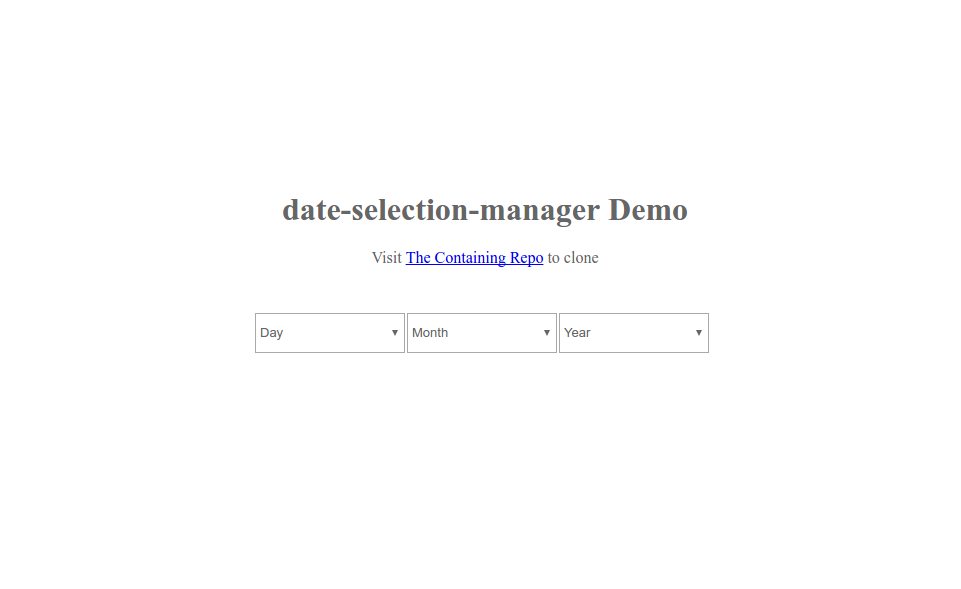
This package takes care of date entries via select elements. It prevents the entry of invalid dates like February 30, June 31, or February 29 on a non-leap year.
    import dateSelectionManager from 'date-selection-manager';
    dateSelectionManager.loadDate(configObject); // the configObject parameter may be absent
How To Use
At the terminal do:
cd path/to/your/project/if you want to use date-selection-manager in devDependencies
npm install --save-dev date-selection-managerelse if you want to have date-selection-manager globally installed
npm install date-selection-manager -gSetup your DOM elements for example:
  <div id='wrapper'>
    <div class='date-holder'>
      <select id='day'><option value=''>Day</option></select>
      <select id='month'><option value=''>Month</option></select>
      <select id='year'><option value=''>Year</option></select>
    </div>
  </div>
In your JS file which you may need to transpile using babel perhaps, do the following:
Require date-selection-manager
import dateSelectionManager from 'date-selection-manager';Invoke the manager to start managing your date DOM elements created in step 2
dateSelectionManager.loadDate();
Pass custom JS object to date-selection-manager
date-selection-manager loadDate() method can take a configuration object. This configuration object can be absent in the call to loadDate and defaults will be used instead. So to call loadDate, one can do:
loadDate(configObject)or
loadDate()Where configObject can be patterned thus:
  let configObject = {
    dayContainer: [optionalValue], // defaults to document
    dayId: [optionalValue], // defaults to 'day'
    dayText: [optionalValue], // defaults to 'Day'
    dayValue: [optionalValue], // defaults to ''
    dayStartDigit: [optionalValue], // defaults to '1'
    dayEndDigit: [optionalValue], // defaults to '31'
    dayDefaultValue: [optionalValue], // defaults to ''
    dayChangeEventCallback: [optionalValue], // defaults to null
    monthContainer: [optionalValue], // defaults to document
    monthId: [optionalValue], // defaults to 'month'
    monthText: [optionalValue], // defaults to 'Month'
    monthValue: [optionalValue], // defaults to ''
    monthStartDigit: [optionalValue], // defaults to '1'
    monthEndDigit: [optionalValue], // defaults to '12'
    monthDefaultValue: [optionalValue], // defaults to ''
    monthChangeEventCallback: [optionalValue], // defaults to null
    yearContainer: [optionalValue], // defaults to document
    yearId: [optionalValue], // defaults to 'year'
    yearText: [optionalValue], // defaults to 'Year'
    yearValue: [optionalValue], // defaults to ''
    yearStartDigit: [optionalValue], // defaults to '1940'
    yearEndDigit: [optionalValue], // defaults to '2060'
    yearDefaultValue: [optionalValue], // defaults to ''
    yearChangeEventCallback: [optionalValue], // defaults to null
  }
Details on the names and default values of the configuration object properties are shown below:
| Key | Default Value | Explanation |
|---|---|---|
| dayContainer | document | The DOM element you want to reference as holding the 'day' select element. |
| dayId | 'day' | The id of the select element representing "day". |
| dayText | 'Day' | The text of the first option element in the select element representing "day". |
| dayValue | '' | The value of the first option element in the select element representing "day". |
| dayStartDigit | '1' | Where the select element representing "day" starts counting from. |
| dayEndDigit | '31' | The number at which the select element representing "day" ends. |
| dayDefaultValue | '' | The value selected by default on the select element representing "day" once date-selection-manager is invoked. |
| dayChangeEventCallback | null | A callback function that is called when the select element representing "day" changes value. |
| monthContainer | document | The DOM element you want to reference as holding the 'month' select element. |
| monthId | 'month' | The id of the select element representing "month". |
| monthText | 'Month' | The text of the first option element in the select element representing "month". |
| monthValue | '' | The value of the first option element in the select element representing "month". |
| monthStartDigit | '1' | Where the select element representing "month" starts counting from. |
| monthEndDigit | '12' | The number at which the select element representing "month" ends. |
| monthDefaultValue | '' | The value selected by default on the select element representing "month" once date-selection-manager is invoked. |
| monthChangeEventCallback | null | A callback function that is called when the select element representing "month" changes value. |
| yearContainer | document | The DOM element you want to reference as holding the 'year' select element. |
| yearId | 'year' | The id of the select element representing "year". |
| yearText | 'Year' | The text of the first option element in the select element representing "year". |
| yearValue | '' | The value of the first option element in the select element representing "year". |
| yearStartDigit | '1940' | Where the select element representing "year" starts counting from. |
| yearEndDigit | '2060' | The number at which the select element representing "year" ends. |
| yearDefaultValue | '' | The value selected by default on the select element representing "year" once date-selection-manager is invoked. |
| yearChangeEventCallback | null | A callback function that is called when the select element representing "year" changes value. |
Change-Event Callbacks
If you want to do something whenever a select element changes value, invoke dateSelectionManager with a configObject having the appropriate ChangeEventCallback dayChangeEventCallback, monthChangeEventCallback, yearChangeEventCallback. You can pass a parameter to the corresponding callback function which will stand for the event object returned whenever a change occurs in the select element. For example:
  dateSelectionManager.loadDate({
    // changeEvent is the event object returned upon a change in the select element.
    //
    dayChangeEventCallback: (changeEvent) => {
      // Do something after the change. You can work with the change event: changeEvent
    },
    monthChangeEventCallback: (changeEvent) => {
      // Do something after the change. You can work with the change event: changeEvent
    },
    yearChangeEventCallback: (changeEvent) => {
      // Do something after the change. You can work with the change event: changeEvent
    }
  });
Acknowledgement
I wish to acknowledge the authors and contributors of the following packages which were used in the devDependencies of this work:
- autoprefixer
- babel cli, core, loader, preset-es2015
- chai
- css-loader
- jsdom
- jshint
- jshint-loader
- mocha
- node-sass
- postcss-loader
- sass-loader
- style-loader
- uglifyjs-webpack-plugin
- watch
- webpack
Please send bug issues you may encounter to Issues
Copyleft
 2017 Daniel Okwufulueze
Licence
This package is distributed under the GNU GPL-3.0 licence