ember-route-promise-chain v1.0.4
ember-route-promise-chain







Information

A tiny ember-cli addon to enable promise-based hooks upon entering or exiting routes.
Usage
Install the addon with ember-cli.
ember install ember-route-promise-chainCreate a new instance-initializer and inject the addon.
import injectPromiseChain from 'ember-route-promise-chain';

export function initialize(appInstance) {
  injectPromiseChain(appInstance);
}

export default {
  name: 'route-promise-chain',
  initialize
};
In order to define a new hook, you can setup your routes as follows:
export default Ember.Route.extend({

  onEnter() {
    return [new Promise(resolve => resolve())];
  },

  onExit() {
    return [new Promise(resolve => resolve())];
  }

});
Both hooks are executed when the transition finishes. On leaving routes, onExit hooks are executed, and on entering routes onEnter hooks are executed.
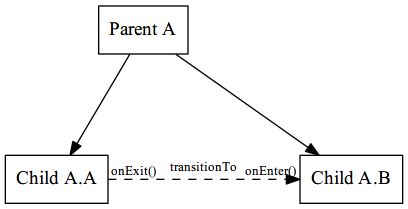
Also, you can setup conditions for your hook to execute. Every condition is evaluated just before promise is executed, if the condition returns false, promise won't be executed.
export default Ember.Route.extend({

  onEnter() {
    return [{
      condition: () => true,
      promise: new Promise(resolve => resolve())
    }];
  }

});
On nested routes, onExit hooks are executed in child-parent order whilst onEnter hooks are executed in parent-child order. So, for example, in the next figure,
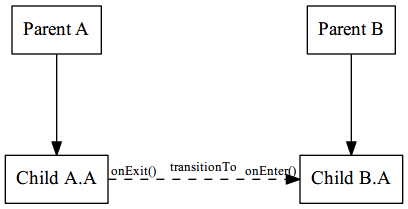
hooks, are executed as follows:
- onExit: Child A.A -> Parent A.
- onEnter: Parent B -> Child B.A.
Or, as follows:
- First, Child A.A, onExit method.
- Next, Parent A, onExit method.
- Next, Parent B, onEnter method.
- Last, Child B.A, onEnter method.
Every hook must return an array with objects with promise property. Optionally, a condition property can be used to define conditions for the object. This objects are known as chains.
Hooks onEnter and onExit, and properties promise and condition can be async functions.
export default Ember.Route.extend({

  async onEnter() {
    return [{
      condition: () => !this.get('fetched'),
      promise: async () => {
        const response = await this.fetch();

        this.set('fetched', true);
      }
    }];
  }

});
When a chain (condition or promise properties) returns a rejection, next chains on same hierarchy are not executed.
When a chain triggers a transition to another route, next chains on all hierarchies are not executed.
Extending routes can be handy to define some behaviour in order to set promise chains dependencies. On the next example, my-promise chain will only execute if promise-base chain is not going to be executed.
// File: base.js
export default Ember.Route.extend({

    async onEnter() {
      return [{
        name: 'promise-base',
        condition: () => this.get('shouldFetch'),
        promise: () => this.fetch()
      }];
    }

});

// File: my-route.js
export default BaseRoute.extend({

    async onEnter() {
      const chains = await this._super();

      return [{
        name: 'my-promise',
        condition: () => !chains[0].condition(),
        promise: () => this.myFetch()
      }].concat(chains);
    }

});
Contribute
If you want to contribute to this addon, please read the CONTRIBUTING.md.
Versioning
We use SemVer for versioning. For the versions available, see the tags on this repository.
Authors
See the list of contributors who participated in this project.
License
This project is licensed under the MIT License - see the LICENSE.md file for details