
eslint-plugin-harmony






A eslint config styles package that work across IDEs.
Design Principles
There are several configurations available in this package. Although they are different as they are designed for different programmers, here are the principles that they all follow:
- They are designed to be used by team
- Each team member can use one of the supported IDE
- The formatter available on each IDE should work with each configuration
- Code should look well and consistent on each IDE with folding
- so that when you stop by your team member's cube, the code looks the same.
- Thrive for easy to write (with the fewest keystrokes) while keeping the code clean
Supported IDE
- Visual Studio Code (1.20.0): https://code.visualstudio.com/
- phpStorm (2017.3.4): https://www.jetbrains.com/phpstorm/
- Atom (1.24.0): https://atom.io/
Requirements
- Node.js
^20.19.0 || ^22.13.0 || >=24— this package is ESM only - ESLint
>=8.57.0
Installation
npm install --save-dev eslint eslint-plugin-harmonyUsage
eslint.config.js (flat config) is the supported way to use this package on every
ESLint version it supports:
import { defineConfig } from 'eslint/config'
import harmony from 'eslint-plugin-harmony'

export default defineConfig([
  { files: ['**/*.js'], plugins: { harmony }, extends: ['harmony/recommended'] }
])
extends: ['harmony/<name>'] needs ESLint 9.23 or later, which falls back to the
flat/<name> entry of the plugin. On ESLint 8 and 9.22 and earlier, spread the
config instead — this works on every version:
import harmony from 'eslint-plugin-harmony'

export default [...harmony.configs['flat/recommended']]
The configs
extends name |
spread name | notes |
|---|---|---|
harmony/recommended |
harmony.configs['flat/recommended'] |
the JavaScript style |
harmony/latest |
harmony.configs['flat/latest'] |
recommended without the indentation rule |
harmony/es5 |
harmony.configs['flat/es5'] |
pins the language to ES5 |
harmony/es5-strict |
harmony.configs['flat/es5-strict'] |
ES5, plus semi and no trailing commas |
harmony/ts-recommended |
harmony.configs['flat/ts-recommended'] |
TypeScript |
harmony/ts-recommended-type-check |
harmony.configs['flat/ts-recommended-type-check'] |
TypeScript, type-aware rules |
harmony/ts-recommended-requiring-type-checking |
… | same, older name |
harmony/ts-recommended-cra |
… | Create React App variant |
harmony/ts-recommended-type-check-cra |
… | Create React App variant |
harmony/ts-prettier |
harmony.configs['flat/ts-prettier'] |
experimental; pair with eslint-config-prettier |
These configs are overlays
The eslintrc configs pull in eslint:recommended, plugin:@typescript-eslint/*
and prettier by name. Flat config has no string extends, so the flat configs
carry only the rules harmony itself sets and you compose the bases yourself —
harmony last, so its style wins:
import { defineConfig } from 'eslint/config'
import js from '@eslint/js'
import harmony from 'eslint-plugin-harmony'

export default defineConfig([
  js.configs.recommended,
  { files: ['**/*.js'], plugins: { harmony }, extends: ['harmony/recommended'] }
])
Two other deliberate differences from the eslintrc twins:
- The
ts-*flat configs apply to**/*.{ts,tsx,mts,cts}on their own. eslintrc left that to youroverrides.files. - No
ecmaVersionis pinned, except ines5andes5-strictwhere it is the point. The eslintrc configs pinned ES2018/ES2019, which in flat config would win over yours and turna?.binto a parsing error.
TypeScript
The ts-* flat configs set @typescript-eslint/* rules but do not register the
plugin or the parser — pinning a parser here would override the one your
typescript-eslint version installs. Compose them on top of
typescript-eslint, which supplies both:
import { defineConfig } from 'eslint/config'
import tseslint from 'typescript-eslint'
import harmony from 'eslint-plugin-harmony'

export default defineConfig([
  ...tseslint.configs.recommended,
  { files: ['**/*.ts', '**/*.tsx'], plugins: { harmony }, extends: ['harmony/ts-recommended'] }
])
For the type-aware configs, also give typescript-eslint your
languageOptions.parserOptions.project — harmony does not set it.
For harmony/ts-prettier, put eslint-config-prettier last so it turns the
formatting rules off again.
Legacy: eslintrc (ESLint 8 and 9 only)
ESLint 10 removed the eslintrc format.
.eslintrc.*files are not read there at all, andESLINT_USE_FLAT_CONFIG=falseno longer brings it back, soplugin:harmony/*cannot be used on ESLint 10. Move to the flat configs above.
The plugin:harmony/* configs are unchanged from earlier versions:
{
  "extends": ["plugin:harmony/recommended"],
  "overrides": [
    {
      "files": ["*.ts", "*.tsx"],
      "extends": ["plugin:harmony/ts-recommended"]
    }
  ]
}
Available: plugin:harmony/recommended, plugin:harmony/latest,
plugin:harmony/es5, plugin:harmony/es5-strict, plugin:harmony/ts-prettier,
plugin:harmony/ts-recommended, plugin:harmony/ts-recommended-type-check,
plugin:harmony/ts-recommended-cra, plugin:harmony/ts-recommended-type-check-cra.
For ts-recommended-type-check you still need to specify
parserOptions.project:
{
  "extends": ["plugin:harmony/recommended"],
  "overrides": [
    {
      "files": ["*.ts", "*.tsx"],
      "extends": ["plugin:harmony/ts-recommended-type-check"],
      "parserOptions": { "project": "tsconfig.json" }
    }
  ]
}
JetBrains IDE
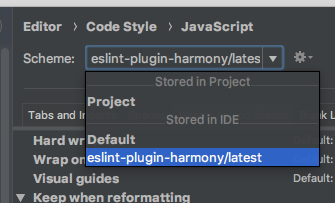
After you import the settings, you need to use them in the setting:
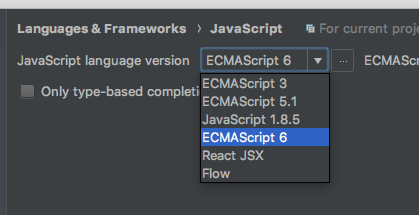
You also need to change your language version appropriately:
Contribute
pnpm i
pnpm bootstrap