
express-endpoints-collection
Description
This package provides easy to use helper for creating API endpoints in Express with TypeScript inference, validation and OpenAPI 3 schema out of the box.
No need to duplicate OpenAPI definitions in your codebase. Just define your API endpoints and automatically generate OpenAPI 3 schema.
You can configure exposed endpoints, request and response schemas, and validation rules.
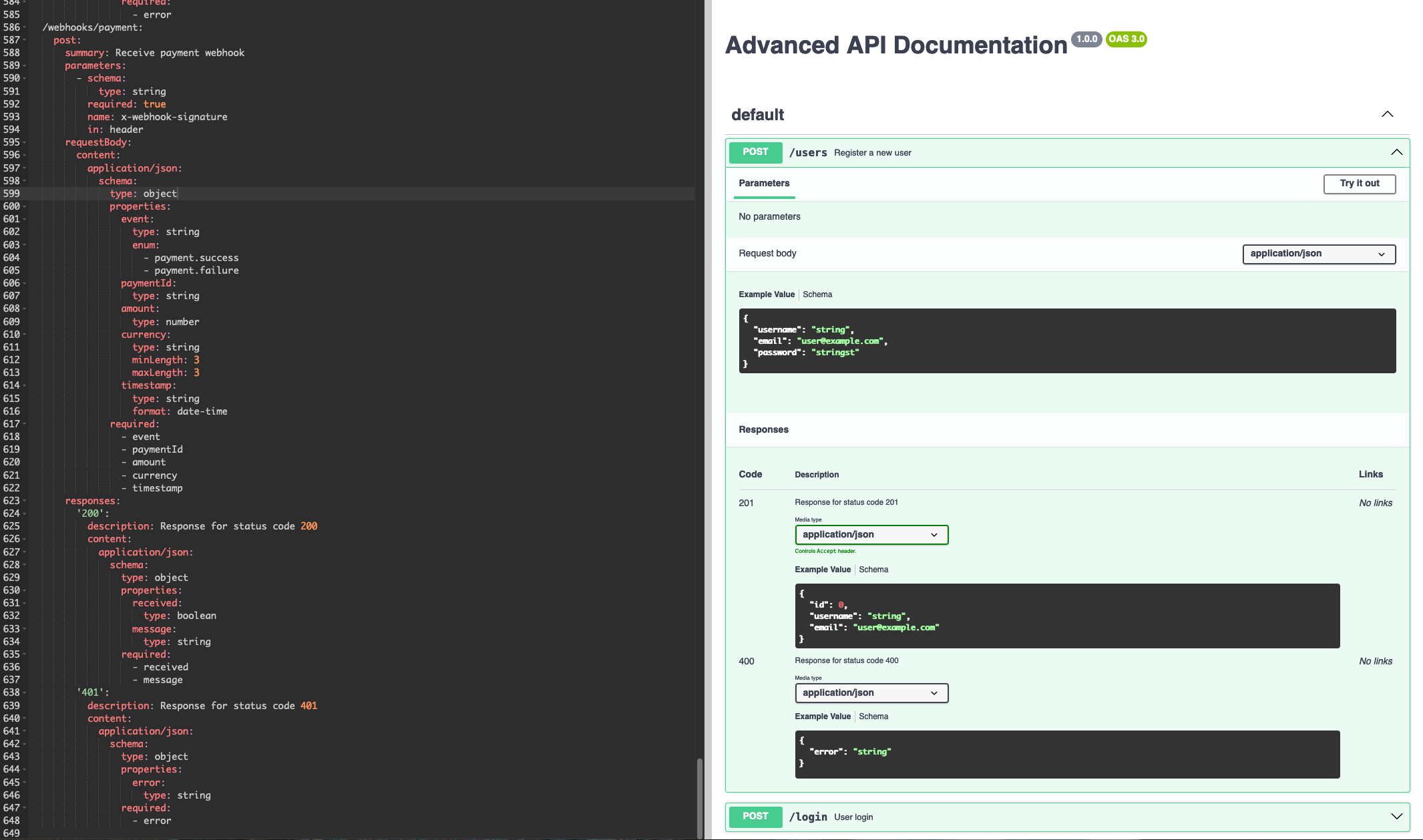
For support of zod v3 and express v4 use 1.0.28
Features
- Fully typed endpoints (TypeScript hints and checks) for Express v5
- Request body
- Response body
- Query parameters
- Path parameters
- Headers
- Automatic OpenAPI 3.0 schema generation
- Request and response validation using Zod v4
- Full middleware support
- Minimal setup
Installation
npm install express-endpoints-collection

# or

yarn add express-endpoints-collection

# or

pnpm add express-endpoints-collection
Usage
import express, { Express } from "express";
import bodyParser from "body-parser";
import { z } from "zod";
import { EndpointsCollection } from "express-endpoints-collection";
import { generateOpenAPI } from "express-endpoints-collection/generator";

// 1. Create express app
const app: Express = express();
app.use(bodyParser.json());

// 2. Create endpoints collection, this will store all your endpoints
const endpointsCollection = new EndpointsCollection();

// 3. Add new endpoint
endpointsCollection.post(
  "/add",
  {
    inputSchema: {
      body: z.object({
        a: z.number(),
        b: z.number(),
      }),
    },
    outputSchema: [
      {
        status: 200,
        body: z.object({
          result: z.number(),
        }),
      },
    ],
    summary: "Add two numbers",
  },
  // 4. req and res are fully typed!
  (req, res) => {
    const { a, b } = req.body;
    res.json({ result: a + b });
  },
);

// 5. Collection creates its own router, to use it just add it to your app
app.use(endpointsCollection.getRouter());

// 6. Expose OpenAPI 3 schema
app.get("/openapi", (req, res) => {
  res.setHeader("Content-Type", "text/yaml");
  res.send(
    generateOpenAPI({
      title: "Minimal demo",
      version: "1.0.0",
      endpoints: endpointsCollection.getEndpoints(),
      servers: ["http://localhost:3000"],
    }),
  );
});

// 7. Start the server and done!
app.listen(3000, () => {
  console.info(`Server is running on port http://localhost:3000`);
});
it will generate OpenAPI 3 definition as follow:
openapi: 3.0.0
info:
  title: Minimal demo
  version: 1.0.0
components:
  schemas: {}
  parameters: {}
paths:
  /add:
    post:
      summary: Add two numbers
      requestBody:
        content:
          application/json:
            schema:
              type: object
              properties:
                a:
                  type: number
                b:
                  type: number
              required:
                - a
                - b
      responses:
        "200":
          description: Response for status code 200
          content:
            application/json:
              schema:
                type: object
                properties:
                  result:
                    type: number
                required:
                  - result
or as JSON
{
  "openapi": "3.0.0",
  "info": {
    "title": "Minimal demo",
    "version": "1.0.0"
  },
  "components": {
    "schemas": {},
    "parameters": {}
  },
  "paths": {
    "/add": {
      "post": {
        "summary": "Add two numbers",
        "requestBody": {
          "content": {
            "application/json": {
              "schema": {
                "type": "object",
                "properties": {
                  "a": {
                    "type": "number"
                  },
                  "b": {
                    "type": "number"
                  }
                },
                "required": ["a", "b"]
              }
            }
          }
        },
        "responses": {
          "200": {
            "description": "Response for status code 200",
            "content": {
              "application/json": {
                "schema": {
                  "type": "object",
                  "properties": {
                    "result": {
                      "type": "number"
                    }
                  },
                  "required": ["result"]
                }
              }
            }
          }
        }
      }
    }
  }
}
Example
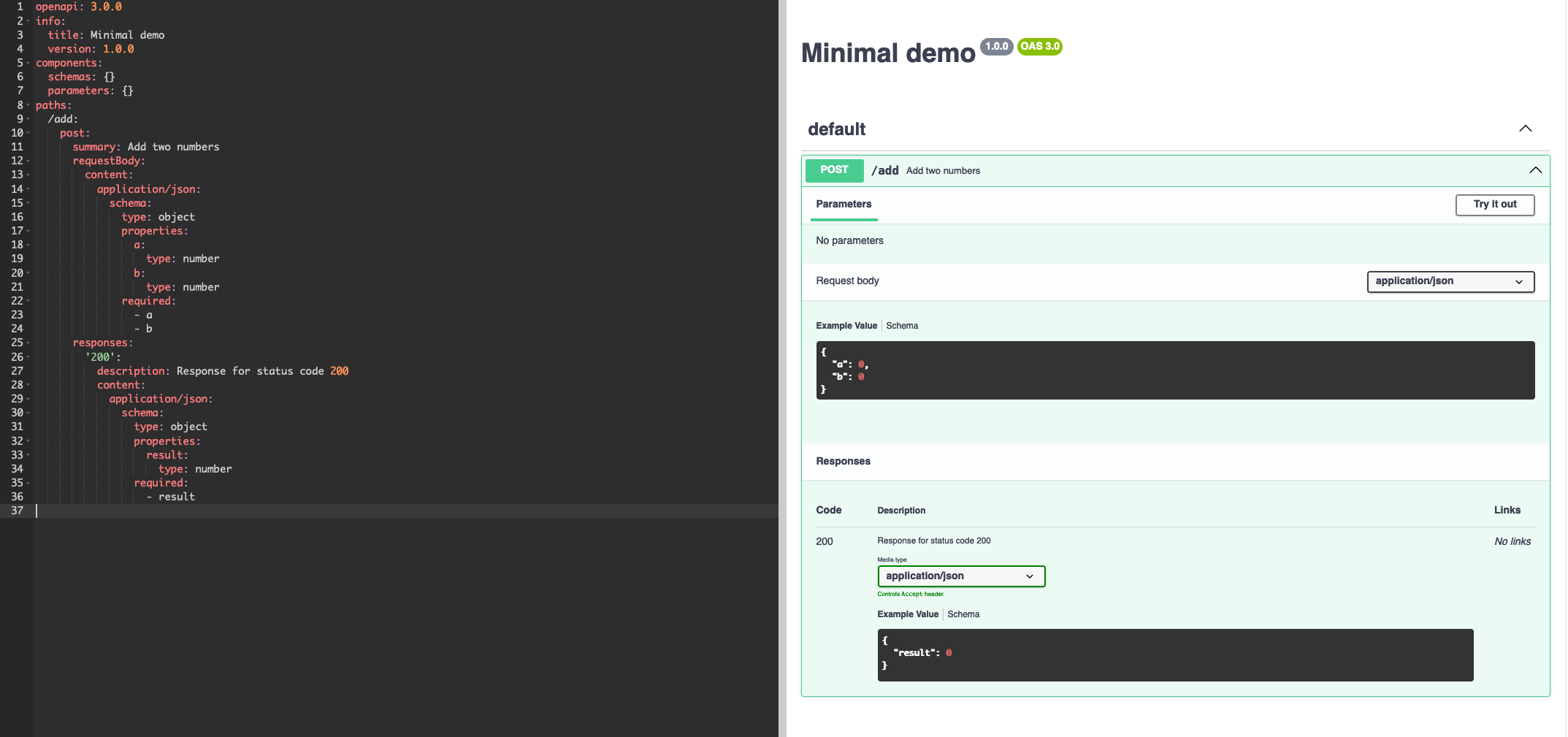
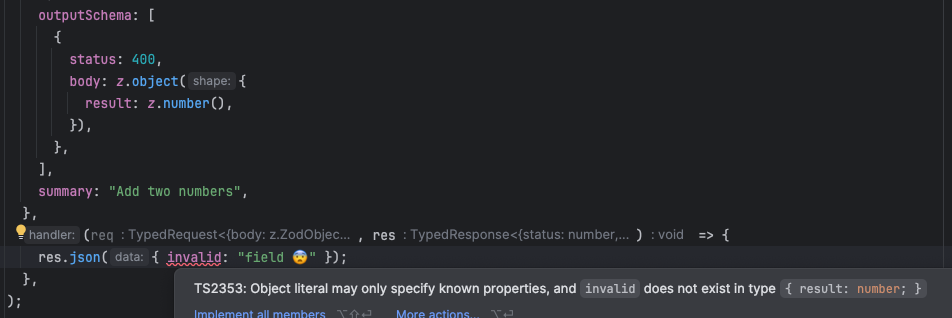
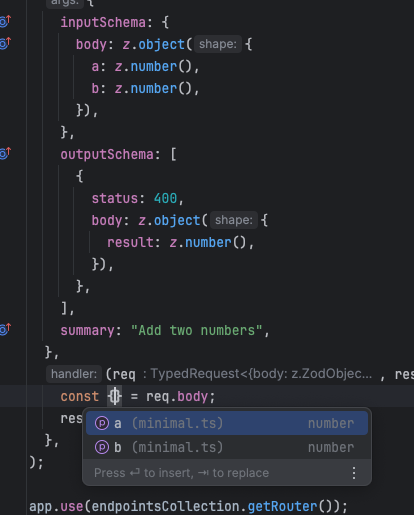
Type inference and checks:
Built-in middlewares
Import z from this package so request schemas use the same Zod instance the collection validates with.
import {
  defineMiddlewares,
  EndpointsCollection,
  z,
} from "express-endpoints-collection";

const api = defineMiddlewares({
  customErrorHandler: (_error, details) => ({
    error: "ValidationError",
    details,
  }),
  middlewares: {
    requestLogger: { enabled: true },
    jwt: { secret: process.env.JWT_SECRET ?? "dev-secret" },
    cache: { stdTTL: 60, checkperiod: 120 },
    rateLimit: { windowMs: 60_000, limit: 30 },
    errorHandler: { enabled: true },
  },
});

const shops = new EndpointsCollection({
  collectionPrefix: "/shops",
  ...api,
});

const account = new EndpointsCollection({
  collectionPrefix: "/account",
  ...api,
  middlewares: {
    ...api.middlewares,
    jwt: { ...api.middlewares.jwt, enabled: true },
  },
});

shops.get(
  "/",
  {
    outputSchema: [{ status: 200, body: z.object({ ok: z.boolean() }) }],
    middlewares: { cache: true, rateLimit: { limit: 10 } },
  },
  (_req, res) => {
    res.json({ ok: true });
  },
);
Collection jwt: { secret } with enabled omitted is settings only; routes stay open until they set jwt: true or a partial such as jwt: { required: false }. Collection enabled: true applies that middleware to every route unless the route sets false. The same rules apply to requestLogger, cache, rateLimit, and errorHandler. Per-route cache: true or rateLimit: { limit: 10 } still opt in when collection enabled is omitted.
Replacing jwt with { enabled: true } drops secret. Spread the preset first: jwt: { ...api.middlewares.jwt, enabled: true }.
Other middleware still goes on beforeInputValidation, afterInputValidation, or beforeResponse. A cache hit returns before beforeInputValidation, so that hook does not run for a stored response. A per-route checkperiod is ignored. stdTTL on a route is the TTL for that route's cache entries. Client options such as checkperiod belong on the collection.
License
This software is licensed under the GNU Affero General Public License v3.0. See LICENSE.
Anyone may use it under AGPLv3, including in a commercial product, if they comply with that license.
For a written license without AGPL copyleft, contact the author on GitHub. Until that agreement exists, AGPLv3 applies.