
Free Range <Div>s
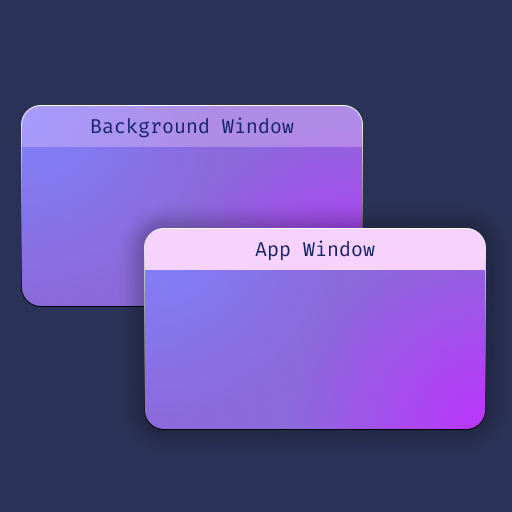
Have you ever wanted to build a web page that behaves like a desktop?
Think <div>s that behave like windows, with dragging and resizing that works the way you expect.
Or maybe you're building a workspace-style app, but need something less rigid than a Kanban board or tiling dashboard.
Or maybe you're making an avant-garde design for your personal website?
free-range-divs is for you.
What's in the box?
Currently it's two React components:
<Desktop>- Coordinates the child<FreeDiv>s. It's the sandbox for absolute positioning of the<FreeDiv>s.<FreeDiv>- A minimally-styled container that holds your component. You decide how your content should look.<FreeDiv>takes care of movement and resizing.
How do I install it?
> yarn add free-range-divsCan I see it in action?
Yep, have fun!
API
By example:
<Desktop width={1024} height={768}>
  <FreeDiv key="app-notepad">
    {({ isActive, titleProps }) => (
      <div className={`my-window ${isActive ? 'my-window--active' : ''}`}>
        <div className="my-window__title" {...titleProps}>
          notepad.exe - Hello World
        </div>
        <h1>Window contents.</h1>
      </div>
    )}
  </FreeDiv>
  <FreeDiv key="app-chrome">
    {({ isActive, titleProps }) => (
      <div className={`my-window ${isActive ? 'my-window--active' : ''}`}>
        <div className="my-window__title" {...titleProps}>
          chrome.exe - Messageboard
        </div>
        <p>Leave a message...</p>
      </div>
    )}
  </FreeDiv>
</Desktop>
.my-window {
background-color: white;
color: #888;
border: 2px solid #ddd;
height: calc(100% - 4px);
}
.my-window--active {
color: black;
}
.my-window__title {
background-color: #ddd;
padding: 12px;
white-space: nowrap;
overflow: hidden;
text-overflow: ellipsis;
}Each <FreeDiv> takes a render function, that receives:
isActive: Is this window the one currently on top?titleProps: Spread this on whichever element represents the area that initiates a window drag. Traditionally this is the title bar, but you can pass it to any part of your component.
The render function should return your component. In the example above I show returning bare DOM elements with a couple of custom classNames. But those are just for demo!
API - <FreeDiv> Only
Using the <Desktop> component is entirely optional! It provides tracking for which window among its children is "active". An active FreeDiv has a higher z-index than its siblings, and the isActive render prop is set to true.
If your app doesn't need to manage multiple <FreeDiv>s or if you're only interested in the drag/drop/resize functionality, <FreeDiv> can be used on its own. Note that the isActive prop passed to the render function never changes if there's no container <Desktop>!
Deployment
For my own notes, but also for any future contributors.
Steps:
- Merge all new features via PR.
- (Admin only)
pnpm version [major|minor|patch]on main branch. - (Admin only)
git push origin main - (Admin only)
git push origin tag [vN.N]
This will run the associated Github workflow to publish to NPM with trusted publishing.