
Inibase
A file-based & memory-efficient, serverless relational database with crash-atomic ACID: single-table DML + multi-table transactions — per-table writer locks, write-ahead journal + crash recovery, fsync-backed durability, and a
begin/commit/rollbacktransaction API (exact scope in Durability & crash safety).


Quick start · How it works · Durability · Benchmarks
Small footprint. Real benchmark results.
Inibase is a file-based TypeScript database designed for fast data access and low memory usage, with column selection, built-in caching, and optional gzip compression.
In the 100,000-record CMS benchmark, Inibase 3.7.0 with gzip used 1.64 MiB of allocated disk — 89.4% less than LevelDB and 98.7% less than SQLite. Reading two selected columns took 44.3 ms in the same workload.

Source: inicontent/benchmarks, median of three trials on Apple M5 with repetitive synthetic CMS content and full durability. The chart measures disk storage, not RAM. Results depend on the workload; indexed competitors were faster for key lookups.
Explore the full results · Read the methodology
Features
- Lightweight
- Minimalist (but powerful)
- 100% TypeScript
- Built for fast access Built-in caching and column projection
- ATOMIC Per-table writer locks, write-ahead journal + crash recovery, fsync-backed durability, and multi-table transactions (
begin/commit/rollback) for atomic cascades (exact scope below) - Built-in form validation (+unique values )
- Suitable for large data (tested with 4M records)
- Incremental updates Opt-in update log (
log: true) appends small frames instead of rewriting whole columns - Support Compression (using built-in nodejs zlib)
- Support Table Joins
- Memory-conscious design File-based storage and streaming reads
- Safe (no sql or javascript injections)
- Easy to use
- ... and much more
Usage
import Inibase from "inibase";
// const db = new Inibase("databaseName", ".", "es");
const db = new Inibase("databaseName");

// Get all items from "user" table
const users = await db.get("user");

// Read page 2 content
const users = await db.get("user", undefined, { page: 2, per_page: 15 });

// Get only required columns to improve speed
const users = await db.get("user", undefined, {
  columns: ["username", "address.street", "hobbies.name"],
});

// Get items from "user" table where "favoriteFoods" does not includes "Pizza" or "Burger"
const users = await db.get("user", { favoriteFoods: "![]Pizza,Burger" });
Enjoy using Inibase? Consider sponsoring us via PayPal
Your support helps us maintain and improve our services.
Thank you!
Install
<npm|pnpm|yarn|bun> install inibaseIf you're using Windows, the following Unix commands are required:
zcat,sed,gzip, andecho.To use the missing commands, you need to install additional tools:
- GnuWin32: Provides individual GNU utilities for Windows.
- Cygwin: Offers a full Unix-like environment for Windows.
Alternatively, consider using the Windows Subsystem for Linux (WSL) to run a Linux environment on Windows. Learn more here.
How it works?
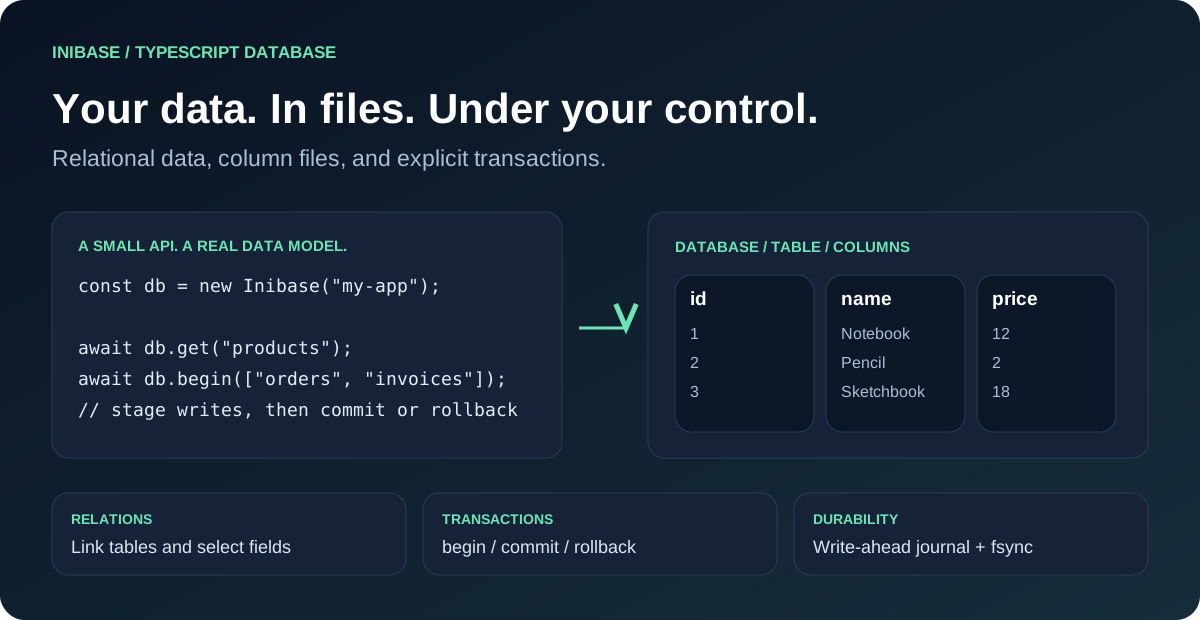
Inibase organizes data into databases, tables, and columns, each stored in separate files.
- POST: New data is appended to column files efficiently.
- GET: Data retrieval is optimized by reading files line-by-line.
- PUT: Updates are streamlined: on a plain table only the relevant column file is rewritten, while a table with the update log enabled appends a small frame instead.
- DELETE: Removes lines from column files for swift deletion.
This structure ensures efficient storage, retrieval, and updates, making our system scalable and high-performing for diverse datasets and applications.
Durability & crash safety
DML (post / put / delete / truncate) is crash-atomic per table. A logical operation spans many column files plus a pagination-metadata file; all of those files are committed as one journaled unit, so a table is never observed half-applied. Multi-table atomicity is available explicitly through the transaction API (
begin/commit/rollback, see below) — cascade deletes and multi-table writes are atomic inside a transaction, and best-effort without one.
How each property is provided
| Property | Mechanism |
|---|---|
| Atomicity | Write-ahead journal: one journal per table (.tmp/journal.jsonl) for single-table DML, plus a database journal (<db>/.tmp/journal.jsonl) that transactions append op entries to. Intent is fsynced before any live file changes; a commit marker is fsynced after publication. On crash: no commit marker → roll back (restore backups), commit present → roll forward (complete swaps, discard backups). Recovery runs automatically under the lock before any mutation/read. |
| Consistency | Schema validation + uniqueness enforcement happen before anything is written; every operation is atomic, so a table is never observed half-applied. |
| Isolation | One writer lock per table serializes every mutation (single-host and multi-host / NFS); a transaction holds the writer lock of every table it touches for its whole lifetime, plus a database lock to serialize transactions. Reads are lock-free with optimistic version-retry: each read snapshots the identity of every column + pagination file, and is re-run if anything changed mid-scan — a reader never sees torn rows. |
| Durability | Durability knob INIBASE_DURABILITY=full (default) fsyncs the temp file, the journal (begin/commit), and the affected directories (incl. shell sed/gzip temp paths and stream pipelines). DDL (create/update table, compression & prepend toggles) is fsynced too. INIBASE_DURABILITY=none skips every fsync while keeping the exact journal protocol — the data is process-crash safe (a crash leaves an in-flight journal that recovery rolls back or forward) but not power-loss safe, because the OS page cache can be lost. |
Commit-point ordering: the pagination metadata rename happens first (the atomic publication point — the row count flips in a single rename that lock-free readers observe), then column files are swapped live → backup + tmp → live.
Transactions (multi-table atomicity)
await db.begin(["orders", "invoices"]); // pre-lock tables in sorted order (deadlock-free)
try {
  await db.post("orders", order);
  await db.post("invoices", invoice);
  await db.commit(); // publish everything crash-atomically
} catch {
  await db.rollback(); // discard everything; no live file was touched
}- Semantics: mutations issued inside a transaction are staged — their
temps are fsynced and an
opentry appended to the database journal — but no live file changes untilcommit().commit()publishes every staged mutation (per table: pagination rename first, then column swaps) and ends with a single fsyncedcommitmarker, making the whole set atomic with respect to crashes and process kills.rollback()removes the temps and the journal without touching any live file. - Cascade: a
deleteinside a transaction cascades into referencing tables through the same journal, so the whole parent + children removal is atomic; a failure during the cascade aborts the transaction. - Rules & limits (v1):
- No read-your-writes: reads inside a transaction observe the last committed state, not staged writes.
- One mutation per table per transaction. A second post/put/delete on a
table already staged in the same transaction throws
INVALID_PARAMETERS(composing same-table writes would require read-your-writes). - DDL is not allowed inside a transaction (
createTable/updateTablethrowINVALID_PARAMETERS). beginwithout a table list locks tables on first touch, in first-touch order; list the tables up front to get sorted, cycle-free ordering.returnPostedDatainside a transaction returns the formatted staged rows (no joins);returnUpdatedDatainside a transaction throwsINVALID_PARAMETERS.- Transactions are excluded from structural lock-upgrade deadlocks, but two long transactions that touch overlapping tables can only deadlock in the first-touch-order case (pre-listing avoids it).
Scope & caveats
- Best-effort without a transaction. Cross-table cascade deletes outside a
transaction stay best-effort: referencing rows are removed after the
primary delete commits, and a crash in between can leave orphaned references.
Wrap them in
begin/commitfor atomicity. - NFS: lock files use
O_EXCLcreation, which is advisory on some NFS servers — two hosts may briefly both believe they hold a lock. Locks store{pid, host, startedAt}: a same-host owner that is provably dead (kill(pid, 0)fails) is stolen immediately; foreign/unknown owners fall back to the TTL (INIBASE_LOCK_TTL_MS, default60000). - fsync guarantees: durability assumes the OS/filesystem honours
fsync. Some disks and virtualized filesystems silently ignore it; directoryfsyncis unsupported on a few platforms (best-effort there).nonemode deliberately gives up power-loss durability — that is the whole point of the knob. - Cost: at
full, every mutation fsyncs the temp file, journal, and directories — expect noticeably slower hot-path writes than pre-durability builds (the benchmark comparesfullvsnoneside by side). The swap protocol also transiently holds temp + backup + live copies (~2–3× a column's size; worst case is aputwith nowhere— a full-table rewrite). - Cache (
.cache): entries are derived, rebuildable artifacts versioned by the row count; they detect staleness but never participate in the ACID guarantee. Non-fsync'd.
Run pnpm test:durability for the journal-recovery, multi-process writer,
live-reader and stale-lock test suite, pnpm test:transaction for the
transaction/cascade/crash-recovery suite, and pnpm benchmark:durability for
the full vs none throughput comparison.
Incremental update log
Opt a table into the append-only update log (on-disk format 2) to make put
cheap when a table is large but each update touches few rows:
await db.createTable("user", userTableSchema, { log: true });
// or migrate an existing table in place:
await db.updateTable("user", undefined, { log: true });- Writes.
putappends one length-prefixed,crc32-checked frame ({ id, cols, updatedAt }) toupdates.loginstead of rewriting column files, so the fast path is proportional to the number of updated rows rather than the table size.postanddeletestill rewrite the base columns. - Reads. Every read —
get, criteria,columns, sort, pagination, aggregates, and uniqueness checks — merges the log over the base columns, so results match an un-logged table. With an empty log the merge is a no-op. - Compaction.
await db.compact(tableName)folds the log into the base columns and resets it, returning the newbaseGen— ornullwhen there was nothing to fold. Compaction is crash-safe and semantically neutral: it only materializes already-acknowledged updates. It also runs automatically under backpressure so the overlay and log stay bounded (INIBASE_MAX_OVERLAY_RECORDS, default100000;INIBASE_MAX_LOG_BYTES, default 64 MiB); if the bound is hit and compaction cannot run, the write fails withMAINTENANCE_REQUIREDrather than growing without limit. - Requirements. The table must use the append layout (no
prepend) and a schema of simple top-level fields. Transactions, schema changes, and disabling the log on a log table throwMAINTENANCE_REQUIREDfor now (they need compaction rewiring, planned for 3.9). - On disk. A
.formatmarker recordsformat,baseGen, and the compatibility contract (minReader);updates.logholds the frames. A table with no.formatis legacy format 1 and behaves exactly as before. - Downgrade safety. A reader older than the log format ignores the marker
and would silently serve stale base columns. The marker's
minReadermakes a conforming engine refuse such a table withUNSUPPORTED_FORMATinstead of mis-reading it.
Backups. A raw directory copy is only a valid backup when writes are quiesced or the copy is a filesystem snapshot. Copying a logged table during writes can capture base columns paired with a mismatched
updates.log/baseGen. Runningcompactfirst does not remove the need to quiesce writes.
Inibase CLI
npx inibase -p <databaseFolderPath>
# by default it will diplay a list of available commands (or type 'help')
Examples
Tables
Config
interface {
  compression: boolean;
  cache: boolean;
  prepend: boolean;
  decodeID: boolean;
}
Schema
Types
interface Field {
  id: number; // position in the schema; 0 = the row id, -1 = createdAt, -2 = updatedAt
  key: string;
  required?: boolean;
  unique?: boolean | string; // boolean for simple uniqueness, string for grouped uniqueness
  regex?: RegExp; // Regular expression for custom validation
  type:
    | "string"
    | "number"
    | "boolean"
    | "date"
    | "email"
    | "url"
    | "password"
    | "html"
    | "ip"
    | "json"
    | "id";
}

interface TableField {
  id: number;
  key: string;
  required?: boolean;
  unique?: boolean | string; // Supports uniqueness constraints
  type: "table";
  table: string;
}

interface ArrayField {
  id: number;
  key: string;
  required?: boolean;
  unique?: boolean | string; // Supports uniqueness constraints
  type: "array";
  children: string | string[]; // Can be a single type or an array of types
}

interface ObjectOrArrayOfObjectsField {
  id: number;
  key: string;
  required?: boolean;
  unique?: boolean | string; // Supports uniqueness constraints
  regex?: RegExp; // For validation of object-level keys
  type: "object" | "array";
  children: Schema; // Nested schema for objects or arrays
}
Unique
The
uniqueproperty ensures that the values of a specific column or a group of columns are unique within a table. This property can be either a boolean or a string.
- Boolean: Setting
unique: trueensures that the values in the column are unique across all rows.- String: By setting a string value, you can group columns to enforce a combined uniqueness constraint. This is useful when you need to ensure that a combination of values across multiple fields is unique.
Examples
Unique Column
{
  key: "email",
  type: "string",
  required: true,
  unique: true, // Ensures all email values are unique
}
Group of Unique Columns
[
  {
    key: "firstName",
    type: "string",
    required: true,
    unique: "nameGroup", // Part of "nameGroup" uniqueness
  },
  {
    key: "lastName",
    type: "string",
    required: true,
    unique: "nameGroup", // Part of "nameGroup" uniqueness
  },
]
Create Table
import Inibase from "inibase";
const db = new Inibase("/databaseName");

const userTableConfig = {
  compression: true,
  cache: true,
  prepend: false,
  decodeID: false
}

const userTableSchema = [
  {
    key: "username",
    type: "string",
    required: true,
  },
  {
    key: "email",
    type: "string",
    required: true,
  },
  {
    key: "age",
    type: "number",
    required: true,
  },
  {
    key: "isActive",
    type: "boolean",
    // required: false
  },
  {
    key: "hobbies",
    type: "array",
    children: [
      {
        key: "name",
        type: "string",
        // required: false
      },
      {
        key: "level",
        type: "string",
        // required: false
      },
    ],
  },
  {
    key: "favoriteFoods",
    type: "array",
    children: "string",
    // required: false
  },
  {
    key: "address",
    type: "object",
    children: [
      {
        key: "street",
        type: "string",
        // required: false
      },
      {
        key: "city",
        type: "string",
        // required: false
      },
      {
        key: "country",
        type: "string",
        // required: false
      },
    ],
  },
];

await db.createTable("user", userTableSchema, userTableConfig);
decodeIDBy default a row's
idis stored as a number but only ever handed back as an encrypted (aes-256-cbc, hex) string, so ids can't be guessed by incrementing. SetdecodeID: trueand the id is exposed as the plain number everywhere —getrows,get/put/deleteby id, relation lookups, and the id returned bypost:const db = new Inibase("/databaseName"); await db.createTable("item", [{ key: "name", type: "string" }], { decodeID: true, }); const id = await db.post("item", { name: "widget" }); // => 1 (a number) await db.get("item", 1); // works with the raw numberSo
postreturns anumberon adecodeIDtable and an encryptedstringon every other table — in TypeScript its return type isstring | number((string | number)[]for a bulk post). Encrypted ids stay valid inputs on adecodeIDtable too, so existing clients that round-trip an id keep working either way.decodeIDcan be toggled later withupdateTable.Update Table
Change Name
import Inibase from "inibase";
const db = new Inibase("/databaseName");

// this will change table name also in joined tables
await db.updateTable("user", undefined, {name: "userV2"});
Update field
import Inibase from "inibase";
import { setField } from "inibase/utils";

const db = new Inibase("/databaseName");

const userTableSchema = (await db.getTable("user")).schema;
setField("username", userTableSchema, {key: "fullName"});
await db.updateTable("user", newUserTableSchema);
Remove field
import Inibase from "inibase";
import { unsetField } from "inibase/utils";

const db = new Inibase("/databaseName");

const userTableSchema = (await db.getTable("user")).schema;
unsetField("fullName", userTableSchema);
await db.updateTable("user", newUserTableSchema);
Join Tables
import Inibase from "inibase";
const db = new Inibase("/databaseName");

const productTableSchema = [
  {
    key: "title",
    type: "string",
    required: true,
  },
  {
    key: "price",
    type: "number",
  },
  {
    key: "createdBy",
    type: "table",
    table: "user",
    required: true,
  },
];

await db.createTable("product", productTableSchema);

const productTableData = [
  {
    title: "Product 1",
    price: 16,
    createdBy: "1d88385d4b1581f8fb059334dec30f4c",
  },
  {
    title: "Product 2",
    price: 10,
    createdBy: "5011c230aa44481bf7e8dcfe0710474f",
  },
];

const product = await db.post("product", productTableData);
// [
//   {
//     "id": "1d88385d4b1581f8fb059334dec30f4c",
//     "title": "Product 1",
//     "price": 16,
//     "createdBy": {
//       "id": "1d88385d4b1581f8fb059334dec30f4c",
//       "username": "user1",
//       "email": "user1@example.com",
//       ...
//     }
//   },
//   {
//     "id": "5011c230aa44481bf7e8dcfe0710474f",
//     "title": "Product 2",
//     "price": 10,
//     "createdBy": {
//       "id": "5011c230aa44481bf7e8dcfe0710474f",
//       "username": "user2",
//       ...
//     }
//   }
// ]
Methods
POST
import Inibase from "inibase";
const db = new Inibase("/databaseName");

const userTableData = [
  {
    username: "user1",
    email: "user1@example.com",
    age: 25,
    isActive: true,
    hobbies: [
      { name: "Reading", level: "Intermediate" },
      { name: "Cooking", level: "Beginner" },
    ],
    favoriteFoods: ["Pizza", "Sushi", "Chocolate"],
    address: {
      street: "123 Main St",
      city: "Exampleville",
      country: "Sampleland",
    },
  },
  {
    username: "user2",
    email: "user2@example.com",
    age: 30,
    isActive: false,
    hobbies: [
      { name: "Gardening", level: "Advanced" },
      { name: "Photography", level: "Intermediate" },
    ],
    favoriteFoods: ["Burgers", null, "Salad"],
    address: {
      street: "456 Elm Rd",
      city: "Testington",
      country: "Demo Country",
    },
  },
];

const users = await db.post("user", userTableData);
// [
//   {
//     "id": "1d88385d4b1581f8fb059334dec30f4c",
//     "username": "user1",
//     "email": "user1@example.com",
//     "age": 25,
//     "isActive": true,
//     "hobbies": {
//       "name": [
//         "Reading",
//         "Cooking"
//       ],
//       "level": [
//         "Intermediate",
//         "Beginner"
//       ]
//     },
//     "favoriteFoods": [
//       "Pizza",
//       "Sushi",
//       "Chocolate"
//     ],
//     "address": {
//       "street": "123 Main St",
//       "city": "Exampleville",
//       "country": "Sampleland"
//     }
//   },
//   {
//     "id": "5011c230aa44481bf7e8dcfe0710474f",
//     "username": "user2",
//     ...
//   },
//   ...
// ]
GET
GET by ID
import Inibase from "inibase";
const db = new Inibase("/databaseName");

const user = await db.get("user", "1d88385d4b1581f8fb059334dec30f4c");
// {
//     "id": "1d88385d4b1581f8fb059334dec30f4c",
//     "username": "user1",
//     "email": "user1@example.com",
//     "age": 25,
//     "isActive": true,
//     "hobbies": {
//         "name": [
//             "Reading",
//             "Cooking"
//         ],
//         "level": [
//             "Intermediate",
//             "Beginner"
//         ]
//     },
//     "favoriteFoods": [
//         "Pizza",
//         "Sushi",
//         "Chocolate"
//     ],
//     "address": {
//         "street": "123 Main St",
//         "city": "Exampleville",
//         "country": "Sampleland"
//     }
// }
GET by criteria
import Inibase from "inibase";
const db = new Inibase("/databaseName");

const users = await db.get("user", { favoriteFoods: "[]Pizza" });
// [
//   {
//     "id": "1d88385d4b1581f8fb059334dec30f4c",
//     "username": "user1",
//     "email": "user1@example.com",
//     "age": 25,
//     "isActive": true,
//     "hobbies": {
//       "name": [
//         "Reading",
//         "Cooking"
//       ],
//       "level": [
//         "Intermediate",
//         "Beginner"
//       ]
//     },
//     "favoriteFoods": [
//       "Pizza",
//       "Sushi",
//       "Chocolate"
//     ],
//     "address": {
//       "street": "123 Main St",
//       "city": "Exampleville",
//       "country": "Sampleland"
//     }
//   },
//   ...
// ]
GET with columns
import Inibase from "inibase";
const db = new Inibase("/databaseName");

// Get all "user" columns except "username" & "address.street"
const users = await db.get("user", undefined, {
  columns: ["!username", "!address.street"],
});

// Columns accept dotted nested paths (e.g. "address.street" => nested field)
const nested = await db.get("user", undefined, {
  columns: ["address.street", "hobbies.name"],
});

// Get all columns explicitly with the "*" wildcard
const all = await db.get("user", undefined, {
  columns: ["*"],
});
PUT
import Inibase from "inibase";
const db = new Inibase("/databaseName");

// set "isActive" to "false" for all items in table "user"
await db.put("user", { isActive: false });

// set "isActive" to "true" for specific "user" by id
await db.put("user", { isActive: false }, "1d88385d4b1581f8fb059334dec30f4c");

// set "isActive" to "true" in table "user" by criteria (where "isActive" is equal to "true")
await db.put("user", { isActive: false }, { isActive: true });
DELETE
import Inibase from "inibase";
const db = new Inibase("/databaseName");

// delete all items in "user" table
await db.delete("user");

// delete a specific "user" by id
await db.put("user", "1d88385d4b1581f8fb059334dec30f4c");

// delete "user" by criteria (where "isActive" is equal to "false")
await db.put("user", { isActive: false });
SUM
import Inibase from "inibase";
const db = new Inibase("/databaseName");

// get the sum of column "age" in "user" table
await db.sum("user", "age");

// get the sum of column "age" by criteria (where "isActive" is equal to "false") in "user" table
await db.sum("user", ["age", ...], { isActive: false });

// aggregate over the elements of an array-of-objects column: `items.quantity`
// counts every element of every row's `items` (single array path per call;
// `product` here is an *element* predicate, matching elements whose linked
// product is the given row)
await db.sum("orders", "items.quantity", { product: "id-of-widget" }, { nested: true });

// multiple columns share one predicate and return a record
await db.sum(
	"orders",
	["items.quantity", "items.lineTotal"],
	{ product: "id-of-widget" },
	{ nested: true },
); // => { "items.quantity": 5, "items.lineTotal": 1295 }
MAX
import Inibase from "inibase";
const db = new Inibase("/databaseName");

// get the biggest number of column "age" in "user" table
await db.max("user", "age");

// get the biggest number of column "age" by criteria (where "isActive" is equal to "false") in "user" table
await db.max("user", ["age", ...], { isActive: false });
MIN
import Inibase from "inibase";
const db = new Inibase("/databaseName");

// get the smallest number of column "age" in "user" table
await db.min("user", "age");

// get the smallest number of column "age" by criteria (where "isActive" is equal to "false") in "user" table
await db.min("user", ["age", ...], { isActive: false });
SORT
import Inibase from "inibase";
const db = new Inibase("/databaseName");

// order users by the age column
await db.get("user", undefined, { sort: "age" });

// order users by the age and username columns
await db.get("user", undefined, { sort: ["age", "username"] });
await db.get("user", undefined, { sort: {age: -1, username: "asc"} });
Computed Fields
A
computedcolumn is derived from other columns of the same row whenever the row is written (post/put, including backfill onupdateTable). The result is stored in its own column file like any other value, so reads and criteria queries work unchanged.const db = new Inibase("/databaseName"); await db.createTable("product", [ { key: "name", type: "string" }, { key: "price", type: "number" }, ]); // ids are assigned per table in schema order: customer=1, status=2, items=3, // product=4, quantity=5, unitPriceCents=6, totalCents=7, totalCentsLive=8 await db.createTable("orders", [ { key: "customer", type: "string" }, { key: "status", type: "number" }, { key: "items", type: "array", children: [ { key: "product", type: "table", table: "product" }, { key: "quantity", type: "number" }, { key: "unitPriceCents", type: "number" }, ], }, { key: "totalCents", type: "number", computed: "sum(5 * 6)" }, // quantity x unitPriceCents { key: "totalCentsLive", type: "number", computed: "sum(5 * 4.2)" }, // quantity x product.price ]); const posted = await db.post( "orders", { customer: "acme", status: 1, items: [ { product: "id-of-widget", quantity: 2, unitPriceCents: 250 }, { product: "id-of-gadget", quantity: 1, unitPriceCents: 100 }, ], }, undefined, true, ); // posted.totalCents === 600 (2*250 + 1*100) // posted.totalCentsLive === 847 (2*price(widget) + 1*price(gadget))A child of an array-of-objects column can itself be computed. It is evaluated once per element and stored in its own element cell, so it works like any other element child in queries — including
sumwith{ nested: true }:// ids are assigned per table in schema order: status=1, items=2, product=3, // quantity=4, lineTotal=5 await db.createTable("orders", [ { key: "status", type: "number" }, { key: "items", type: "array", children: [ { key: "product", type: "table", table: "product" }, { key: "quantity", type: "number" }, // lineTotal = quantity × product.price ("4 * 3.2": id 4 = quantity, // hop to the linked product's price, id 2 in `product`) { key: "lineTotal", type: "number", computed: "4 * 3.2" }, ], }, ]); const posted = await db.post( "orders", { status: 1, items: [ { product: "id-of-widget", quantity: 2 }, { product: "id-of-gadget", quantity: 1 }, ], }, undefined, true, ); // posted.items[0].lineTotal === 2 * price(widget) // posted.items[1].lineTotal === 1 * price(gadget) // per-product revenue without touching the line items yourself: await db.sum("orders", "items.lineTotal", { product: "id-of-widget" }, { nested: true });A top-level computed may read a computed child through a helper (
{ key: "totalCents", type: "number", computed: "sum(5)" }) — the children are derived first, in dependency order.Element expressions (child computeds).
- Every reference must be a sibling child of the same array root — top-level columns and siblings of a different array are rejected (
COMPUTED_FIELD_INVALID_TARGET), and helpers (sum/avg/...) are not allowed inside element expressions.- Link hops are supported (
4 * 3.2= siblingquantity× linkedproduct.price).- The element field must be
type: "number".- A missing/null operand in an element evaluates to
0for that element (it never aborts the write and never stores null). A genuinely dangling link (a link to a missing row) still raisesCOMPUTED_FIELD_DANGLING_LINK, same as top-level computeds.updateTablebackfills element cells when a child computed is added or its expression changes; the backfill resolves links from the persisted element values and follows the same missing-operand →0rule.Expression language (v1, integer-only).
- Operators:
+-*/%;( )for grouping. Multiplication binds tighter than addition (1 * 2 + 3=(1*2) + 3).- Helpers:
sumcountavgminmaxiterate an array-of-objects found by the ids inside the parentheses (sum(5 * 6)= quantity x unit-price per item).- Paths:
id ("." id)*where.hops through atablelink (4.2= price of the linked product row).- Integers only: there are no decimal literals —
.is the path separator, so3.14is a path (field 3, hopfield 14), never 3.14. Fractional results are written as division:314 / 100→ 3.14.- A bare integer that matches a field id in the table's schema is that field (ids are locative); a bare integer that matches no field is a literal.
Rules & limits (v1).
- Computed fields cannot be
required,uniqueorregex(aCOMPUTED_FIELD_CONFLICTerror).- Computed values are never user-settable (
post/putwith a computed key throwsCOMPUTED_FIELD_SETTABLE).- Values are evaluated at write time and persisted; compiled expressions are stored as
{ expr, ast }in the schema. The AST carries only field ids, so renaming a column (or its linked table's columns) never retargets an expression.updateTablebackfills existing rows when a computed field is added or its expression changes; a backfill that fails (missing dependency, arithmetic error, dangling link) aborts the migration and leaves the schema untouched.- Aggregates:
sumover no values is0,countis the element count, andavg/min/maxover no values throwCOMPUTED_FIELD_ARITHMETIC.- Non-numeric operands, division/modulo by zero, and arithmetic over missing (null) values throw
COMPUTED_FIELD_ARITHMETIC; a link to a missing row throwsCOMPUTED_FIELD_DANGLING_LINK. (Element expressions are the one exception: a missing/null operand there evaluates that element to0— see above.)- Child computeds (see above) extend the v1 rules to element fields of array-of-objects columns; array contents stay reachable from top-level helpers. Only one level of nesting is computed.
- Missing link values make a single bare path evaluate to null (stored empty).
Benchmark
Bulk
| 10 | 100 | 1000 | |
|---|---|---|---|
| POST | 11 ms (0.66 mb) | 5 ms (1.02 mb) | 24 ms (1.44 mb) |
| GET | 29 ms (2.86 mb) | 24 ms (2.81 mb) | 36 ms (0.89 mb) |
| PUT | 21 ms (2.68 mb) | 16 ms (2.90 mb) | 12 ms (0.63 mb) |
| DELETE | 14 ms (0.82 mb) | 13 ms (0.84 mb) | 2 ms (0.17 mb) |
Single
| 10 | 100 | 1000 | |
|---|---|---|---|
| POST | 45 ms (1.07 mb) | 12 ms (0.52 mb) | 11 ms (0.37 mb) |
| GET | 200 ms (2.15 mb) | 192 ms (2.72 mb) | 190 ms (2.31 mb) |
| PUT | 49 ms (3.22 mb) | 17 ms (2.98 mb) | 17 ms (3.06 mb) |
| DELETE | 118 ms (0.59 mb) | 113 ms (0.51 mb) | 103 ms (3.14 mb) |
Default testing uses a table with username, email, and password fields, ensuring password encryption is included in the process
Results are measured on a default table plus dedicated tables withprepend,compression, anddecodeIDconfigs enabled
To run benchmarks, install typescript & tsx globally and runbenchmarkby default bulk, for single usebenchmark --single|-sThe numbers above were measured before always-on fsync + write-ahead journaling landed (they no longer reflect current hot-path write costs). Run
pnpm benchmark:durabilityfor the crash-atomic numbers.
Computed fields
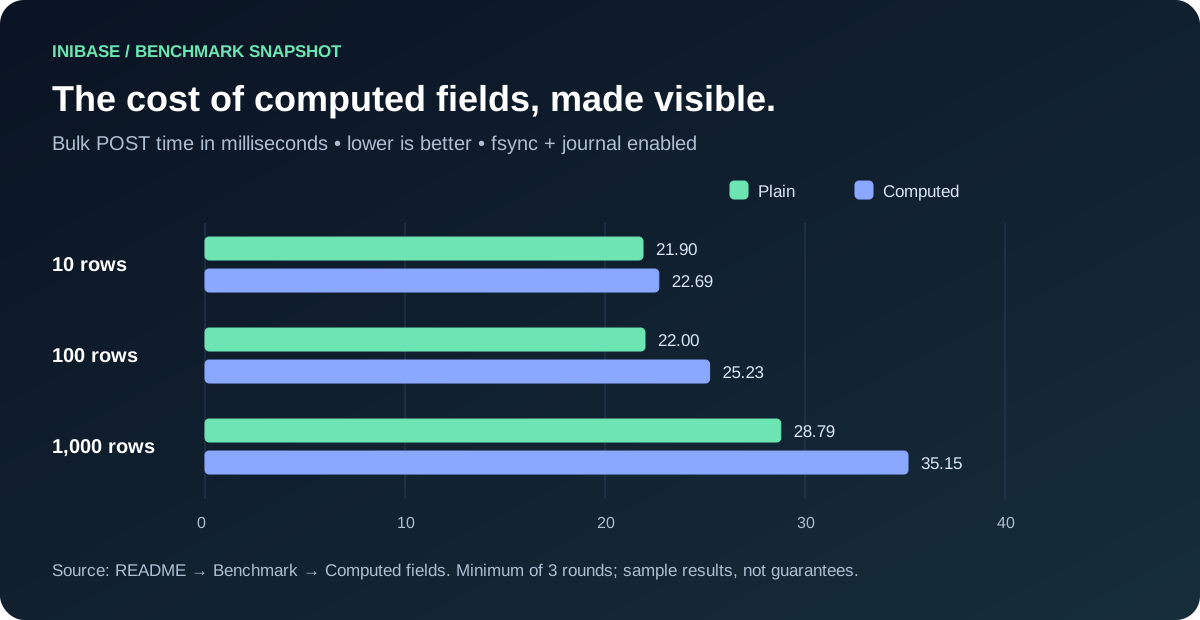
Charted from the results below, with fsync and journaling enabled. These are recorded sample measurements, not a new benchmark run; hardware and version were not recorded with this table.
Write-time evaluation cost (helpers sum(3 * 4), avg(4), min(4), max(4), count(3) over an items array with 3 lines, plus an arithmetic field itemTotal × (314 / 100)), compared against the identical table without computed fields:
| rows | POST bulk (plain / computed) | POST single (plain / computed) | PUT recompute (plain / computed) |
|---|---|---|---|
| 10 | 21.90 / 22.69 ms | 25.24 / 26.80 ms | 23.10 / 37.07 ms |
| 100 | 22.00 / 25.23 ms | 25.24 / 26.80 ms | 22.16 / 40.00 ms |
| 1000 | 28.79 / 35.15 ms | 25.24 / 26.80 ms | 21.01 / 45.05 ms |
Min of 3 rounds (fsync + journal on); the plain-vs-computed delta is the pure expression-evaluation cost (~6 ms/1000 rows of helpers on POST, more on
PUTbecause every matched row is recomputed). GET all (1110 rows): 11.44 / 15.90 ms — computed values are stored in real column files, so reads never evaluate; the gap is the larger column count to scan. Runpnpm benchmark:computedto reproduce.
Link-heavy: shared product catalog with batched link-hop reads. Every order's line items reference a shared 20-row catalog; totalCentsLive = sum(quantity, product.price) follows one link hop per line item. The engine batches the hops across the whole post: each batch resolves at most one read per distinct (table, column, id) triple (here: catalogSize=20 product rows) instead of one full row-level read per line item (2000 reads for 1000 orders × 2 items):
| rows | POST bulk (lk link hop) |
|---|---|
| 10 | 42.29 ms |
| 100 | 47.76 ms |
| 1000 | 59.46 ms |
Shared 20-row catalog (10/100/1000 orders × 2 line items). Without batching every line item re-reads its product row; with it each batch resolves ≤ catalogSize distinct linked rows once (deduplicated across every line item and every order of the batch) and re-evaluates against the warm in-memory cache. A dangling link anywhere in the batch still rejects the whole post (
COMPUTED_FIELD_DANGLING_LINK). HTTP-request bound, not disk-bound: the cost scales with the number of distinct linked rows the catalog actually has, not with line-item count.
Roadmap
- Actions:
- GET:
- Pagination
- Criteria
- Columns
- Sort
- POST
- PUT
- DELETE
- SUM
- MAX
- MIN
- GET:
- Schema supported types:
- String
- Number
- Boolean
- Date
- Url
- Table
- Object
- Array
- Password
- IP
- HTML
- Id
- JSON
- TO-DO:
- Use new Map() instead of Object
- Ability to search in JSON fields
- Re-check used exec functions
- Use smart caching (based on N° of queries)
- Commenting the code
- Add Backup feature (generate a tar.gz)
- Add Custom field validation property to schema (using RegEx?)
- Features:
- Encryption
- Data Compression
- Caching System
- Computed fields (v1 id-only expression language)
- Suggest new feature +