
Linked Data Fetch: a HTTP client for RDF resources

Fetch Linked Data documents within your browser, from the command line, or from your NodeJS script.
npm install -g ldfetchIn order to use it as a library, you can leave out the -g.
Features
Supports these features over standard fetch:
- Sets an accept header for negotiating an RDF serialization
- Parses a wide variety of RDF serializations, each through its own dedicated streaming parser: rdf-parser-ts (Turtle, TriG, N-Triples, N-Quads, RDF 1.2, RDF Message Logs) by Pieter Colpaert, jsonld-streaming-parser, rdfa-streaming-parser and microdata-rdf-streaming-parser (all three run together and merged for HTML, so a page's RDFa attributes, Microdata attributes, and any embedded
<script type="application/ld+json">blocks all contribute triples), and rdfxml-streaming-parser, all by Ruben Taelman, shaclc-parse by Jesse Wright for SHACL Compact syntax, and rdfjs-jelly for the compact binary Jelly-RDF format (requires Node.js >=24; lazily loaded, so older Node versions are unaffected unless you actually fetch Jelly-RDF content) - Returns the Triples/Quads containing the data in the RDFJS triple representation
- Returns the URL of the document after redirects
- Returns and streams any prefixes/namespaces declared by the source document (Turtle/TriG, SHACL Compact syntax, Jelly-RDF), in addition to any registered with
addPrefix - Groups RDF Message-framed sources (Turtle/TriG "-messages" versions, and Jelly-RDF, which is inherently message-framed) into
response.messages, and emits amessageevent per message as it's parsed -- progressively, as each message completes, not only once the whole source has been read - Emits events for:
request,response,redirect,cache-hit,cache-miss,quad,prefix,messageandparsed--quadfires per parsed triple, so you can consume results as they stream in instead of waiting for the whole document
Try it live in the playground, which fetches and streams any Linked Data document straight in your browser, with optional JSON-LD framing.
Features for the NodeJS framework in specific:
- Automatically follows redirects
- Able to be configured with HTTP caching
- Able to limit the amount of concurrent requests and schedule these
Features for the Command Line:
- Writes data on any URL in TriG on stdout by default; pass
--format nquadsor--format json-ldfor N-Quads or JSON-LD instead - Streams that output as the source is being downloaded and parsed, rather than waiting for the whole thing -- so a multi-gigabyte RDF Message log starts printing triples immediately instead of after a full download (formats without an incremental parser -- JSON-LD, RDF/XML, HTML, SHACL Compact -- are still buffered internally;
--frame,--predicatesand--format json-ldalso require the whole response and fall back to buffering) - Round-trips an RDF Message-framed source (see Features above) as a proper RDF Message Log:
--format trig/nquadskeep theVERSION/MESSAGE(or@version/@message) delimiters, including empty messages;--format json-ldinstead writes newline-delimited JSON-LD (NDJSON-LD), one JSON object per message, with{}for an empty one - Extra features to automatically follow links (see
ldfetch --helpafternpm install -g ldfetch)
How to use it
Command line
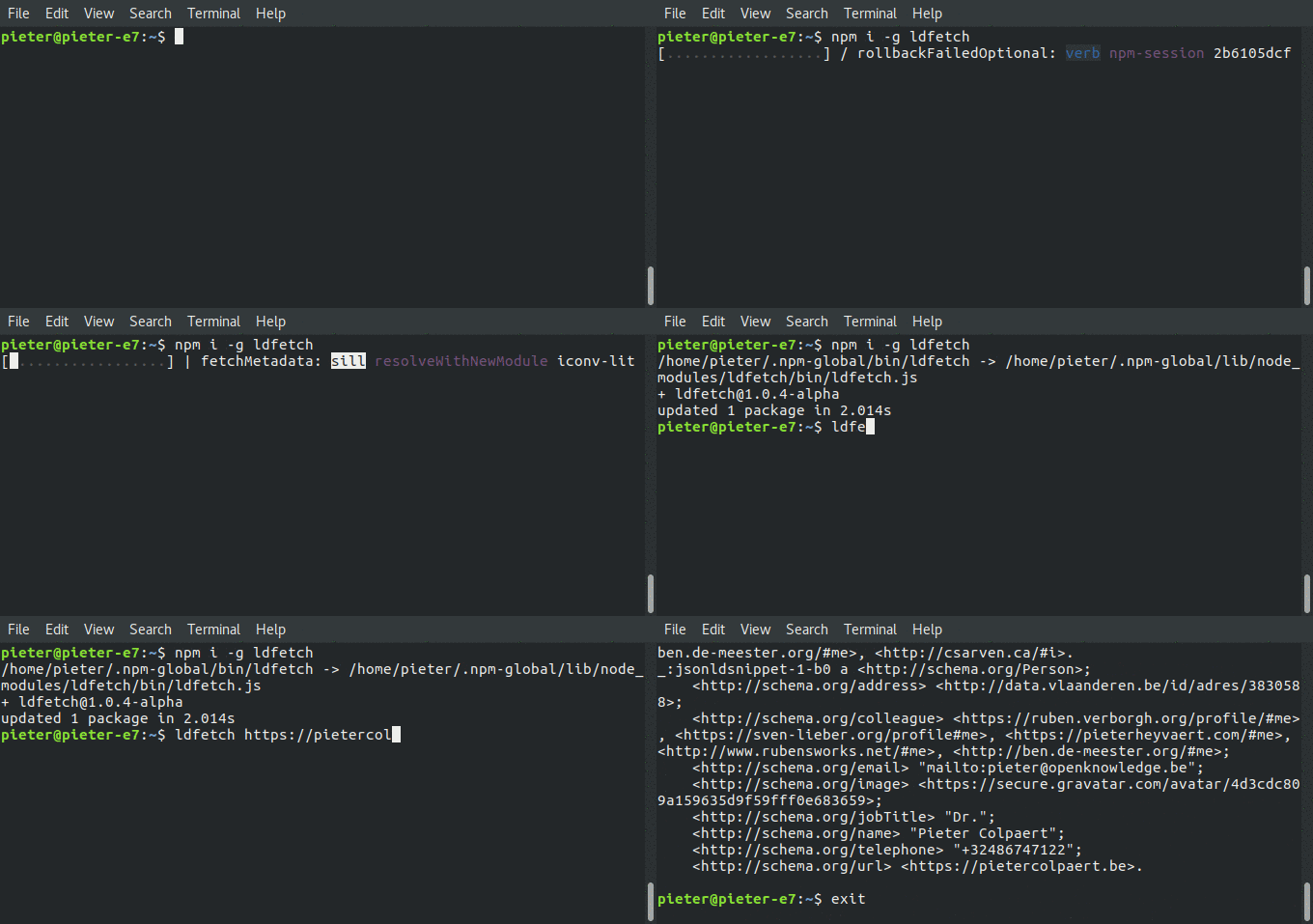
You can also use JSON-LD framing from the CLI: ldfetch https://pietercolpaert.be/ --frame {} to return a JSON-LD object complying to your frame. This applies to the whole graph as one document, so it always buffers, regardless of --format or RDF Message framing.
By default, only http:// and https:// URLs are fetched. Pass --local-files to also allow file:// URLs, e.g. ldfetch --local-files file:///path/to/data.ttl (disabled by default for security; only use with trusted input).
For full, well tested and modular SPARQL or GraphQL Web Querying, we refer to the Comunica project.
Browser
And using esbuild you can compile it for browser purposes:
npm run build<script src="dist/main.js"></script>
<script>
let fetcher = new window.ldfetch();
let main = async function () {
let objects = await fetcher.get('https://staging.api.irail.be/graph/').then(response => {
//LDFetch also exposes a frame function that can be used on the triples
//See https://json-ld.org/spec/latest/json-ld-framing/
return fetcher.frame(response.triples, {'@graph':{}});
});
console.log(objects);
}
try {
main();
} catch (e) {
console.error(e);
}
</script>NodeJS
A small example fetching the next page of a paged collection and returning the url
  let ldfetch = require('../lib/ldfetch.js');
  try {
    let url = 'https://staging.api.irail.be/graph/';
    let fetch = new ldfetch({}); //options: allow to add more headers if needed
    let response = await fetch.get(url);
    for (let i = 0; i < response.triples.length; i ++) {
      let triple = response.triples[i];
      if (triple.subject.value === response.url && triple.predicate.value === 'http://www.w3.org/ns/hydra/core#next') {
        console.error('The next page is: ', triple.object.value);
      }
    }
    fetch.frame(response.triples, {'http://www.w3.org/ns/hydra/core#next': {}}).then(object => {
      console.error('Or you can also use the JSON-LD frame functionality to get what you want in a JS object', object);
    });
  } catch (e) {
    console.error(e);
  }
If HTTP requests with specific headers are needed, the options object may be used by defining an object inside of it, named headers containing HTTP header names and values.
The response object will look like this:
{
  "responseCode": 200,
  "triples": [{},{},{}],
  "prefixes": {"foaf": "http://xmlns.com/foaf/0.1/"},
  "messages": [],
  "url": "https://{url after redirects}"
}
prefixes merges what you registered with addPrefix and whatever the source document declares itself. messages is only populated for RDF Message-framed sources (see Features above) -- each entry is the array of quads belonging to one message.
Streaming large sources with getStream
For sources too large to hold in memory (the CLI uses this internally, see Features above), getStream never accumulates triples/messages at all -- consume quad/message/prefix events on the fetcher as they arrive instead:
let fetch = new ldfetch({});
fetch.on('quad', quad => console.log(quad));
fetch.on('message', quadsInMessage => console.log('message with', quadsInMessage.length, 'quads'));
let response = await fetch.getStream('https://example.org/huge-rdf-message-log.nt');
console.log('done, saw prefixes:', response.prefixes);
Only content types with a genuine incremental parser (Turtle, TriG, N-Triples, N-Quads and Jelly-RDF) actually stream this way; anything else (JSON-LD, RDF/XML, HTML, SHACL Compact) is buffered internally from the same connection and parsed as usual, still without a triples/messages array in the resolved response -- only available in the Node.js version, not in the browser bundle.
For a message-framed source, every quad event also carries the RDF Message it belongs to as a second argument (undefined for an ordinary quad): fetch.on('quad', (quad, messageCounter) => { ... }). This is what lets a consumer write RDF Message Log-shaped output quad by quad instead of waiting for a whole message: rdf-writer-ts's writer.addQuad({ quad, messageCounter }) form writes the VERSION/MESSAGE delimiters itself, filling in empty messages from gaps in the counter, exactly like the CLI's default output does.
messageToJsonLd(quads) converts one RDF Message's quads into a JSON-LD "data message" per the NDJSON-LD RDF Message Log format -- the empty message becomes {}, a single-subject message unwraps to that subject's plain object, and anything else keeps the @graph wrapper:
fetch.on('message', quadsInMessage => console.log(JSON.stringify(fetch.messageToJsonLd(quadsInMessage))));License and copyright
This library was developed by Pieter Colpaert and contributors. The source code is available under an MIT license.