license-badger v0.21.1
license-badger






(see also licenses for dev. deps.)


license-badger does not currently support badge-creation for pnpm or Yarn
projects. It also currently requires a package-lock.json file. See the
FAQ.
Build a badge indicating the licenses of your project's dependencies (dependencies, devDependencies, whitelist-bundled devDependencies, and/or your project's own license).
Here's a sample badge (see below on the format):

You can also opt to only show non-empty types:

License selections
This project allows licenses to be selected in several different manners.
Current license checking tools typically only allow checking dependencies or
devDependencies, or they allow checking selected packages without transitive
dependencies. This project allows you to check specific selected packages but
with their transitive dependencies.
You can also create a badge which combines whitelisted licenses (or all
devDependencies) with the licenses in dependencies.
The following section. gives more detail on the types and which can be combined.
Your own license (packageJson)
This option if set will check the license within the package.json pointed
to by packagePath (possibly also using name and version), where
packagePath defaults to the current working directory.
This option can be combined with any of the options.
Those wishing for all of dependencies (production)
This option gathers license data from all dependencies in package.json
and can be combined with any of the options.
Note that if you do not want to check a licenseInfoPath and only want
dependencies checked, you need to specify an empty string for
licenseInfoPath.
Those wishing for all devDependencies (allDevelopment)
This option gathers license data from all devDependencies in package.json
and can be combined with the production option. licenseInfoPath will
not be used if this is set.
Those wishing a subset of devDependencies (licenseInfoPath)
Projects may wish to bring over third-party dependencies into their final distribution files and/or repo via a copy routine (e.g., one run upon dependency updates).
This license selection type is done through the argument licenseInfoPath
pointing to a JSON file (recommended as licenseInfo.json at project root)
with an array bundledRootPackages property indicating the devDependencies
that are bundled. It can be combined with production but allDevelopment
will override this setting and include all devDependencies instead.
This whitelist will determine which of your top-level devDependencies
you are bundling and uses this information to build a badge
showing the license types within your distribution, including those packages'
transitive dependencies (not including your own project's license) and
sorted by permissiveness (see below for more permissiveness degrees).
Projects may use this selection type to take advantage of npm versioning,
but instead of only deploying to clients that have the capability to install
dependencies, they may wish to deploy to Github-based hosting services
(such as Github Pages) which normally wouldn't bring in node_modules yet
can host static files copied into a repository which can be viewed in
browsers.
Other current solutions may not be desired because a project may not wish to be forced to either:
- include all of
node_modulesand use actualbundledDependencies, creating a potentially very large repository - use the likes of rollup-plugin-license (though see to-do below which might combine the functionalities) to grab licenses while pulling in modules during a bundling routine (as useful as this can be), perhaps because the project wishes instead for their source to be usable within a live ESM browser version for rapid debugging/development which has no need of a bundling step or which has a bundling step but is not used for all files such as an online demo.
Those already having a list of licenses
Though this option is only recommended for tools and such because one might
otherwise miss transitive dependencies (dependencies of your dependencies)
that should also be included. But if you are sure you know the complete list,
including transitive dependencies, you can use the option completePackageList,
a Map of package names (only available in the programmatic interface).
Notes on license categories
Adopts helpful categories of npm-consider (now a part of a separate and maintained license-types project):
"publicDomain", "permissive", "weaklyProtective", "protective", "networkProtective", "useProtective", "modifyProtective", and "uncategorized". We also add "unlicensed" (which is copyrighted or otherwise explicitly against reuse--rather than merely being currently unspecified), "custom" (for "SEE LICENSE IN") and "missing".
It might be worth bearing in mind that "public domain" is a reference to specific licenses which seek to enforce that general principle (otherwise, the principle of public domain does not automatically apply world-wide), so this should make sense as the first category.
It might also be worth noting that these categories are only rough and items in the same category do not substitute for one another, e.g., different "permissive" licenses still have certain requirements. And even the same license may have different needs depending on the project for which it was used--e.g., the need to preserve the copyright notice for each package and/or file.
Installation
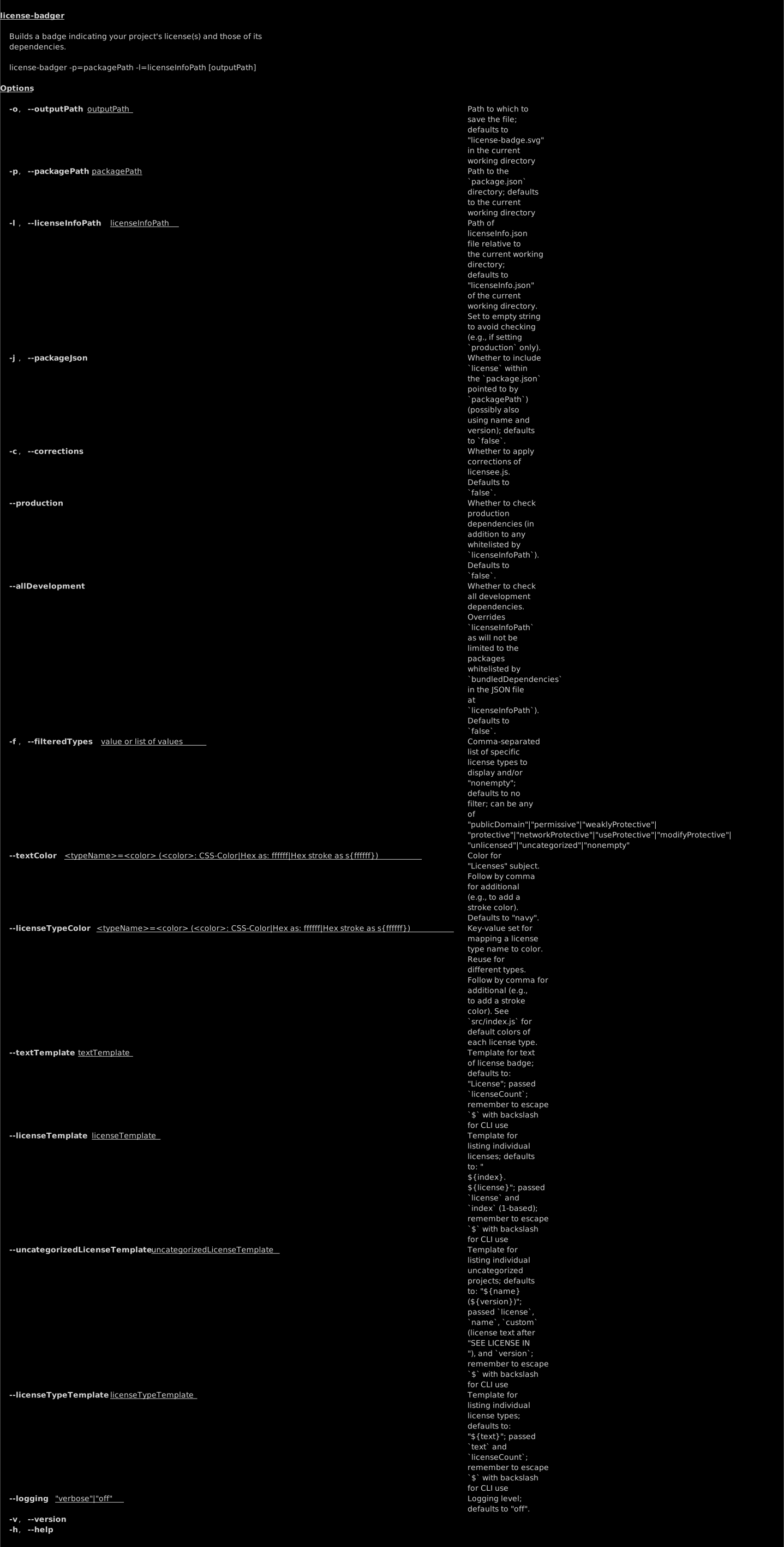
npm i -g license-badgerUsage
license-badger --filteredTypes=weaklyProtective,protective --textTemplate \"License types (\\${licenseCount})\" --licenseTypeColor networkProtective=blue,s{white} -l test/fixtures/licenseInfo.json test.svgIt is recommended you add this to a package.json prepare script so that you have the
latest info reflected upon adding new dependencies (or use a
prepublishOnly script if only wishing to update for releases).
There is also a helper which only takes one argument and returns:
get-license-type "license expression"CLI
Tips
You may wish to use the likes of @hkdobrev/run-if-changed (with husky)
so as to check for package.json/package-lock.json changes and run
license-badger to ensure it is being built against the latest dependencies
(and/or devDependencies). (The package is also useful for ensuring your
local installation is auto-updated to reflect your project's latest package
lock.)
See also
- eslint-formatter-badger - Locally created badges indicating linting results (as run against your project and/or your dependencies)
- filesize-badger - Locally created badges indicating file size (also buildable as part of Rollup routine)
- mocha-badge-generator - Locally created badges for Mocha test results
- coveradge - Locally-created badges for nyc/istanbul coverage
Development
Some npm commands (npm audit fix) might auto-add items to the dependencies,
but if you use such a command, be sure to undo the change (and run tests to be
sure).
FAQ
- Why was a lock file (currently
package-lock.json) required?
Due to deprecation
by npm and lack of support by yarn or pnpm, we needed to replace the
_requiredBy property which we were using to detect devDependencies (though
we might be able to just avoid it since devDep. detection was intended to
check all anyways). See to-do below.
Immediate to-dos
- We might see about iterating through
package.jsondevDependenciesand trace dependency chains ourselves to restore ability to avoidpackage-lock.json(as long asnode_modulesstructure was not changed like withpnpm);npm ls --json --parseable --long --unicode --prod/--dev? - If not changing to iterate solely through
node_modules, we should support pnpm and yarn; need@pnpm/listforlicensee.jsreplacement for pnpm (for reading subpackages and obtaining license metadata); for Yarn, need https://github.com/nodeca/js-yaml/issues/62 due to Yarn currently building ayarn.lock(at least against this repo) which cannot be read by that parser. - Get
getLicenseTypeto stop treating AND as potentially getting stricter one (though each license is different, at least with "permissive" or "public domain" which could normally submit to the other type). Originally filed https://github.com/delfrrr/npm-consider/pull/26, but now handling internally. May even have problem with "OR" per this issue, though this seems due to an outdated dep.
To-dos
- Provide export for convenient use with
rollup-plugin-license,
building our
completePackageListmap option as itstemplateoption is called:
// UNTESTED
import getLicenseType from 'license-badger/src/getLicenseType.js';

const licenseMap = new Map();

const rollupConfig = {
  plugins: [
    license({
      thirdParty: {
        output: {
          template (dependencies) {
            dependencies.forEach((dependency) => {
              const types = getLicenseType(dependency.license);
              types.forEach((type) => {
                const set = licenseMap.has(type)
                  ? licenseMap.get(type)
                  : new Set();
                set.add(dependency.license);
                licenseMap.set(type, set);
              });
            });
          }
        }
      }
    }),
    // Making plugin here on the fly, but should expose to API
    (() => {
      return {
        name: 'license-badger',
        buildEnd () {
          licenseBadger({
            licenseInfoPath: '',
            completePackageList: licenseMap,
            textColor: 'orange,s{blue}'
          });
        }
      };
    })()
  ],
  input: '...',
  output: {
    //
  }
};

export default rollupConfig;- Get to work with Git submodules
- Ability to normalize an AND/OR license, e.g.,
(MIT OR (MIT OR GPL-3.0)),(MIT AND (MIT AND GPL-3.0)), or(MIT AND (MIT OR GPL-3.0)); use for overwriting oflicensementioned above and for feeding current license and other licenses for license badge creation. - Add Rollup plugin that can ovewrite
bundledRootPackagesinlicenseInfoPath/licenseInfo.json; might adapt rollup-plugin-license - Process
licenseeInfo.jsonfilesByLicenseto optionally overwritelicenseinpackage.json - Extract jsdoc iterator from
eslint-plugin-jsdocto own repo and use to search for@licensewithin files so as to be able to overwritefilesByLicensewith dynamic info - Generate reports (MD, HTML, JSON, CLI) creating a
bundledPackagesByLicense(and repeatingfilesByLicenseinfo), and usinglicenseeInfo.json'sbundledRootPackages(and optionallydefault)- Change the badge-making itself into a reporter, so can be optional,
in case just want to get at aggregated license type +
licenseeinfo, e.g., to list on command line - Use
unapproved,nonApproved, and especiallymanuallyCorrectedinfo in reports so users can know whether to report. - Link to issue tracker and/or search of issue tracker for "license", so users can easily see if filed/discussed, at least for those missing, manually corrected, etc.
- Along the lines of https://www.gnu.org/software/librejs/free-your-javascript.html#step3/
https://www.gnu.org/licenses/javascript-labels.html, might advertise
permissiveness of JS (to a browser add-on which could indicate the
license type(s) automatically). (Would also be nice to settle on a
means of advertising the server-side licenses in use behind a site
as well as info on how to get source.). Could make this as a reporter
which builds the necessary code (probably caching a static copy for
performance reasons)--i.e., build a JS web labels table (being sure
to link to it).
- Might alternatively provide
<link/a rel>mechanism to point to apackage.jsonfile. (Besides being easier to convert this code base to work in this manner, would be useful to have a formal mechanism for finding other meta-data and source code.) Might have separate<link>orrelto distinguish between a package with just JS code and server code?
- Might alternatively provide
- Change the badge-making itself into a reporter, so can be optional,
in case just want to get at aggregated license type +
- See about using license-checker for more detection opportunities (e.g., README and License file); see also https://github.com/davglass/license-checker/issues/225 to make this easier on our end.
- Utilize
es-file-traverseto be able to list licenses for files actually in use.
3 years ago
3 years ago
3 years ago
5 years ago
5 years ago
6 years ago
6 years ago
6 years ago
6 years ago
6 years ago
6 years ago
6 years ago
6 years ago
6 years ago
6 years ago
6 years ago
6 years ago
6 years ago
6 years ago
6 years ago
6 years ago
6 years ago
6 years ago
6 years ago
6 years ago
6 years ago
6 years ago
6 years ago
6 years ago
6 years ago
6 years ago
6 years ago
6 years ago
6 years ago
6 years ago
6 years ago
6 years ago
6 years ago