
node-notifier 


Send native desktop notifications from Node.js on macOS, Windows and Linux.
Uses Notification Center on macOS, Toasts on Windows 8+ (taskbar balloons on older
Windows) and notify-send on Linux, with Growl as a fallback.
Works with Electron.

Install
npm install node-notifierRequires Node.js 22.22+, 24.15+ or 26+. The package is ES modules only, but
require('node-notifier') still works through Node's require(esm) support.
TypeScript types are included, so @types/node-notifier is no longer needed
(uninstall it if you have it). Each notifier has its own options type, e.g.
NotificationCenterNotification or NotifySendNotification.
CLI
Need notifications from the terminal or a shell script? Use node-notifier-cli, no install needed:
npx node-notifier-cli -t "Hello" -m "My message"See the node-notifier-cli README for all options.
Usage
import notifier from 'node-notifier';

notifier.notify('Message');

notifier.notify(
  {
    title: 'My notification',
    message: 'Hello, there!',
    icon: '/absolute/path/to/icon.png', // Not supported on macOS or balloons
    sound: true,
    actions: ['OK', 'Cancel'] // Waits for the user (macOS, Windows, Linux)
  },
  (error, response, metadata) => {
    // metadata.activationType, and metadata.activationValue for actions and replies
  }
);

notifier.on('click', (notifierObject, options, event) => {});
notifier.on('timeout', (notifierObject, options) => {});
The default notifier picks the right notifier for your platform (see the
decision flow). Options that a platform doesn't support are
ignored. To tune options per platform, use a notifier directly:
import {
  NotificationCenter, // macOS
  WindowsToaster, // Windows 8+
  WindowsBalloon, // Windows < 8
  NotifySend, // Linux
  Growl
} from 'node-notifier';

new NotifySend(options).notify(notification, callback);
Requirements
- macOS: 10.14 or newer.
- Windows: 8 or newer for Toasts. Earlier versions use taskbar balloons.
- Linux:
notify-send(libnotify-binon Debian/Ubuntu). - Other: Growl running.
NotificationCenter (macOS)
Wraps the bundled terminal-notifier 3.0.0
(universal binary for Intel and Apple silicon). Other terminal-notifier flags can be
passed as options, e.g. -group becomes { group: 'id' }.
import { NotificationCenter } from 'node-notifier';

const notifier = new NotificationCenter({
  withFallback: false, // Use Growl on macOS < 10.14
  customPath: undefined // Path to your own terminal-notifier binary
});

notifier.notify(
  {
    title: undefined,
    subtitle: undefined,
    message: undefined,
    sound: false, // true ('Bottle') or a name: Basso, Blow, Bottle, Frog, Funk, Glass, Hero, Morse, Ping, Pop, Purr, Sosumi, Submarine, Tink
    contentImage: undefined, // Absolute path to a local image
    open: undefined, // URL to open on click
    group: undefined, // Notifications in the same group replace each other
    actions: undefined, // String | Array<String>. Action buttons
    reply: false, // Boolean | String. Adds a text field, a string is used as placeholder
    timeout: 10, // Seconds to wait for actions/reply, or false to wait forever
    wait: false // Shorthand for timeout: 5
  },
  (error, response, metadata) => {}
);- Only notifications with
actionsorreplywait for the user. Others call the callback right away and emit noclickortimeoutevents. metadata.activationTypeiscontentsClicked,actionClicked,replied,closedortimeout.- A waiting notification keeps your process alive. Call
notifier.clearAll()to stop waiting on all notifications from that instance. iconis not supported. macOS always shows the icon of the sending app. For a custom icon, buildterminal-notifierwith your icon (make icon ICON=logo.png APP_NAME=my-tool) and pointcustomPathto it.- macOS asks for notification permission the first time a notification is sent.
See example/macInput.ts for actions and reply.
WindowsToaster (Windows 8+)
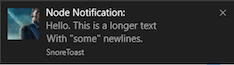
Uses SnoreToast.
import { WindowsToaster } from 'node-notifier';

const notifier = new WindowsToaster({
  withFallback: false, // Use balloons on Windows < 8
  customPath: undefined // Path to your own SnoreToast.exe
});

notifier.notify(
  {
    title: undefined,
    message: undefined, // Required unless `remove` is set
    icon: undefined, // Absolute path to a PNG, max 1024×1024 px and 200 KB
    sound: false, // true, or a Windows sound such as 'Notification.Mail'
    actions: undefined, // Array<String>. Action buttons
    appID: undefined, // Your app's ID. Without it the toast shows "SnoreToast"
    id: undefined, // Number. ID to use with `remove`
    remove: undefined, // Number. ID of a notification to close
    duration: undefined, // 'short' (~7s, default) or 'long' (~25s)
    install: undefined, // Creates a Start menu shortcut for `appID`
    application: undefined // Executable to start when clicked after node-notifier stopped listening
  },
  (error, response, metadata) => {}
);- Set
appIDto the ID your app registered at install (e.g.com.squirrel.your.appwith Squirrel). Otherwise the toast shows "SnoreToast". - Toasts always wait for the user.
waitandtimeoutdon't change how long a toast is shown, useduration. After that it stays in the Action Center. - Choosing an action emits an event named after the lower-cased label. See
example/toaster-with-actions.ts. - On 32-bit Windows the bundled SnoreToast is 0.7.0:
durationis ignored, and clicks with a customappIDaren't reported. UsecustomPathwith a newer SnoreToast to get both. - No toasts? Check that banners are enabled for the app under Settings › System › Notifications.
WindowsBalloon (Windows < 8)
Uses notifu.
import { WindowsBalloon } from 'node-notifier';

new WindowsBalloon({ withFallback: false, customPath: undefined }).notify(
  {
    title: undefined,
    message: undefined,
    sound: false,
    time: 5000, // Milliseconds to show the balloon
    wait: false,
    type: 'info' // info | warn | error
  },
  (error, response) => {}
);
NotifySend (Linux)
import { NotifySend } from 'node-notifier';

new NotifySend().notify(
  {
    title: 'Foo',
    message: 'Hello World',
    icon: '/absolute/path/to/icon.png',
    timeout: 10, // Seconds before the notification expires
    actions: undefined, // String | Array<String>. Requires notify-send 0.7.10+
    transient: false, // Don't keep it in the notification history
    'app-name': 'node-notifier',
    urgency: undefined, // low | normal | critical
    category: undefined,
    hint: undefined
  },
  (error, response, metadata) => {}
);- Only notifications with
actionswait for the user. Choosing an action emitsclickwith the label inmetadata.activationValue, running out of time emitstimeout. Seeexample/notify-send-actions.ts. actionsneeds libnotify 0.7.10+ (e.g. Ubuntu 24.04, Debian 12) and a notification daemon that supports actions.- See
notify-send(1)for all flags.
Growl
import fs from 'node:fs';
import { Growl } from 'node-notifier';

new Growl({ name: 'My App', host: 'localhost', port: 23053 }).notify({
  title: 'Foo',
  message: 'Hello World',
  icon: fs.readFileSync('/path/to/icon.png'),
  sticky: false
});
See growly for more options.
Common issues
WSL
Under WSL, notifications are shown in Windows. To use Linux notifications instead (with an X server and a notification daemon), start the process with:
NODE_NOTIFIER_WSL_NOTIFIER=linux node app.jsIt is read when node-notifier is imported, so setting process.env later has no
effect. You can also use NotifySend directly.
Windows can only show icons from a Windows drive. An icon on a mounted drive
(e.g. /mnt/c/Users/me/icon.png) is converted to its Windows path, other icons are
skipped. If you copied the package without keeping file permissions, run
chmod +x on the .exe files in vendor/.
Cron, PM2 and services
Notifications are shown on the desktop of the logged-in user, so the process must run as that user while they are logged in.
Linux: cron and some process managers start without the session environment, so
notify-sendcan't reach the session bus. SetXDG_RUNTIME_DIR(andDBUS_SESSION_BUS_ADDRESSif needed):* * * * * XDG_RUNTIME_DIR=/run/user/$(id -u) DBUS_SESSION_BUS_ADDRESS=unix:path=/run/user/$(id -u)/bus node /path/to/app.jsWith PM2, run it as the desktop user (not root), or set the same variables.
Windows: services running as
SYSTEMcan't show notifications. Make the service (or PM2) log on as the logged-in user.
Electron
Binaries can't run from inside an asar archive. Unpack the vendor/ folder:
asar pack . app.asar --unpack "./node_modules/node-notifier/vendor/**"Or with electron-builder, in package.json:
"build": {
  "asarUnpack": ["./node_modules/node-notifier/**/*"]
}
Bundlers (webpack, etc.)
node-notifier finds its bundled binaries relative to its own files, so keep it out
of the bundle. In webpack:
externals: {
  'node-notifier': 'commonjs node-notifier'
}
Thanks
node-notifier is made possible by
terminal-notifier,
SnoreToast,
notifu and
growly.
License
MIT. The vendored SnoreToast (LGPL-3),
notifu (BSD 3-Clause) and
terminal-notifier have their own licenses. See
vendor/snoreToast/README.md for the versions and
source of the bundled SnoreToast binaries.