1.1.0 • Published 2 years ago
server-timings-elem v1.1.0
Install
Get the server-timings.js file to your webpage.
Grab it from GitHub or via npm:
npm install server-timings-elemUsage
HTML
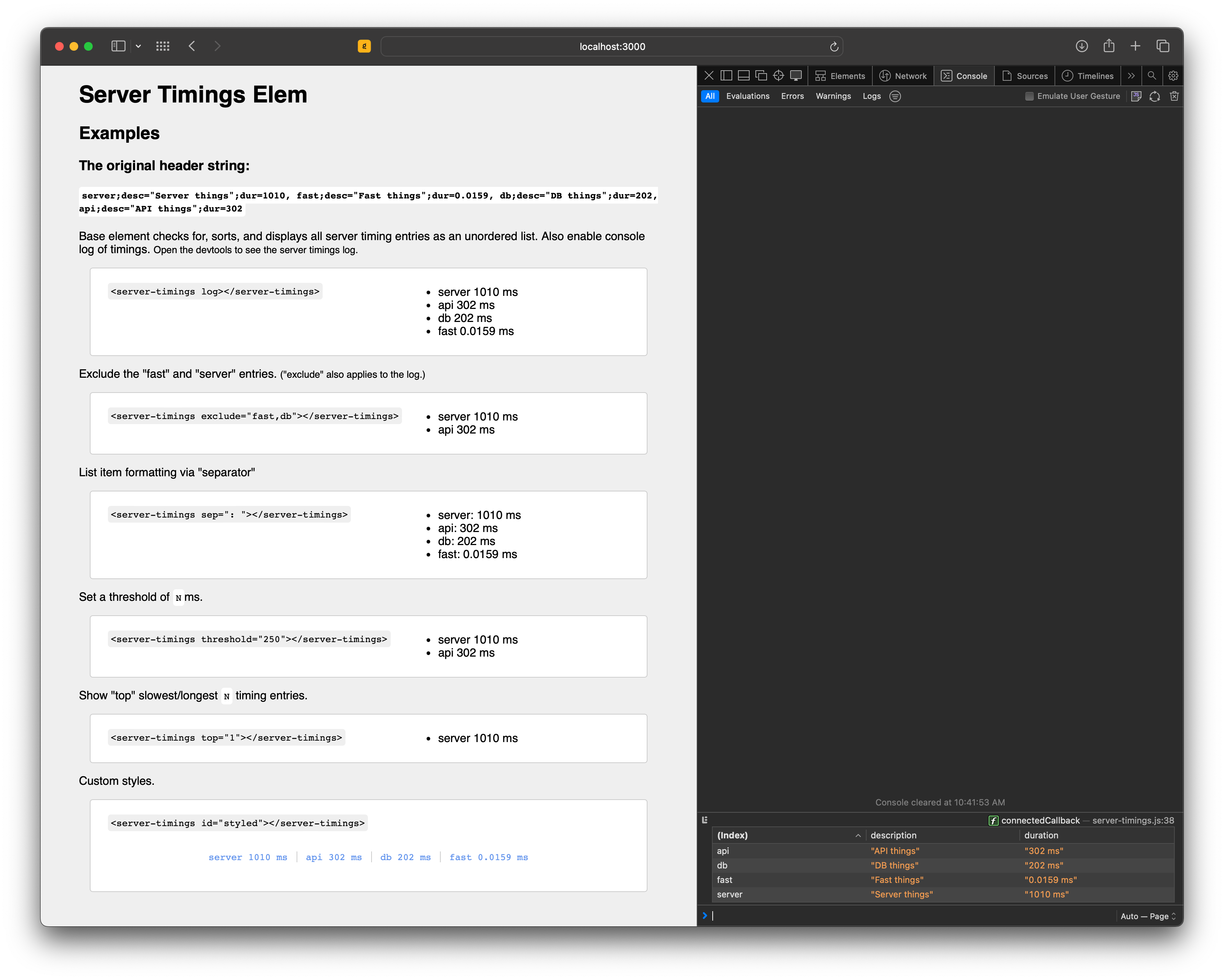
Include the <server-timings></server-timings> element in your HTML document. The element will render as an unstyled <ul>.
<server-timings></server-timings>
<server-timings log></server-timings>
<server-timings exclude="fast,cdn-*"></server-timings>
<server-timings sep=": "></server-timings>
<server-timings threshold="250"></server-timings>
<server-timings top="1"></server-timings>
Attributes
log- Log the timings to the console as a table.exclude- Comma-separated list of names to exclude from the list.- Supports wildcard
*at the end of a name.
- Supports wildcard
sep- Separator string to use between the name and duration.threshold- Minimum duration in ms to display.top- Number of greatest duration timings to display.
JS API
<server-timings> will emit a server-timings event on itself after gathering, filtering, and sorting timings. The event's detail property will be a dictionary of the timings by name.
Also, the list of PerformanceServerTiming objects can be retrieved from the timings property.
(function() {
  const $st = document.querySelector('server-timings#unique')
  $st.addEventListener('server-timings', ({ detail }) => {
    console.log('server-timings', detail)
    console.log($st.timings)
  })
})()
The event can be disabled with the quiet attribute.
CSS
Sample CSS for styling the element:
server-timings {
  display: block;
}
server-timings ul {
  margin: 0;
  padding: 0;
  list-style: none;
  display: flex;
  flex-direction: row;
  justify-content: center;
  gap: 1.5rem;
}
Links
header-timers - Node.js module for creating Server-Timing headers
Server-Timing reference MDN documentation on Server-Timing headers