1.0.2 • Published 10 years ago
terminal-js v1.0.2
Introduction
Simple front-end terminal simulator with animation.
Here is a live demo:
https://micooz.github.io/terminal-js
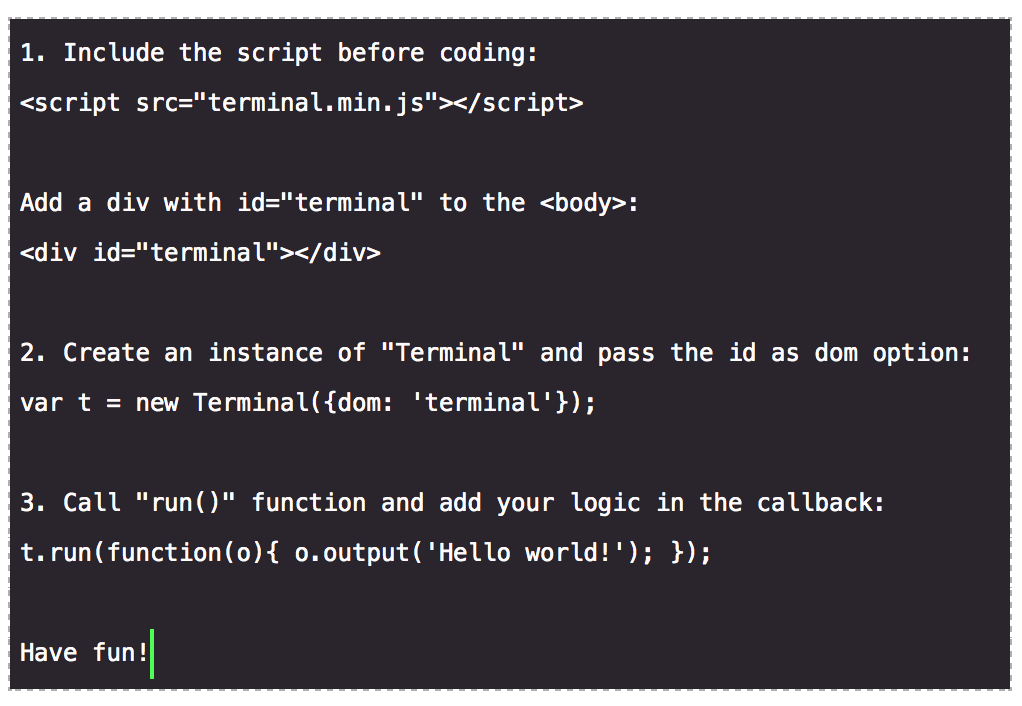
Screenshot:
Usage
First, provide a div in your html code:
<div id="terminal"></div>Second, include terminal[.min].js:
<script src="dist/terminal.min.js"></script>Finally, coding as this example:
1). Create an instance of Terminal class. You can specify options in an object and pass it to the constructor:
var t = new Terminal({
  dom: document.getElementById('terminal'), // required
  speed: 15 // chars per second
});
2). run() will give you an object of 'Operator' in your callback. The 'Operator' supports chain operation or function calls respectively:
t.run(function (o) {
  o.output('Hi, there. I\'m Micoz. ').wait(300);
  o.del(3).output('oz. ').wait(1000);

  o.output('I want to show you an awesome simulator');
  o.del(9).output('terminal powered by HTML4').wait(200).del(1).output('5. ').wait(800);

  o.output('The terminal is a simulator with animation.').wait(800);
  o.newline();
  o.output('-- Micooz');
});
Installation
$ npm ivia npm
$ npm i terminal-js --saveBuild
$ npm run buildCompile and compress src/*.* into dist/terminal.min.js, this file is for production.
Run in Development
$ npm run devCompile src/*.* into dist/terminal.js and generate source maps for better debugging. Auto-recompile sources after modification.
License
MIT