

Motivation
TypeScript is a powerful assistant when your are developping, with autocomplete suggestion and complilation errors. I made some utils to define a schema object and then avoid to always import types or interfaces if your shema doesn't change.
Tutorial
My use case come from HTTP request pattern. Our REST API schema is always the same and can be define in one place in the application. Let's see our requirement for make HTTP request:
- the request need an
urlto work correctly. - the request have a specific
method, like GET, POST, PATCH... - the url can contain
path params, like a resource id. - the url can contain
query params, like a pagination - the request can contain
data(orbody) - the request contain a
response, with always the same data types
Some of these data are dynamics, and others never change. url and method never change, while path params, query params, data and response depends on the context.
Let's define our schema:
const schema = {
  'PATCH users/:id': {
    url: (pathParams: { id: string }) => `users/${pathParams.id}`,
    method: 'PATCH',
    queryParams: null,
    data: {} as {
      username?: string,
      email?: string
    },
    response: {} as {
      id: string,
      username: string,
      email: string
    }
  },
}
Wait, what is that object ? Is a plain JavaScript object or a TypeScript definition ?
It's both !
Technicaly, it's a plain JavaScript object, but it's also used as TypeScript definition for some keys with the powerful of as TypeScript keyword.
Now, let's build a request() function, base on native fetch browser:
import queryString from 'query-string'

const request = (config) => {
  const {
    url,
    method,
    data,
    queryParams,
    ...restConfig
  } = config

  const baseURL = 'https://api.com'
  const queryParamsStr = queryString.stringify(queryParams)
  const fullURL = `${baseURL}/${url}?${queryParamsStr}`

  return fetch(fullURL, {
    method,
    body: JSON.stringify(data),
    ...restConfig
  }).then(res => res.json())
}
It's a very basic function with some data handling, like stringify query params and data, concat baseURL and return a promise with plain JavaScript object.
Currently, TypeScript doesn't know anything about the request schema. It could be usefull if TS can autocomplete config data depends on the request ?
typescript-object-schema provide 3 utils types to build a powerfull config schema:
import { ObjectParams, FnParams, Extends } from 'typescript-object-schema'ObjectParams- used to add an object of your schema in your configFnParams- used to add a function argument of your schema in your configExtends- used to extends an object (internally, it avoid conflict withObjectParamsandFnParamskeys)
Too complicated ? Let's see an example:
type Schema = typeof schema
type SchemaKeys = keyof Schema

type RequestConfig = NonNullable<Parameters<typeof fetch>[1]>

type Config<T extends SchemaKeys> =
  { name: T }
  & FnParams<Schema[T], 'url', 'pathParams'>
  & ObjectParams<Schema[T], 'queryParams'>
  & ObjectParams<Schema[T], 'data'>
  & Extends<Schema[T], RequestConfig>
What Config look like ? It's equivalent to:
interface Config<T extends SchemaKeys> {
  name: T,
  pathParams: {
    ...
  }
  queryParams: {
    ...
  }
  data: {
    ...
  }
  // and other RequestConfig properties, like headers, cors, etc...
}pathParams, queryParams and data will depends on name. In our plain JS object schema, name is the key of object: PATCH users/:id, but you can name it like you want.
Why use a merge of Typescript Type instead of an interface extends ?
Because ObjectParams will make your key optional depends on your schema definition, and we can't merge dynamic object with interface extends .
Now, let's build our Request function type:
type Request = <T extends SchemaKeys>(config: Config<T>) => Promise<Schema[T]['response']>We can now use Request as a type of our request() function.
But wait, why our Config doesn't include url and method ?
Because they never change for a specific end point. In our schema, they only are JS plain value. Let's update our request():
import queryString from 'query-string'

const request = (config) => {
  const {
-   url,
-   method,
+   name,
+   pathParams,
    data,
    queryParams,
    ...restConfig,
  } = config

+ const { url, method } = schema[name]

+ const urlWithPathParams = typeof url === 'function'
+   ? url(pathParams)
+   : url

  const baseURL = 'https://api.com'
  const queryParamsStr = queryString.stringify(queryParams)
- const fullURL = `${baseURL}/${url}?${queryParamsStr}`
+ const fullURL = `${baseURL}/${urlWithPathParams}?${queryParamsStr}`

  return fetch(fullURL, {
    method,
    body: JSON.stringify(data),
    ...restConfig,
  }).then(res => res.json())
}
We have finished ! You can now use request() and TypeScript will automcomplete and show errors if you provide the wrong config.
Examples
fetch()
import queryString from 'query-string'
import { ObjectParams, FnParams, Extends } from 'typescript-object-schema'

const schema = {
  'GET /users': {
    url: 'users',
    method: 'GET',
    queryParams: {} as null | {
      page?: number,
      pageSize?: number,
    },
    data: null,
    response: {} as {
      id: string,
      username: string,
      email: string
    }[]
  },
  'GET /users/:id': {
    url: (pathParams: { id: string }) => `users/${pathParams.id}`,
    method: 'GET',
    queryParams: null,
    data: null,
    response: {} as {
      id: string,
      username: string,
      email: string
    }
  },
  'POST /users/:id': {
    url: 'users',
    method: 'POST',
    queryParams: null,
    data: {} as {
      username: string,
      email: string
    },
    response: {} as {
      id: string,
      username: string,
      email: string
    }
  },
  'PATCH /users/:id': {
    url: (pathParams: { id: string }) => `users/${pathParams.id}`,
    method: 'PATCH',
    queryParams: null,
    data: {} as {
      username?: string,
      email?: string
    },
    response: {} as {
      id: string,
      username: string,
      email: string
    }
  },
  'DELETE /users/:id': {
    url: (pathParams: { id: string }) => `users/${pathParams.id}`,
    method: 'DELETE',
    queryParams: null,
    data: null,
    response: null
  },
}

type Schema = typeof schema
type SchemaKeys = keyof Schema

type RequestConfig = NonNullable<Parameters<typeof fetch>[1]>

type Config<T extends SchemaKeys> =
  { name: T }
  & FnParams<Schema[T], 'url', 'pathParams'>
  & ObjectParams<Schema[T], 'queryParams'>
  & ObjectParams<Schema[T], 'data'>
  & Extends<Schema[T], RequestConfig>

type Request = <T extends SchemaKeys>(config: Config<T>) => Promise<Schema[T]['response']>

const request: Request = (config) => {
  const {
    name,
    pathParams,
    data,
    queryParams,
    ...restConfig
  } = config

  const { url, method } = schema[name]

  const urlWithPathParams = typeof url === 'function'
    ? url(pathParams)
    : url

  const baseURL = 'https://api.com'
  const queryParamsStr = queryString.stringify(queryParams)
  const fullURL = `${baseURL}/${urlWithPathParams}?${queryParamsStr}`

  return fetch(fullURL, {
    method,
    body: JSON.stringify(data),
    ...restConfig
  }).then(res => res.json())
}
Usages:
// GET All
const users = await request({
  name: 'GET /users',
  queryParams: {
    page: 1,
    pageSize: 10,
  }
})

// GET ONE
const user = await request({
  name: 'GET /users/:id',
  pathParams: {
    id: '1'
  }
})

// POST
const user = await request({
  name: 'POST /users',
  data: {
    username: '...'
  }
})
Axios
Note: schema is the same than fetch example above, except the queryParams was renamed params because query parametters on axios config are named params. But you can use what you want
import axios, { AxiosRequestConfig, AxiosPromise } from 'axios'
import { ObjectParams, FnParams, Extends } from 'typescript-object-schema'

const schema = {
  'GET /users': {
    url: 'users',
    method: 'GET',
    params: {} as null | {
      page?: number,
      pageSize?: number,
    },
    data: null,
    response: {} as {
      id: string,
      username: string,
      email: string
    }[]
  },
  'GET /users/:id': {
    url: (pathParams: { id: string }) => `users/${pathParams.id}`,
    method: 'GET',
    params: null,
    data: null,
    response: {} as {
      id: string,
      username: string,
      email: string
    }
  },
  'POST /users/:id': {
    url: 'users',
    method: 'POST',
    params: null,
    data: {} as {
      username: string,
      email: string
    },
    response: {} as {
      id: string,
      username: string,
      email: string
    }
  },
  'PATCH /users/:id': {
    url: (pathParams: { id: string }) => `users/${pathParams.id}`,
    method: 'PATCH',
    params: null,
    data: {} as {
      username?: string,
      email?: string
    },
    response: {} as {
      id: string,
      username: string,
      email: string
    }
  },
  'DELETE /users/:id': {
    url: (pathParams: { id: string }) => `users/${pathParams.id}`,
    method: 'DELETE',
    params: null,
    data: null,
    response: null
  },
}

type Schema = typeof schema
type SchemaKeys = keyof Schema

type Config<T extends SchemaKeys> =
  { name: T }
  & FnParams<Schema[T], 'url', 'pathParams'>
  & ObjectParams<Schema[T], 'params'>
  & ObjectParams<Schema[T], 'data'>
  & Extends<Schema[T], AxiosRequestConfig>

type Request = <T extends SchemaKeys>(config: Config<T>) => AxiosPromise<Schema[T]['response']>

const axiosInstance = axios.create({ baseURL: 'https://api.com' })
const request: Request = axiosInstance.request
Usages:
request({
  name: 'GET /users',
  params: {
    page: 1
  }
}).then(res => {
  res.data.map(user => {
    console.log(user.username)
  })
})
IntelliSense examples
name
data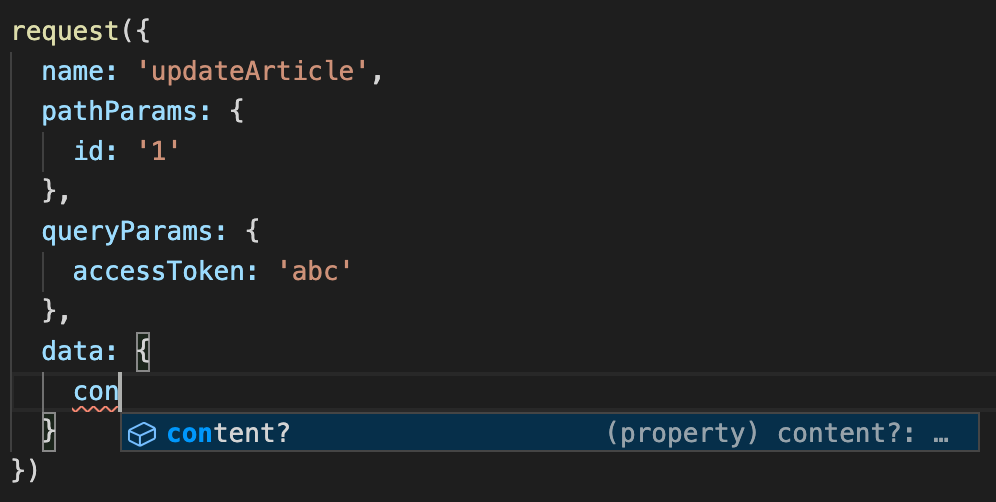
queryParams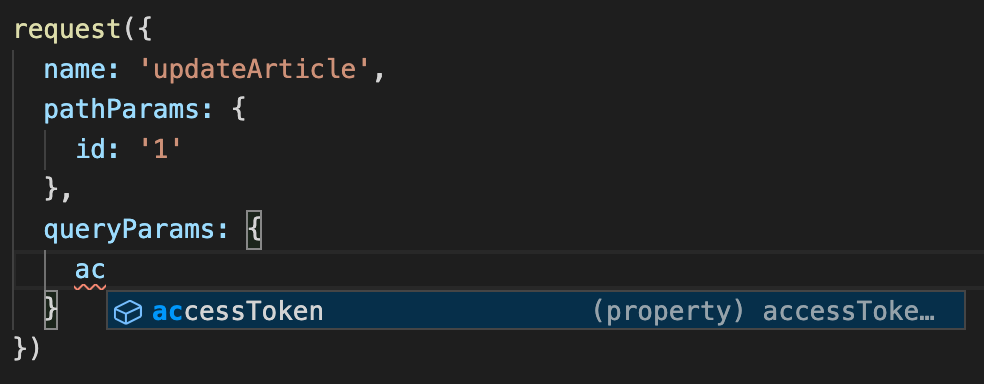
response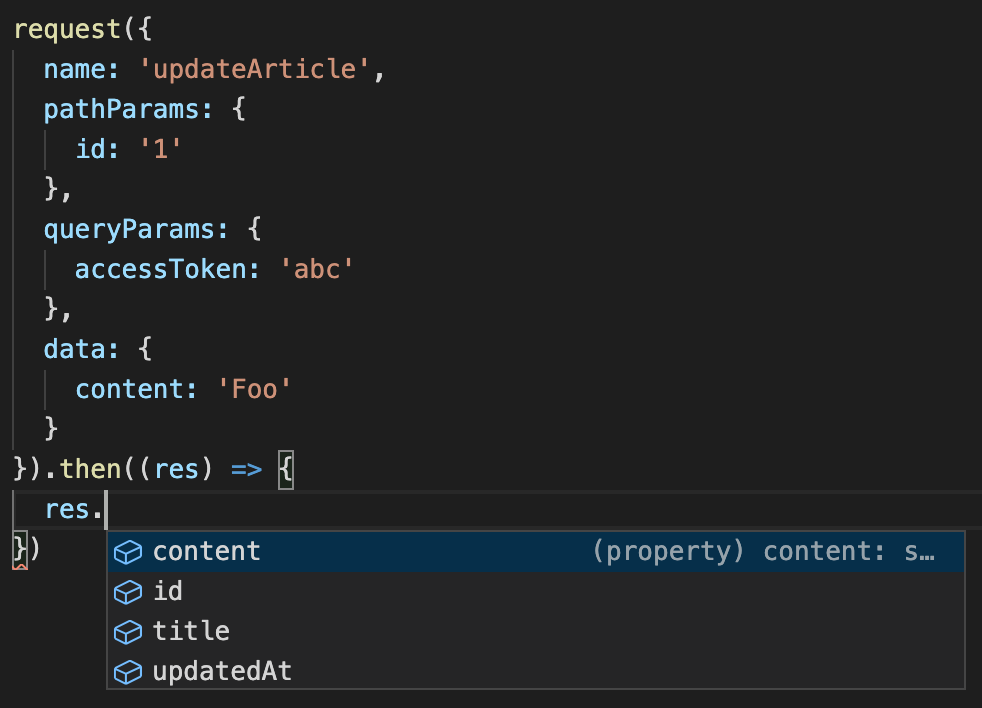
othersProperties
Things to know
Schema keys names
Each keys of the schema object can be named like you want. In examples, names are GET users, GET users/:id, but you can named it GET_users, users get, retrieve users, update users/id, etc. Keys are use by TypeScript to find the correct route schema, so it's completely arbitrary. TypeScript will autocomplete keys for you, so even with a complicated format like GET users/:id, you don't have to remember it.