uranio-cli v0.0.63
Uranio CLI
Uranio command line interface.
Table of Contents
About
uranio-cli is the only package you need in order to work with Uranio.
Uranio is a framework that builds CRUD APIs.
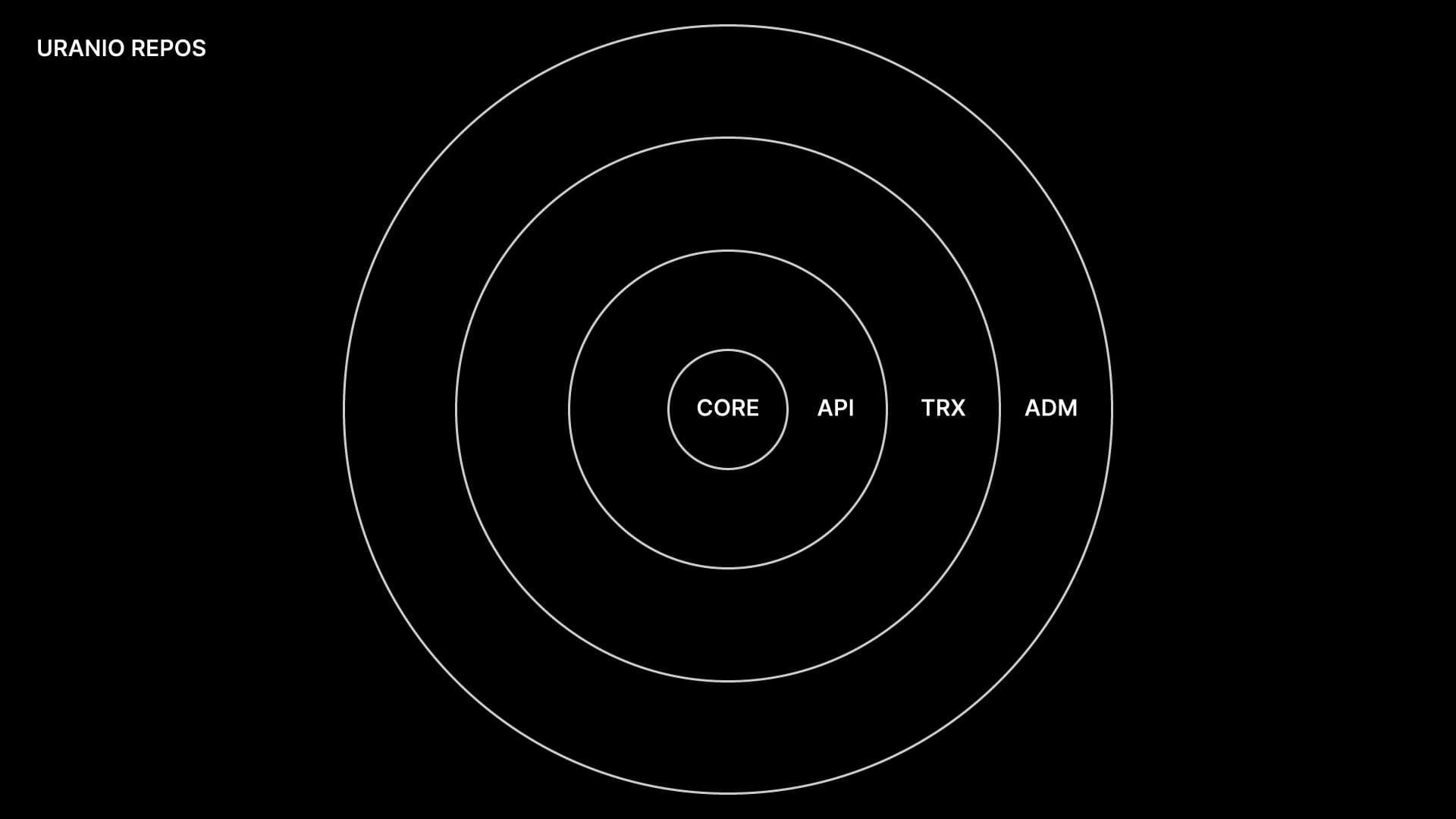
Uranio can be installed as one of the following repo:
core, api, trx, adm.
Each repo includes the previous one.
Core
uranio-core generates classes needed to interact with the database.
Uranio can interact with the following databases: MongoDB
More Database will be implemented in the future.
Api
uranio-api runs a web service that expose a CRUD API.
The web service use Express.js internally.
Uranio API can also be used inside a Lambda Function. It has a method that creates a service to use inside Netlify Functions.
uranio.api.lambda.create();TRX
uranio-trx creates Hooks that can be used to query the API from a client.
See Hooks
ADM
uranio-adm creates a full Administration Panel that interact with the API.
Installation
Uranio CLI requires Node.js, version 14 or above.
To install uranio-cli, run the following command from any directory
in your terminal:
yarn global add uranio-clior if you are using npm
npm install uranio-cli -gWhen using the CLI in a CI environment we recommend installing it locally as a development dependency, instead of globally. To install locally, run the following command from the root directory of your project:
yarn add --dev uranio-clior if you are using npm
npm install --save-dev uranio-cliUsage
Installing the CLI globally provides access to the uranio command.
uranio [command]Run help for detailed information about CLI commands
uranio helpShortcut
urn [command]Commands
init
uranio initThis command initialize the repository. It will download and install all dependencies and copy all the files needed in order to start developing.
Flags
-s --root(string) - Set project root. If empty Uranio will auto detect the closest repo.-r --repo(string) - Set Uranio repo core, api, trx, adm-f --force(boolean) - Run without prompts.-p --pacman(string) - Set package manager npm, yarn-k --docker(boolean) - Compile and run inside a Docker container - Docker must be installed on the machine.--docker_db(boolean) - Run a DB in a Docker container - Docker must be installed on the machine.--db(string) - Set docker DB mongo - Docker must be installed on the machine.
dev
uranio devThis command starts a local development server.
| Subcommand | description |
|---|---|
dev:server | Run development only for server |
dev:panel | Run development only for the admin panel |
build
uranio buildThis command build and compiled the code that will be needed in production.
| Subcommand | description |
|---|---|
build:server | Build the server |
build:panel | Build the admin panel |
start
uranio startThis command starts the server and the admin panel for production.
| Subcommand | description |
|---|---|
start:server | Start the server in production mode |
start:panel | Start the admin panel in production mode |
deinit
uranio deinitThis command deletes everything uranio created and return the repo in its initial state.
info
uranio infoThis command prints the information uranio was initialized with.
help
uranio helpThis command prints the list of all commands, parameters and options.
version
uranio version

#or

uranio
This command prints uranio-cli version.
Output options
-v --verbose(boolean) - log in verbose mode.-u --debug(boolean) - log in debug mode.-n --hide(boolean) - do not output log.-b --blank(boolean) - log with no colors.-w --fullwidth(boolean) - log in full width.-x --prefix(string) - set a log prefix.-t --time(boolean) - log with timestamp.-a --context(boolean) - log with context.-l --filelog(boolean) - save log on file.-i --spin(boolean) - log with spinner.-e --native(boolean) - log in native mode.-c --color_log(string) - log color.-o --color_verbose(string) - verbose log color.-q --color_debug(string) - debug log color.
Getting started
Change directory to your npm repo:
cd /path/to/my/repoIf not already, run:
yarn init
#or
npm init
Then initialize Uranio with:
uranio initThe command will prompt with questions regarding the repository you want to initialize.
- Choose the package manager yarn, npm
- Choose if you want to run and compile inside a Docker container.
- Choose if you want Uranio to create a Docker container with a database.
- If the previous answer was affirmative, choose the database type.
- Choose the uranio module you want to use: core, api, trx, adm
This might take a while, depending on your internet connection.
After it is done, your repo is ready for development.
In order to start developing you will need to create and run a development server. Run:
uranio devHere you will see all the logs, also it will print the IP of the Admin panel
in the case of the adm repo.
Now you can start developing.
How to develop
The first things that need to be defined in Uranio are Atoms.
Atoms are the objects stored in the database.
For example if we want to define an Atom with the name product, we need to
create the directory src/atoms/product and the file src/atoms/prodcut/index.ts.
The name product will be picked from the name of the directory just created.
The src/atoms/product/index.ts must export a default object with the Atom
definition, like so:
import uranio from 'uranio';

export default uranio.register.atom({
	properties: {
		title: {
			type: uranio.types.PropertyType.TEXT,
			label: 'Title'
		},
		price: {
			type: uranio.tyoes.PropertyType.FLOAT,
			label: 'Price'
		},
		// ...
	},
	// ...
});
Uranio already creates the following required Atoms:
Core
- superuser
- user
- group
- media
Api
- request
- error
Admin
- setting
Atom register
The parameter of the function uranio.register.atom used in src/atoms/product/index.ts
is of type:
uranio.types.Book.Definition.
properties: Book.Definition.Properties
plural?: string
authenticate?: boolean
connection?: ConnectionName
security?: Book.Definition.Security
dock?: Book.Definition.Dock
A full Atom definition would be like this:
import uranio from 'uranio';

export default uranio.register.atom({
	plural: 'customers',
	authenticate: true,
	security: {
		type: uranio.types.BookSecurityType.UNIFORM,
		_r: uranio.types.BookPermissionType.NOBODY
	},
	connection: 'main',
	properties: {
		full_name: {
			type: uranio.types.PropertyType.TEXT,
			label: 'Full name'
		},
		email: {
			type: uranio.tyoes.PropertyType.EMAIL,
			label: 'Email'
		},
		password: {
			type: uranio.tyoes.PropertyType.ENCRYPTED,
			label: 'Password',
			hidden: true
		},
		groups: {
			type: uranio.tyoes.PropertyType.ATOM,
			label: 'Group',
			atom: 'group',
			optional: true
		},
	},
	dock: {
		url: '/products'
	}
});
Plural
plural define the plural word to define the Atom.
e.g.: For the Atom product will be products.
Authenticate
authenticate define if the Atom is an AuthAtom.
See AuthAtom
AuthAtom are Atoms that can be authenticated, meaning they have
methods that authenticate with email and password.
For example they can be used to define customers.
Uranio already provide 2 AuthAtoms: superuser and user.
Connection
connection define with which connection the Atom is stored.
connection can be one of the follwing: main (default), log, trash.
Uranio creates 3 database with 3 different connections.
- The
mainconnection is where are stored all the mainAtoms. - The
logconnection is where are stored theAtoms that define logs. - The
trashconnection is where Uranio put the deletedAtoms.
Uranio API already provide 2
Atoms that are used in thelogconnection. They arerequestanderror. For each API request anAtomrequestis stored. For each Uranio error andAtomerroris stored.
Security
security define the security of the Atom, meaning how the database can
be queried.
Uranio creates an Access Control Layer (ACL) before querying the database. This will check if the request can read or write in the database.
Each Atom relation can have its own rules.
security can be of type:
uranio.types.SecurityType.UNIFORM.uranio.types.SecurityType.GRANULAR.
Default is UNIFORM.
UNIFORM permission will check on a relation level, meaning that the rule is
defined for the entire Atom relation.
GRANULAR permission will check on a Record level, meaning that the rules can
differ between the records. Each record has its own write and read rules.
Each relation / record has two attributes _r and _w, respectively for reading
and writing permission. The value of these attributes is an Atom group ID Array.
_r will narrow from Everybody
_w will widen from Nobody
_r == nullish -> Everybody can read
_w == nullish -> Nobody can write
For example:
// src/atoms/product/index.ts

import uranio from 'uranio';

export default uranio.register.atom({
	// ...
	security: {
		type: uranio.types.BookSecurityType.UNIFORM,
		_r: uranio.types.BookPermissionType.NOBODY
	},
	// ...
});
The above definition means that Nobody can read or write on the entire Atom relation.
// src/atoms/product/index.ts

import uranio from 'uranio';

export default uranio.register.atom({
	// ...
	security: {
		type: uranio.types.BookSecurityType.UNIFORM,
		_w: uranio.types.BookPermissionType.PUBLIC
	},
	// ...
});
The above definition means that Everybody can read and write on the entire Atom relation without
authenitcation.
// src/atoms/product/index.ts

import uranio from 'uranio';

export default uranio.register.atom({
	// ...
	security: {
		type: uranio.types.BookSecurityType.UNIFORM,
		_w: ['61d81a12f3e4ea6edbdcdd1e', '61d81a12f3e4ea6edbwcddff']
	},
	// ...
});
The above definition means that Everybody can read but only authenitcated AuthAtom that have
groups with the following ids: ['61d81a12f3e4ea6edbdcdd1e', '61d81a12f3e4ea6edbwcddff']
can write.
// src/atoms/product/index.ts

import uranio from 'uranio';

export default uranio.register.atom({
	// ...
	security: {
		type: uranio.types.BookSecurityType.GRANULAR,
	},
	// ...
});
When the security type is GRANULAR, the ACL will check if the singles Atoms
have the right permission to be read or written.
Dock
If dock property is defined, Uranio will create the CRUD API and expose it
in the web serivce.
dock must have a url property starting with /.
For example:
// src/atoms/product/index.ts

import uranio from 'uranio';

export default uranio.register.atom({
	// ...
	dock: {
		url: '/products'
	},
	// ...
});
will create a route in the webserice https://[WEBSERVICEURL]/uranio/api/products where
the Atom relation product can be queried.
[WEBSERVICEURL] can be defined in uranio.toml.
/uranio/api prefix can be defined in uranio.toml.
See uranio.toml definition
dock has also the properties auth_url that need to be defined when
authenticate is equal to true.
auth_url define the route url where the AuthAtom can authenticate.
For example:
// src/atoms/customer/index.ts

import uranio from 'uranio';

export default uranio.register.atom({
	// ...
	dock: {
		url: '/customers',
		auth_url: '/auth-customer'
	},
	// ...
});
will create a route in the webservice https://[WEBSERVICEURL]/uranio/api/auth-customer
tha will accept as body in JSON format:
{
	email: 'uranio@email.com',
	password: 'MyPassword1234'
}
and will return an AuthResponse object with a token and a http-only cookie
if authenitcated.
Properties
Type Book.Definition.Properties is a list of all the relation key.
Each key is of type Book.Definition.Property:
//type Book.Definition.Property

Property.ID |
Property.Text |
Property.LongText |
Property.Email |
Property.Integer |
Property.Float |
Property.Binary |
Property.Encrypted |
Property.Day |
Property.Time |
Property.SetString |
Property.SetNumber |
Property.EnumString |
Property.EnumNumber |
Property.Atom |
Property.AtomArray;
Each property type has the following common properties:
type: BookPropertyType
label: string
optional?: boolean
hidden?: boolean
unique?: boolean
default?: any
on_error?: (old_value: any) => any
BookPropertyType can be one of the following
// BookPropertyType

ID = 'ID',
TEXT = 'TEXT',
LONG_TEXT = 'LONG_TEXT',
EMAIL = 'EMAIL',
INTEGER = 'INTEGER',
FLOAT = 'FLOAT',
BINARY = 'BINARY',
ENCRYPTED = 'ENCRYPTED',
DAY = 'DAY',
TIME = 'TIME',
ENUM_STRING = 'ENUM_STRING',
ENUM_NUMBER = 'ENUM_NUMBER',
SET_STRING = 'SET_STRING',
SET_NUMBER = 'SET_NUMBER',
ATOM = 'ATOM',
ATOM_ARRAY = 'ATOM_ARRAY'4 years ago
4 years ago
4 years ago
4 years ago
4 years ago
4 years ago
4 years ago
4 years ago
4 years ago
4 years ago
4 years ago
4 years ago
4 years ago
4 years ago
4 years ago
4 years ago
4 years ago
4 years ago
4 years ago
4 years ago
4 years ago
4 years ago
4 years ago
4 years ago
4 years ago
4 years ago
4 years ago
4 years ago
4 years ago
4 years ago
4 years ago
4 years ago
4 years ago
4 years ago
4 years ago
4 years ago
4 years ago
4 years ago
4 years ago
4 years ago
4 years ago
4 years ago
4 years ago
4 years ago
4 years ago
4 years ago
4 years ago
4 years ago
4 years ago
4 years ago
4 years ago
4 years ago
4 years ago
4 years ago
4 years ago
4 years ago
4 years ago
4 years ago