websync v0.0.14
Websync

Websync is like aws s3 sync with automatic CloudFront invalidation and more.
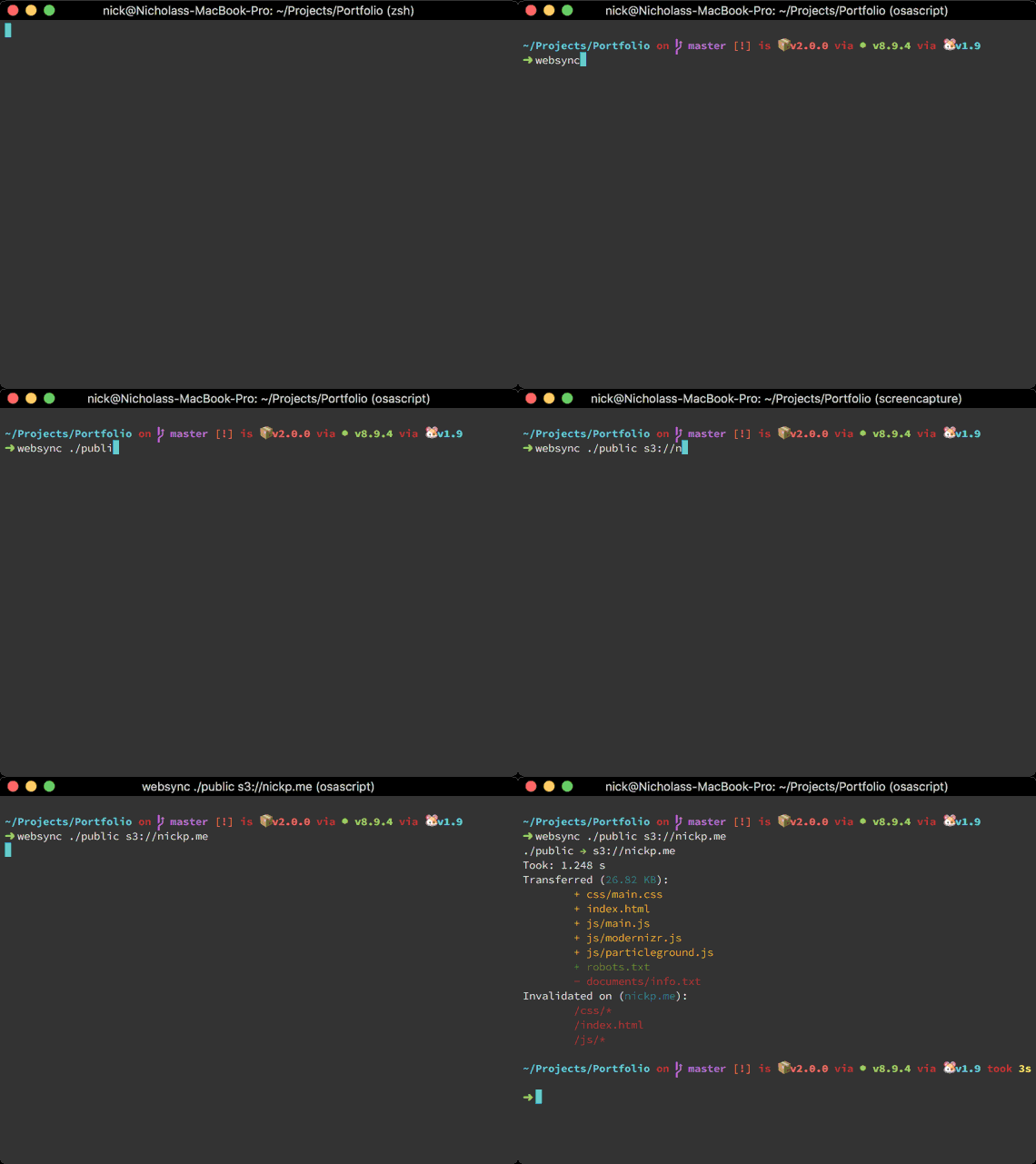
Websync sync is meant to be a replacement for aws s3 sync. Websync, like the AWS cli, syncs local directories with s3 prefixes, and visa-versa. Websync expands on these features by automatically creating optimized invalidations on any associated CloudFront distributions, and exposing an expressive configuration system (on top of the CLI interface) with JSON or JavaScript, and a programmatic API.
Table Of Contents
Installation
# Install global cli, the `websync` command
npm i -g websync
# Install local
npm i websync
Usage
websync command
# Parse configuration from `websync.json` or `websync.js`
websync
# Parse configuration explicitly
websync --config ./myConfig.js
# With command line options
websync ./www s3://mybucket.io
# General
websync [source] [target] [...options]
Options
sourceSource container (local directory or S3 bucket):./myDirectorytargetTarget container (S3 bucket or local directory):s3://my-bucketconfigExplicit configuration file (JSON or JavaScript):--config ./myConfig.jsonincludeGlob pattern to filter files (from source) to include:--include **/*.extexcludeGlob pattern to filter files (from source) to exclude:--exclude **/*.extdiffByOverride property by which items are diffed (modtime, orsizewith default:modtime):--diffBy sizewildcardPolicyOverride the wildcard policy (majority,unanimous, orminoritywith default:majority):--wildcardPolicy unanimouswildcardAllAppend wildcard to all invalidation paths (NOTE: this does not change invalidation path resolution), useful for invalidating querystring paths:--wildcardAllinvalidateDeletesInvalidate paths for items being deleted from target. Useful for situations where you do not want users to be able to access the items anymore:--invalidateDeletesdistributionOne or more CloudFront distribution IDs (NOTE: this overrides discovery of distributions):--distribution <DIST ID> --distribution <ANOTHER DIST ID>yesSkip all prompts with a "yes" response (NOTE: websync will warn you if more than 500 invalidations are being made, as this will require a payment):--yes
NOTE: More options are available in the Configuration Files
NOTE: All command line arguments OVERRIDE configuration file options. Additionally, source and target are required, but can be provided by CLI or Configuration File
Configuration Files
Configuration files can provide all of the options available from the CLI with the addition of modifiers, a flexible system to provide explicit arguments to S3 put operations.
Modifiers Object
The modifier object of the configuration file is an object in which the keys are Glob Patterns, and the values are S3.putObject Params, or a function that returns either an S3.putObject Params, or a Promise which resolves S3.putObject Params. Note, if a function is provided (async or not) it will be called with a single Item argument that will represent the file or object from the SOURCE container.
NOTE: Source files can match multiple modifiers, allowing one to keep things DRY.
Examples
JavaScript configuration. See the example for context.
const Path = require('path')

const DOWNLOAD_CONTENT_TYPE = 'application/octet-stream'
const DOWNLOAD_TAG = 'Downloadable'
const REDIRECT_TAG = 'Redirectable'

const makeDispositionName = fileName =>
  `${Path.basename(fileName).split('.')[0]}-${Date.now()}${Path.extname(fileName)}`

module.exports = {
  source: './public',
  target: 's3://websync-complex-example-bucket',
  modifiers: {
    // This matches all files, provides Plain Object
    '**/*': {
      Metadata: {
        'source-user': process.env.USER,
      },
    },
    // Matches all files in downloads, provides a synchronous function
    'downloads/**/*': item => ({
      ContentType: DOWNLOAD_CONTENT_TYPE,
      ContentDisposition: `attachment; filename="${makeDispositionName(item.key)}"`,
      Tagging: DOWNLOAD_TAG,
    }),
    // Matches any file with the `.redirect` extension, provides an asynchronous funcion
    '*.redirect': async item => ({
      WebsiteRedirectLocation: (await item.read()).toString().trim(),
      ContentType: 'text/html',
      Tagging: REDIRECT_TAG,
    }),
  },
}
JSON configuration. See the example for context. In the example below, the !*.* pattern matches any item with no extension, i.e. "another-page", and overrides the implied Content-Type with text/html to have clean paths for a simple static website.
{
    "source": "./public",
    "target": "s3://websync-basic-example-bucket",
    "exclude": "*.exclude",
    "modifiers": {
        "!*.*": {
            "ContentType": "text/html"
        }
    }
}
Item API
Websync's Item object is an interface that abstractly represents either a local file, or an S3 Object. With regards to the Configuration File, the Item object passed to a modifier function is always from the source container (local directory, or S3 Bucket). All Items adhere to the following interface:
interface Item {
  // The "key" (path or S3 Object key)
  key: string
  // Last modification time
  modtime: Date
  // Size in bytes of the Item
  size: number
  // Whether item is a symbolic link (always false for S3)
  isSymbolicLink: boolean
  // Read the *entire* body of the item
  read(): Promise<Buffer>
}
Invalidation System
Websync's invalidation system automatically creates the minimal amount of invalidation paths required to accommodate the provided wildcard policy. It does this by creating a diff of the target and the source, and two trees: one of the items in the diff and all of the items in the target. It then walks the diff (starting at the root) tree and compares the number of children that are being invalidated with those that are not -- this is where the wildcard policy makes all the difference. Additionally, websync will detect when a given path that is being wildcarded should invalidate all of its children, or only its direct children, thereby producing the most optimal invalidation paths.
NOTE: the wildcardAll option DOES NOT change the invalidation path generation, rather, wildcards are appended to every path generated. This is useful for invalidating querystring paths for a given object, etc.
For more information on how invalidations work on CloudFront, please refer to the AWS Documentation.
Wildcard Policies
Wildcard policies determine when a given path will be wildcarded, thereby invalidating, all or only its direct, children to reduce the number of invalidation paths generated. The three policies available from least strict to most strict include minority, majority, and unanimous.
minority
A given path is wildcarded when a minority of its children are being invalidated. NOTE: This always results in a the /* invalidation path, when invalidations are required.
Example:
All Target Items:
//cssmain.cssvendor.css
/jsmain.js
index.html
Invalidated Items:
/index.html
Invalidation Paths:
/*
majority
A given path is wildcarded when a majority of its children are being invalidated.
Example:
All Target Items:
//cssmain.cssvendor.css
/jsmain.js
index.html
Invalidated Items:
//cssmain.cssvendor.css
index.html
Invalidation Paths:
/css/*/index.html
unanimous
A given path is wildcarded when a all of its children are being invalidated.
Example:
All Target Items:
//cssmain.cssvendor.css
/jsmain.js
index.html
Invalidated Items:
//cssmain.css
/js/main.js
index.html
Invalidation Paths:
/css/main.css/js/*/index.html
Roadmap
- Initial CLI
- Programmatic API Documentation
- Better Roadmap
7 years ago
8 years ago
8 years ago
8 years ago
8 years ago
8 years ago
8 years ago
8 years ago
8 years ago
8 years ago
8 years ago
8 years ago
8 years ago
8 years ago
11 years ago
11 years ago
12 years ago
12 years ago
12 years ago