
That's not a mock-up. It's one short 8BitScript program, photographed on a Commodore 64.



Development version. 8BitScript is a work in progress. A published release is a snapshot of ongoing work, and does not mean the language or the toolchain is finished.
8BitScript
Remember when a computer switched on and was simply ready?
No boot screen. No update. No twelve megabytes of runtime between you and the metal. You typed, it did. 8BitScript is a programming language for those machines — the Commodores, the Ataris, the NES — written the way you write today, compiled into the honest 6502 machine code they've always wanted. And the very same program builds for the web, so your friends without a VIC-20 can play too.
It looks like TypeScript. It compiles like C. It runs like it was written in 1983 by someone who really knew the chip.
Why you'll want one
WRITE IT ONCE. RUN IT ON EVERY MACHINE.
screen, text, and input are the same calls on every target, and each
one resolves to that machine's own hand-tuned implementation at build time.
No #ifdef. No lowest-common-denominator. Your source never has to
mention which computer it's on.
REAL MACHINE CODE. YOU PAY FOR WHAT YOU WRITE. No interpreter. No garbage collector. No heap. Every array and string is laid out at compile time and the build tells you exactly what it cost:
memory: 0 bytes of RAM for variables, 188 bytes of program (code and data)That's Hello World on a VIC-20. If a program won't fit, the build says so — and says by how many bytes.
THE COMPILER CATCHES IT BEFORE THE MACHINE DOES. Eight fixed-width integer types, range-checked while you type:
let score: u8 = 300;error 8BS1021: 300 does not fit in u8 (0..255)NO ASSEMBLY REQUIRED. (UNLESS YOU WANT TO.)
asm6502 { … } blocks, @address registers, and memory.write are part
of the language, not a trapdoor. Drop to the chip in the middle of a
function whenever the hardware deserves it.
IT KNOWS WHAT IT'S RUNNING ON.
#fact(video.raster) is answered at compile time, so a raster-bar effect
guarded by it costs the PET exactly zero bytes — and the C64 gets the
whole show.
THE BROWSER IS A TARGET, NOT A COMPROMISE. The web build honours the same memory model and the same 8-bit arithmetic as the native one. What wraps on the C64 wraps in Chrome.
Look how little it takes
Hello, World. One file. Every machine. Zero edits.
import { screen } from "@8bitscript/screen";
import { text } from "@8bitscript/text";

export function main(): void {
    screen.blank();
    text.print(0, "Hello World!");
    text.releaseCursor();
}
$ 8bs run c64
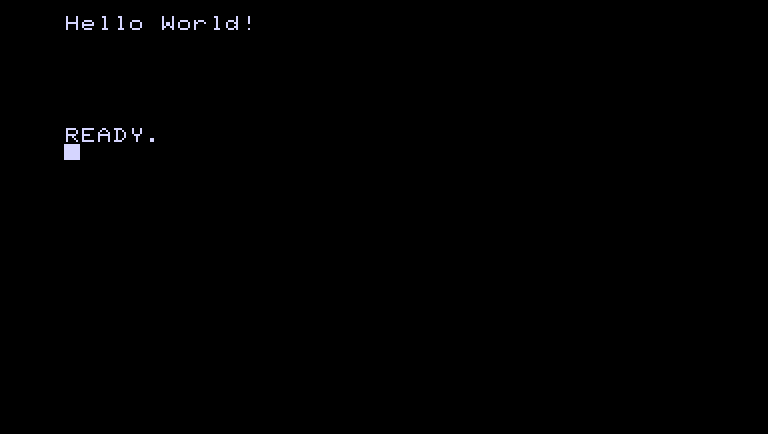
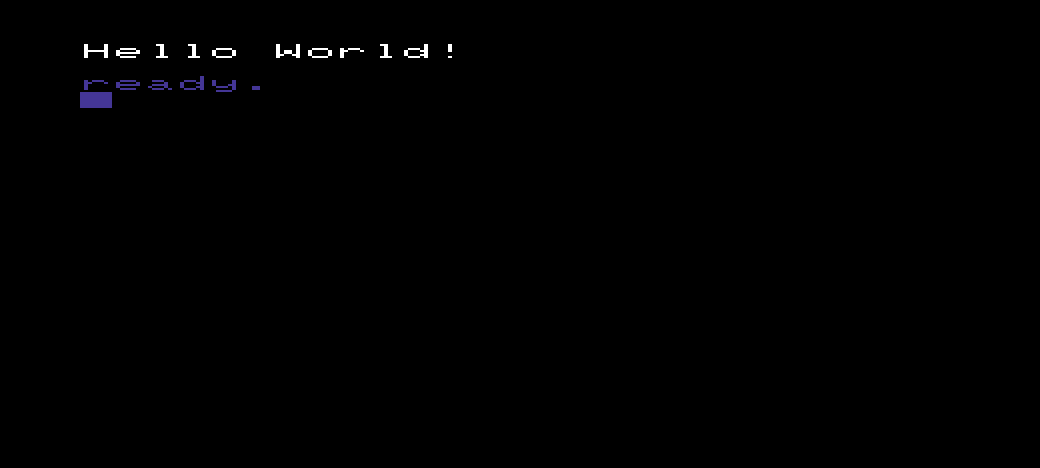
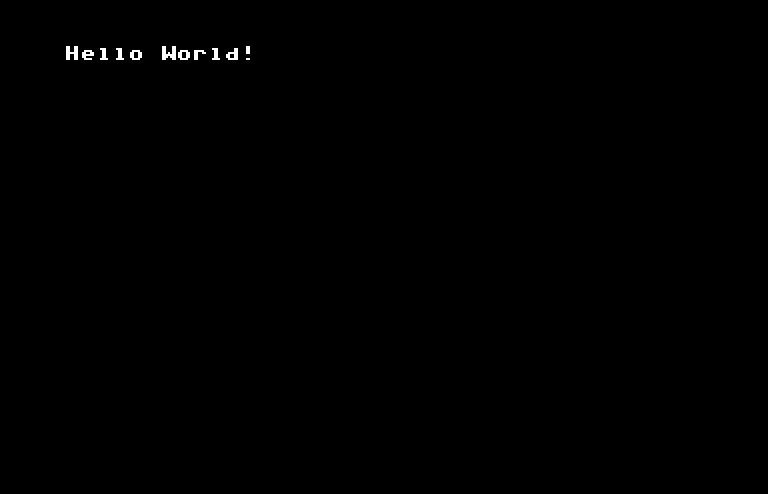
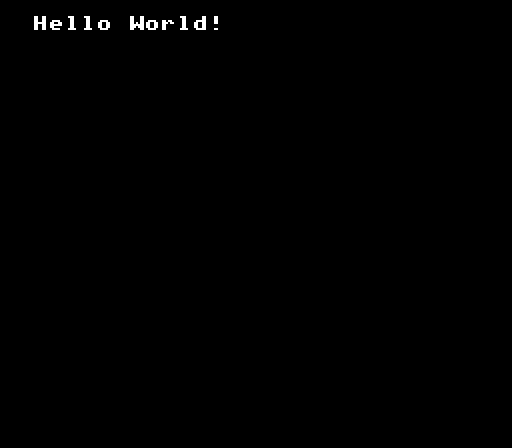
PET · VIC-20 · C64 · NES — the same file, four builds, straight out of the emulators.
A game loop. Tap left or right — keyboard, joystick, or pad, whichever
the machine has — and an 8 steps along the top row.
import { screen } from "@8bitscript/screen";
import { text } from "@8bitscript/text";
import { input } from "@8bitscript/input";

let x: utinyint = 20;

export function main(): void {
    screen.blank();
    input.begin();
    while (true) {
        waitFrame();            // one tick of the machine's own refresh
        input.poll();           // keyboard, joystick, or pad — whatever's plugged in
        text.print(x, " ");
        if (input.left() && x > 0) { x--; }
        if (input.right() && x < text.COLUMNS - 1) { x++; }
        text.print(x, "8");
    }
}
Talk to the chip. Every VIC-20 owner learned POKE 36879 in week one —
it's the screen and border colour. Here it is the 8BitScript way, then
the assembler's way:
import { screen } from "@8bitscript/screen";
import { text } from "@8bitscript/text";

export function main(): void {
    screen.blank();
    memory.write(36879, 10);    // POKE 36879,10 — the VIC-20's screen and border colour
    text.print(0, "BORDER: RED");
    asm6502 {                   // or say it to the chip yourself
        lda #10
        sta $900F
    }
}
$ 8bs run vic20
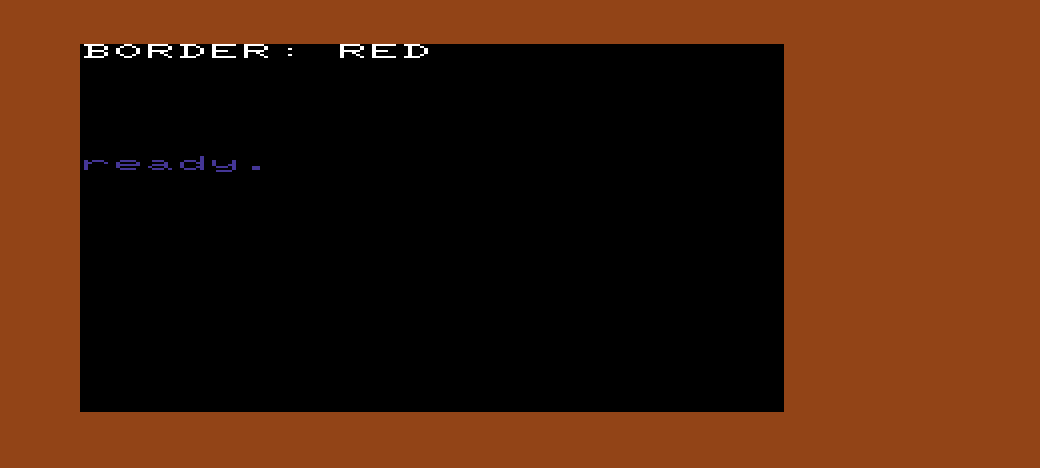
Every one of these builds as shown. Try them in the manual, where each entry is one thing you can do, with the real code.
See what it can do
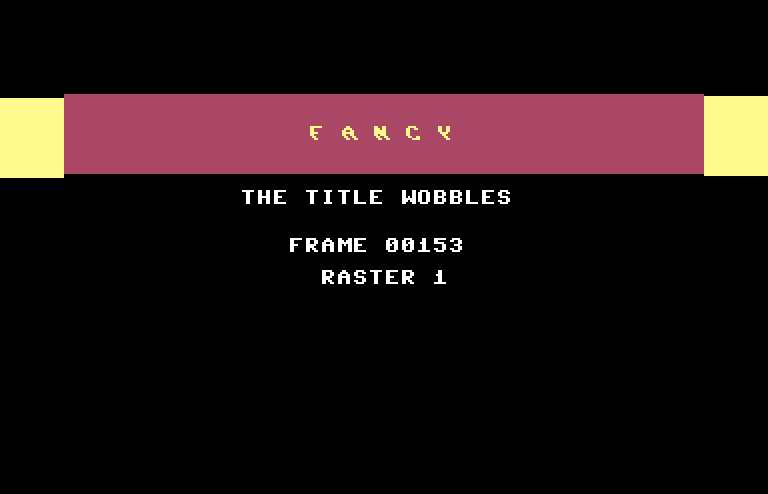
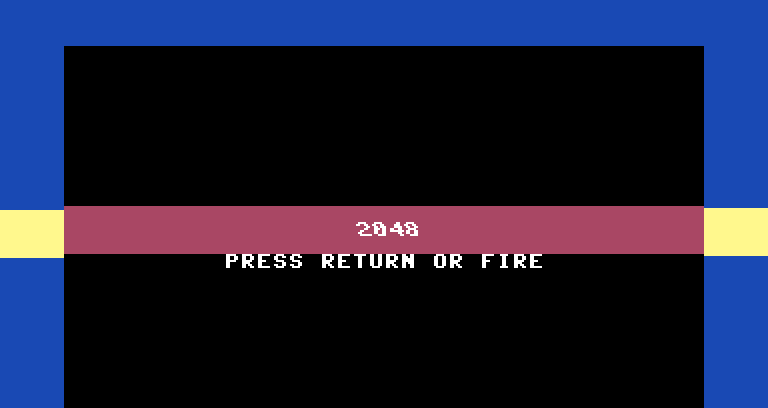
Left: a per-scanline raster effect, driven from portable code. Right: 2048, a whole game, on the C64.
2048 is the reference game — one program that builds, runs, and plays on all nine machines. It's how we know the language works. Clone it, run it, read it.
Available now
Nine machines. Every one of them builds, runs, and renders today.
| Machine | Year | Target | |
|---|---|---|---|
| Commodore PET | 1977 | pet |
|
| Atari 8-bit (400/800/XL/XE) | 1979 | atari8 |
|
| Commodore VIC-20 | 1980 | vic20 |
|
| Commodore 64 | 1982 | c64 |
|
| Nintendo Entertainment System | 1983 | nes |
|
| Commodore 128 | 1985 | c128 |
|
| Commander X16 | 2020s | cx16 |
|
| MEGA65 | 2022 | mega65 |
|
| Your web browser (WebAssembly) | now | web |
Coming attractions
Named on the roadmap, not yet built. Nothing here compiles today. The machine notes say what is known about each and what is still to verify. The list is closed: a machine is on it when its CPU is 8-bit, and the Intellivision is off it because the CP1610 is not.
| Machine | Notes | |
|---|---|---|
| Apple II family | 6502 — next in line | |
| Commodore Plus/4, C16, C116 | 6502 — next in line | |
| BBC Micro | 6502 — next in line | |
| Oric-1 / Atmos | 6502 — next in line | |
| Atari 5200 | 6502 console | |
| Atari 7800 | 6502, MARIA graphics | |
| Atari Lynx | 6502 handheld | |
| PC Engine / TurboGrafx-16 | HuC6280, a 65C02 | |
| Watara Supervision | 6502 handheld | |
| Atari 2600 | the hard one | |
| Game Boy | SM83 | |
| Game Boy Color | SM83, its own target | |
| Sega Master System | Z80, shared with the Game Gear | |
| Game Gear | Z80 | |
| Sega SG-1000 | Z80, TMS9918 | |
| ZX Spectrum | Z80 | |
| MSX1 | Z80, TMS9918 | |
| Amstrad CPC | Z80 | |
| ColecoVision | Z80, TMS9918 | |
| TRS-80 Color Computer | 6809 | |
| Vectrex | 6809, vector display | |
| Magnavox Odyssey² / Videopac | Intel 8048 | |
| Fairchild Channel F | Fairchild F8 |
builds today · up next · on the drawing board
Get yours today
Sixty seconds to a running game — the toolchain, the emulators, and 2048:
git clone https://github.com/8BitScript/2048.git && cd 2048
pnpm install
pnpm exec 8bs doctor    # checks Node, pnpm, and the emulators; offers to install what's missing
pnpm start:c64          # builds and boots it in the real thing (well, VICE)
pnpm start:web          # the same game, in a browser tab
Your own program is a folder with a package.json, the CLI, one config
file, and a main():
pnpm add -D @8bitscript/cli// 8bitscript.config.ts
export default {
entry: 'src/main.8bs',
targets: { c64: {}, vic20: {}, web: {} },
};pnpm exec 8bs run c64Everything else — project config, every
command, the standard packages, .8bx components, embedding the web
build in a page — lives at
8bitscript.org. That's the manual. This is
the brochure.
The fine print
Breaking changes arrive between releases, and some constructs you'd expect from TypeScript aren't here yet. What's listed above is what compiles today; the manual's Not yet available page is the rest.
It is not TypeScript — it borrows the syntax and nothing else. Existing TypeScript won't compile, and npm packages written for Node won't import. 8BitScript's own packages are on npm, though, and yours can be too.
Want to help build the Apple II backend? See CONTRIBUTING.md. MIT licensed — see LICENSE.
Made with a 6502 and a great deal of affection.