









pi-agent-harness — The Team-Architecture Factory for pi
pi-agent-harness is a team-architecture factory for pi, the minimal terminal coding agent. Say "build a harness for this project" (English) or "하네스 구성해줘" (한국어) or "ハーネスを構成して" (日本語), and it turns your domain description into pi agent definitions, the skills they use, and the orchestration prompts that drive them — picked from six pre-defined team-architecture patterns.
Ported from Claude Code. This package is a pi-only port of the original Harness (a Claude Code plugin). It maps the same factory onto pi's primitives —
.pi/agents/,.pi/skills/,.pi/prompts/, and the bundledsubagentextension — because pi deliberately ships no built-in subagents, no MCP, no plan mode, no todos.
Overview
pi is intentionally minimal: it gives the model four tools (read, write, edit, bash) and everything else is added via skills, prompt templates, extensions, and packages. This harness leverages that extensibility to decompose complex tasks into coordinated specialist agents. Say "build a harness for this project" and it generates:
- Agent definitions (
.pi/agents/*.md) — specialist personas withtools/modelfrontmatter; each runs in an isolatedpiprocess - Skills (
.pi/skills/*/SKILL.md) — Agent Skills standard procedural knowledge - Orchestration prompts (
.pi/prompts/*.md) —/commandsthat drive thesubagenttool insingle/parallel/chainmodes
The bundled subagent extension (extensions/subagent/) supplies the delegation tool pi lacks natively, so generated harnesses run out of the box.
Category — Where Harness Sits
Harness lives at the L3 Meta-Factory layer — the layer that generates other harnesses rather than being one. Inside L3, we pick a specific sub-layer: Team-Architecture Factory. This package targets the pi runtime.
| Layer | What it does | Neighbors |
|---|---|---|
| L3 — Meta-Factory / Team-Architecture Factory (us) | Domain sentence → pi agent team + skills + orchestration prompts, via 6 team patterns | — |
| L3 — Meta-Factory / Runtime-Configuration Factory | Deterministic, repeatable runtime configurations | coleam00/Archon |
| L3 — Meta-Factory / Claude Code original | Same concept, Claude Code runtime | revfactory/harness |
| L2 — Cross-Harness Workflow | Standardize skills/rules/hooks across harnesses | affaan-m/ECC |
Key Features
- Agent Design — 6 architectural patterns: Pipeline, Fan-out/Fan-in, Expert Pool, Producer-Reviewer, Supervisor, and Hierarchical Delegation — mapped to pi's
single/parallel/chaindelegation modes - Skill Generation — Auto-generates Agent-Skills-standard skills with Progressive Disclosure for efficient context management
- Orchestration —
subagent-tool prompts with{previous}chaining,_workspace/file handoff, and error handling - Model Tiering — Per-agent model selection (
claude-haiku-4-5for recon,claude-sonnet-4-5for work,claude-opus-4-7for hard reasoning) - Validation — Trigger verification, dry-run testing, and with-skill vs without-skill comparison via the
subagenttool
Why this vs other pi harnesses
The pi.dev gallery has 40+ "harness" packages. Most are single-agent guardrail/workflow tools for software coding only. pi-agent-harness is positioned differently (full landscape in docs/competitive-analysis.md):
- Zero companion dependencies. Multi-agent harnesses like
skynex-pirequire 4 extra packages to install alongside. We bundle thesubagentdelegation tool —pi installand go. - Domain-agnostic, not code-only. Every direct competitor targets software engineering. This factory builds teams for any domain — research, novels, webtoons, marketing, and code.
- A team-architecture factory, not a profile manager. vs
pi-harness-factory(single-agent modes) and governance-only harnesses: we decompose a domain into a coordinated team with 6 named patterns. - Lean surface. vs
ultimate-pi's 20+ commands: one orchestration prompt per domain, generated to fit.
We also adopt what works across the ecosystem: complexity triage (scale process to task size), a structured inter-agent handoff schema, run manifests (artifacts-as-truth), a verification gate + bounded repair loop, HITL checkpoints, and no-auto-commit governance.
Workflow
Phase 1: Domain Analysis
    ↓
Phase 2: Architecture Design (single / parallel / chain delegation)
    ↓
Phase 3: Agent Definition Generation (.pi/agents/)
    ↓
Phase 4: Skill Generation (.pi/skills/)
    ↓
Phase 5: Orchestration Prompts (.pi/prompts/) + AGENTS.md pointer
    ↓
Phase 6: Validation & Testing
    ↓
Phase 7: Harness Evolution (feedback-driven)
Installation
Install as a pi package (the bundled subagent extension and the harness skill load automatically):
# From npm (pi.dev gallery)
pi install npm:@baryonlabs/pi-agent-harness

# Or from git
pi install git:github.com/baryonlabs/pi-agent-harness

# Or a local checkout
pi install /absolute/path/to/pi-agent-harness

# Project-local install (shareable with your team via .pi/settings.json)
pi install -l npm:@baryonlabs/pi-agent-harness
Try it without installing:
pi -e /absolute/path/to/pi-agent-harnessThen, inside pi, trigger it:
하네스 구성해줘
Build a harness for this project
Package Structure
pi-agent-harness/
├── package.json                    # pi manifest (extensions + skills)
├── extensions/
│   └── subagent/                   # Bundled delegation tool (single/parallel/chain)
│       ├── index.ts
│       ├── agents.ts
│       └── README.md
├── skills/
│   └── harness/
│       ├── SKILL.md                # Main skill (7-Phase workflow)
│       └── references/
│           ├── agent-design-patterns.md   # 6 patterns + Claude→pi mapping
│           ├── orchestrator-template.md   # Orchestration prompt templates
│           ├── team-examples.md           # 5 real-world configurations
│           ├── skill-writing-guide.md     # Skill authoring guide
│           ├── skill-testing-guide.md     # Testing & evaluation methodology
│           └── qa-agent-guide.md          # QA agent integration guide
└── README.md
Usage
Delegation Modes
pi has no built-in agent teams or live messaging. Collaboration is implemented by the main agent delegating via the bundled subagent tool and exchanging results through _workspace/ files. The orchestration prompt must pass agentScope: "both" so project-level .pi/agents/ are discovered.
| Mode | Tool params | Use for |
|---|---|---|
| single | { agent, task } |
One-off isolated task, expert-pool selection |
| parallel | { tasks: [...] } (≤8, 4 concurrent) |
Fan-out/fan-in independent work; main integrates |
| chain | { chain: [...] } with {previous} |
Sequential pipeline, producer-reviewer loops |
Architecture Patterns → pi modes
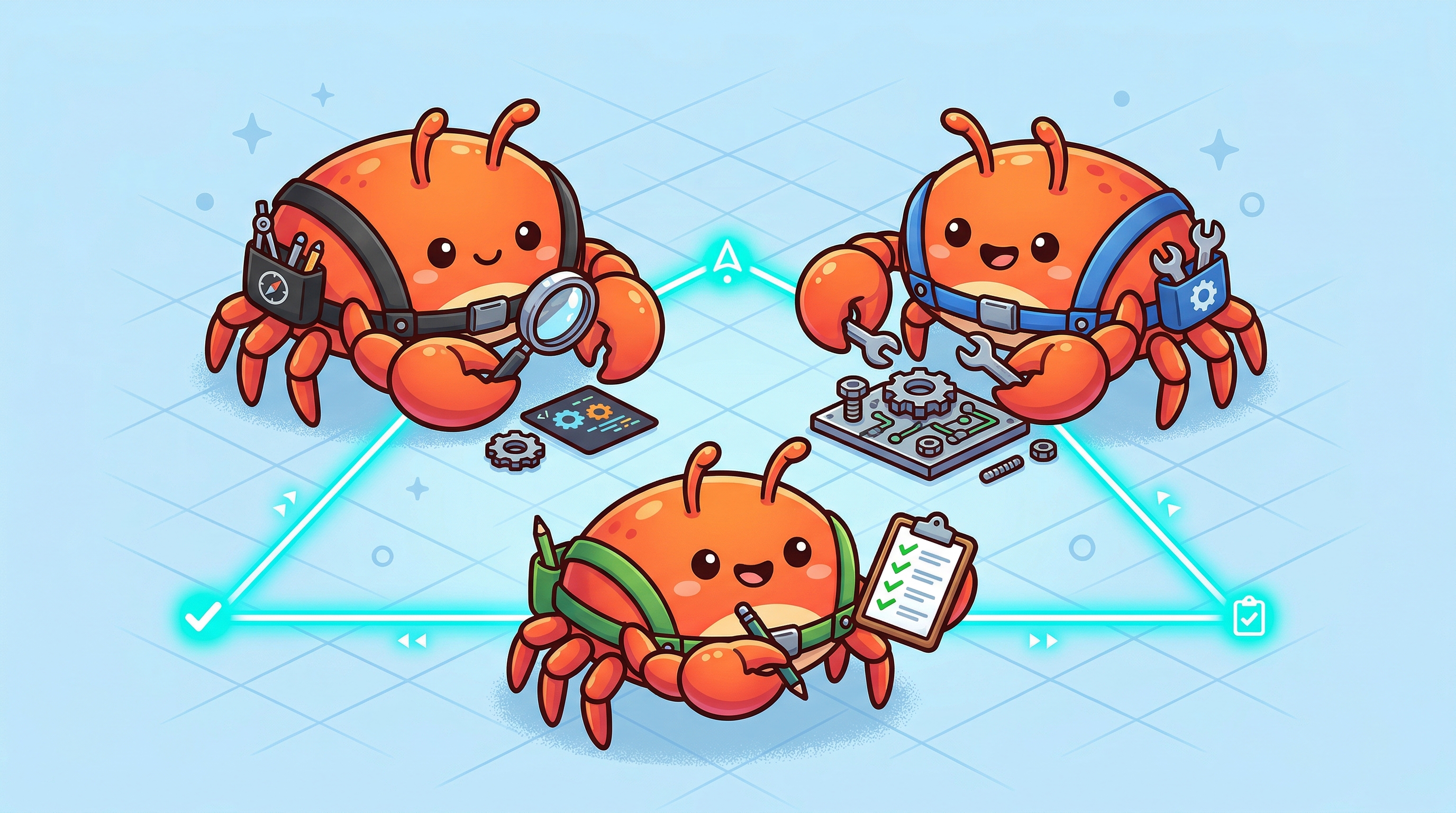
| Pattern | pi mapping |
|---|---|
| Pipeline | chain |
| Fan-out/Fan-in | parallel → main integrates |
| Expert Pool | single (selective) |
| Producer-Reviewer | chain (worker → reviewer → worker) |
| Supervisor | main agent's dynamic parallel loop |
| Hierarchical Delegation | 2-level delegation |
Output
Files generated by Harness in your project:
your-project/
├── .pi/
│   ├── agents/          # Agent definitions (name, description, tools, model)
│   │   ├── analyst.md
│   │   ├── builder.md
│   │   └── qa-inspector.md
│   ├── skills/          # Skill files
│   │   ├── analyze/
│   │   │   └── SKILL.md
│   │   └── build/
│   │       ├── SKILL.md
│   │       └── references/
│   └── prompts/         # Orchestration prompts (/commands)
│       └── build-feature.md
└── AGENTS.md            # Harness pointer (trigger rule + change log)
Use Cases — Try These Prompts
After installing, trigger any of these inside pi:
Deep Research — Build a harness for deep research: parallel agents investigating a topic from official, media, and community angles, then the main agent cross-validates and writes a report.
Website Development — Build a harness for full-stack website development as a chain: design → frontend (React/Next.js) → backend API → QA testing.
Code Review — Build a harness for comprehensive code review: parallel agents checking architecture, security, and performance, then merged into a single report.
Webtoon Production — Build a harness for webtoon episodes: a producer-reviewer chain where an artist agent generates panels and a reviewer agent enforces style consistency.
Marketing Campaign — Build a harness for marketing campaigns: research the market, write ad copy, design visual concepts, and plan A/B tests with iterative review.
Requirements
- pi coding agent installed (
npm install -g --ignore-scripts @earendil-works/pi-coding-agent) - A model provider authenticated in pi (
/loginor an API key such asANTHROPIC_API_KEY) - The bundled
subagentextension (installed automatically with this package) — no extra setup
Security note: the
subagenttool runs project-local agents (.pi/agents/*.md) only when invoked withagentScope: "both"/"project", and prompts for confirmation in interactive mode. Only enable for repositories you trust. Seeextensions/subagent/README.md.
Built with Harness (Claude Code original)
The original Claude Code harness was validated in a controlled A/B study and shipped a large catalog. Those artifacts target Claude Code; the methodology carries over to this pi port.
- revfactory/harness-100 — 100 production-ready agent team harnesses across 10 domains (EN + KO).
- revfactory/claude-code-harness — A/B experiment (n=15): +60% avg quality (49.5 → 79.3), 15/15 win-rate, −32% variance (author-measured, third-party replications pending).
Full paper: Hwang, M. (2026). Harness: Structured Pre-Configuration for Enhancing LLM Code Agent Output Quality.
FAQ
Q1. How is this different from the original Harness?
A. Same factory, different runtime. The original revfactory/harness is a Claude Code plugin that generates .claude/agents/ + .claude/skills/ and relies on Claude Code's native agent teams (TeamCreate/SendMessage/TaskCreate). This package is a pi-only port: it generates .pi/agents/ + .pi/skills/ + .pi/prompts/ and implements collaboration through the bundled subagent extension (single/parallel/chain) plus _workspace/ file handoff, because pi has no built-in subagents or live team messaging.
Q2. pi has no subagents — how do agent teams work?
A. This package bundles a subagent extension that spawns a separate pi process per delegation, each with an isolated context window. The main agent acts as coordinator: it fans out with parallel, chains dependent steps with chain (passing {previous}), and integrates results itself (pi has no team-consensus channel). See skills/harness/references/agent-design-patterns.md for the full Claude→pi mapping.
Q3. Can I reuse my existing Claude Code skills?
A. Yes. pi can load skills from other harnesses by adding their directories to settings.json (e.g. "skills": ["~/.claude/skills"]). Agent Skills standard SKILL.md files are largely portable between Claude Code and pi.
Q4. How is this different from pi-harness-factory?
A. They solve different problems and are complementary.
pi-harness-factoryis a single-agent profile manager: it defines "working modes" (presets liketdd,safe-coder,code-reviewer,researcher) that constrain one agent's tool access, mutation scope, validation strictness, and safety gates. It answers "what is this one agent allowed to do, and how strict should it be?" — a runtime-configuration factory (guardrails).pi-agent-harness(this project) is a multi-agent team factory: from one domain sentence it generates a team of specialist agents (.pi/agents/), their skills (.pi/skills/), and orchestration prompts (.pi/prompts/) that fan out and chain work via the bundledsubagenttool. It answers "how do I decompose this domain into a coordinated team of agents?" — a team-architecture factory.
pi-harness-factory |
pi-agent-harness (this) |
|
|---|---|---|
| Unit of work | One agent, many modes | Many agents, one team |
| Produces | JSON profiles (.pi/harness-factory/) |
Agents + skills + orchestration prompts (.pi/) |
| Focus | Guardrails / constraints | Decomposition / orchestration |
| Layer | Runtime-configuration factory | Team-architecture factory |
You can use both: constrain each generated agent with pi-harness-factory modes while pi-agent-harness designs and orchestrates the team.
License
Apache 2.0