


While NRG is at
v0, breaking changes can land in any release and will not bump the major version. Pin an exact version and review the release notes before upgrading.
NRG
Build Node-RED nodes with Vue 3, TypeScript, JSON Schemas, Vite and Vitest.
Quick Start
Scaffold a new project with everything wired up:
pnpm create @bonsae/nrgTo add NRG to an existing project, install it alongside its build-time peers:
pnpm add -D @bonsae/nrg node-red vue vite vitestAll of these are dev dependencies, needed only at build time.
@bonsae/nrgis the authoring toolkit; a built node depends only on@bonsae/nrg-runtime(declared automatically in the generateddist/package.json), never the toolkit. Vue is included as a dependency of the runtime and served automatically to the editor.
Node-RED Resolution
The vite plugin needs a Node-RED instance for the dev server. It resolves it in this order:
runtime.version— if specified in the plugin config, downloads that exact version vianpx(overrides any locally installed version)- Local
node_modules— ifnode-redis installed as a dependency, it is used directly (fastest) - Fallback — downloads the latest
node-redvianpx
Installing node-red as a dev dependency is recommended for fast, reliable dev server startup across all platforms (especially Windows). If you need a specific version (e.g., a beta), set runtime.version in the plugin config instead.
vite.config.ts
import { defineConfig } from "vite";
import { nrg } from "@bonsae/nrg/vite";

export default defineConfig({
  plugins: [nrg()],
});
src/shared/schemas/my-node.ts
import { defineSchema, SchemaType } from "@bonsae/nrg/schema";

export const ConfigsSchema = defineSchema(
  {
    name: SchemaType.String({ default: "" }),
    prefix: SchemaType.String({ default: "hello" }),
  },
  { $id: "my-node:configs" },
);

export const InputSchema = defineSchema(
  { payload: SchemaType.String() },
  { $id: "my-node:input" },
);

export const OutputSchema = defineSchema(
  { payload: SchemaType.String() },
  { $id: "my-node:output" },
);
src/server/nodes/my-node.ts
NRG supports two ways to define nodes:
| Functional API | Class API |
|---|---|
| |
| Automatic type inference, less boilerplate | Custom methods, inheritance, mixins |
src/server/index.ts
import { defineModule } from "@bonsae/nrg/server";
import MyNode from "./nodes/my-node";

export default defineModule({
  nodes: [MyNode],
});
See the getting started guide for the full walkthrough, or the node-red-vue-template repo for a reference example.
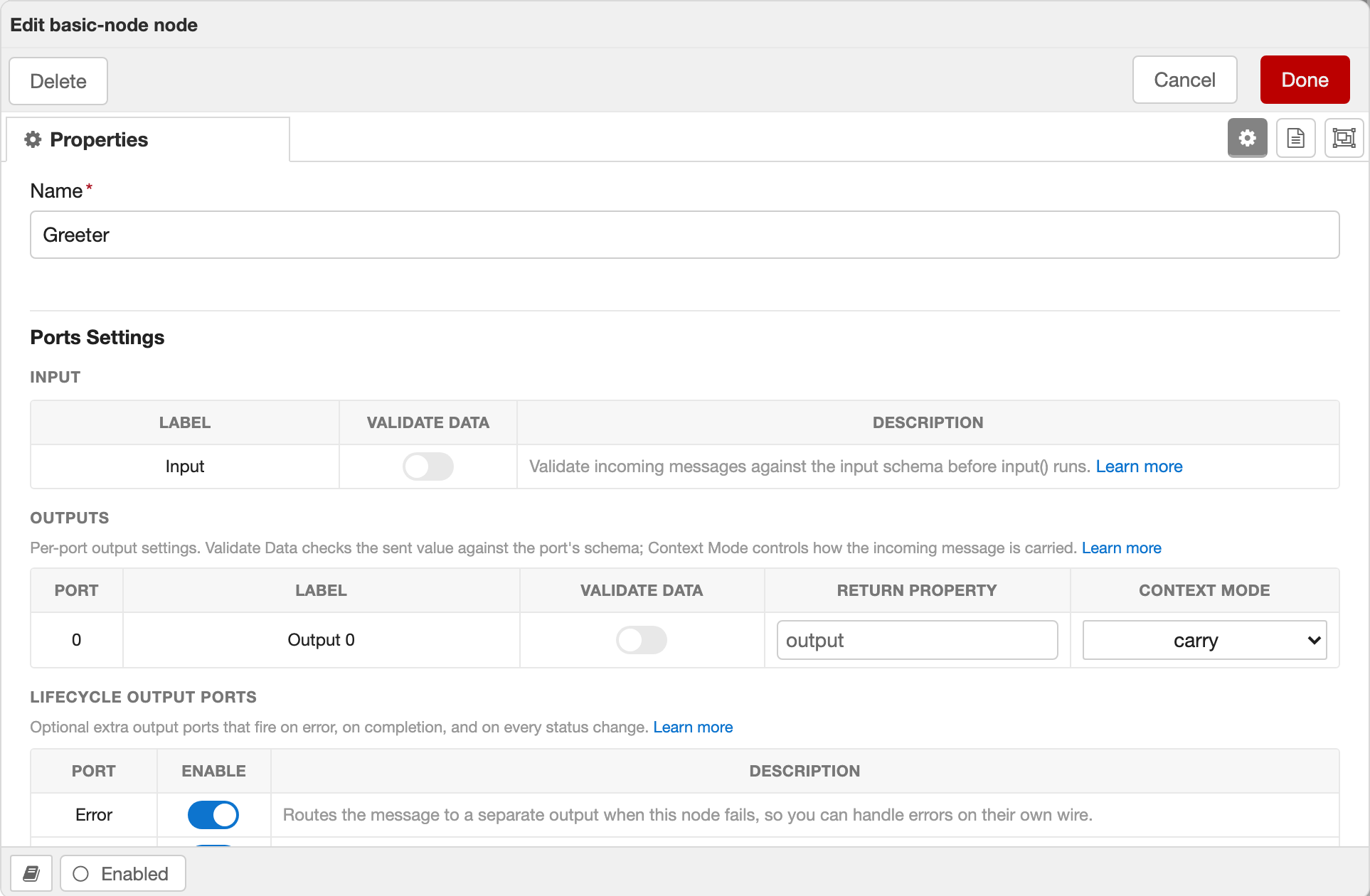
The generated editor form
NRG builds the node's edit dialog from your schema — no HTML or jQuery. Your config fields render first, then a Ports Settings section (input/output validation, return key, and per-port context modes) and a Lifecycle Output Ports section (error / complete / status):
Testing
NRG provides five test libraries and ships most test infrastructure as direct dependencies, so you only need to install vitest plus any optional peer dependencies:
pnpm add -D vitestOptional peer dependencies:
| Package | When to install |
|---|---|
@vitest/browser-playwright |
Component tests (Playwright browser provider for Vitest) |
playwright |
Component tests or E2E tests (direct import in test files) |
vitest-browser-vue |
Component tests (render helper for Vue components) |
@vitest/coverage-v8 |
Coverage with --coverage (V8 provider) |
@vitest/coverage-istanbul |
Coverage with --coverage (Istanbul provider) |
@bonsae/nrg/test/server/unit— server-side unit tests@bonsae/nrg/test/server/integration— server-side integration tests (real Node-RED runtime)@bonsae/nrg/test/client/unit— client-side unit tests (TypeScript logic)@bonsae/nrg/test/client/component— client component tests (Vue + browser)@bonsae/nrg/test/client/e2e— browser E2E tests (Playwright)
Server Unit Tests
Instantiate your node with mocked Node-RED internals and exercise its full lifecycle in-process:
// vitest.server.unit.config.ts
import { defineConfig, mergeConfig } from "vitest/config";
import { defaultConfig } from "@bonsae/nrg/test/server/unit/config";

export default mergeConfig(
  defaultConfig,
  defineConfig({
    test: {
      include: ["tests/server/unit/**/*.test.ts"],
    },
  }),
);
// tests/server/unit/my-node.test.ts
import { describe, it, expect } from "vitest";
import { createNode } from "@bonsae/nrg/test/server/unit";
import MyNode from "../../../src/server/nodes/my-node";
describe("my-node", () => {
it("should process messages", async () => {
const { node } = await createNode(MyNode, {
config: { prefix: "hello" },
});
await node.receive({ payload: "world" });
expect(node.sent(0)).toEqual([
{ payload: "world", output: { payload: "hello: world" } },
]);
});
});Server Integration Tests
Boot a real, headless Node-RED runtime, deploy your nodes, and drive them with real messages — verifying config-node resolution, credentials, wiring, and context, none of which unit mocks can exercise. Integration tests live in tests/server/integration, separate from tests/server/unit. Add node-red as a dev dependency, then:
// vitest.server.integration.config.ts
import { defineConfig, mergeConfig } from "vitest/config";
import { defaultConfig } from "@bonsae/nrg/test/server/integration/config";

export default mergeConfig(
  defaultConfig,
  defineConfig({
    test: {
      include: ["tests/server/integration/**/*.test.ts"],
    },
  }),
);
// tests/server/integration/my-node.test.ts
import { describe, it, expect, beforeAll, afterAll } from "vitest";
import {
startRuntime,
type Runtime,
} from "@bonsae/nrg/test/server/integration";
import MyNode from "../../../src/server/nodes/my-node";
describe("my-node (integration)", () => {
let runtime: Runtime;
beforeAll(async () => {
runtime = await startRuntime({ nodes: [MyNode] });
});
afterAll(async () => {
await runtime.stop();
});
it("processes input in a real runtime", async () => {
const flow = runtime.flow();
const node = flow.addNode(MyNode, { prefix: "hello" });
await flow.deploy();
await node.receive({ payload: "world" });
const out = (await node.read()) as { output: { payload: string } };
expect(out.output.payload).toBe("hello: world");
});
});Client Unit Tests
Test client-side TypeScript logic (validation, utilities) with mocked RED and $ globals:
// vitest.client.unit.config.ts
import { defineConfig, mergeConfig } from "vitest/config";
import { defaultConfig } from "@bonsae/nrg/test/client/unit/config";

export default mergeConfig(
  defaultConfig,
  defineConfig({
    test: {
      include: ["tests/client/unit/**/*.test.ts"],
    },
  }),
);
// tests/client/unit/my-util.test.ts
import { describe, it, expect } from "vitest";
import { myUtil } from "../../../src/client/my-util";
describe("myUtil", () => {
it("works with RED globals", () => {
expect(myUtil("input")).toBe("expected");
});
});Client Component Tests
Test your Vue editor components with mocked Node-RED globals. Components that use useFormNode() receive their node data via Vue's provide/inject — use createNode().provide to supply it in tests:
// vitest.client.component.config.ts
import { defineConfig, mergeConfig } from "vitest/config";
import { defaultConfig } from "@bonsae/nrg/test/client/component/config";

export default mergeConfig(
  defaultConfig,
  defineConfig({
    test: {
      include: ["tests/client/component/**/*.test.ts"],
    },
  }),
);
// tests/client/component/my-form.test.ts
import { describe, test, expect, vi } from "vitest";
import { render } from "vitest-browser-vue";
import { createNode } from "@bonsae/nrg/test/client/component";
import MyForm from "../../../src/client/components/my-form.vue";
describe("MyForm", () => {
test("renders fields from injected node", async () => {
const { provide } = createNode({
name: "test",
url: "https://example.com",
});
const screen = render(MyForm, {
global: { provide },
});
await expect.element(screen.getByDisplayValue("test")).toBeInTheDocument();
});
test("accesses node id for API calls", async () => {
const fetchSpy = vi.fn().mockResolvedValue({ ok: true, json: () => ({}) });
vi.stubGlobal("fetch", fetchSpy);
const { node, provide } = createNode({ name: "test" });
render(MyForm, { global: { provide } });
await vi.waitFor(() => {
expect(fetchSpy).toHaveBeenCalledWith(`my-api/${node.id}`);
});
});
test("asserts RED.editor API calls", async () => {
const { RED, provide } = createNode();
render(MyForm, { global: { provide } });
expect(RED.editor.createEditor).toHaveBeenCalled();
});
});Client E2E Tests
Drive the real editor in a live Node-RED instance with Playwright — schema-driven forms, validation, TypedInput, config selectors, and i18n. Install playwright, then point a global setup at a flow and walk the editor with NodeRedEditor:
// vitest.client.e2e.config.ts
import { defineConfig } from "vitest/config";
import { defaultConfig } from "@bonsae/nrg/test/client/e2e/config";

export default defineConfig({
  test: {
    ...defaultConfig,
    globalSetup: "tests/client/e2e/global-setup.ts",
    include: ["tests/client/e2e/**/*.test.ts"],
  },
});
// tests/client/e2e/global-setup.ts
import {
setup as baseSetup,
teardown as baseTeardown,
} from "@bonsae/nrg/test/client/e2e";
export async function setup() {
await baseSetup({
flow: [
{ id: "tab1", type: "tab", label: "E2E Tests" },
{ id: "n1", type: "my-node", z: "tab1", name: "", wires: [[]] },
],
});
}
export async function teardown() {
await baseTeardown();
}// tests/client/e2e/my-node.test.ts
import { describe, test, expect, beforeAll, afterAll } from "vitest";
import { chromium, type Browser } from "playwright";
import { NodeRedEditor } from "@bonsae/nrg/test/client/e2e";
describe("my-node editor", () => {
let browser: Browser;
let editor: NodeRedEditor;
beforeAll(async () => {
browser = await chromium.launch();
const port = Number(process.env.NODE_RED_PORT);
editor = new NodeRedEditor(await browser.newPage(), port);
await editor.open();
});
afterAll(() => browser.close());
test("name field round-trips", async () => {
await editor.editNode("n1");
const name = editor.field("Name");
await name.fill("Test Node");
await editor.clickDone();
await editor.editNode("n1");
expect(await name.getValue()).toBe("Test Node");
await editor.clickCancel();
});
});See the testing guide for full API reference.
Development
pnpm install
pnpm build                        # build all (server, client, vite plugin, test libs)
pnpm validate                     # type-check + lint + format check
pnpm validate:tsc                 # type-check all tsconfigs
pnpm validate:lint                # eslint
pnpm validate:format              # prettier check
pnpm test                         # run all tests
pnpm test:core:server:unit        # server unit tests
pnpm test:core:server:integration # server integration tests (real Node-RED)
pnpm test:core:client:unit        # client unit tests
pnpm test:core:client:component   # client component tests
pnpm test:core:client:e2e         # client E2E tests
pnpm docs:dev                     # start docs dev server
License
MIT