
Coro
An open workflow harness for AI-assisted software delivery
Open-source workflow runner for the full spec-to-merge path on your codebases, with layered markdown intelligence and review-gated self-improvement so conventions and lessons accumulate in git—not in one-off threads. Desktop app for macOS and Windows; CLI for automation.


Download (macOS) · Download (Windows) · Documentation · Contributing · License
Pre-1.0. APIs, workflows, and team/cloud features are still evolving. See ROADMAP.md.
Quick start (desktop)
The Coro desktop app is the recommended way to run Coro. It bundles the runner and dashboard—no terminal required for day-to-day use.
1. Install
Download the latest release from Coro-ai-framework/coro-release:
| Platform | File |
|---|---|
| macOS (Apple Silicon) | Coro-*-arm64.dmg (or .zip) |
| Windows (x64) | Coro-*-x64.exe |
Install and open Coro. The app starts a local runner in the background and opens the dashboard in a window.
2. Configure
On first launch, go to Settings and add:
- Anthropic credentials — API key, OAuth token, or Claude Code login
- Git provider + access token — GitHub, GitLab, or Bitbucket (clone repos and open PRs)
- Working directory and intelligence directory (defaults under
~/.coro/are fine)
Settings are saved to ~/.coro/config.json.
3. Run a job
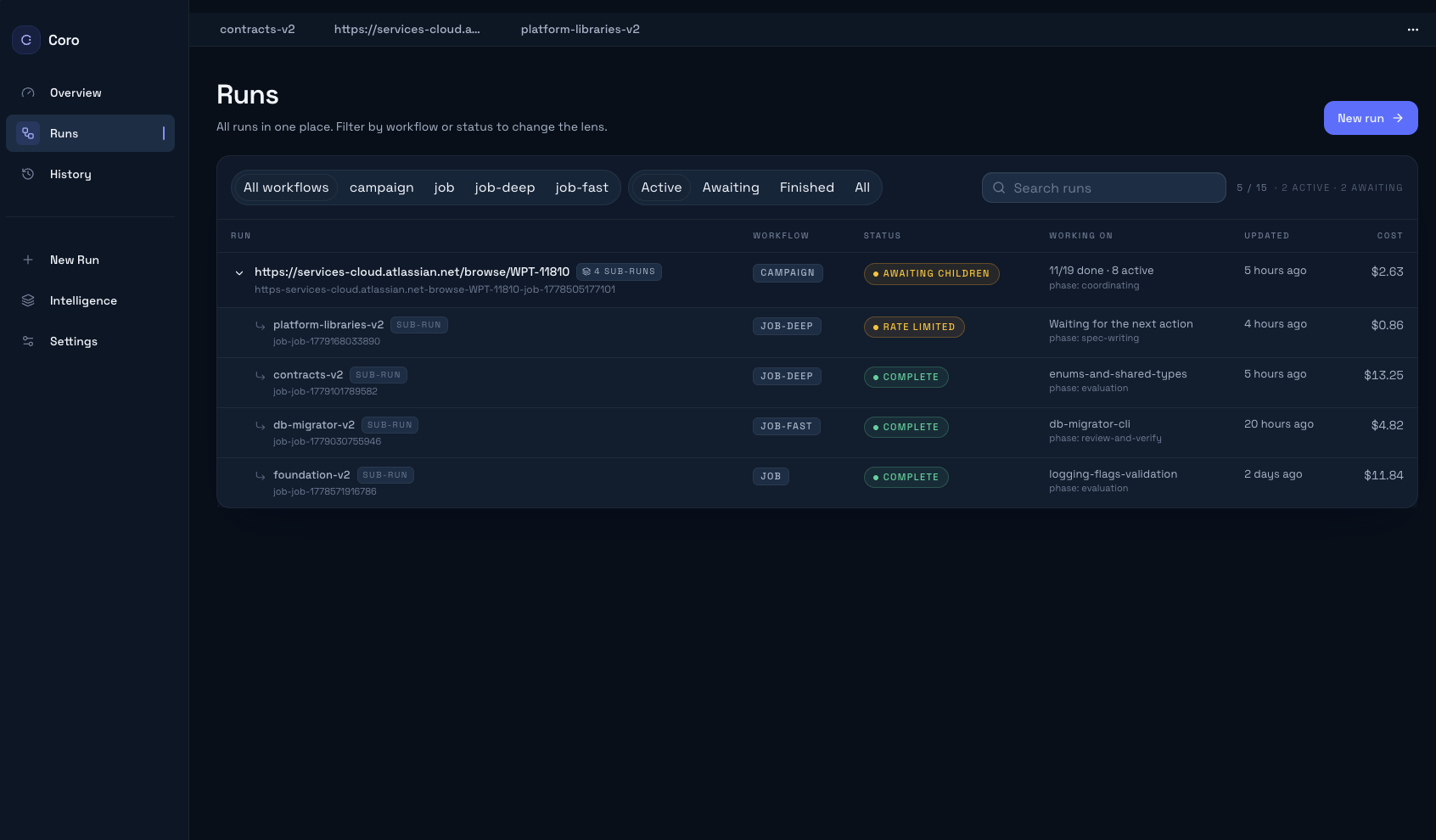
Open New Job, choose a repository, and describe the change. Watch phases progress in the UI. When the workflow finishes, Coro opens a pull request on your target repo.
Other ways to run Coro
| Method | Best for |
|---|---|
| Desktop app | Daily use on macOS and Windows |
| Browser + local runner | Linux, or hacking on Coro itself — see docs/local-setup.md |
| CLI | Scripts, CI, automation — requires a running runner (CLI reference) |
Browser + runner (developers)
From a built clone of this repository:
pnpm install && pnpm -r build
pnpm start    # or: node packages/runner/dist/cli/index.js start
Opens http://localhost:3000/dashboard/ in your browser (suppressed in headless/SSH; use --no-open or CORO_NO_OPEN=1).
Contributors: use
pnpm, notnpm— this is a pnpm workspace. See CONTRIBUTING.md and docs/local-setup.md.
How Coro works
Coro is not an IDE and not a single chat agent. Markdown files are the intelligence; TypeScript is the plumbing.
Workflow phases — A typical implementation job runs spec → plan → code (with an in-phase code reviewer) → merge coordination → evaluation on the merged result. Jobs park on external events (PR review, webhooks) and resume when the runner is notified.
Layered intelligence — Each job materialises overlays into _intelligence/:
┌─────────────────────────────────────────────────────────────┐
│ Repo overlay        <repoCheckout>/.coro/                   │
├─────────────────────────────────────────────────────────────┤
│ Tenant overlay      localDir | gitRemote | cloud            │
├─────────────────────────────────────────────────────────────┤
│ Base intelligence   @coro-ai/intelligence-base/layer/          │
└─────────────────────────────────────────────────────────────┘| Layer | What it carries |
|---|---|
| Base | Generic agents, workflows, skills (shipped with Coro) |
| Tenant | Team conventions, memory, service facts |
| Repo | Per-codebase overrides in .coro/ |
Review-gated self-improvement — Agents record insights during runs; the evaluator can bundle vetted updates into propose_change PRs against your overlay (memory, skills, agent instructions). Nothing silently rewrites canonical behaviour.
Deeper tour: docs/architecture-overview.md · Monorepo engineering: CLAUDE.md
What makes Coro different
Coro runs your delivery lifecycle, not a chat thread. Most AI coding today lives in a chat window. Coro is built around the feature instead. Each unit of work — a ticket, a spec, a bug — moves through the real software delivery lifecycle (spec → plan → code → review → evaluate → merge) as a durable, resumable job. It parks and resumes across PRs and webhooks, asks for humans only at the decisions that matter, and commits what it learned back to git. The session is the feature — and it follows the same delivery pipeline your team already trusts.
| Capability | What Coro does | Why it's distinctive |
|---|---|---|
| Harness, not an IDE or chat | Orchestrates a full delivery pipeline alongside your coding agent — it does not replace your editor or a single chat session | Composes with Claude Code and other executors instead of competing as another IDE or prompt box |
| Feature-scoped runs across the SDLC | Each job is a durable, multi-phase run tied to a feature or ticket that walks spec → plan → code → review → evaluate → merge and parks/resumes across days and PRs | The unit of work is the feature and its delivery pipeline — not an ephemeral chat thread you babysit prompt-by-prompt |
| Whole delivery pipeline, not just codegen | One run produces a spec, a plan, a reviewed PR, and post-merge evaluation — SDLC artifacts, not a pile of unreviewed edits in your working tree | Covers planning, review, merge coordination, and verification — not only the moment code is generated |
| Fixed multi-agent roles | Separate planner, coder, in-phase code reviewer, PR gatekeeper, and evaluator agents with distinct responsibilities | Role separation and checkpoints replace a single agent improvising every step in one session |
| Workflow lanes | FAST, STANDARD, and DEEP lanes route work by scope and risk; switch lanes in place mid-run | Lightweight fixes skip deep review; migrations and new APIs get analysis and QA — without one-size-fits-all prompting |
| Markdown intelligence | Agents, workflows, skills, and memory live as git-tracked markdown — behavior is authored, not hardcoded in the runner | Teams own and review how agents behave; the runner is dumb plumbing that follows the contract |
| Layered intelligence | Base, tenant, and repo overlays materialise per job with append/last-wins merge rules | Versioned, reviewable team knowledge — not ephemeral chat memory or a single rules file |
| Review-gated self-improvement | Agents propose memory, skill, and agent-instruction updates via propose_change PRs — nothing silently rewrites canonical behaviour |
Institutional learning accumulates in git with human review; other tools rarely gate knowledge changes behind PRs |
| Campaign orchestration | One initiative fans out to dependency-aware child jobs with integration and aggregation phases | Multi-repo or multi-issue delivery with explicit coordination — beyond parallel background agents on unrelated tasks |
| Event-driven parking | Jobs park on PR review, webhooks, and human approval; zero LLM cost while waiting (polling in solo, webhooks in hybrid) | Long-running delivery fits real review cycles instead of burning tokens in an active chat session |
| Automatic rate-limit handling | On provider rate limits, jobs enter awaiting-rate-limit and auto-resume when the window clears |
Runs survive transient API limits instead of failing mid-pipeline |
| PR preview gate | Humans review the diff before a PR is opened; merge requires explicit human approval | Humans gate the decisions that matter — spec, plan, PR preview, merge — not every keystroke |
| Runner-enforced guardrails | PR size limits, required descriptions, merge approval, markdown-only proposals, and bash/path sandboxing enforced by the harness | Policy lives in the runner, not only in the model's prompt |
| Provider-agnostic plugins | SCM, tracker, and LLM-executor plugins (GitHub, Bitbucket, GitLab; Jira, Linear, GitHub Issues; Anthropic, OpenAI) with per-phase model selection | Swap git hosts, issue trackers, and models without forking the harness |
| Language-agnostic skills | Language conventions ship as on-demand skill files — add a language by adding a skill, not changing runner code | Same harness works across Go, .NET, TypeScript, Python, and more |
| Per-run cost tracking | Token usage and cost surfaced per run and per phase in the dashboard | Teams see the economics of agentic delivery by feature, not opaque session totals |
| Self-hostable open core | Local runner, dashboard, and SQLite state on your machine; BUSL-1.1 (Apache-2.0 in 2029) | Run on your infrastructure with intelligence in your git repos — not a closed cloud-only agent VM |
Plugin architecture
The runner is provider-agnostic. Anything that varies by Git host, issue tracker, or LLM is implemented as a plugin loaded at startup from ~/.coro/config.json (and installable via coro plugin install).
| Kind | Role | Examples in this repo |
|---|---|---|
| SCM | Clone repos, open/update PRs, webhooks, merge polling | Built-in GitHub (packages/runner/src/plugins/builtin/github/); reference @coro-ai/plugin-gitlab |
| Tracker | Tickets, comments, transitions, job triggers | Built-in Jira (packages/runner/src/plugins/builtin/jira/) |
| Executor | Run workflow phases against an LLM (tools, sessions, models) | @coro-ai/llm-anthropic, @coro-ai/llm-openai |
Workflow YAML can pin a provider per phase (provider: / model aliases). Jobs can override defaults with set_job_params({ scm: 'gitlab', tracker: 'jira' }).
Contributing a new integration — Implement a separate package that depends on @coro-ai/plugin-sdk:
- SCM / tracker — extend
ScmPluginBaseorTrackerPluginBase; shipcoro-plugin.json, optional MCP server wiring, and optionalintelligence/snippets for the overlay. - LLM — extend
ExecutorPluginBaseand return aPhaseExecutor(see the Anthropic/OpenAI packages for the pattern).
Scaffold locally with coro plugin init <id>, or study packages/plugin-gitlab as a full SCM example. SDK reference: packages/plugin-sdk/README.md. Extension contract notes: docs/workflow-extension-contract.md.
Deployment shapes
| Mode | What runs where |
|---|---|
| Solo | Runner + dashboard + SQLite on your machine (desktop or local runner) |
| Team (hybrid) | Per-developer runner + shared cloud control plane (commercial; see NOTICE.md) |
CLI reference
The CLI talks to a running runner (started by the desktop app or coro start). Useful for automation—not required for normal use.
| Command | Purpose |
|---|---|
coro start [--no-open] [--port N] |
Start runner + serve dashboard |
coro job --repo … --description … |
Submit a job |
coro jobs / coro status <id> / coro logs <id> --follow |
Inspect jobs |
coro resume <id> / coro message <id> <text> |
Control running jobs |
coro init / coro login |
Scripted setup / cloud pairing |
After pnpm -r build, the entrypoint is packages/runner/dist/cli/index.js. Run any command with --help for flags.
Config schema: packages/runner/src/config/local-config.ts (~/.coro/config.json).
Repository layout
packages/
├── desktop-electron/     ← macOS + Windows desktop app
├── runner/               ← CLI, job engine, MCP tools, REST server
├── dashboard/            ← React UI (embedded in desktop + served by runner)
├── intelligence-base/    ← Base agents, workflows, skills, memory templates
├── plugin-sdk/           ← SDK for SCM, tracker, and executor plugins
├── plugin-gitlab/        ← Reference SCM plugin (GitLab)
├── llm-anthropic/        ← Executor plugin (Claude Agent SDK)
├── llm-openai/           ← Executor plugin (OpenAI)
└── cloud-protocol/       ← Shared runner ↔ cloud protocol types

runner/src/plugins/builtin/   ← Built-in github (SCM) and jira (tracker)

packages/runner/src/cloud/   ← Commercial control plane (see NOTICE.md)
Generic intelligence lives only in packages/intelligence-base/layer/.
Developing Coro
pnpm install && pnpm -r build
pnpm test && pnpm typecheck| Task | Command |
|---|---|
| Run runner from source | pnpm dev |
| Run desktop from source | pnpm --filter @coro-ai/desktop-electron dev |
| Work on a plugin | pnpm --filter @coro-ai/plugin-gitlab test (or your package) · plugin-sdk README |
| Package desktop | See docs/desktop-packaging.md |
Full setup, hybrid/cloud, and troubleshooting: docs/local-setup.md.
Community & license
We need your help — extend SCM, tracker, and LLM plugins, and run Coro on real projects (different languages, repos, and tooling). See ROADMAP.md → Help wanted.
- Contributing · Code of conduct · Security
- ROADMAP.md · NON-GOALS.md
- License: BUSL-1.1 (converts to Apache-2.0 on 2029-05-19) — see NOTICE.md for the open-core split