
@eleven-labs/nest-profiler-validator

Powered & maintained by Eleven Labs







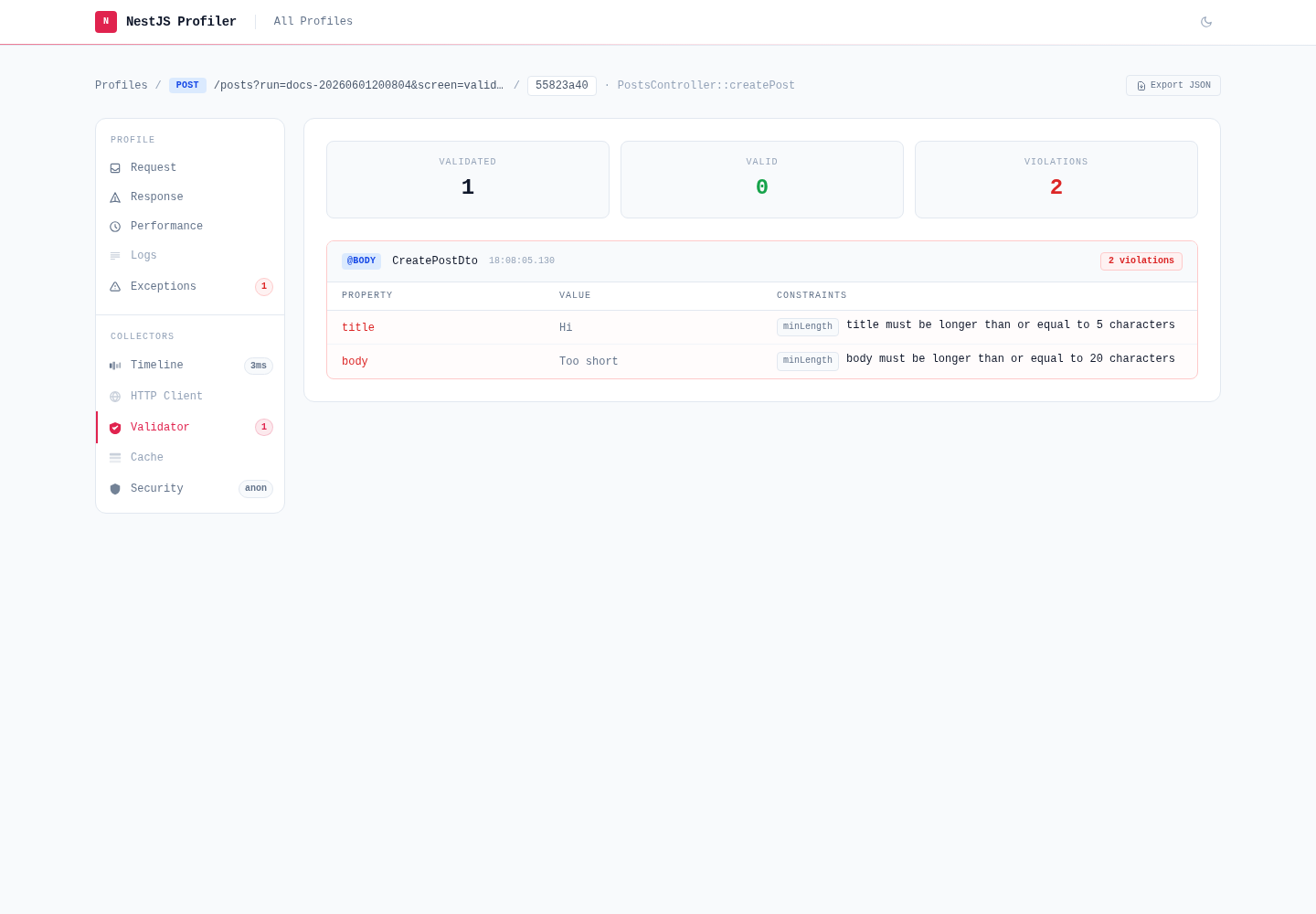
@eleven-labs/nest-profiler-validator captures every DTO validation result (valid or invalid) and displays it in a dedicated Validator panel, inspired by Symfony's Web Profiler validator tab.
It is validator-agnostic: instead of being tied to class-validator, it wraps any validation PipeTransform and normalizes failures through pluggable, duck-typed extractors. Built-in extractors cover class-validator, nestjs-zod, and a generic HttpException fallback.
Installation
pnpm add @eleven-labs/nest-profiler-validatorThen install the validator you use:
# class-validator (default)
pnpm add class-validator class-transformer

# …or nestjs-zod
pnpm add nestjs-zod zodclass-validator/class-transformer are not peer dependencies — they are only required when you rely on the default class-validator pipe.
Setup
ValidatorCollectorModule.forRoot() registers ProfilerValidationPipe as the global APP_PIPE. It wraps your validation pipe — do not also register a separate global ValidationPipe.
With class-validator (default)
When pipe is omitted, a class-validator ValidationPipe is built from validationPipeOptions:
import { ValidatorCollectorModule } from '@eleven-labs/nest-profiler-validator';

@Module({
  imports: [
    ProfilerModule.forRoot({ isGlobal: true }),
    ValidatorCollectorModule.forRoot({
      validationPipeOptions: {
        whitelist: true, // remove extra properties
        transform: true, // transform payload to DTO class
        // any other ValidationPipe options
      },
    }),
  ],
})
export class AppModule {}
With nestjs-zod
Pass your own pipe via pipe; class-validator is never loaded:
import { ValidatorCollectorModule } from '@eleven-labs/nest-profiler-validator';
import { ZodValidationPipe } from 'nestjs-zod';

@Module({
  imports: [
    ProfilerModule.forRoot({ isGlobal: true }),
    ValidatorCollectorModule.forRoot({ pipe: new ZodValidationPipe() }),
  ],
})
export class AppModule {}
A NestJS app uses a single global validation strategy, so use one validator at a time.
Options
| Option | Type | Description |
|---|---|---|
enabled |
boolean |
Default true. When false, no pipe is installed. |
pipe |
PipeTransform |
The validation pipe to wrap. Defaults to a class-validator pipe built from the option below. |
validationPipeOptions |
ValidationPipeOptions |
Forwarded to the default class-validator pipe when pipe is omitted. |
extractors |
ValidationViolationExtractor[] |
Override the extractor chain. Defaults to [classValidator, zod, generic]. |
Prerequisite: value import for DTO types
For reflect-metadata to emit the DTO class constructor as parameter metadata, use a value import (not import type) on the DTO in your controllers:
// ✓ value import — emits reflect-metadata
import { CreateProductDto } from './dto/create-product.dto';

// ✗ type-only import — metadata is erased, metatype shows as 'Function'
import type { CreateProductDto } from './dto/create-product.dto';
What it captures
For each @Body(), @Query(), or @Param() parameter using a DTO class:
| Field | Description |
|---|---|
source |
body, query, param, or custom |
dtoClass |
DTO class name (e.g., CreateProductDto) |
status |
valid or invalid |
violationCount |
Total number of constraint violations |
violations |
Per-property breakdown with constraint names and messages |
Each violation entry includes:
property— the property path that failed (nested properties use dot notation)value— the rejected value (when available)constraints— map of constraint name → message (e.g.,{ isNotEmpty: "name should not be empty" })
How it works
ProfilerValidationPipe implements PipeTransform and wraps an inner pipe:
- On
transform(), it delegates to the inner pipe. On success it records avalidentry. - On failure it runs the configured extractors over the thrown error, records an
invalidentry with the normalized violations, then re-throws the original exception.
Extractors are tried in order; the first to recognize the error wins:
- class-validator —
createClassValidatorPipe()attaches the rawValidationError[]to the thrown exception (under a private symbol) so the full property/constraint tree is recovered. - nestjs-zod / zod — reads
ZodError.issues(viagetZodError()or a bareZodError). - generic — any
HttpExceptionexposing amessagestring/array (the universal fallback).
Reading the active profile uses CLS, so capture is concurrent-safe across requests.
Custom extractors
To support another validator, implement ValidationViolationExtractor and pass it via extractors:
import type { ValidationViolationExtractor } from '@eleven-labs/nest-profiler-validator';

const myExtractor: ValidationViolationExtractor = {
  extract({ error }) {
    // return ViolationEntry[] if recognized, otherwise null to defer to the next extractor
    return null;
  },
};

ValidatorCollectorModule.forRoot({ pipe: myPipe, extractors: [myExtractor] });
Toolbar badge
- All valid: number of validated DTOs (e.g.,
1) - With violations: total violation count (e.g.,
3 violations)
Part of the nest-profiler toolkit · Powered & maintained by Eleven Labs