
Licence
MIT
Version
0.2.0
Deps
4
Size
114 kB
Vulns
0
Weekly
0
h8 — Hamravesh CLI
Command-line interface for Hamravesh, the Iranian cloud platform.
Install
Requires Node.js >= 22 and kubectl (for h8 kubectl).
npm (global)
npm install -g @erfanium/h8-cli
h8 --help
npx (no install)
npx @erfanium/h8-cli app listFrom source
git clone https://github.com/erfanium/h8-cli.git
cd cli
npm install
npm run build
npm link
h8 --help
Uninstall
npm uninstall -g @erfanium/h8-cliSetup
export H8_API_KEY=your-api-key
export H8_ORGANIZATION=your-org

# or persist to disk
h8 login <api-key> --org <name>

# verify
h8 app list
Get an API key from the Hamravesh Console under your account settings.
Quick Start
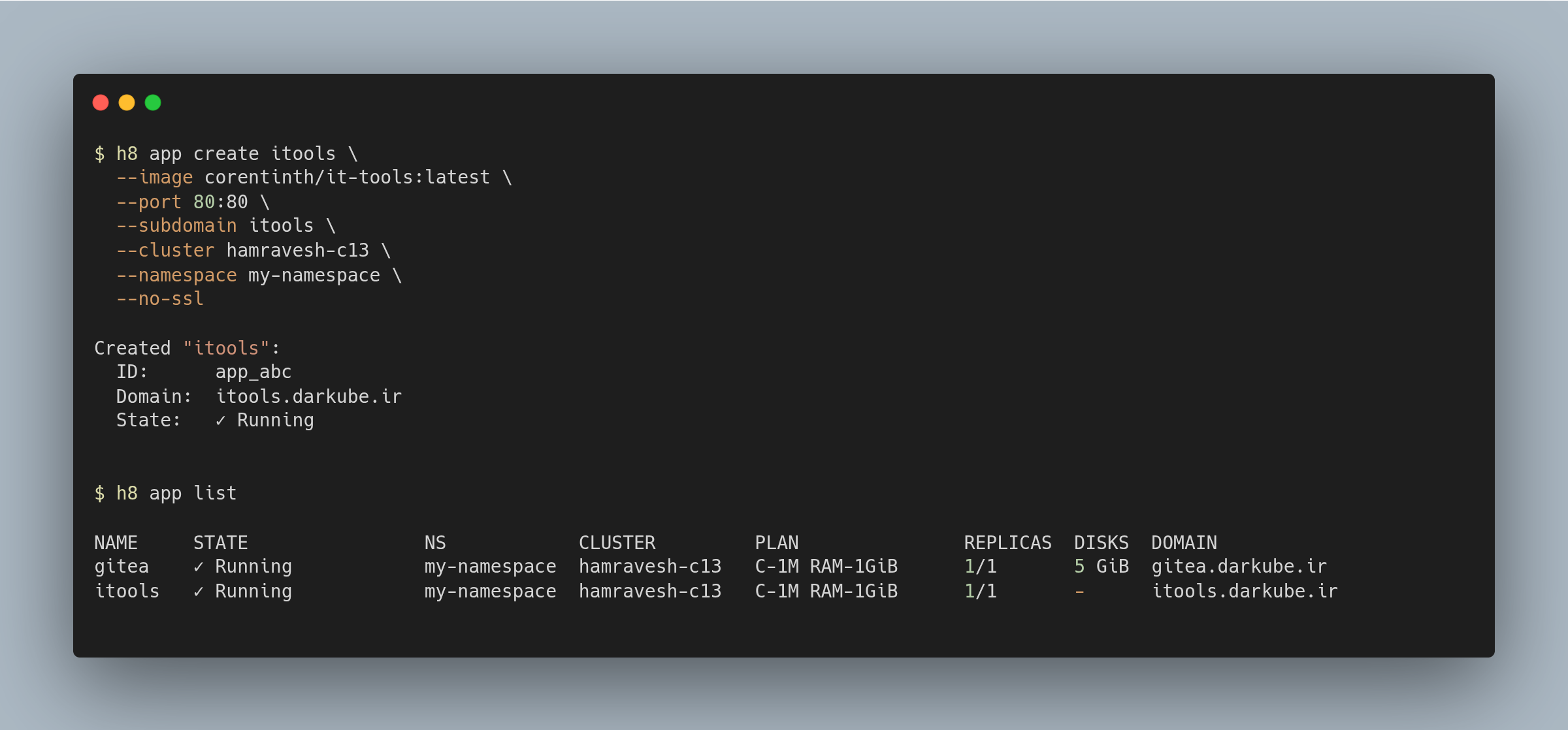
Deploy IT-Tools — 50+ developer utilities in one page:
# see what's available
h8 cluster list
h8 namespace list

# deploy
h8 app create itools \
  --image corentinth/it-tools:latest \
  --port 80:80 \
  --subdomain itools \
  --cluster hamravesh-c13 \
  --namespace my-namespace \
  --no-ssl

# wait a few seconds, then verify
h8 app list
h8 app describe itools
h8 app pods itools
h8 app logs itools

# it's live at https://itools.darkube.ir
Add a disk, change envs, scale up:
h8 set disk itools 5 /data
h8 set env itools DEBUG=true
h8 set replicas itools 2
Tear it down:
h8 app delete itoolsCommands
Apps
h8 app list [--json] [--limit=N]        List apps
h8 app describe <name|id> [--json]      Show app details
h8 app create <name> [flags]            Create a new app
h8 app restart <name>                   Restart an app
h8 app start <name>                     Start a stopped app
h8 app stop <name>                      Stop an app
h8 app delete <name>                    Delete an app
h8 app logs <name> [--tail=N] [--json]  View app logs
h8 app events <name> [--json]           Watch deployment events (WebSocket)
h8 app pods <name> [--json]             List running pods
Mutations (kubectl-style set)
h8 set image <app> <repo>[:<tag>]       Change image
h8 set replicas <app> <count>           Scale replicas
h8 set env <app> KEY=VALUE [...]        Set environment variables
h8 set disk <app> <size> <path>         Attach persistent disk
Infrastructure
h8 cluster list [--json]                List available clusters
h8 namespace list [--json]              List namespaces
Builds & Contexts
h8 build list <app> [--json]            List builds for an app
h8 build logs <build-id> [--json]       Show build details
h8 context list [--json]                List deploy contexts
h8 context describe <name> [--json]     Show context details
kubectl
h8 login kubectl [--email X] [--password Y]   Get a k8s OIDC token
export H8_KUBECTL_TOKEN=<token>

h8 kubectl get pods                            Run kubectl commands
h8 kubectl describe pod <name>
h8 kubectl logs <pod-name>
h8 kubectl get svc
h8 kubectl fetches a kubeconfig from the API, injects your token, and passes all remaining arguments to the real kubectl binary. No files are written to ~/.kube — fully stateless.
JSON Output
Append --json to any command for machine-readable output:
h8 app list --json
h8 app describe my-app --json
h8 app events my-app --json
Environment Variables
| Variable | Description |
|---|---|
H8_API_KEY |
Hamravesh API key |
H8_ORGANIZATION |
Organization name |
H8_KUBECTL_TOKEN |
OIDC id_token for kubectl |
License
MIT