

GTKX
The React framework for Linux.
Build GTK4 and Adwaita apps in TypeScript, with React components and hooks driving GNOME's own widgets. What you ship is a GNOME app.





Homepage · Documentation · Examples · Contributing
GTKX generates fully typed bindings for the entire GTK4 and Adwaita surface directly from GObject-Introspection. On top of those bindings you get the React programming model: components and hooks driving GObject instances, with Fast Refresh while you develop.
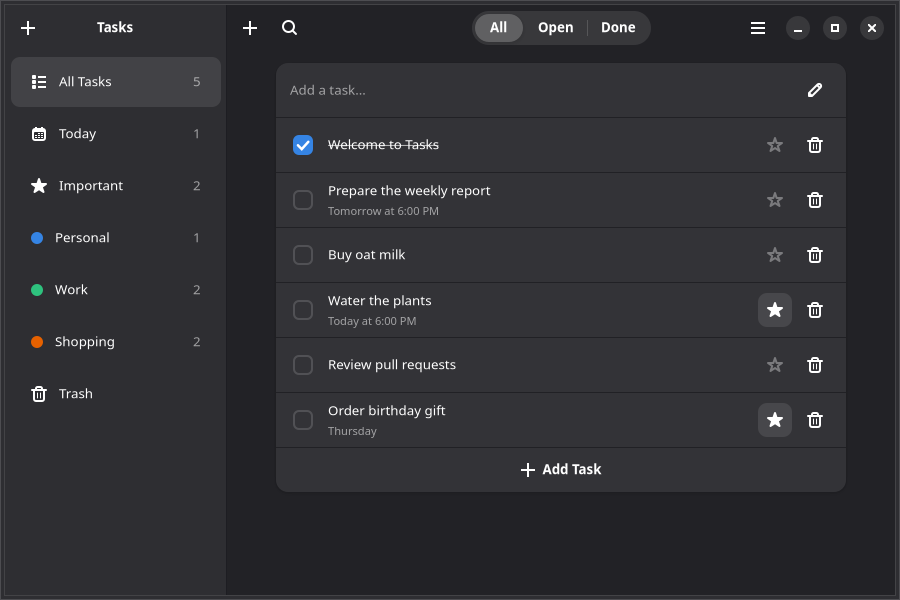
The Tasks app you build in the tutorial.
Demo
The intrinsic elements in this snippet render GTK4 widgets, and ordinary React hooks and events drive them:
import * as Gtk from "@gtkx/gi/gtk";
import { GtkApplication, GtkApplicationWindow, GtkBox, GtkButton, GtkLabel } from "@gtkx/jsx/gtk";
import { createRoot, quit } from "@gtkx/react";
import { useState } from "react";

const Counter = () => {
  const [count, setCount] = useState(0);

  return (
    <GtkApplicationWindow
      title="Hello GTKX"
      defaultWidth={400}
      defaultHeight={300}
      onCloseRequest={quit}
    >
      <GtkBox
        orientation={Gtk.Orientation.VERTICAL}
        spacing={20}
        marginTop={40}
        marginBottom={40}
        marginStart={40}
        marginEnd={40}
        valign={Gtk.Align.CENTER}
        halign={Gtk.Align.CENTER}
      >
        <GtkLabel cssClasses={["title-1"]}>Welcome to GTKX!</GtkLabel>
        <GtkLabel cssClasses={["title-2"]}>{`Count: ${count}`}</GtkLabel>
        <GtkButton
          label="Increment"
          onClicked={() => setCount((c) => c + 1)}
          cssClasses={["suggested-action", "pill"]}
        />
      </GtkBox>
    </GtkApplicationWindow>
  );
};

const App = () => (
  <GtkApplication>
    <Counter />
  </GtkApplication>
);

createRoot().render(<App />);
This is the hello-world example, with app.tsx and index.tsx combined into a single snippet. @gtkx/gi and @gtkx/jsx are per-project bindings generated by the CLI, not packages you install from npm.
Why GTKX
A declarative layer for the GNOME stack
GTK4 is mature, and GtkBuilder XML can lay out a static interface, but nothing re-renders that interface when your application state changes, and nothing hot-reloads it as you work. GTKX adds that missing layer, and the tooling around it, on top of the stack you already know:
- a React reconciler that exposes every GObject as a JSX element,
- a CLI for scaffolding, development, and production builds,
- a dev server with Fast Refresh that patches your running UI in place,
- CSS-in-JS styling and high-level list, grid, and dialog components,
- a Testing Library-style API for querying and driving your widgets in tests,
- and a Model Context Protocol (MCP) server that exposes your live app to AI agents.
The full GNOME API surface
React Native and similar frameworks hide the native toolkit so one API can run everywhere. GTKX exposes it: GTK4, Adwaita, and any other GObject-Introspection library on your system. Linux-only by design.
Why Node.js, and why generated bindings
GTKX runs on Node.js, which puts native modules, the npm ecosystem, and the tooling built for Node.js APIs within reach. GJS is GNOME's own runtime, built on SpiderMonkey rather than V8; node-gtk runs on Node.js but is lightly maintained, on the older nan/V8 ABI rather than N-API, and still centered on GTK3. The why-gtkx guide covers the comparison in full.
GTKX generates the TypeScript types and the native FFI calls from the same GObject-Introspection data, so the types cannot drift from the calls they back. Codegen covers the whole GTK4 and Adwaita surface.
At runtime, the native Rust core calls straight into the system GTK4, Adwaita, and GLib libraries through libffi, without loading libgirepository at all.
Quick start
GTKX is Linux-only and needs Node.js 24 or later. See Requirements.
Scaffold a new app with the create-gtkx initializer:
npm create gtkx@rcThe same command works with other package managers: pnpm create gtkx@rc or yarn create gtkx@rc.
Then run your new app:
cd my-app
npm run dev
To go further, follow the tutorial.
Documentation
The documentation at gtkx.dev includes a step-by-step tutorial that builds a complete GNOME app, from scaffolding to packaging and shipping, plus guides and a full API reference.
Requirements
GTKX is Linux-only. You need:
- Linux with the GTK4 (4.20 or later), Adwaita (1.8 or later), and GLib development libraries
- Node.js 24 or later
The @gtkx/native addon ships prebuilt for x64 and arm64 glibc Linux; other targets need to build it from the GTKX repository, which requires a Rust toolchain.
Examples
Explore the example apps:
hello-world: the counter above.gtk-demo: a React port of the official GTK4 widget showcase, covering lists, dialogs, gestures, CSS, and OpenGL.browser: a WebKitWebView-based web browser.tutorial: the Tasks app the documentation builds.
Status
GTKX 1.0 is at the release candidate stage.
Contributing
Contributions are welcome. See CONTRIBUTING.md, the Code of Conduct, and the security policy. Building the repo needs Node.js 24 or later, pnpm, and a Rust toolchain.
License
GTKX is licensed under MPL-2.0.