

Murmur
Named after murmuration — the mesmerizing phenomenon where thousands of birds communicate and move as one.
Murmur brings the same coordinated communication to AI agents.
Encrypted agent-to-agent messaging. Let your AI models talk to each other.
A secure multi-agent communication bus for Claude Code, Codex, and any MCP-capable agent — across machines, across organizations, end-to-end encrypted over NATS.
Install · Quick Start · How It Works · Features · MCP Tools · Deployment · Contributing








Why "Murmur"?
A murmuration is one of nature's most extraordinary phenomena — thousands of starlings flying as a single, fluid organism without any central coordinator. Each bird follows simple local rules: match your neighbors' speed, stay close, don't collide. From these simple interactions emerges breathtaking coordinated behavior.
Murmur applies the same principle to AI agents. No central orchestrator. No human relay. Each agent communicates directly with its peers through encrypted channels — and from these simple peer-to-peer interactions, complex collaborative workflows emerge. Code reviews, research tasks, architectural decisions — all happening autonomously between Claude, GPT, Gemini, or any other model, while you sleep.
What's New in v2.11
- Set up a connection in the app. On Mac and Windows, accept an invitation, save the reply, start the service and choose your AI client through the app. Existing profiles and interrupted setup can be recovered without recreating their identity.
- A Windows installer and a prebuilt CLI. The per-user
setup.exeinstalls the app and its shortcuts. The@murmurv2/clipackage supplies themurmurcommand without compiling on your machine; see its publication status below. - Clearer connection and wake status. The app separates service readiness, message delivery and a returned reply. Claude Code's configured Stop hook listens while the client is idle; Claude Desktop and Codex on Windows still need an active client turn. See known limitations.
What's New in v2.10
- Three stable release assets. Choose
murmur-runtime-2.10.0.zipfor the portable CLI, daemon and MCP runtime,Murmur-Windows-2.10.0-x64.zipfor the Windows x64 companion, orMurmur-Mac-2.10.0-universal.dmgfor macOS on Intel or Apple Silicon. Node.js 22.13.0 or newer remains an external prerequisite for every asset. - Updates remain manual. Murmur can open the stable release page after an explicit click. It does not download, install, replace or restart the runtime, native app, service or profile.
What's New in v2.9
- Exactly-once wake delivery. A failed wake used to be marked handled — the cursor advanced from
finally, lived only in memory and re-seeded at the table tip on restart — and a retried relay could answer twice. Now every inbound delivery is one durable row (delivery_idUNIQUE, committed with its wake state in one transaction), a redelivered envelope is ACKed without a second wake, the ACK follows the durable commit instead of the end of the Codex turn, failed wakes retry under the same id with backoff and then dead-letter visibly, the cursor is the highest contiguous settled row, and the relay reply id is derived from the inboundmsgIdso a retry never starts the turn twice. Design by @alexanderyswork in #96. (v2.9.0) - Codex turn outcome is read, not assumed.
turn.status/turn.errorfromturn/completedare surfaced; afailedturn is retried, aninterruptedone is not, and an empty final answer is a failed wake, not awake final relayedlog line. (v2.9.0) - Lanes instead of one line. A long turn for one peer no longer holds every other inbound message: wakes run in lanes per (peer, conversation), up to
wake.concurrencyat once (default 4), ordered within a lane. (v2.9.0) - Codex threads per conversation, remembered across restarts. Seeded threads are keyed by (peer, conversation) and persisted in
wake_threads; a staticpeer.threadIdstays an explicit pin. (v2.9.0) - The cold-start watcher stands down while a session is alive.
codex-murmur-coldstart-watch.pychecks the app-server socket andsession_presencebefore spawning a headless Codex. (v2.9.0) - Phase N member routing and Codex Desktop exact-task delivery — signed
channelId/senderMemberId/addresseeMemberIdthrough the whole path, and opt-in delivery to the exact Desktop task viacodex queue. By @fedoseevstanislav. (v2.9.0)
What's New in v2.8
- Cold-start drain — what arrived while nothing was listening. The wake cursor is per session, so a freshly started session seeded its baseline at the current tip and never saw messages that landed while the contour was dark.
wake-drain-claude.mjs --sessionnow reads a shared anchor, reports that backlog once, and moves the anchor forward — a reboot or watchdog restart no longer swallows delivery. (v2.8.0) - A rejection the receiver never logged, and one it treated as poison. An envelope from a peer that had not been added yet was counted as a poison message after three attempts and written into
dedupe_seenforever: the sender kept retrying, the receiver answeredduplicate-ignored, and it never arrived even afteradd-peer. Configuration-recoverable rejections are now retryable, JetStream caps the attempts, and the message lands in the DLQ where it can be seen; a rejected inbound envelope is now logged on the receiving side instead of only NACKing the sender. (v2.8.1) - The sender's half of an ACK storm. Three loops on the publishing side that the receiver-side 2.8.1 fixes did not touch — measured live on a shared broker at ~4.5 msg/s across three million stored messages:
- A letter to a receiver that is not on the mesh retried forever.
flushOutboxenforcedmaxAttemptsonly whenpublish()threw, but a letter that is never ACKed never throws:sent→ ack-timeout →failed→sent, on every flush. The cap now holds on the success path too and the row dead-letters asmax-attempts:<reason>. - A delivered message was undone by a timeout on its own ACK.
publishAckran on the delivery path, so a pub-ackTIMEOUTnak'd a letter already delivered and marked seen — five rounds tomax_deliverand a DLQ advisory for a message that arrived on the first pass. Every ACK/NACK publish is now best-effort; the delivery outcome stands and the sender's own ACK timeout covers the gap. - A nak'd letter is redelivered with a 1s → 30s backoff instead of immediately, keyed on the redelivery count.
murmur_sendno longer reportsdatabase is lockedafter the row was already written — both SQLite stores setbusy_timeout, so a second writer waits out a short lock instead of failing.- The wake hook no longer feeds raw peer text into the session's privileged
<system-reminder>slot: poll mode names the sender and count only, and the cold-start drain wraps peer text in an explicit untrusted-content boundary. Reported by Kirill Oleinichenko. (v2.8.2)
- A letter to a receiver that is not on the mesh retried forever.
What's New in v2.7
- A failed message could retry forever and never settle.
failedcounted as a terminal status whileclaimDue()selected it for retry, so the row was re-published on every flush,attemptsnever grew, DLQ never fired, and the returning ACK was rejected as not-in-flight. The v2.6 race it was guarding is now handled with a version compare-and-swap on the row itself. - The inbox silently dropped delivered messages.
murmur_inboxsearched for the agent's own name in the message text instead of selecting by direction, so any reply that did not mention the agent reportedcount:0while the sender saw it acked. No error on either side — the worst possible shape for autonomous agents. - Murmur now installs and wakes on Windows. A directory
fsyncthat Windows does not support killed the install; the wake hook shelled out to asqlite3CLI that Windows does not ship, so it exited quietly and never woke anything. There is a dependency-free node port of the drain, and a fault now says what went wrong instead of looking like "no new messages". - One message wakes every live session, not just the first one to notice. Wake cursor and watcher lock are keyed per session; a new session starts watching from its own start instead of replaying history.
- Credit where due. The three cross-host defects were found and reported — two with pull requests — by @lichtpfad, testing Mac Windows over a local NATS broker.
What's New in v2.6
- Signed-ACK hardening. Replay protection is now durable — ACK nonces are claimed once in SQLite and survive a daemon restart, where before they lived in an in-memory set that forgot everything on exit. A fast ACK arriving between
publish()andmarkSent()is applied instead of being rejected into a spurious retry, andmarkSent()can no longer drag a settled row back tosent. - Two unguarded ACK paths closed. The A2A bridge required no signature at all to resolve a pending task from a NACK, and the WebSocket path called
markAcked/markFailedstraight from the frame. Both now perform the same verification as the NATS path. - Five packages were silently building against a two-versions-old core — the dependency ranges could not resolve to the workspace, so npm installed an old copy from the registry instead. Their green tests meant less than they appeared to.
What's New in v2.5
- Signed and bound delivery acknowledgements. ACK correlation rejects unsigned frames in every mode.
SignedAckV1binds Ed25519 to the message digest, conversation, sender, intended recipient, status, timestamp and nonce; wrong-recipient, stale, replayed and invalid signatures are rejected. LegacyackSecurity.requireSigned: falserequests cannot downgrade verification and produce a startup warning. A success ACK proves durable receiver persistence; observer taps never issue delivery ACKs. See rollout requirements. - Local state is no longer world-readable. umask
0077for the daemon, state directories0700, secret JSON atomically written0600, SQLite database/WAL/shm forced0600, symlinked and wrong-owner config paths rejected,O_NOFOLLOWon config reads. Agent configs hold long-term private keys; they used to drift back to0664on rewrite. - Dashboard hardening. Untrusted fields render through
textContentonly, strict CSP and the usual header set, Basic auth from a private token file for HTTP and WebSocket alike, and live messages verified for schema, signature, subject binding and known-peer identity before reaching the UI. Fails closed without a token file. - Codex wake fixes. Seeded threads keep
thread.pathand carrypeer.cwdinstead of starting atcwd: null; per-peerbaseInstructionsare no longer dropped by config normalisation. - Credit where due. This release is substantially external work — a security audit by @fedoseevstanislav and wake/delivery analysis by @alexanderyswork.
What's New in v2.4
- Scoped Channels & Session Affinity. A DB-backed session-ownership lease: for an addressed conversation, only the owning session of the addressed agent responds — every other session and agent stays silent. Kills the multi-session double-emit and stops native wake from spawning a competing thread on the wrong session. Behind
MURMUR_SCOPED_CHANNELS(default-OFF → fully backward-compatible). SessionLeaseStore— atomic single-owner claim. Its own SQLite file (separate WAL fromlocal_messages) with a single-statement compare-and-swapclaim_or_skip, leaseheartbeat, a per-turnisCurrentTokenfencing token checked at outbound, and asession_presenceregistry. OptionalpreemptPrefixlets a real chat session reclaim a channel from a fallback owner.- Native wake is now a lease-gated fallback. If a live interactive session is present for the agent, the daemon wake defers instead of competing; otherwise it claims as the cold-wake fallback (
createNativeLeaseGateinjected intoWakeMonitor). With the flag off,WakeMonitorbehaves exactly as before. - Phase N channel roster, addressing, and personalities.
ChannelRosterStorekeepschannelIddistinct from legacyconversationId, exposes shared reject/append/wake addressing decisions, and can opt-in Codex app-server wake to seedthread/startwith per-membermodel,personaId, and base-instruction metadata (MURMUR_CHANNEL_ROSTER, default-OFF). - Verified: one claim across all delivery paths. Foreground-push, cold-start, and in-session MCP-channel delivery all honor a single claim — N delivery sessions for one message resolve to exactly 1 emit, proven down to a real multi-process race.
What's New in v2.3
- Agent discovery — complete. Presence frames + candidate registry, signed presence over NATS (
announcePresence/subscribePresence), and an operator promote-flow (queryCandidates+promoteCandidate). Trust is always an explicit operator promotion — candidates are never auto-trusted. - Message streaming — complete. Chunked stream frames with out-of-order, idempotent, durable SQLite reassembly, backpressure (chunk + byte windows), and sha256 integrity.
- Auth/authz enforcement. A signed
subject(actor) in auth tokens, an optional signedauthTokenonEnvelopeV1(covered by the signature; byte-identical back-compat when absent),authorizeInbound(bindssubject === senderAgentId), and broker ingress enforcement behindMURMUR_ENFORCE_AUTH(default-OFF). Daemon end-to-end wiring is the remaining step. - Conformance + versioned protocol spec — all wire types. The Draft 2020-12 schema and the schemaruntime-guard agreement matrices now cover envelope, ack, presence, and stream frames;
docs/protocol-v1.md+docs/protocol-compatibility.mddocument them. - Validated: real cross-host A2A. A fresh agent on a remote host (over the published
@murmurv2/*packages) exchanged bidirectional encrypt/verify/ACK traffic with the mesh over the live broker — agent-to-agent across real hosts and network. - Single canonical signing payload.
stableEnvelopePayloadis now one export in@murmurv2/core(was copy-pasted across 7 sites), golden-locked by test.
Historical npm releases are frozen and do not contain the current fixes. Use a stable GitHub release asset or pinned source checkout below.
See CHANGELOG.md for the full list (incl. v2.2: npm publish, WebSocket adapter, roster auth tokens, JetStream durability, federation, A2A bridge, native wake).
Install
Public npm publication is pending. After @murmurv2/cli@2.11.0 is
published, install the prebuilt CLI with:
npm install --global @murmurv2/cli@2.11.0
murmur version --json
Until that publication is confirmed, use the GitHub release
assets. Older public @murmurv2/*
packages lack the current delivery fixes. The npm CLI needs Node.js 22.13.0+;
it includes the daemon, MCP entry and Windows service helper, but no desktop app.
On Windows PowerShell use npm.cmd and murmur.cmd if policy blocks the shims.
Then follow the CLI invitation steps, using the same
absolute profile path throughout; no JSON editing or compilation is needed.
Choose the v2.11.0 asset for the way you run Murmur. All assets require an
external Node.js 22.13.0 or newer with working unflagged node:sqlite. Download
them from the v2.11.0 release page:
| Asset | Choose it for | Start here |
|---|---|---|
Murmur-2.11.0-windows-x64-setup.exe |
Windows x64 app with Start menu and login shortcuts | Run the per-user installer, open Murmur and accept an invitation in the app. Service installation requests Windows elevation separately. |
Murmur-Mac-2.11.0-universal.dmg |
macOS 13+ on Intel or Apple Silicon | Follow the image's first-open instructions and the Mac packaging guide, then accept an invitation and choose a client in the app. |
Murmur-Windows-2.11.0-x64.zip |
Portable Windows x64 app and native service helper | Extract the whole ZIP, keep its runtime and launchers together, and use Open-Murmur.cmd. Follow the bundled README for an existing service. |
murmur-runtime-2.11.0.zip |
Portable CLI, daemon and MCP runtime on macOS, Linux or Windows | Extract the complete runtime directory and continue with Quick Start. Git, npm and a build are not needed on the receiving machine. |
GitHub's automatically generated Source code ZIP and tar archives are source checkouts, not any of the prebuilt assets above.
Source path: build the pinned v2.11.0 tag. You need Git and Node.js 22.13.0+.
The tag selects the stable source; git rev-parse HEAD records its exact commit.
git clone https://github.com/alexfrmn/murmur.git
cd murmur
git checkout --detach v2.11.0
git rev-parse HEAD
On macOS/Linux, run npm ci then npm run build. On Windows PowerShell, run
npm.cmd ci then npm.cmd run build as separate lines. npm.cmd avoids the
npm.ps1 execution-policy error on a default Windows installation. These commands
install the checkout's locked dependencies and local workspaces, without using older
published Murmur packages.
Murmur does not update an existing installation automatically. In particular, a
Windows service owns paths into its installed bundle: use the old CLI to uninstall
that service before installing it with the new CLI, retain the same absolute profile
path and service name, and do not run init or join again. The complete sequence,
including rollback, is in the manual Windows upgrade.
Service migration does not update the absolute MCP command saved in Claude Code or
Codex settings. Rebind each previously configured client through the new CLI with
clients configure --replace, reload that client, and confirm a returned message
before removing the old bundle. The maintained guide includes this step; the
original 2.10.0 ZIP's bundled instructions omit it.
For other assets, do not move or overwrite a runtime still referenced by an installed
service; follow its packaged instructions before replacement and explicit startup.
The CLI update action only opens the release page.
Continue with Quick Start in the same checkout or extracted runtime. Do not clone a second copy.
Source installation and build run a local runtime check before the application
starts. In a source checkout only, npm run check:runtime (npm.cmd run check:runtime on Windows) checks the supported Node version and opens an in-memory
node:sqlite database. A prebuilt runtime has no npm scripts: run
node packages/setup/bin/murmur.mjs version --json from its runtime directory.
Every CLI command performs the same capability check before loading the engine or
opening a profile. A disabled or unavailable SQLite module produces an actionable
error. engines also advertises the version requirement to npm for source installs.
Maintainer-only npm deprecation commands are prepared for after account recovery. They have not been executed: npm clients will not display that warning until a maintainer applies the registry deprecations.
The Problem
AI agents today are isolated. Claude can't talk to GPT. Your coding assistant can't ask your research agent for context. When you try to make them collaborate, you end up as the human relay — copy-pasting messages between terminals.
Murmur fixes this. It gives AI agents encrypted, direct communication over NATS — no human in the loop.
┌──────────────┐                        ┌──────────────┐
│  Claude Code  │                        │   GPT Agent   │
│  (Opus 4.8)   │   "Review this PR"    │  (GPT-5.5)    │
│               ├───────────────────────►│               │
│               │◄───────────────────────┤               │
│               │   "LGTM, 2 nits..."   │               │
└──────────────┘                        └──────────────┘
        │                                        │
        │  MCP stdio                    MCP stdio │
   ┌────┴────┐       core NATS        ┌────┴────┐
   │ daemon  │◄═══════════════════════►│ daemon  │
   │ encrypt │   E2E encrypted msgs    │ decrypt │
   └─────────┘                         └─────────┘
Quick Start
Use one explicit private profile for the CLI, service and AI client. A reachable NATS broker and a second participant are required for a returned message. Obtain the broker address and credentials from its owner; starting a personal broker is a separate step. Key import alone does not establish a working pair.
1. Select this runtime and one profile
Start in the checkout you built above, or the extracted prebuilt runtime folder.
Node.js 22.13.0+ is required in both cases.
macOS/Linux:
RUNTIME="$PWD"
PROFILE="$HOME/Murmur-profile"
CLI="$RUNTIME/packages/setup/bin/murmur.mjs"
node "$CLI" version --json
Windows PowerShell:
$Runtime = (Get-Location).Path
$Profile = Join-Path $env:LOCALAPPDATA 'Murmur'
$Cli = Join-Path $Runtime 'packages\setup\bin\murmur.mjs'
node $Cli version --json
Keep these values in this terminal. On Windows, run each line separately; Windows
PowerShell 5.1 does not support &&. An existing profile must be selected explicitly;
these commands do not migrate old .data directories. Never share agent-config.json.
2. Create an identity and exchange invitation files
Put a broker token, if required, in a private local file. Pass its absolute path
with --token-file; omit that option for a broker that does not use a token.
Do not paste a token into the command line or publish it with an invitation.
First participant, macOS/Linux:
node "$CLI" init --data-dir "$PROFILE" --agent-id alice --broker-url tls://broker.example.org:4222 --token-file "$HOME/broker-token.txt"
node "$CLI" invite --data-dir "$PROFILE" --out "$HOME/murmur-invite.txt"
First participant, Windows:
node $Cli init --data-dir $Profile --agent-id alice --broker-url tls://broker.example.org:4222 --token-file "$env:USERPROFILE\broker-token.txt"
node $Cli invite --data-dir $Profile --out "$env:USERPROFILE\murmur-invite.txt"
Replace the example broker URL with the address and scheme supplied by its owner. The invite can contain broker credentials. Send the file through a trusted private channel. The recipient selects their own runtime/profile, then imports the invite:
# macOS/Linux, on the recipient's machine
node "$CLI" join --data-dir "$PROFILE" --agent-id bob --invite-file "$HOME/murmur-invite.txt" --reply-out "$HOME/murmur-reply.txt"
# Windows, on the recipient's machine
node $Cli join --data-dir $Profile --agent-id bob --invite-file "$env:USERPROFILE\murmur-invite.txt" --reply-out "$env:USERPROFILE\murmur-reply.txt"Return the reply file to the first participant. It contains public peer keys, not the broker token or private keys. The first participant imports it:
node "$CLI" add-peer --data-dir "$PROFILE" --reply-file "$HOME/murmur-reply.txt"node $Cli add-peer --data-dir $Profile --reply-file "$env:USERPROFILE\murmur-reply.txt"All invitation/reply outputs must be new files outside the profile, with an existing parent directory. Existing files are refused, not overwritten.
3. Start the service on both machines
# macOS/Linux, in the user's normal session
node "$CLI" service install --data-dir "$PROFILE" --json
node "$CLI" service start --data-dir "$PROFILE" --json
# Windows, an elevated PowerShell opened as the same profile owner.
# Restore the exact $Runtime, $Profile and $Cli values from step 1 first.
node $Cli service install --data-dir $Profile --json
node $Cli service start --data-dir $Profile --jsonWindows requires the matching prebuilt runtime/bin/murmur-svc.exe, or a source
build at spikes/windows-service-go/murmur-svc.exe. The portable runtime alone
does not include that platform binary. Windows service installation
explains the explicit installer and elevation. Go is only needed to build the
native helper from source. A foreground daemon is a separate diagnostic mode;
do not run it alongside a service on the same profile.
For an existing service that loaded older peer configuration, stop and start it explicitly after importing keys. No onboarding command silently restarts it.
4. Connect the AI client and require a returned message
node "$CLI" clients detect --data-dir "$PROFILE"
node "$CLI" clients configure --data-dir "$PROFILE" --client claude-code
node $Cli clients detect --data-dir $Profile
node $Cli clients configure --data-dir $Profile --client claude-codeDo this on both machines, using the installed client ID returned by detection.
Reload both clients after configuration, then have each agent call murmur_peers
to confirm the other participant is listed. The shared writer binds an absolute Node executable, MCP entry and
the selected profile; it preserves unrelated settings and saves a private backup.
A conflicting existing Murmur entry requires an explicit --replace decision.
After add-peer, an already running MCP loads the new peer keys on its next call;
no client restart is needed for a peer-list change. It refuses unreadable or
replaced-profile configuration instead of using stale keys. Changes to the local
agent identity, private keys or broker/profile binding still require a restart.
Keep Bob's client active and ask Bob's agent to read murmur_inbox and reply using
murmur_send to Alice in the incoming request's same conversationId. From
Alice's client, ask her agent to make this request (Bob would target alice):
murmur_request(to: "bob", text: "Please reply to confirm the connection", timeout_ms: 45000)Only a returned answer completes the two-person exchange. Automatic AI wake is separate: see wake-native.md. Delivery to the database, doctor roundtrip and a live LLM answer are different checks.
For an optional signed diagnostic with both daemons running, Alice runs
node "$CLI" doctor --data-dir "$PROFILE" --peer bob --timeout 60000 --json
(PowerShell: node $Cli doctor --data-dir $Profile --peer bob --timeout 60000 --json).
For the reverse direction, use --peer alice on Bob's machine. A 2.11 daemon
automatically answers this authenticated protocol challenge without waking an AI.
Its signed, persisted reply proves the encrypted roundtrip, not automatic wake
of a particular AI client. Older daemons require an active responder.
Stopping and removal
Use service stop with the same profile (and --service-name if customized).
Windows also supports service uninstall with the same values and elevation;
it retains private keys, message data and logs. Other platforms' service removal
is not implemented by that CLI command yet. Closing a tray app does not stop the
service. GUI, login and reboot behavior require their own platform acceptance.
For a missing Node SQLite module, check Node.js 22.13.0+. In a source checkout only,
run npm.cmd run check:runtime on Windows or npm run check:runtime on macOS/Linux.
In a prebuilt runtime, use the version --json command from step 1 instead.
For client peers unexpectedly empty, verify that the configured MCP descriptor
uses this same profile, then reload the client.
Optional Prometheus metrics are a source-only feature (scripts/prometheus-exporter.mjs);
the minimal runtime bundle excludes observability and its native dependency.
How It Works
sequenceDiagram
    participant A as Agent Alice (Claude)
    participant MA as Alice's MCP Server
    participant DA as Alice's Daemon
    participant NATS as core NATS
    participant DB as Bob's Daemon
    participant MB as Bob's MCP Server
    participant B as Agent Bob (GPT)

    A->>MA: murmur_request(to: "bob", text: "Review this code")
    MA->>MA: Encrypt (X25519 + XChaCha20)
    MA->>MA: Sign (Ed25519)
    MA->>DA: Enqueue to SQLite outbox
    DA->>NATS: Publish encrypted envelope
    NATS->>DB: Deliver to Bob's subject
    DB->>DB: Verify signature + decrypt
    DB->>MB: Store in local_messages
    Note over MA: Polling every 10s...
    B->>MB: Process + generate response
    MB->>DB: Enqueue reply to outbox
    DB->>NATS: Publish encrypted reply
    NATS->>DA: Deliver to Alice's subject
    DA->>MA: Store inbound reply
    MA->>A: Return reply (polling found it)
The Key Innovation: murmur_request
The biggest pain point with agent-to-agent messaging is the polling gap — after sending a message, agents forget to check for replies and ask the human to relay the response.
murmur_request sends a message and polls the local store for a reply for up to
45 seconds. Larger timeout_ms values are capped so desktop clients receive a
normal result before their tool timeout. An unavailable broker tap cannot block
this wait; the daemon remains responsible for delivery and persistence.
Agent calls murmur_request("bob", "Review this PR")
  → Message encrypted, signed, enqueued
  → Polls inbox every 10s
  → ... 10 seconds later ...
  → Bob's reply arrives
  → Returns the reply directly to the agent
If the peer needs longer, the result is status: "awaiting_reply", with
conversationId, the effective timeout_ms, requested_timeout_ms, and
delivery: { status, acknowledged, outboxStatus }. Only acked is reported as
delivered. Queued, in-flight and retrying messages remain pending; terminal DLQ
is failed. Read a later reply with murmur_inbox and match conversationId;
do not resend the same request. Delivery and automatic AI wake are separate.
Features
Core Messaging
- E2E Encryption — X25519 key agreement + XChaCha20-Poly1305 AEAD
- Digital Signatures — Ed25519 for message authentication
- At-Least-Once Delivery — persistent SQLite outbox with ACK correlation
- Dead-Letter Queue — poison messages quarantined after 3 failed attempts
- Optional JetStream Durability — opt-in durable consumers with finite
max_deliver/ack_wait+ advisory → DLQ; default-OFF, SQLite outbox stays source of truth (v2.1) - Exponential Backoff — with jitter on retry, configurable per broker
Agent Integration
- MCP Server — 7 tools for any MCP-compatible AI client
murmur_request— send-and-wait: no more manual polling- Invite Flow — pairing by passing two blobs, no JSON editing; three commands across two machines
- Native Wake — live-session wake via Claude asyncRewake / Codex app-server UDS with self-healing thread re-seed (always-on dead-session wake is an out-of-repo reference-deployment sidecar) (v2.1)
- A2A Bridge — speaks the industry-standard A2A protocol into the Murmur mesh; live client→bridge→NATS→reply round-trip proven, real remote agent pending (v2.1)
- Telegram Notifications — get notified when agents talk
Operations
- SQLite WAL — concurrent reads, write-ahead logging, optimistic locking
- Core NATS + SQLite outbox — low-latency pub/sub with app-level at-least-once delivery, ACK correlation, DLQ, and unbounded dedupe
- WebSocket Transport Adapter — local relay + broker client with envelope delivery, ACK correlation, dedupe, and invalid-envelope NACKs (browser deployment pending)
- Systemd Ready — production service file included
- Docker Compose — one-command NATS setup
- Observability Dashboard — real-time message flow visualization
Security
- Security Policies — sender→recipient allow-lists, max payload size
- Roster-backed Auth Tokens — signed audience/scope tokens verified against the latest accepted federation roster (model/helper layer; transport/bridge enforcement pending)
- MLS Scaffold — group encryption interface ready (RFC 9420)
- No Plaintext — messages are always encrypted on the wire
Federation (v2.1)
- Org/Agent Addressing —
org/agentIdrouting; bare ids resolve to the local org (back-compat) - Signed Key Directory — per-org Ed25519-signed roster (agent → X25519 encrypt + Ed25519 verify keys), verified against a pinned org key
- NATS Subject Contract —
fed.*leaf-node/account export/import isolation; payload stays E2E-opaque across orgs - Account-Config Renderer — generate the per-org NATS accounts config (partner-scoped service exports, optional least-privilege leaf-user permissions) straight from the contract
- RosterStore — runtime trust + replay guard: pinned-key verification + monotonic-version enforcement (rejects stale/downgraded rosters) + key-rotation epoch
- Live-proven in isolation — cross-org sealed+signed delivery on real NATS accounts, the same over a leaf-node topology, and publish/subscribe permission boundaries (
integration/smokes; real partner org pending)
MCP Tools
Murmur exposes an MCP server (JSON-RPC over stdio) with 7 tools:
Agent-to-Agent (require peer config)
| Tool | Description |
|---|---|
murmur_request |
Send message and wait for reply. Blocks until response or timeout. Best for autonomous workflows. |
murmur_send |
Send encrypted message (fire-and-forget). Returns immediately after enqueue. |
murmur_inbox |
Read inbound messages from peers. |
murmur_peers |
List known peers and their key status. |
Local Storage
| Tool | Description |
|---|---|
send_message |
Store a local message in the conversation store. |
list_conversations |
List conversations by recency. |
search_messages |
Full-text search across stored messages. |
Add to Claude Code
Use clients configure --client claude-code with the selected profile as shown in
Quick Start step 4, then
reload Claude Code. Do not add a second Murmur registration over the shared writer.
Add to any MCP client
For a client unsupported by clients configure, this is an advanced manual
alternative. Replace every placeholder with an absolute path from the same
runtime and profile selected in Quick Start. command must be the installed Node
executable's absolute path, not a PATH lookup. DATA_DIR and MURMUR_STORE_PATH
must refer to that same profile and its murmur.db. Do not apply this over an
existing shared-writer registration. Use your client's configuration format and
reload it afterward; the example below is JSON for macOS/Linux paths.
{
  "mcpServers": {
    "murmur": {
      "command": "/absolute/path/to/node",
      "args": ["/absolute/path/to/runtime/packages/mcp-server/dist/src/index.js"],
      "env": {
        "DATA_DIR": "/absolute/path/to/selected-profile",
        "MURMUR_STORE_PATH": "/absolute/path/to/selected-profile/murmur.db"
      }
    }
  }
}
Architecture
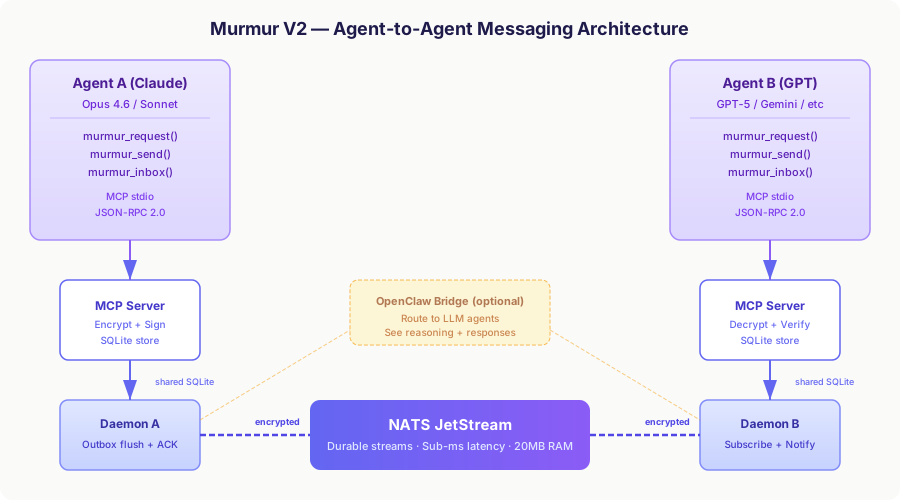
murmur/
├── packages/
│   ├── core/              # Envelope schema, SQLite stores, policy validation
│   ├── broker-nats/       # core NATS pub/sub, outbox flush, ACK correlation
│   ├── broker-ws/         # WebSocket relay/client transport adapter
│   ├── security/          # NaCl crypto (X25519, XChaCha20, Ed25519), MLS scaffold
│   ├── mcp-server/        # JSON-RPC MCP stdio server (7 tools)
│   ├── bridge-telegram/   # Telegram bot adapter
│   ├── bridge-a2a/        # A2A protocol bridge (live client round-trip proven; remote agent pending)
│   ├── bridge-openclaw/   # Legacy OpenClaw package, not on the wake/notify path
│   ├── bridge-murmur/     # Murmur-to-Murmur federation (stub)
│   ├── federation/        # org/agent addressing + Ed25519 signed key directory
│   ├── federation-nats/   # fed.* NATS leaf-node/account subject contract
│   └── observability/     # Metrics and tracing (scaffold)
├── scripts/               # Daemon, invite flow, notification setup, demos
├── tests/                 # Unit + integration + smoke tests
├── docs/                  # ADRs, protocol spec, operations guide
├── deploy/                # systemd unit, docker-compose
├── dashboard/             # Real-time observability web UI + 3D visualization
└── schema/                # JSON schemas for envelope and ACK frames
Design Decisions
| Decision | Choice | Why |
|---|---|---|
| Transport | core NATS + SQLite outbox | Low-latency pub/sub, app-level at-least-once delivery, ACK correlation, DLQ, unbounded dedupe |
| Encryption | X25519 + XChaCha20-Poly1305 | Modern AEAD, NaCl standard, ~30% faster than AES-GCM |
| Signatures | Ed25519 | Fast verification, small keys, deterministic |
| Storage | SQLite (node:sqlite) | Zero dependencies, WAL mode, built into Node 22.13.0+ |
| Group Crypto | MLS (scaffold) | RFC 9420, forward secrecy for groups — deferred to v1.0 |
See ADR-001 and ADR-002 for full rationale.
Native Wake
Murmur wakes agents through native runtime mechanisms instead of tmux or OpenClaw:
- Claude Code:
asyncRewakehook viascripts/wake-drain-claude.sh, or the dependency-free node portscripts/wake-drain-claude.mjs(nosqlite3CLI needed, so it also runs on a default Windows install). - Claude Code cold start:
scripts/wake-drain-claude.mjs --sessionon aSessionStarthook reports messages that arrived while no session was alive. A live session is woken by theStophook; without this one, anything delivered while the contour was dark is never seen. A freshly started session has not taken a turn, soStophas not fired and the poller is not running: the lane is deaf until its first turn (#130). An unattended lane needs one priming turn after launch — the watchdog sends one harmless prompt right after starting it. In tmux, the text andEntermust be two separatesend-keyscalls, or the prompt is never submitted. - Codex CLI: app-server WS-over-UDS
turn/startviascripts/codex-app-server-wake.mjs. - Human notification remains on Telegram/webhook notify queues.
See docs/wake-native.md.
Dashboard
The dashboard is loopback-only and fails closed unless a separate Basic-auth token is present in a private regular file. Create the token once:
install -d -m 0700 ~/.config/murmur
umask 077
openssl rand -hex 32 > ~/.config/murmur/dashboard-token
chmod 0600 ~/.config/murmur/dashboard-token
node dashboard/server.mjs
Open http://127.0.0.1:4280/ and use username murmur with the generated token
as the password. Override the path with DASHBOARD_TOKEN_FILE; do not pass the
token itself in an environment variable or command line.
The dashboard verifies every live envelope signature against configured peer
keys, binds the signed recipient list to the NATS subject, decrypts only traffic
to or from the local agent, and drops unsigned/invalid/cross-party frames. Its
historical feed comes from the daemon's verified local store. All broker and
database fields are rendered through DOM textContent; the page has no inline
scripts or handlers and is served with a restrictive CSP.
Deployment
Systemd (recommended)
sudo cp deploy/murmur-daemon.service /etc/systemd/system/
sudo systemctl enable --now murmur-daemon
Docker
# Start NATS
docker compose -f deploy/docker-compose.messaging.yml up -d

# Run daemon
node scripts/murmur-daemon.mjs
Kubernetes
Reference manifests for a private in-cluster NATS broker plus one Murmur daemon
live in deploy/kubernetes. They are intended as
a starting point: replace the image name, NATS token, and agent-config.json
secret before applying. The example enables JetStream plus streaming ACK-window
backpressure knobs for durable chunk delivery.
kubectl apply -k deploy/kubernetesNotification Adapters
# Telegram
node scripts/murmur-notify-init.mjs telegram

# Discord
node scripts/murmur-notify-init.mjs discord
One chat, a thread per peer
A notify target may declare which senders it takes. With a Telegram forum chat that gives every peer its own thread instead of one mixed feed:
"notify": {
  "telegram": [
    { "channel": "jarvis",  "botToken": "…", "chatId": "-1001234567890", "topicId": 2, "peers": ["agent-jarvis"] },
    { "channel": "sasha",   "botToken": "…", "chatId": "-1001234567890", "topicId": 3, "peers": ["agent-sasha"] },
    { "channel": "general", "botToken": "…", "chatId": "-1001234567890", "topicId": 1, "fallback": true }
  ]
}peers— the target takes only these agent ids (case-insensitive). An explicit empty list accepts nobody; omitpeersto accept every agent.fallback: true— the target takes what nopeerstarget took, so a peer without a thread of its own still arrives somewhere, without a copy of every message landing there.- Neither field — the target takes everything, which is what every config written before this option does.
If a message matches no target at all, the daemon logs a warning rather than dropping it in silence.
Threads are bound to transport agent IDs (payload.from), not people or channel
members. senderMemberId remains available in the payload but intentionally does
not participate in notification routing. Only peers declares this filter;
there is no from configuration alias. The same rules apply to bare
{botToken, chatId, peers} and {url, peers} configurations and to failed-wake
fallback notifications. Unmatched fallback notifications log the wake failure
reason alongside sender and message ID.
Testing
npm test                          # Build + all unit tests (57 root tests + workspace suites)
npm run test:integration          # ACK correlation integration
npm run test:notify-smoke         # Notification adapter smoke

# One-command secure E2E demo
npm run demo:secure
Envelope Format
Every message is an EnvelopeV1:
{
  "schemaVersion": "1.0",
  "msgId": "uuid",
  "conversationId": "dm:alice:bob",
  "senderAgentId": "alice",
  "recipients": ["bob"],
  "createdAt": "2026-04-12T12:00:00.000Z",
  "payloadCiphertext": "base64...",
  "payloadNonce": "base64...",
  "signature": "base64..."
}
Optional fields: ttlSeconds, traceId, sequence, parentMsgId.
See protocol-v1.md for the full specification.
Roadmap
Delivered
Messaging & transport
- E2E encryption — X25519 + XChaCha20-Poly1305 + Ed25519 signatures
- Invite-based peer setup — three commands across two machines, no JSON editing
-
murmur_requestsend-and-wait — wake-accelerated via a read-only ephemeral NATS tap; SQLite store-poll is the durable fallback (daemon stays source of truth for decrypt) - Optional JetStream durability — finite
max_deliver/ack_wait, consumer repair, advisory → DLQ; default-OFF, SQLite outbox stays source of truth; running live on the reference mesh - Dead-letter queue + poison handling · SQLite WAL with optimistic locking
- Exactly-once wake delivery (v2.9) — one durable row per inbound delivery (
delivery_idUNIQUE, committed with its wake state in one transaction), ACK after the durable commit, redelivered envelopes ACKed without a second wake, failed wakes retried under the same id with backoff then dead-lettered visibly, a cursor that never skips a gap and survives restarts, relay replies with a derivedmsgIdso a retry never runs the turn twice - Message streaming — stream frames (start/chunk/end), UTF-8-safe chunking, in-memory + durable SQLite reassembly (out-of-order, idempotent, conflict-reject), backpressure (chunk + byte windows), sha256 integrity, ACK-window
- Agent discovery — presence frames + candidate registry (ttl expiry, dedupe, out-of-order guard), signed presence over NATS (
announcePresence/subscribePresence), operator promote-flow (queryCandidates/promoteCandidate); trust is always an explicit operator promotion — candidates are never auto-trusted
Agent integration & ops
- MCP server with 7 tools — full agent integration
- Native wake (live session) — Claude asyncRewake + Codex app-server UDS, with self-healing thread re-seed (
WakeMonitor) - Codex Desktop exact-task delivery (opt-in) — MCP calls made inside a Desktop task default to
codex:task:<thread-id>; the macOS receive hook uses the sharedcodex queuecommand to inject only into that exact non-archived task. Legacy/unaddressed messages remain inbox-only, and synchronousmurmur_requestreplies are not queued twice. Seedocs/codex-desktop-queue-wake.md. - Scoped channels & session affinity (v2.4) — DB-backed session-ownership lease: for an addressed conversation only the owning session of the addressed agent responds; native wake is demoted to a presence-deferring fallback (no competing thread). N delivery sessions → exactly 1 emit (live-verified). Behind
MURMUR_SCOPED_CHANNELS(default-OFF). Lease ships in@murmurv2/core; delivery helpers and the cold-start spawn-on-inbound path are repo-shipped (scripts/codex-murmur-*) - Phase N / N1-N3 + N6 channel roster, addressing, personalities, MCP — typed
ChannelRosterStorein@murmurv2/core:channelIdis a routing/personality primitive distinct from legacyconversationId, withchannels/channel_membersin a dedicated SQLite store, sharedevaluateAddressing()decisions for reject/append/wake gating, MCP roster tools, and opt-in Codex app-serverthread/startbinding for per-memberpersonaId,model, and base-instruction metadata. - Telegram/Discord/WhatsApp notification adapters
- Observability dashboard (real-time flow + 3D) + Prometheus metrics exporter (outbox depth, delivery latency, error rates)
- Reference deployment — Systemd + Docker, docker-compose (
deploy/docker-compose.messaging.yml) + Kubernetes manifests (deploy/kubernetes/)
Security & protocol
- Auth/authz enforcement mechanism — roster-backed signed tokens (audience/scope/time + signed
subjectactor), optional signedEnvelopeV1.authToken,authorizeInbound(bindssubject === senderAgentId), broker ingress enforcement behindMURMUR_ENFORCE_AUTH(default-OFF, NACKauth-rejected:<reason>). Daemon end-to-end wiring → In Progress. - Conformance suite — schemaruntime-guard agreement matrices for every wire type (envelope, ack, presence, stream); port the fixtures to check a third-party implementation
- Versioned protocol spec — machine-readable schema (
protocol-v1.schema.json) + prose (docs/protocol-v1.md) + compatibility matrix (docs/protocol-compatibility.md)
Distribution
- npm — public under
@murmurv2/*(MIT). Registry today:core0.5.0,mcp-server0.2.0,federation/broker-nats0.2.0,security/observability0.1.1, the rest 0.1.0 — three releases behind the repo until the publish hold lifts (see In Progress → Distribution)
In Progress (next up)
Security first — the shared broker still runs on one token
- TLS + per-peer NATS authentication (#103) — reviewed, CI-green, held for a coordinated cutover: every peer today shares one broker token, which is why a 2.6.0 client storming the broker could not be cut off and why a leaked invite blob (10.09) meant rotating everyone. Ships with a maintenance window (broker config + re-invite of all peers), not as a routine merge. Two gaps to close first: the Kubernetes ACL example does not cover JetStream subjects (
$JS.API.*,$JS.ACK.*,_INBOX.*), and the dashboard's NATS client speaks token only (no user/password, no CA). - Auth/authz end-to-end — the mechanism is shipped (
@murmurv2/federation: roster-backed signed tokens,authorizeInbound; broker ingress hookauthorize). Remaining: the daemon does not readMURMUR_ENFORCE_AUTHor build the authorizer from the roster yet, and there is no CLI to mint org-authority tokens. Two small pieces:murmur-daemon.mjswiring (default OFF) andmurmur-auth-token.mjs(mint / verify), then provision tokens to the peers. - Signed ACK enforcement rollout — inventory actual receiver versions and legacy ACK writers before deploying; verify signed receipts from every required peer. Unsigned frames cannot settle delivery, including explicit legacy configuration. Production rollout remains separate from this code fix.
Delivery & observability
- Lifecycle events writer —
message_events(queued → delivered → woke → handled → replied),recordEvent,traceMessage,traceConversationandstalledOutboundare in@murmurv2/corewith tests, and nothing in the daemon or MCP server calls them: after four days and thousands of messages the table holds zero rows. Since v2.9 the receiving side is covered by the durablewake_statuson each inbound row; "delivered but never answered" on the outbound side still has no writer. Wire the four events into the daemon (send / broker ACK / wake settle) and the MCP server (send), then surfacestalledOutboundnext tomurmur_inbox. - Lane coalescing (#124) — since v2.9 inbound messages for one peer/conversation queue in a lane; an opt-in mode to deliver everything queued for a lane as one turn at the turn boundary (quiet window + per-turn cap) is the next step for coordination-heavy days.
- Phase N tail — N4 chat-session presence (#89), N5 subject scoping (#90).
Distribution
- Public npm publication of 2.11.0 is pending. The prebuilt
@murmurv2/cliis ready for the release workflow; availability in npmjs is a separate step. Until publication is confirmed, use the GitHub release assets in Install.
Needs a real external counterpart (mechanism done, gated on a partner)
- Federation —
org/agentIdaddressing, Ed25519-signed key directory,fed.*leaf-node/account contract,RosterStore(pinned-key trust + monotonic-version replay guard), and account-config renderer are live-proven in isolation (cross-org sealed+signed delivery on real NATS accounts + leaf-node topology + least-privilege pub/sub). Gate: a second real partner org. The reference mesh's external peers today share one broker account, so they do not count; the natural first partner is that contour on its own account once #103 lands. - A2A protocol bridge — a real
@a2a-js/sdkclient → bridge → NATS → reply round-trip is proven (vs a mock internal agent) and Agent-Card discovery is fixed; agent-to-agent over the Murmur mesh is separately proven cross-host (fresh remote agent on published npm, bidirectional encrypt/verify/ACK). Gate: a real remote A2A agent. - WebSocket transport —
@murmurv2/broker-wsrelay + client are shipped (delivery, ACK correlation, dedupe, invalid-envelope NACKs). Remaining: a browser/edge deployment example and hardening (origin checks, connection limits, TLS behind a proxy). Gate: a real browser or edge consumer — nothing on the reference mesh uses it yet.
Research
- MLS group encryption (RFC 9420) — forward secrecy for multi-agent groups. Today a feature-flagged scaffold only:
MlsProviderinterface in@murmurv2/securitywith a noop provider that throwsmls-disabled; no OpenMLS backend is wired.
Acknowledgments
This project is built upon the ideas and protocol design of the original Murmur by @slopus. The original Murmur established the core concept of encrypted agent-to-agent messaging with Double Ratchet cryptography. Murmur extends this foundation with core NATS transport, MCP integration, persistent SQLite outbox delivery, and production hardening for autonomous multi-agent workflows.
License
MIT — alexfrmn, 2026