
cairn





Platform analysis, a live dashboard and log chat for any project. Zero dependencies. Node 18.17+.
npx @nouman-amjad/cairn analyzeThat is the whole first step. No config file, no signup, no API key.
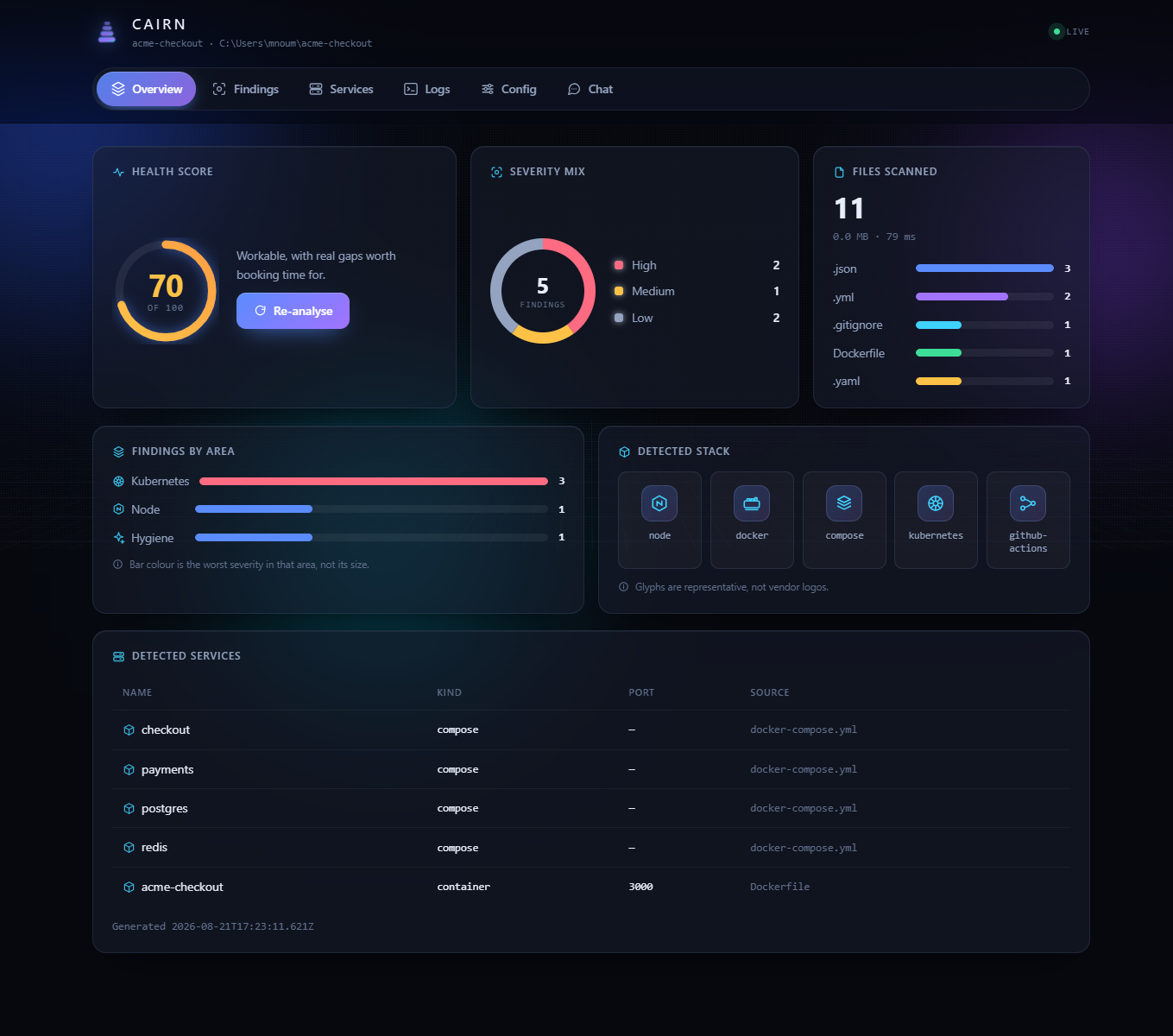
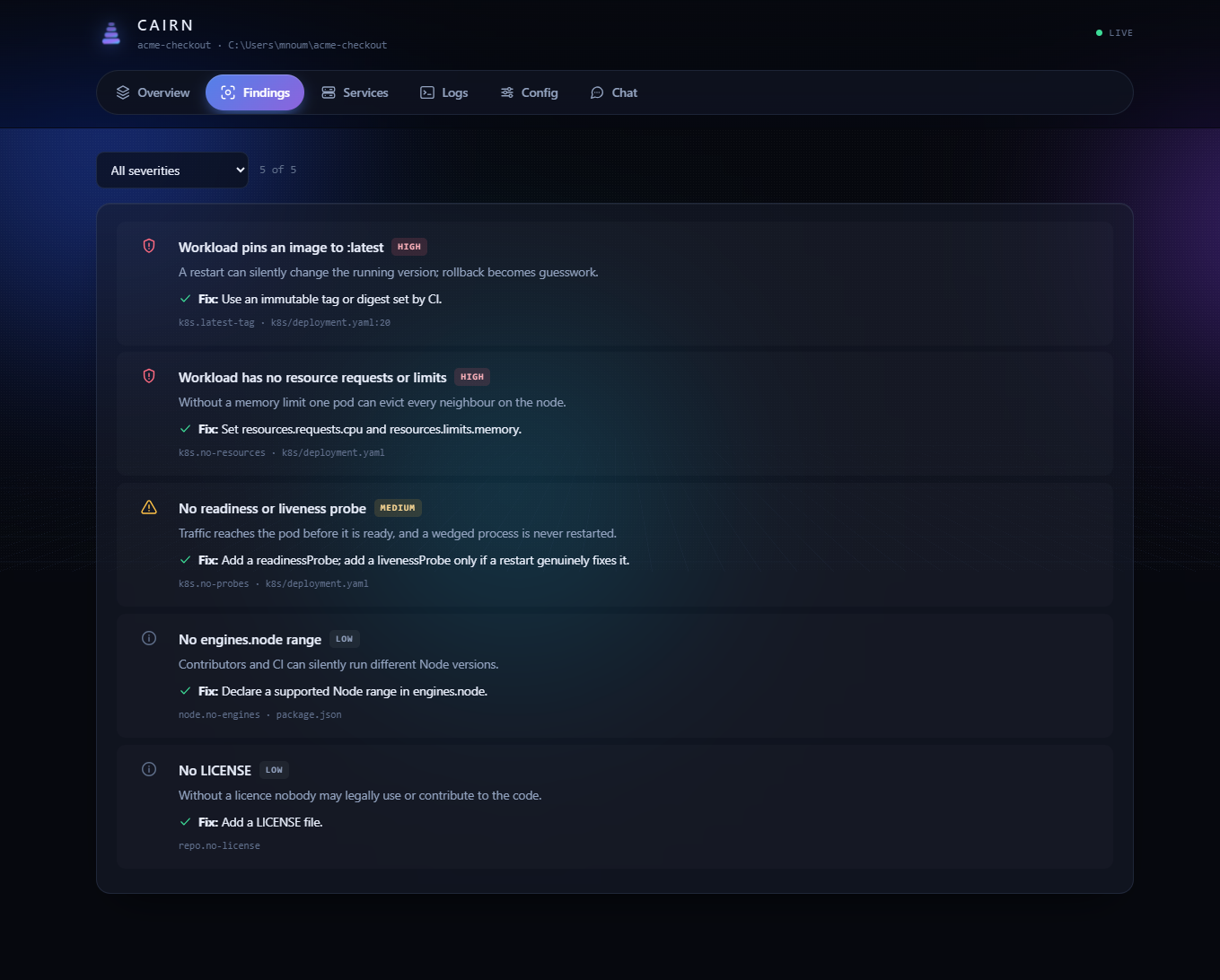
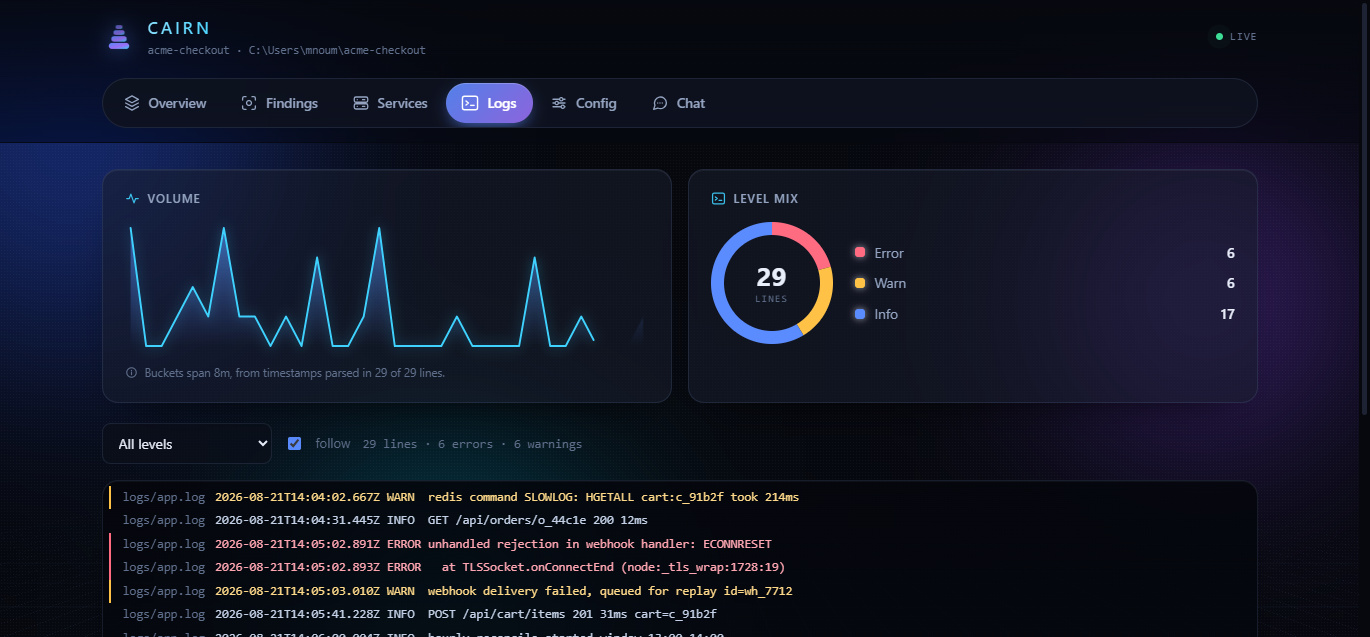
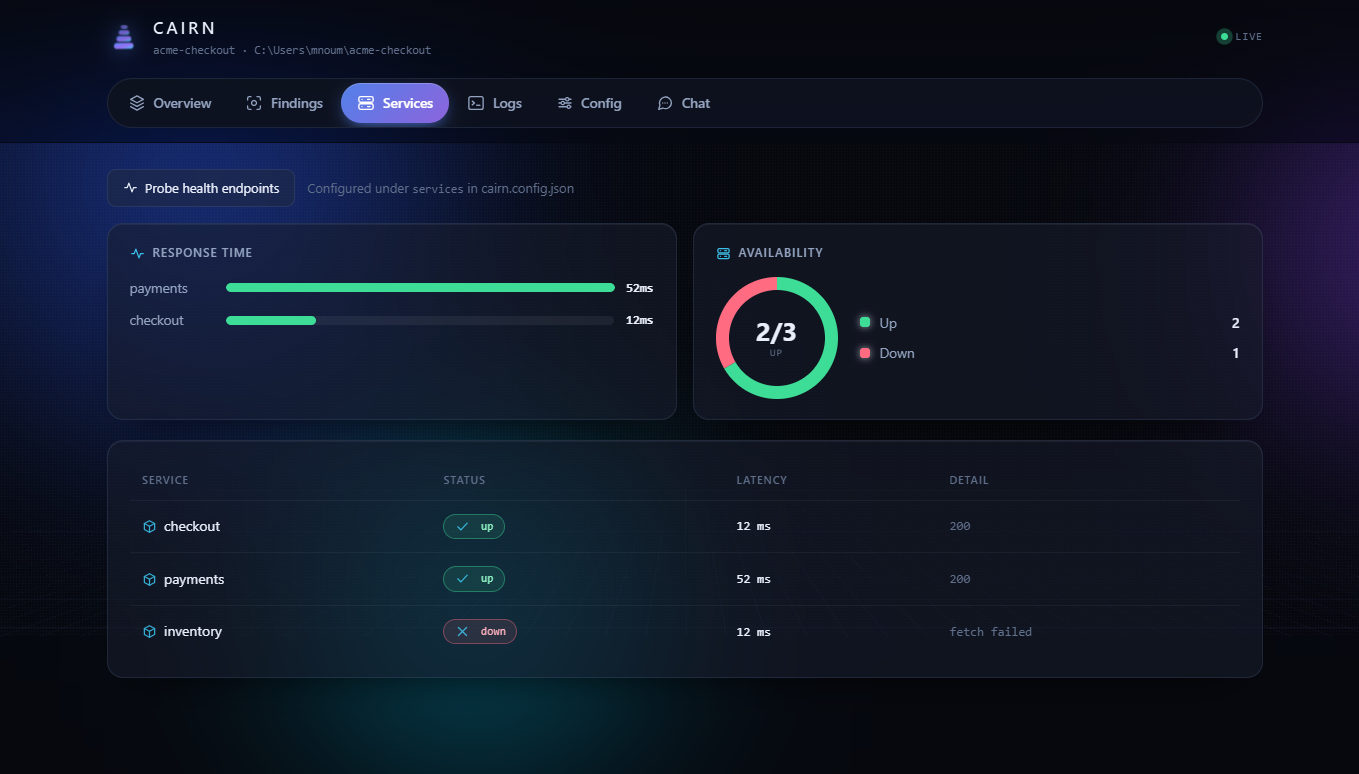
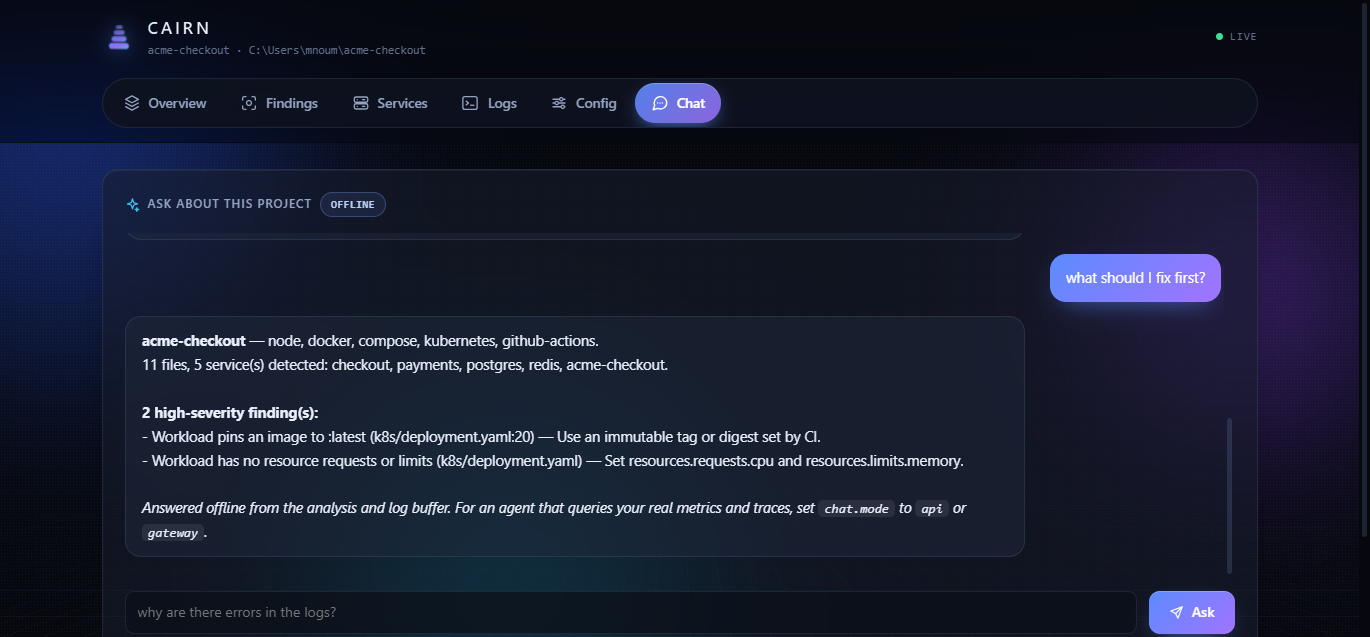
Findings, logs, services and chat
Install it once and the command shortens to cairn:
npm install -g @nouman-amjad/cairn
cairn analyze
Cairn /home/you/checkout-api
score 62/100 (81 ms)
stack node, docker, kubernetes, github-actions
files 1,284
services checkout-api, worker
findings 2 high · 3 medium · 1 low
docker
high Container runs as root
Dockerfile
No USER instruction switches away from root. A process escape starts with uid 0.
fix Add a non-root user and `USER 10001:10001` before CMD.
kubernetes
high Workload has no resource requests or limits
k8s/deployment.yaml
Without a memory limit one pod can evict every neighbour on the node.
fix Set resources.requests.cpu and resources.limits.memory.The dashboard
npx @nouman-amjad/cairn dashboard # or: cairn dashboard, if installedOpens on http://127.0.0.1:7777 with six tabs:
| Tab | What it shows |
|---|---|
| Overview | Health score, stack, detected services, file inventory |
| Findings | Every finding with its file, why it matters, and the fix |
| Services | Live health probes against the services you configure |
| Logs | Your log sources, tailed and streamed live, coloured by level |
| Config | Every setting, editable in place, written straight back to disk |
| Chat | Ask about the project, the findings and the logs |
It binds to loopback by default, because it shows your configuration and your
logs and a dashboard quietly listening on 0.0.0.0 is a data leak with a nice
chart.
Configure it
npx @nouman-amjad/cairn init # or: cairn init, if installedWrites cairn.config.json, seeded from what it found — services it detected
get health-check entries already filled in. Everything is optional.
{
  "name": "checkout-api",
  "dashboard": { "port": 7777, "host": "127.0.0.1" },
  "analyze": {
    "ignore": ["node_modules", ".git", "dist"],
    "mute": ["docker.no-healthcheck"]   // accepted risks live in the repo
  },
  "logs": {
    "files": ["logs/app.log"],
    "commands": ["kubectl logs -f deploy/checkout-api"]
  },
  "services": [
    { "name": "api", "url": "http://localhost:3000", "healthPath": "/health" }
  ],
  "chat": { "mode": "offline" }
}
Change any value from the Config tab, or:
cairn config                      # list everything
cairn config dashboard.port       # read one
cairn config dashboard.port 9000  # write one
Values are coerced to the type the default declares, so port stays a number
and a typo is rejected at the point you make it rather than three layers down.
Chat about your logs
cairn chat "what should I fix first?"
cairn chat "why are there errors?"
Three modes, set with chat.mode:
offline(default) — deterministic correlation over the analysis and the log buffer. No network, no key, no cost. It clusters a thousand repeated errors into one fact and tells you which findings mention the same files. Plenty of "why is this failing" is a join, not an inference.api— sends the analysis and a log summary to a model API. Setchat.apiKeyEnvto the env var holding your key.gateway— hands the question to a running Cairn deployment: the full agent loop, real tool calls against your metrics and traces, and human approval gates on anything that writes.
In CI
npx @nouman-amjad/cairn analyze --fail-on high      # exit 1 if anything high is found
npx @nouman-amjad/cairn analyze --json > report.json
- run: npx @nouman-amjad/cairn analyze --fail-on highWhat it checks
| Group | Examples |
|---|---|
docker |
root user, unpinned base image, secrets baked into layers, apt cache left behind |
k8s |
no resource limits, :latest images, privileged containers, missing probes |
node |
no lockfile, no test script, no engines range, dependency sprawl |
python |
no lockfile, unpinned requirements |
terraform |
no remote state backend, unencrypted buckets |
compose |
host networking, privileged services |
ci |
no pipeline, a pipeline that never runs tests |
secrets |
credential shapes in source, .env not gitignored |
repo |
no README, no LICENSE, no .gitignore, files over 5 MB |
Every finding carries a rule id, the file it came from, why it matters, and
the fix. Mute one by adding its id to analyze.mute — so "we accepted that
risk" lives in the repository and shows up in review.
As a library
import { analyze, load, exitCode } from "@nouman-amjad/cairn";

const report = analyze(load("."));
console.log(report.score, report.findings.length);
process.exitCode = exitCode(report, "high");
Why zero dependencies
Open package.json and look at dependencies. It is {}.
A tool that audits your supply chain should not enlarge it. Everything here is
Node's standard library: the dashboard is node:http, the log tail is
node:fs, the CLI parses its own arguments. npx @nouman-amjad/cairn downloads one small
package and nothing else, and there is no transitive tree to review, upgrade,
or get compromised.
Commands
cairn init                     Write cairn.config.json with detected defaults
cairn analyze                  Scan the project and print findings
cairn dashboard                Serve the live dashboard
cairn logs                     Tail configured log sources
cairn chat <question>          Ask about the project, its findings and its logs
cairn config [key] [value]     Show or set a configuration value

  --cwd <dir>        Run against another directory
  --json             Machine-readable output
  --fail-on <sev>    analyze: exit 1 at this severity or above
  --port <n>         dashboard: override the port
  --open             dashboard: open a browser
Licence
Apache-2.0. Part of Cairn.