
cezar
Parallel coding agents orchestrator — a local cockpit for running and tracking AI coding-agent tasks in your repo.
Type a task, pick a workflow and an agent — Claude Code, Codex or OpenCode,
or a mix of them per step — and watch it work live: steps, tool calls,
tokens, diffs, in a browser cockpit that runs entirely on your machine.
Your CLI logins, your gh, your files. No accounts, no database, no cloud.
Fire and forget. Queue a stack of autonomous coding and maintenance tasks and let them run — cezar orchestrates them across isolated worktrees, in parallel. Flip the Autonomous flag and a run never stops to ask; it just finishes. Leave it on a VPS and you get a dev team that's always on — a mobile-friendly cockpit you can check from your phone, working your backlog while you're away.
A look inside · What cezar does best · What it solves · Who it's for · Quick start · How it works · Core concepts · Cockpit tour · Agent backends · Remote access


cd your-repo
npx cezar-cli        # → cockpit at http://localhost:4321
That's the whole setup. If your claude CLI is logged in (Pro/Max) and gh is
authenticated, there is nothing else to configure. State lives in .ai/cezar/
inside your repo — plain JSON, NDJSON and Markdown you can cat and fix by hand.
A look inside
Click any thumbnail for the full-size screenshot.
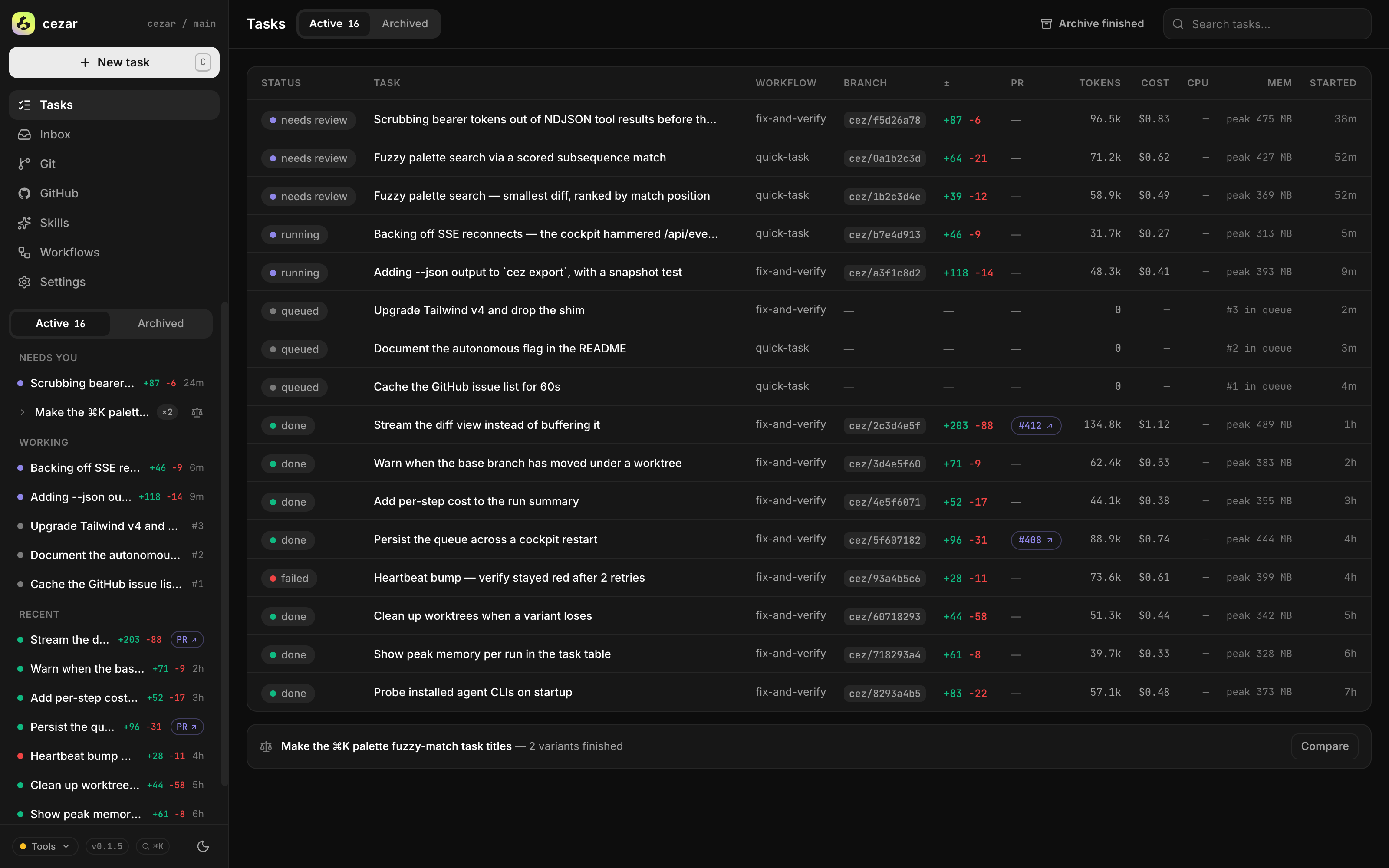
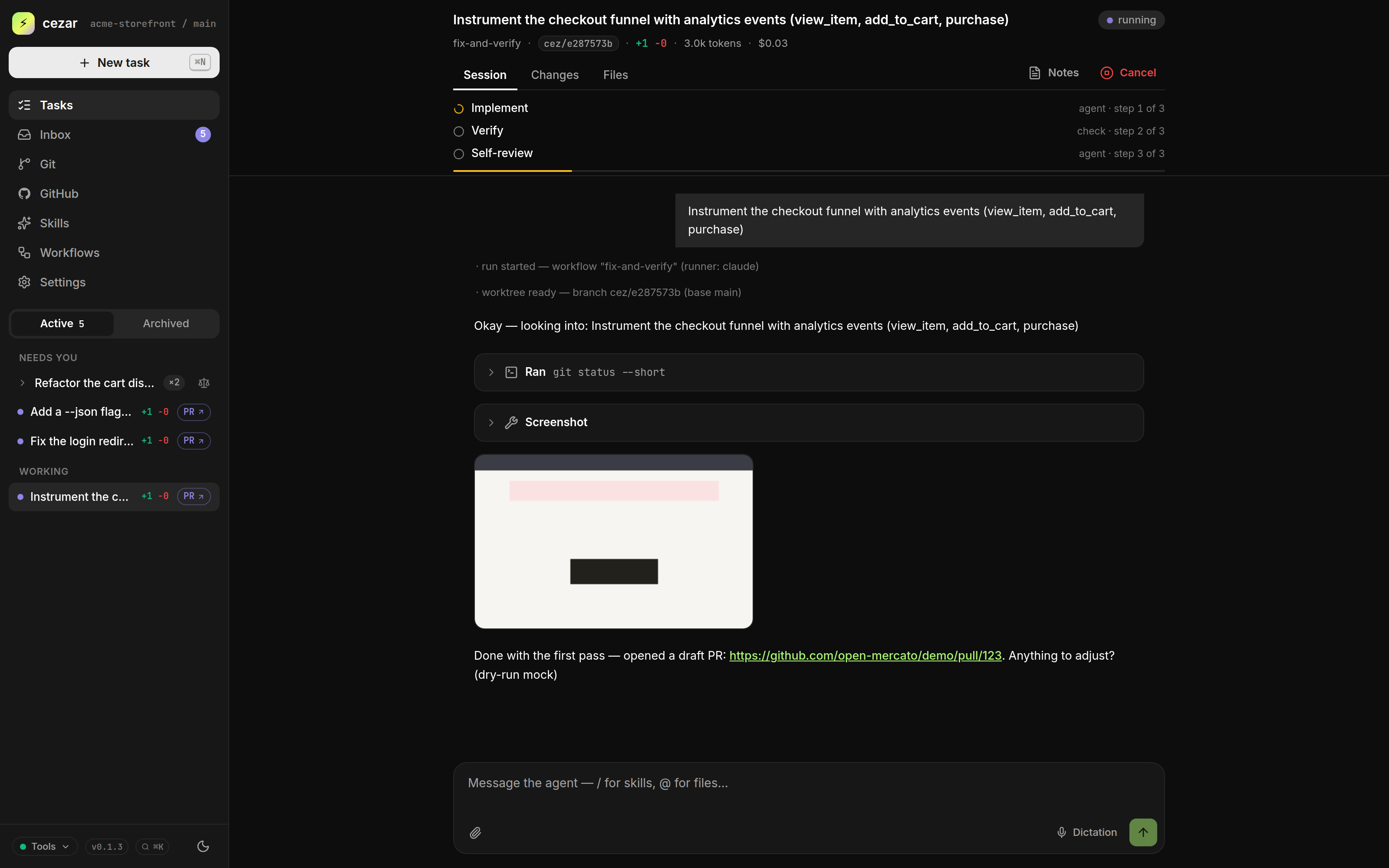
| Orchestrate parallel agents | Watch a run live | Parallel variants |
|---|---|---|
 |
 |
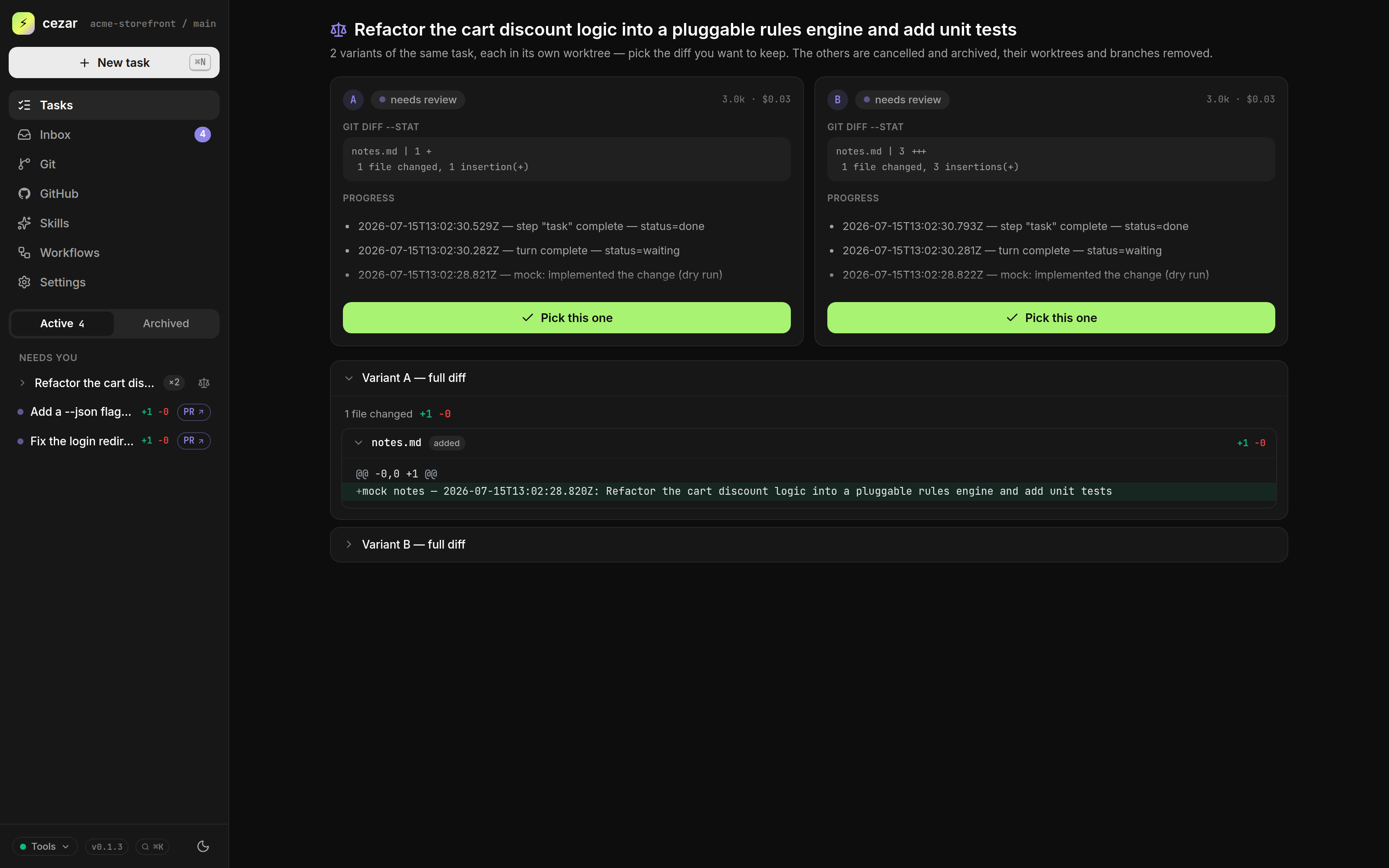 |
| Run and queue many tasks at once — each in its own worktree — with live status, cost and peak memory per run. | Every step, tool call, token and screenshot — streamed as it happens. | Run a task ×2/×3 in isolated worktrees, compare the diffs, keep one. |
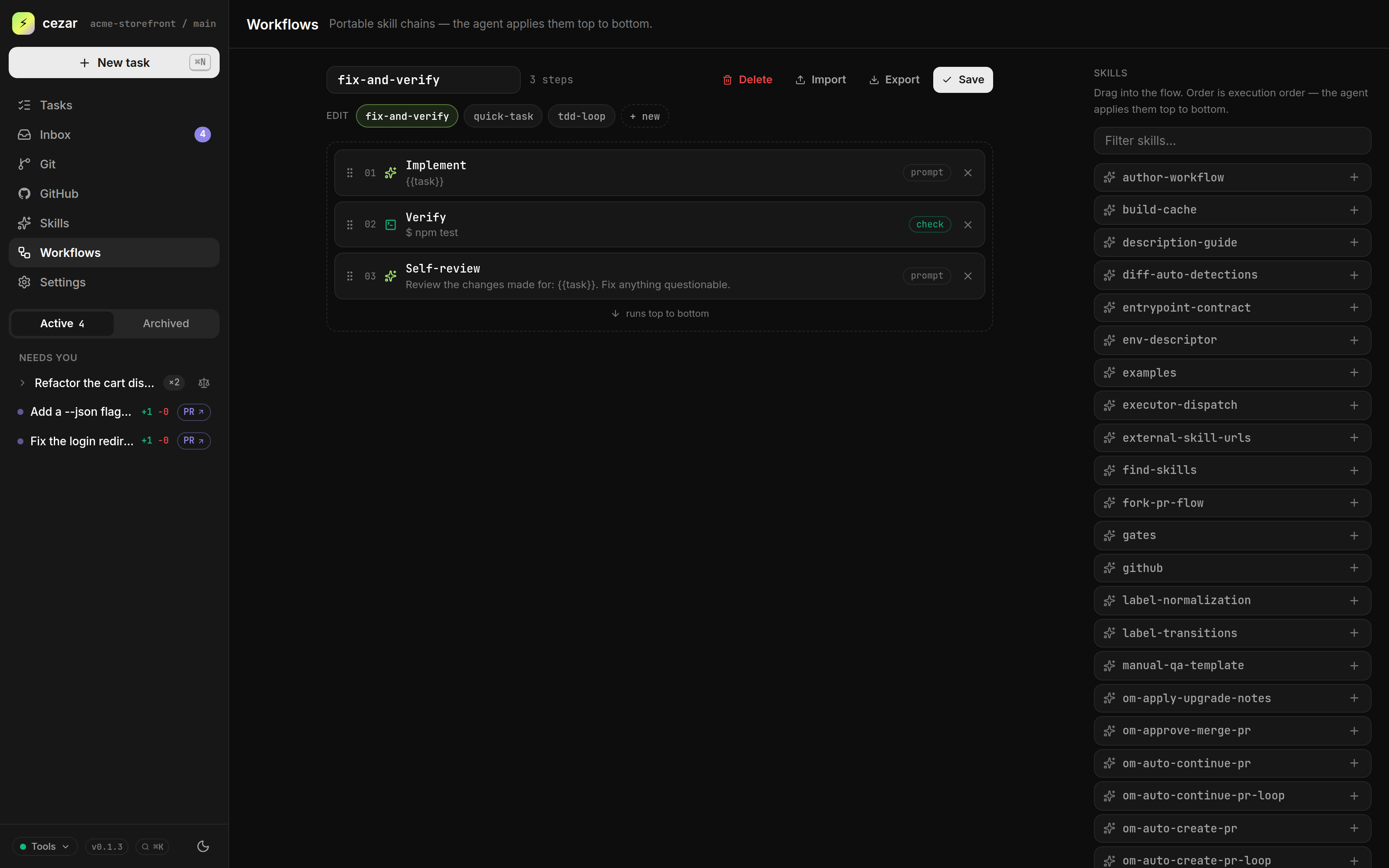
| Workflow builder | GitHub, one click away | Skills + fire-and-forget |
 |
 |
 |
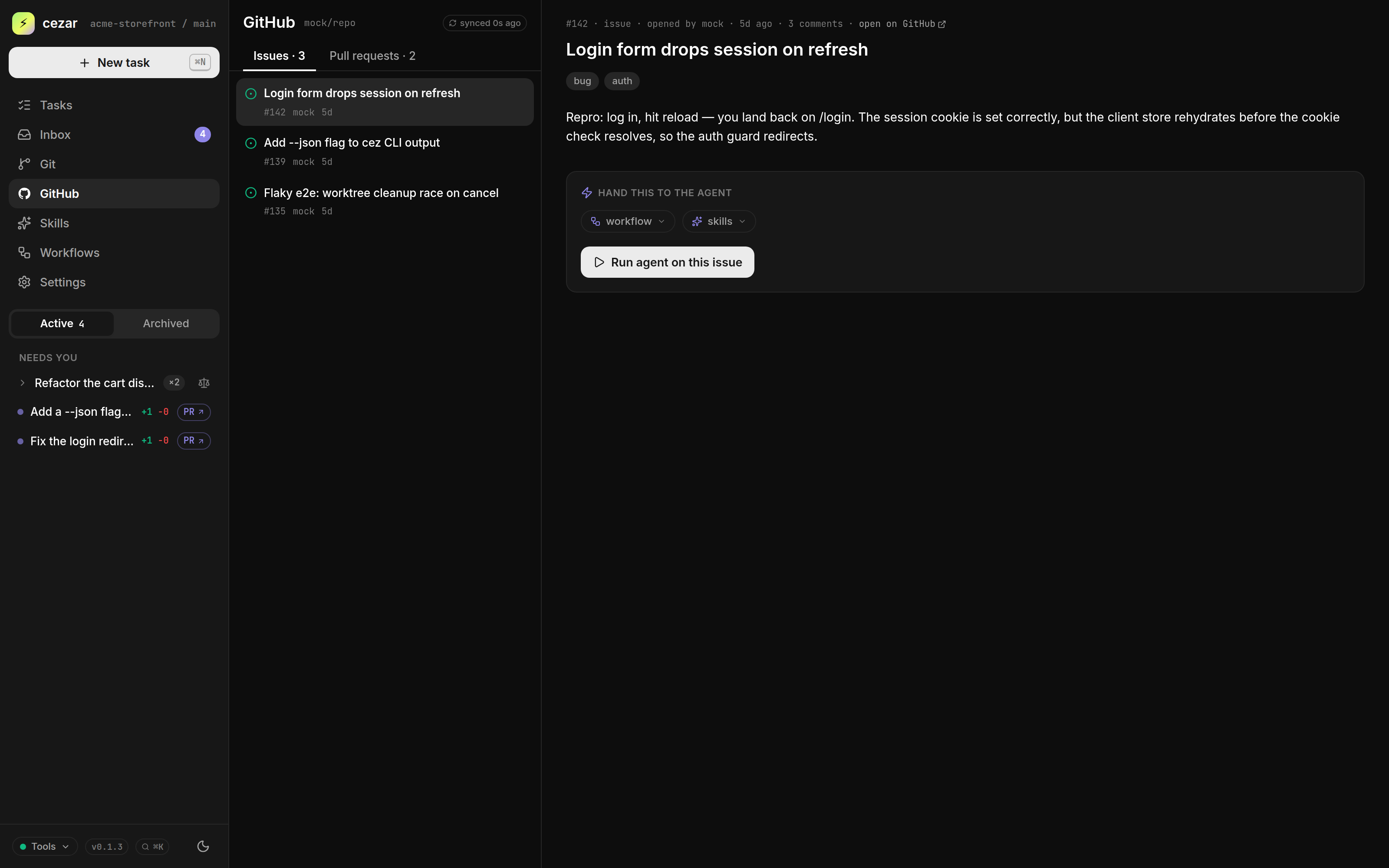
| Stitch skills and shell checks into a reusable YAML chain, no code. | Open issues and PRs via your gh — run the agent straight on an issue. |
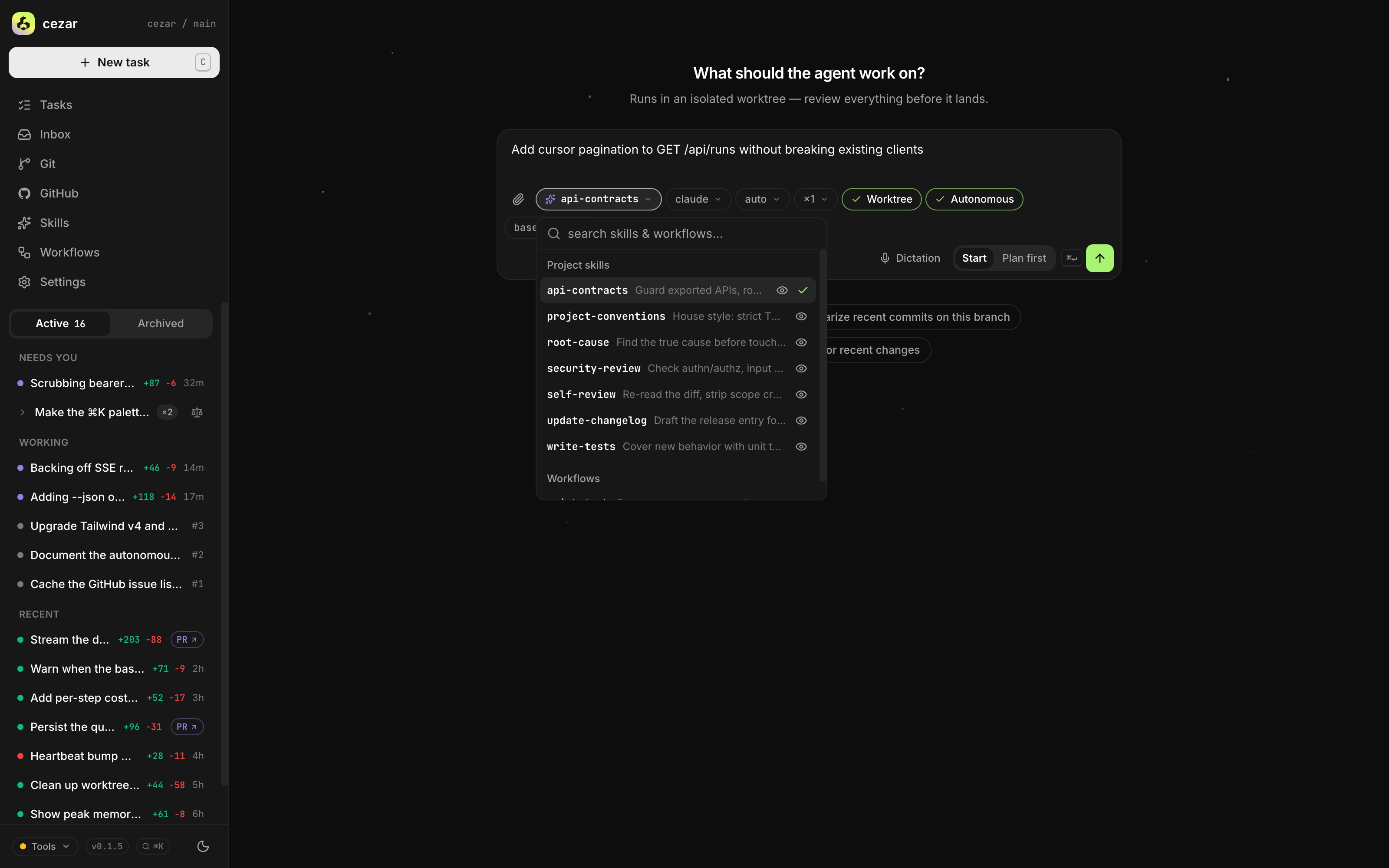
Pick a Markdown skill and flip Autonomous — the run never stops to ask, so you can walk away. |
What cezar does best
Plenty of tools wrap a single coding agent in a nicer window — a "Codex GUI", a conductor-style app, one-agent front-ends. cezar's bet is different. Three things it does better than any of them:
- Genuinely zero config.
npx cezar-cliin your repo and you're running — no wizard, no API keys, no env vars, no schema, no database. It rides theclaude/codex/opencodelogins and theghyou already have, and every missing piece degrades gracefully instead of blocking you. - Built for a server (VPS mode). cezar is made to live on a VPS, cloud, or dedicated box as an always-on janitor for your repo — headless-first, with a mobile-friendly cockpit you drive from anywhere. It's a coding server you can actually watch, not a desktop app bolted onto one machine.
- Parallel + autonomous orchestration. The real edge: cezar runs many agents at once in isolated worktrees, queues the overflow, and pushes each one autonomously through skill playbooks — fire-and-forget. This is exactly what single-agent GUIs don't do well: they babysit one agent, while cezar orchestrates a whole team and drains your backlog while you're away.
What it solves
Most "AI coding agent" tooling makes you choose between a terminal you can't see into once it's running, and a cloud product that wants your API key, your code on their servers, and an account. cezar is the third option: the agents run locally under your subscription, a cockpit shows you exactly what they're doing, and an orchestrator keeps a whole queue of them moving.
- No visibility into a running agent. A headless
clauderun is a black box until it finishes. cezar streams every step — agent text, each tool call and its result, tokens and cost per step — live, and keeps the full replay. - One agent, one working tree, one thing at a time. Kick off a second task and it fights the first over your files. cezar runs each task in its own git worktree, so two (or three) agents work in parallel without stepping on each other — or on the branch you're editing.
- A backlog that needs babysitting. Queue a stack of tasks and cezar
orchestrates them: it runs up to your parallel limit and holds the rest in
an ordered queue. Point it at a GitHub issue and it runs straight on that, so
working the tracker down stops being a manual chore. Turn on the opt-in
Inbox (
CEZ_FOLLOWUPS=1) and an agent's leftover follow-ups become the next tasks too — one click each. - "Autonomous" means you still have to sit there. Flip the Autonomous flag and a run never parks to ask — it keeps going until the task is done. Pair it with a skill (a Markdown playbook) and you've got fire-and-forget automation: hand off "fix this", "upgrade that", "triage these" and walk away.
- The agent finishes and you have to trust it. cezar ends non-trivial runs at a review gate: inspect the diff, send notes back into the same session, or push a draft PR — never an auto-merge.
- Losing a session when it fails. Every run records its
claudesession id. Take it over interactively in one click (claude --resume <id>), or continue it in-process from the cockpit. - Locked into one agent vendor. Most tools wed you to a single CLI. cezar drives Claude Code, Codex and OpenCode through one runner seam — set a default, pick a backend per task, or mix them inside one workflow (implement with one agent, review with another) — and through OpenCode you can point a run at open-source or local models, not just the big vendors. See Agent backends.
- Close the laptop and the work stops. A local agent only runs while your machine is on and awake. Put cezar on a VPS, cloud box, or dedicated server and the cockpit becomes the GUI for an always-on AI coding team — kick off, watch and steer tasks from your laptop or phone, on the train or between meetings, while the agents keep grinding through the backlog back on the server.
- Setup tax. No wizard, no env vars, no schema. Skills are Markdown, workflows
are short YAML, and everything degrades: no
gh→ works without PRs, no network → local skills still load, no.ai/skills→ the bare prompt still runs.
Who it's for
- Solo devs and small teams who want the leverage of coding agents without handing their code and keys to a SaaS — the agent runs on your subscription, on your machine.
claudeCLI power users who love headless runs but want to see them, compare a few attempts side by side, and review a diff before it lands.- Anyone with a backlog who'd rather queue three tasks into isolated worktrees and pick the winners than babysit one terminal.
- Teams with shared conventions who want their playbooks (skills) pulled from a git repo, applied consistently, with zero per-project setup.
Quick start
Prerequisites: Node 20+, at least one logged-in agent CLI — the
claude CLI (Pro/Max subscription),
the codex CLI, or
OpenCode — and, optionally, git and the gh CLI.
cd your-repo
npx cezar-cli              # start the cockpit for the current repo
#   or: npx @open-mercato/cezar
The cockpit opens at http://localhost:4321 (auto-picks the next free port if
busy). Type a task, pick a workflow, hit Start. That's it.
npx cezar-cli run "add a --json flag to the export command"   # headless, CI-friendly
npx cezar-cli init                                            # scaffold .ai/cezar/
Both the cezar and cez commands are installed, so once it's on your PATH you
can run either. No API key is ever used — cezar shells out to whichever agent
CLIs you are already logged into, claude by default.
Contributing? Local development shows how to get a global
cezarcommand straight off your checkout (npm run install-as-command) — no publish needed.
Just kicking the tires? Set
CEZ_DRY_RUN=1to run against a bundled mock instead of the real CLI — the whole cockpit works with noclaudelogin, so you can explore runs, diffs, variants and the review gate offline.
Preview builds
Every green CI run publishes an installable npm snapshot (how it works), so you can try unreleased code without cloning anything:
npx cezar-cli@develop      # current develop head
npx cezar-cli@main         # current main head (ahead of the latest stable release)
Every pull request gets its own preview too — the CI bot posts a sticky comment
on the PR with the exact pinned version to copy-paste
(npx cezar-cli@<version>-pr<N>.<run>). Previews are prerelease versions under
their own dist-tags; a plain npx cezar-cli always resolves to the latest
stable release.
How it works
You describe a task. cezar runs it as a workflow — an ordered list of agent steps and shell checks — shelling out to your locally installed agent CLI (Claude Code by default; Codex and OpenCode are drop-in alternatives, per task or per step). Each task gets its own git worktree; the cockpit streams every event live and parks the run at a review gate when there's a diff to inspect.
   you type a task
        │
        ▼
   ┌─────────────┐   optional: Plan → AI drafts a chain of steps you approve
   │  workflow   │   (agent steps + shell checks, with bounded onFail retries)
   └─────────────┘
        │
        ▼
   ┌──────────────────────────────┐     ┌───────────────────────────────┐
   │  git worktree per task       │     │  agent CLI  (your login)      │
   │  (isolated branch, parallel) │◄───►│  claude · codex · opencode    │
   └──────────────────────────────┘     │  Bash open · no prompts       │
        │                                 └───────────────────────────────┘
        │  agent text · tool calls · tool results · tokens · cost
        ▼
   ┌─────────────┐   SSE (replay + live)   ┌──────────────────────────┐
   │ .ai/cezar/  │ ──────────────────────► │  cockpit  localhost:4321 │
   │ JSON·NDJSON │                         │  Tasks · Git · GitHub ·  │
   │ ·Markdown   │                         │  Skills · Workflows      │
   └─────────────┘                         └──────────────────────────┘
                                                  │
                                          review gate: read the diff →
                                          send notes back · draft PR · finish
When a check fails, the workflow can loop back to an earlier step (bounded by
max) with the failing output appended to the retried agent's prompt. Nothing
auto-merges: a run with changes rests in review until you act on it.
Core concepts
Three words, no jargon — task, skill, chain:
- Tasks are the unit of work. Every task is a run:
queued → running → review / done / failed / cancelled, with a live event log, per-step token and cost usage, cancel/delete, and — for anything with a diff — a review gate. Paste screenshots into the task, or send follow-up messages into the live session while it works. - Skills are Markdown playbooks. Drop them in
.ai/skills/or.ai/cezar/skills/, or pull them from a shared team skills repo (a bare git clone cached globally in~/.cache/cez/). A workflow step references one byskill: <name>and its body becomes the agent's extra system prompt — so you shape how the agent reasons without touching code. - Chains (workflows) stitch steps into a pipeline: agent steps plus shell
checks, with bounded
onFailretry loops. Write the YAML yourself, build one by drag-ordering skills in the Workflows tab, or press Plan first and let the AI draft a chain for your task that you review, trim and start. The built-inquick-task(one agent step) works with zero setup.
Five moves that make the cockpit worth the browser tab:
- Queue + orchestration. Start as many tasks as you like: cezar runs up to
maxParallelat once (default 2; a non-git directory always runs one) and holds the rest in a FIFO queue with visible positions (#1,#2, …). Cancel a queued task before it starts; the queue even survives a cockpit restart — everything stillqueuedis re-enqueued in order. It's the orchestration layer that turns "one agent at a time" into a backlog that drains itself. - Memory-aware runs. Each run's whole process tree is sampled (~2 s) for CPU
and RSS, and its peak memory is recorded and shown in the task table. Set an
optional per-task memory ceiling (
memoryLimitMb) and a run that crosses it is paused — freeing its tree so the queue keeps advancing — and resumes on demand. Event logs are append-only NDJSON and streamed rather than re-serialized, and live UI deltas are coalesced so they never hit disk. - Parallel variants (×2 / ×3). Run the same task as competing agents in separate worktrees, then compare their diffs side by side and pick one — the losers are archived and their worktrees cleaned up.
- Bounded worktree disk. Each task runs in its own full checkout, so a busy
cockpit would otherwise grow without limit. cezar keeps only the last
worktreeRetentionfinished worktrees on disk (default 10;0= unlimited) and reclaims the rest — directory only, thecez/<id8>branch is always kept, so the work stays recoverable. Settings → Resources shows every worktree's disk use with per-row delete and a Reclaim now button. - Review gate. A finished run with changes waits in
review. Read the diff, type notes that go straight back into the agent's session, or push agh pr create --draft. You stay the merge button. - Runs on your coding server, drives from your pocket. The cockpit is a responsive web app streaming over SSE, so the box running cezar can be a VPS, cloud, or dedicated server you never sit in front of. Point a browser — laptop or phone — at it and run an always-on coding team on the move: start tasks, watch them live, and hit the review gate from anywhere.
Cockpit tour
Seven views, one browser window, all live over Server-Sent Events (six until you opt into the Inbox):
| View | What's in it |
|---|---|
| Tasks | Every task with its status, live event stream (agent text · tool calls · tool results · pasted/generated screenshots), tokens and cost. Continue, cancel, open in terminal (claude --resume), review the diff, or push a draft PR. |
| Inbox | Opt-in (CEZ_FOLLOWUPS=1; hidden by default). Follow-ups an agent left behind (todos.json) — one click turns a suggestion into the next task, pre-wired to its suggested skill. Off, agents are never asked to leave follow-ups; each task's own Notes handoff journal is unaffected. |
| Git | Branch, working-tree status, diff vs HEAD, recent commits (click one for its inline patch + GitHub link), and the configurable base branch that worktrees fork from and PRs target. |
| GitHub | Open issues and PRs of the repo's origin, read through your logged-in gh. Hand an issue straight to the agent — pick a workflow and skills, one click runs it. |
| Skills | Local skills plus the team skills repo, with a rendered body + prompt preview. Refresh pulls the latest from the remote. |
| Workflows | Build a chain by drag-ordering skills, save it as portable YAML, import/export, or delete. Built-ins always come back. |
| Settings | Appearance (dark/light theme, accent, density), agent backends, notifications, and the skills catalog. |
The cockpit is a React app served pre-built from the package — npx cezar-cli
still means no build step and no dev server on your machine — with a dark/light
theme, a ⌘K command palette, and bookmarklets that launch a task straight from
a GitHub page.
Workflow format
A workflow is a small YAML file in .ai/cezar/workflows/:
name: fix-and-verify
description: Implement the task, then verify; retry with failing output on red.
steps:
  - id: implement
    name: Implement
    prompt: "{{task}}"
    skill: project-conventions   # optional — from .ai/skills or .ai/cezar/skills
    # model: opus                # optional per-step model override
    # runner: codex              # optional per-step backend: claude · codex · opencode
    # allowedTools: [Read, Edit, Write, Grep, Glob, Bash]
  - id: verify
    name: Verify
    command: "npm test"          # a check step: exit 0 passes
    onFail:
      retry: implement           # loop back to an earlier step…
      max: 2                     # …at most twice
{{task}} is replaced with the task text you typed. When a check fails and loops
back, its failing output is appended to the retried agent's prompt so the next
attempt can see what broke.
Prefer skills over steps? A workflow can also be written in the portable shorthand — an ordered list of skill names, each becoming one agent step:
name: triage-and-fix
skills: [reproduce, root-cause, implement, self-review]
How it runs agents
cezar shells out to your locally installed, logged-in agent CLI —
your subscription, no API key. With the default Claude Code backend that
means headless stream-json mode, tool access via --allowedTools, with
unapproved tools denied without prompting (--permission-mode dontAsk) inside
the task's worktree — but note the zero-config default list (Read, Edit,
Write, Grep, Glob, Bash) grants unrestricted Bash unless a step sets
bashAllowlist, so treat a run as having full shell access in its worktree,
not a sandboxed allowlist. Set CEZ_APPROVAL_GATE=1 to opt into Claude's
interactive approval UI. Codex and OpenCode are driven through their own
native protocols and don't honor allowedTools at all — see
Coding agent backends for what each one actually
locks down. Nothing runs on a server you don't own.
Useful environment variables:
| Var | Effect |
|---|---|
CEZ_DRY_RUN=1 |
Use the bundled mock instead of the real claude CLI — the entire cockpit works offline, for demos and development. |
CEZ_APPROVAL_GATE=1 |
Opt into Claude's interactive approval UI; by default, unapproved tools are denied without interrupting the run. |
CEZ_FOLLOWUPS=1 |
Turn on the global follow-up Inbox: agents are asked to leave follow-ups in todos.json when they finish, and the Inbox view appears. Off by default — each task's own Notes handoff journal runs either way. |
CEZ_AUTOSAVE=1 |
Re-enable the periodic (90 s) cezar autosave commit in task worktrees. Off by default (#471) — turn-end and pre-PR flushes always run, so branches still end complete. |
CEZ_CLAUDE_BIN=/path/to/claude |
Override which claude binary is used. |
CEZ_CODEX_BIN=/path/to/codex |
Override which codex binary is used. |
CEZ_OPENCODE_BIN=/path/to/opencode |
Override which opencode binary is used. |
GITHUB_TOKEN |
Fallback for GitHub reads/PRs when gh isn't authenticated. |
CEZ_ENV_PASSTHROUGH=A,B |
Forward these extra host env vars to spawned agents. By default agents get a least-privilege env (safe shell/toolchain vars + the backend's own auth + GITHUB_TOKEN + CEZ_*), not your full environment — use this to add a var an agent needs. |
CEZ_AGENT_ENV_FULL=1 |
Escape hatch: give spawned agents the full host environment (pre-hardening behavior). Off by default; only set it if you understand that this hands every host secret to the agent process. |
CEZ_REDACT_SECRETS=0 |
Disable scrubbing of credential values/token shapes from the on-disk state (the NDJSON transcript and the free-text fields of runs.json). On by default; leave it on. Best-effort defense-in-depth, not a guarantee: it catches known token shapes and the values of your own secret-named env vars, so a credential in neither category can still get through. |
CEZ_TITLE_UPDATES=0 |
Turn off the live task-title refresh (namer re-runs on each turn end). The Settings → Agents toggle overrides this default. |
CEZ_AUTONAME=0 |
Disable ALL LLM task naming (creation + live) — titles stay heuristic (437: /om-auto-review-pr). Under CEZ_DRY_RUN=1 naming is already off unless forced with CEZ_AUTONAME=1. |
CEZ_REVIEW_GATE=1 |
Turn ON the optional diff-first review gate (#489): a successful, non-autonomous run with changes parks at review (Accept / Send back / Draft PR) instead of finishing. Off by default — changed runs settle to done with the diff left in the worktree. Only 1 enables. The Settings → Agents toggle overrides this; autonomous runs always skip it. |
CEZ_NO_BANNER=1 |
Skip the open-mercato/skills banner on cezar serve startup. Dismissing the same banner in the cockpit silences the terminal one too. |
Coding agent backends
cezar is not married to one vendor. Every agent step runs through a single
AgentRunner seam with three built-in backends:
| Backend | CLI | How cezar drives it | Tool access |
|---|---|---|---|
| Claude Code (default) | claude |
Headless stream-json mode. |
Per-tool --allowedTools (bashAllowlist scopes Bash); dontAsk denies unapproved tools without prompting (CEZ_APPROVAL_GATE=1 → acceptEdits + approval UI). |
| Codex | codex |
codex app-server — JSON-RPC over stdio, the same transport the Codex IDE extensions use. |
Ignores allowedTools; runs its own workspace-write sandbox with approvalPolicy: never and network access on. |
| OpenCode | opencode |
opencode serve — a local HTTP server with an SSE event stream. |
Ignores allowedTools entirely; every permission is auto-approved. |
On startup cezar probes which CLIs are installed and the cockpit only offers the backends it found — install any one of the three and you're operational.
Pick a backend at three levels (most specific wins):
- Config default —
"defaultRunner": "codex"in.ai/cezar/config.json. - Per task — the backend picker next to the task box in the cockpit.
- Per workflow step —
runner:on any step in the YAML.
Per-step overrides are what make mixed-agent strategies a one-liner: implement with one agent, review with another, and let a shell check referee:
name: implement-and-cross-review
steps:
  - id: implement
    name: Implement
    prompt: "{{task}}"
    runner: codex                # one vendor writes the code…
  - id: review
    name: Cross-review
    prompt: "Review the diff produced for: {{task}}. Fix real issues only."
    runner: claude               # …another one reviews it
  - id: verify
    name: Verify
    command: "npm test"
    onFail: { retry: implement, max: 2 }
Parallel variants (×2/×3) of one task share that task's backend — mixing happens per task and per step, not inside a variant group.
The seam is deliberately small: a backend is one class implementing the
AgentRunner interface (src/core/agent-runner.ts) that turns a prompt into
a stream of normalized events. Other CLIs — pi, aider, whatever ships next —
can slot in the same way.
Remote access (host cezar on a server)
cezar runs on localhost by default. To reach the cockpit from another machine —
a shared team box, a VPS, your phone — put an authenticated public front in
front of it. The built-in installer does this interactively, per platform
strategy, and never escalates silently: every privileged command is printed
and verified, and it ends with a real authenticated end-to-end check.
npx cezar-cli server-install   --platform ubuntu-vps   # stand it up
npx cezar-cli server-deploy    --platform ubuntu-vps   # roll out a new version (reload the service)
npx cezar-cli server-uninstall --platform ubuntu-vps   # reverse it

# host a SECOND cockpit for another domain on the same box (ubuntu-vps):
npx cezar-cli server-install   --platform ubuntu-vps --domain shop.example.com
On ubuntu-vps a single host can run several independent cockpits — add
--domain <host> and each gets its own port, nginx site, login and service; a
new domain never resumes or clobbers the first install.
| Provider | --platform |
Public front | Guide |
|---|---|---|---|
| Ubuntu / Debian VPS | ubuntu-vps |
nginx + Let's Encrypt HTTPS, htpasswd login, systemd | Step-by-step → |
| macOS + ngrok | macosx-ngrok |
ngrok tunnel + --basic-auth, launchd |
Step-by-step → |
See the Remote access overview for how it works and how to redeploy new versions.
Configuration (optional)
Zero config is the default — everything below is opt-in via
.ai/cezar/config.json (a missing or invalid file simply uses the defaults, and
never blocks startup):
{
  "skillsRepos": [{ "repo": "open-mercato/skills", "ref": "main" }], // team skills; [] disables
  // Team-skill repos are code-trusted: a skill body becomes an agent system prompt.
  // Only owner/name, https/ssh URLs, or local paths (`/abs`, `./rel`, `~/dir`,
  // `C:\dir`) are accepted — no ext::/fd:: transport helpers. Write a relative
  // path as `./name`, not a bare `name`. Pin `ref` to a full commit SHA to freeze
  // the source against a moving branch head — cezar verifies it resolves to
  // exactly that commit, and reports it as `team.commit`.
  "maxParallel": 2,          // how many tasks may run at once (non-git dirs always run 1)
  "worktreeRetention": 10,   // keep the last N finished worktrees on disk; 0 = unlimited (branch always kept)
  "defaultRunner": "claude", // agent backend: "claude" (default) · "codex" · "opencode"
  "plannerModel": "sonnet",  // model the "Plan first" button uses to draft chains
  "baseBranch": "develop"    // branch worktrees fork from + PRs target (also settable in the Git tab)
}
Run data (runs.json, NDJSON event logs, worktrees, todos.json) is
git-ignored automatically; your workflows and skills stay committable.
Local development
End-to-end, from a fresh clone to a global cezar command you can run in any
repo on your machine — no npm publish required.
1. Prerequisites — Node 20+ and git (plus at least one logged-in agent CLI,
as in Quick start).
2. Clone & install
git clone https://github.com/open-mercato/cezar.git
cd cezar
npm install
3. Build — compiles the server (tsc → dist/) and the cockpit
(vite build → web/dist/), then runs the pack gate:
npm run build4. Install as a global command — build + put cezar / cez / cezar-cli on
your PATH pointing at this checkout:
npm run install-as-command            # live link (default) — see the change loop below
#   or: npm run install-as-command:global   # self-contained snapshot copy
Now cd into any other repo and run it:
cd ~/some-other-project
cezar            # cockpit for that repo, straight off your checkout
cezar-cli --help # same binary; the name matches `npx cezar-cli`
5. The change loop
- Link mode (default): edit source →
npm run build→ the global command reflects it immediately. No relink needed. (It is a live symlink into this checkout — don't move or delete the checkout while it's linked.) - Snapshot mode (
:global): re-runnpm run install-as-command:globalto refresh the installed copy. It survives moving/deleting the checkout.
6. Uninstall
npm run uninstall-as-command # removes cezar / cez / cezar-cli (either flavor)7. Troubleshooting
cezar: command not foundafter install → your npm global bin dir isn't on PATH. The script prints the exact dir; add it to your shell profile (export PATH="$(npm prefix -g)/bin:$PATH").EACCES/ permission denied → your global prefix is root-owned. Point npm at a user-writable one and retry — never sudo:npm config set prefix ~/.npm-global.- Already installed the published
@open-mercato/cezarglobally? The link/snapshot install replaces it;uninstall-as-commandremoves ours, andnpm i -g @open-mercato/cezarbrings the published one back.
In-checkout scripts
npm run dev          # server (API :4321) + Vite dev server, opens the cockpit in the browser
npm run dev:server   # tsx src/index.ts — the API server alone
npm run dev:web      # Vite dev server alone (proxies /api to :4321)
npm run build        # tsc → dist/, vite build → web/dist/, then the pack gate
npm run typecheck    # server + web (tsc --noEmit)
npm test             # vitest — server + cockpit unit suites
npm run test:unit    # node:test — fast core-module tests
npm run test:package # pack/install and exercise the built CLI
npm run test:e2e     # real-browser cockpit suite (agent-browser)
The stack is deliberately small: TypeScript (strict, ESM), Hono + SSE for
the server, Zod at every boundary, YAML for workflows, and a React 19 +
Vite + Tailwind v4 + shadcn/ui cockpit shipped pre-built in web/dist/ — the
published package carries the built app, so npx users never run a bundler.
Every module is meant to be read in one sitting.
Relationship to cezar (the SaaS)
cez is the radically-simple, single-user sibling of cezar — the team SaaS cockpit for running agents across the whole GitHub issue lifecycle (auto-triage, webhooks, Supabase, multi-repo). Same core ideas — agent runner, skills, declarative workflows, a live run cockpit — with none of the accounts, database or cloud. Start here; graduate to cezar when a team needs shared visibility.
License
MIT Patryk Lewczuk