
vstack
Cross-harness package manager for AI coding tools.
Author skills, agents, and hooks once. Install them into Claude Code, Cursor, OpenCode, Codex, or Pi from one CLI.







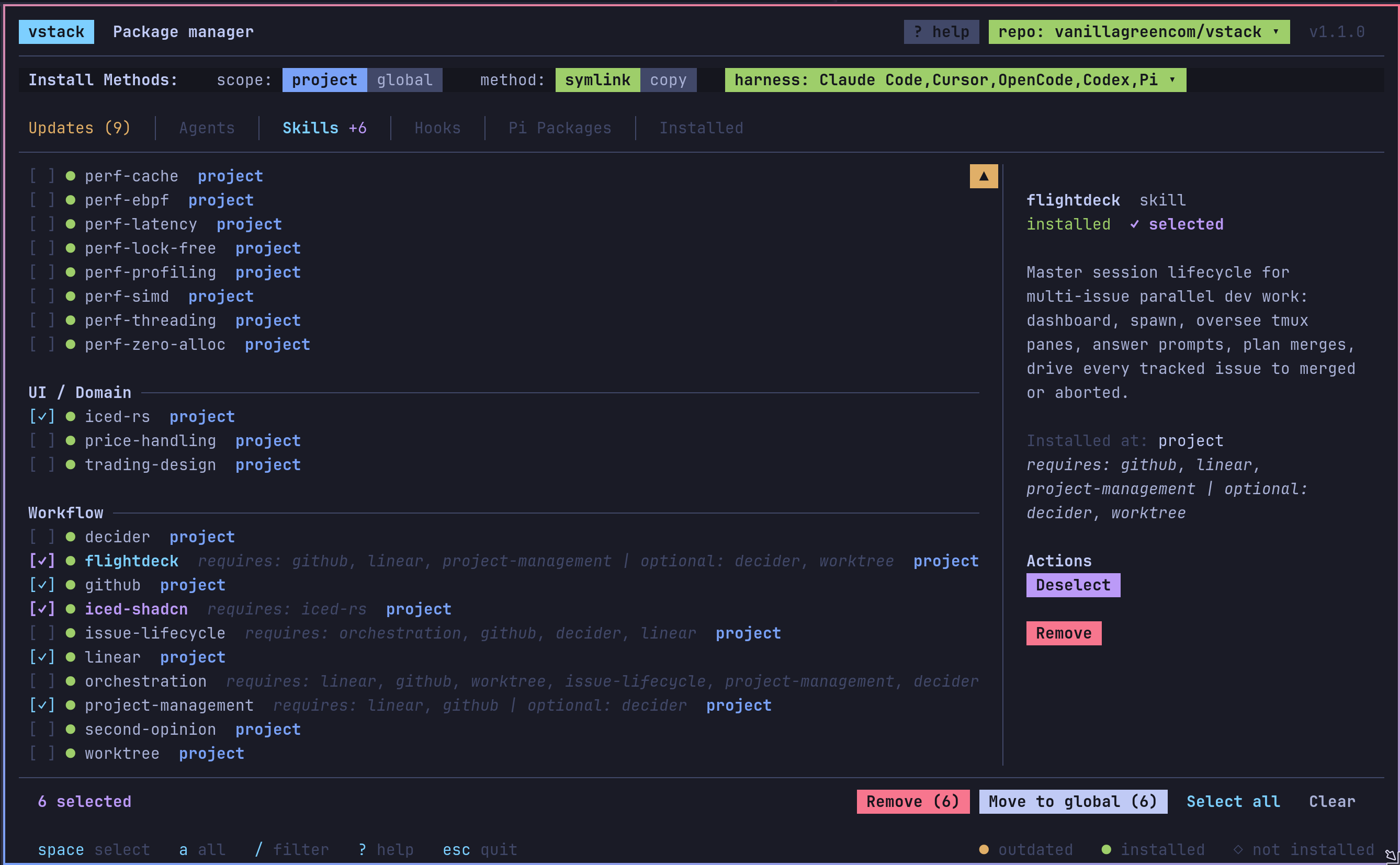
What It Is
A package manager for AI coding workflows. Skills, agents, and hooks live in a source repo; vstack translates them for whichever tool you use. Install per project or for the whole machine, customize freely, and updates won't overwrite your edits.
Highlights
- One source, many tools. Claude Code, Cursor, OpenCode, Codex, Pi.
- Per project or global. One workspace or every project on the machine.
- Customizable. Tweak agents and skills per project — edits survive updates.
- Skill dependencies. Skills declare what they need; everything installs together.
- Swappable catalogs. Use this catalog or any compatible repo.
- Fast TUI. Native Rust interface for browsing, installing, and managing packages.
Quick Start
Requires Rust. If you don't have it, install rustup (Linux/macOS/WSL):
curl --proto '=https' --tlsv1.2 -sSf https://sh.rustup.rs | shThen, open new terminal and:
cargo install --git https://github.com/vanillagreencom/vstack.git vstack
vstack add vanillagreencom/vstack
Nix users can also run the CLI from the flake:
nix run github:vanillagreencom/vstack -- add vanillagreencom/vstackThat opens an interactive installer where you pick which agents, skills, hooks, and Pi extensions to bring in, and which tools to install them into.
How It Works
A source repo is a package registry. vstack discovers what's there, asks which pieces you want, then writes the right files for each tool.
source repo
├─ agents
├─ skills
├─ hooks
└─ Pi extensions
        ▼
   vstack CLI / TUI
        ▼
Claude Code · Cursor · OpenCode · Codex · Pi
Customizing With vstack.toml
vstack add writes a vstack.toml at your project root. Edit it to customize per-agent behavior, then run vstack refresh to apply. Generated agent files are overwritten on refresh — vstack.toml is the stable home for overrides.
# Skills assigned to each agent.
[agent-skills]
rust = ["github", "worktree"]

# Instructions added near the top of the generated agent file.
[agent-launch-instructions]
rust = "Read docs/architecture.md before coding."

# Extra instructions appended to the generated agent file.
[agent-additional-instructions]
rust = "Always run clippy before committing."

# Project instructions prepended to a skill's SKILL.md.
[skill-instructions]
trading-design = "Dark theme, green/red accents."

# Per-harness frontmatter overrides. Each table only affects its own harness.
[agent-frontmatter.claude]
rust = { color = "orange", model = "inherit", effort = "xhigh", deny-tools = ["Agent", "AskUserQuestion"], background = false }

[agent-frontmatter.opencode]
rust = { color = "#f97316", model = "openai/gpt-5.5", model-reasoning-effort = "xhigh", deny-tools = ["task", "question"], mode = "subagent" }

[agent-frontmatter.codex]
rust = { nickname-candidates = ["Rust-Atlas", "Rust-Delta"], model = "gpt-5.5", model-reasoning-effort = "xhigh", sandbox-mode = "danger-full-access" }

[agent-frontmatter.pi]
rust = { color = "orange", model = "inherit", deny-tools = ["subagent", "question"], allowed-subagents = ["scout"], pane = true }
Key rules:
- Prefer
deny-toolsover allowlists. Each harness inherits its normal tool set and blocks only what you list. Claude Code writes it as nativedisallowedTools; OpenCode emitspermission: <tool>: deny; Pi enforces it viapi-agents-tmux. Cursor and Codex don't use per-agent deny lists — Codex subagents usesandbox-mode/approval instead. - Codex
nickname-candidatesare display-only. Generated Codex agents use name-prefixed candidates such asRust-AtlasandRust-Deltaso the Codex app nickname still shows which agent definition was launched. Codex still identifies the subagent by itsname. - Heavy agents inherit the parent model by default. Claude and Pi
opusagents usemodel = "inherit"invstack.toml(Pi omitsmodel:in the generated agent file). Cheaper agents such asscoutcan still pin an explicit model. Override any agent's model in[agent-frontmatter.<harness>]. - Pi
allowed-subagentsenablesdelegate_subagent. vstack engineer agents default toallowed-subagents = ["scout"]so dev agents can dispatch read-only reconnaissance without gaining full orchestration controls. Set[]to disable; non-engineer roles default to disabled (and gaindelegate_subagentin theirdeny-tools). Aliases:allowedSubagents,subagent-agents,subagent_agents. effortis written verbatim by each harness after per-harness frontmatter overrides are applied. Valid:low,medium,high,xhigh(Claude also acceptsmax). When Pi emits an explicit model, it appends effort as:<effort>; Pi has no nativemaxthinking level, so provider metadata or bridge-specific overrides must mapxhighto provider values when needed.- OpenCode agents default to
mode: subagent. Setmode = "primary"only when you want an OpenCode primary agent. OpenCodecolormust be hex. - Claude
backgroundseeds from Pipaneon first install (pane = true→background = false), then your edits are preserved on refresh. - Custom safety hooks (
[[custom-hooks]]) follow the same pattern. Direct edits to generated agent or skill files are also picked up where possible.
v3 migration: legacy shared
[agent-frontmatter]andtoolsallowlists are no longer read. Move overrides into[agent-frontmatter.<harness>]and switch allowlists todeny-tools.
Runtime Settings
Portable skill scripts load runtime settings in this order:
.envvstack.settings.tomlor.vstack/settings.toml.env.local
Use vstack.settings.toml for non-sensitive project defaults that should be committed, such as worktree paths, issue regexes, bot usernames, default Linear team names, and second-opinion command defaults. Keep .env.local for secrets, tokens, API keys, private URLs, signing keys, and personal overrides. See vstack.settings.toml.example and .env.local.example.
When a project install includes a skill that ships vstack.settings.toml.example, vstack add seeds vstack.settings.toml with that skill's non-sensitive defaults. Existing files are merged by adding missing [env] keys only; user values are not overwritten. vstack refresh also performs this merge for installed skills.
Secret values may also be injected by the parent process at launch time. GitHub and Linear helpers preserve already-resolved GH_TOKEN, GITHUB_TOKEN, GH_BOT_TOKEN, and LINEAR_API_KEY values before reading local files or resolving op:// references.
Supported Tools
| Tool | Notes |
|---|---|
| Claude Code | Richest native hook support. Works per project or globally. |
| Cursor | Project scope only; safety rules surface as .cursor/rules. |
| OpenCode | Config-dir aware. |
| Codex | Project agents live in .codex/agents/*.toml; their Required Skills section points project installs at .agents/skills/<name>/SKILL.md. Native hooks are used for supported events; events without a Codex equivalent fall back to safety guidance inside agent instructions. |
| Pi | Adds Pi extension installation alongside agents and skills. |
Windows: CLI runs natively; symlink mode falls back to copy.
Package Catalog In This Repo
Agents
| Agent | Role | Brief |
|---|---|---|
generalist |
engineer | General maintenance, cleanup, docs, stale references, and project hygiene. |
iced |
engineer | Iced UI implementation and architecture specialist. |
planner |
analyst | Turns requirements and scout findings into ordered implementation plans, plan files, and TPM handoff prompts when roadmap/issue planning is needed. |
researcher |
analyst | Exa-powered research specialist for evidence-backed findings reports. |
rust |
engineer | Rust engineer for systems work, performance, zero-allocation, and low-level design. |
scout |
analyst | Fast reconnaissance for unfamiliar code before planning or implementation; may write requested report artifacts. |
tpm |
manager | Technical program management and roadmap analysis agent. |
reviewer-arch |
reviewer | Reviews boundaries, abstractions, and architectural drift. |
reviewer-correctness |
reviewer | Reviews behavior regressions, compatibility, devex breaks, feature-gate leaks, and state/migration correctness. |
reviewer-doc |
reviewer | Reviews documentation accuracy and stale docs. |
reviewer-error |
reviewer | Reviews error handling, silent failures, and propagation. |
reviewer-perf |
reviewer | Reviews latency, benchmarks, and performance regressions. |
reviewer-quality |
reviewer | Reviews maintainability, simplification, abstraction value, type boundaries, and spaghetti-growth risk. |
reviewer-safety |
reviewer | Reviews unsafe Rust, memory safety, and concurrency correctness. |
reviewer-security |
reviewer | Reviews auth, input handling, and security risks. |
reviewer-structure |
reviewer | Reviews modularity, file size, and code organization. |
reviewer-test |
reviewer | Reviews test coverage, missing cases, and test quality. |
Skills
* = needs project-local setup; see that skill's README.
Rust and Performance Guidance
Rust and performance reference material now lives directly in the rust, reviewer-perf, and reviewer-safety agent bodies as compact resource tables.
UI / Domain
| Skill | Brief |
|---|---|
iced-rs |
Iced 0.14 GUI expertise with bundled full-API reference and all upstream examples (incl. iced_wgpu source). |
iced-shadcn |
shadcn Base UI component planning, family decomposition, and parity audits for Iced. |
price-handling |
Price rounding, epsilon comparison, and market-price handling. |
trading-design |
Dense, professional trading-style interface design guidance. |
Workflow / Platform
| Skill | Brief |
|---|---|
decider* |
Architectural decision document management and indexing. |
deep-research |
Exa-powered deep research and portable findings report generation. |
github* |
Bash CLI over the GitHub API for PR operations: threads, comments, reviews, CI logs, merging, and cross-PR analysis. |
html-artifact |
Standalone HTML artifacts for plans, reports, reviews, explainers, prototypes, and custom editors. |
dev* |
Delegated implementation and review-fix issue workflows for dev agents. |
linear* |
Bash CLI over Linear's GraphQL API with local cache, mutation syncing, and structured output (issues, cycles, milestones, projects). |
orch* |
Primary-agent single work-item orchestration for Linear/GitHub issues: prepare, delegate, review, submit, merge, and launch handoff. Sub-agents do NOT load this directly. |
project-management* |
TPM-driven planning, audits, roadmaps, and research-backed decomposition. |
reviewer* |
Strict code-review, whole-codebase review, and QA-review ethos, scope boundaries, workflows, and canonical finding/verdict JSON schema. Loaded by any reviewer-* agent. |
second-opinion |
Cross-model review via the opposite AI CLI (Claude Codex). |
worktree* |
Git worktree create/list/remove with env/config symlinks and per-worktree bot identity. |
Hooks
| Hook | Event | Brief |
|---|---|---|
block-bare-cd |
PreToolUse |
Blocks unsafe bare cd usage and nudges toward subshell-safe patterns. |
pre-commit-check |
PreToolUse |
Validates formatting and lint before commits. |
post-edit-lint |
PostToolUse |
Runs lint checks after source edits. |
task-completed-check |
TaskCompleted |
Runs final lint checks before marking work complete. Claude-Code-only — codex has no clean equivalent event. |
Hook installation per harness:
- Claude Code — script copied under
<scope>/.claude/hooks/, registered insettings.jsonplus the owning agent's frontmatter. - Codex — native install when codex supports the event (
PreToolUse,PostToolUse,PreCompact,PostCompact,PermissionRequest,SessionStart,UserPromptSubmit,Stop): script copied to<scope>/.codex/hooks/, entry merged into<scope>/.codex/hooks.json, and[features] hooks = trueensured inconfig.toml. Events without a codex equivalent fall back to a safety advisory appended to each agent'sdeveloper_instructions. - Cursor — safety advisory
.mdcwritten under<scope>/.cursor/rules/. - OpenCode — permission rule + instruction file referenced from
opencode.json. - Pi — same hook behaviors ship as a first-class Pi extension,
@vanillagreen/pi-hooks. It listens on Pi'stool_call/tool_result/turn_endevents and uses{block: true, reason}to short-circuit unsafe tool calls. Each hook is independently toggleable from the pi-extension-manager settings panel.
Use harnesses: in a hook's frontmatter to scope it explicitly (e.g. harnesses: [claude-code]).
Parity: changes to a hook script must land in the same commit as the matching change in pi-extensions/pi-hooks/extensions/hooks.ts — see AGENTS.md for the rule.
Pi Extensions
Install pi-extension-manager to browse and configure these from inside Pi. Current packages target Pi 0.75+ and follow Pi 0.75's Node.js baseline by declaring engines.node >=22.19.0; Pi 0.73/0.74 installs should stay on older package releases if they must remain on Node 20.
Extensions can ship an instructions.md (declared via pi.appendSystem in package.json); on install, vstack mirrors it into the scope's APPEND_SYSTEM.md (<project>/.pi/APPEND_SYSTEM.md or ~/.pi/agent/APPEND_SYSTEM.md) so Pi loads tool-usage guidance into the system prompt. Removed/disabled extensions strip their block automatically.
If a Pi extension declares production dependencies (dependencies or optionalDependencies), vstack installs them inside the deployed package directory with npm install --omit=dev --package-lock=false --legacy-peer-deps --no-audit --no-fund before registering the package with Pi. The installed node_modules/ stays local to the Pi scope and is ignored by vstack source hashing/verify drift checks.
| Extension | Purpose |
|---|---|
pi-agents-tmux |
Delegate work to subagents in isolated, persistent tmux panes. |
pi-background-tasks |
Non-blocking shell tasks with a live status dashboard. |
pi-caveman |
Caveman communication mode. |
pi-claude-bridge |
Claude Code provider bridge with prompt-context forwarding. |
pi-codex-minimal-tools |
Codex-style image, patch, and image-generation tools alongside Pi natives. |
pi-extension-manager |
Pi-styled package manager and inline settings editor. |
pi-hooks |
First-class Pi port of the vstack safety hooks: bare-cd blocking, pre-commit fmt+clippy, post-edit clippy, end-of-turn lint. |
pi-output-policy |
Large-output policy with transcript-budget-aware truncation, spill-file preservation, and balanced/compact/compat modes. |
pi-prompt-stash |
Per-session prompt stash history with stash/pop editor. |
pi-qol |
Compact statusline, multiline input, image chips, session naming and search. |
pi-questions |
Structured multi-tab popup questions with bridge-driven replies. |
pi-session-bridge |
Side-channel for external control, event streaming, prompt sending, and the Pi activity broker stream. |
pi-session-manager |
Polished session browser for searching, resuming, and managing Pi sessions. |
pi-skills-manager |
Browse, create, edit, and toggle Pi skills from a dedicated shell. |
pi-task-panel |
Persistent structured task panel above the status line. |
pi-tool-renderer |
Compact Claude/opencode-style renderers for built-in tools. |
pi-web-tools |
First-party web stack: search, deep research, fetch, video, and more. |
Extras
Extras are optional non-agent packages distributed by vstack, such as theme packs. See extras/README.md for the catalog and per-extra documentation.
vstack apply vanillagreen-themes --theme ghibli-serene-nature --target ghostty,vscodium,tmux,pivstack apply uses global/user scope by default for app themes. Add --dry-run to preview planned changes before writing config; add --no-ghostty-shaders for palette-only Ghostty applies. The TUI's Extras tab also lets you pick a theme interactively — select the pack, hit Apply, and you get a native picker with a Ghostty shader checkbox plus Uninstall & revert after a successful apply.
License
MIT