

VibeRaven
Your AI agent builds it. VibeRaven controls it.





Website · Quickstart · Agent skills · Releases · Discussions
VibeRaven is the open-source cockpit for AI coding agents. Agents write code fast, but they patch blind. VibeRaven maps your product in seconds: releases, providers, and launch risks, ready to drag into your agent's next prompt.
npx -y viberaven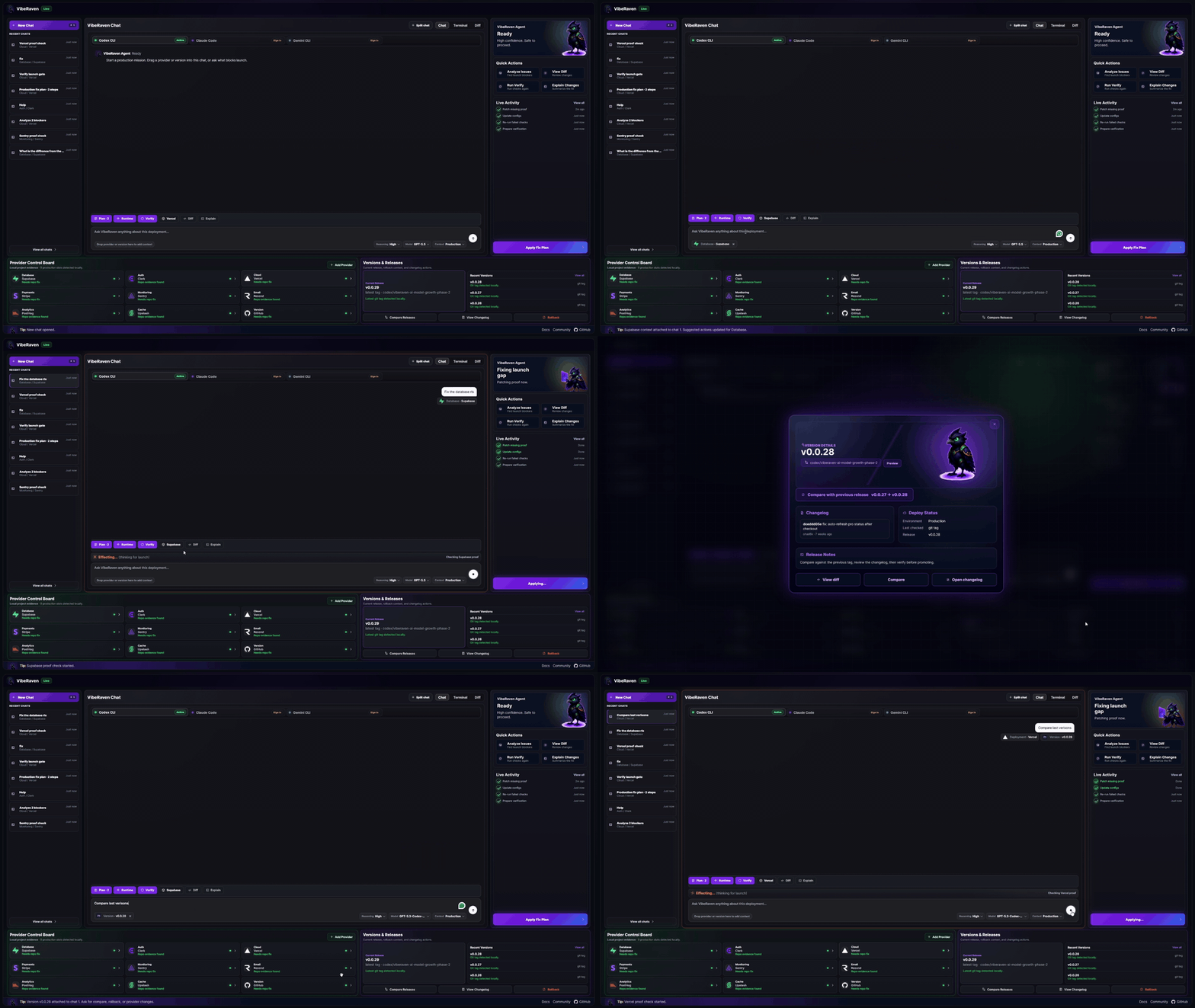
The Studio opens in your browser and works entirely on your machine: it detects your stack, finds your providers, puts your git releases on a timeline, and gives you a "can I ship?" verdict from offline checks. No login, no API key, no telemetry.
Your first 5 minutes
Run it.
npx -y viberavenin your project folder. The Studio opens in your browser and scans your repo offline.Read your verdict. The gate chip and Launch Signals show exactly what blocks launch, ranked. Click any signal, then click Fix to hand it to your agent.
Connect your coding agent. Pick Codex, Claude Code, or Gemini CLI in the chat panel, hit Test connection, and choose how much access it gets (
ask,approve, orfull).Open the Architecture map. Pages, API, data, modules, and providers as a live draggable map. Weak boundaries glow red. Click one and press a plain-English action like "Protect user data (RLS)" or "Fix slow queries".
Open the Worktree. Your branches as a real tree. Uncommitted mess? One tap: Commit with agent. Branch ready? Review explains it in plain language and Merge does it safely.
Give your agent the skills. Install the six-skill pack and the plugin so Codex, Claude Code, and Gemini follow the same senior-engineer loop everywhere:
npx -y skills add ohad6k/VibeRaven --skill viberaven   # skills.sh pack
npx -y viberaven init --agents all                     # agent rules in-repo
Everything the agent needs is also written to .viberaven/ as markdown and JSON, readable by any tool and versioned by git.
What the Studio gives you
| Capability | What it does |
|---|---|
| Agent chat on your repo | Drive Codex, Claude Code, or Gemini CLI from one cockpit, with connection health and live terminal output. |
| Access modes | ask, approve, or full. The mode changes the real agent command it runs, not just the UI copy. |
| Context you can drag | Drop a release, a provider card, or production memory into agent chat, so the agent patches with your product's real state instead of guessing. |
| Versions & releases | Release diffs, tags, changelogs, and "what changed since the last working release" in plain English. |
| Providers via MCP | Connect Supabase, Vercel, and Stripe. Provider status flows into agent prompts, and provider proof stays separate from repo-code fixes. |
The terminal twin: viberaven check
For agents and CI, the same verdict as one command:
npx -y viberaven checkviberaven check · ~/my-app
🔴 RLS disabled on public tables (rls_profiles)
🟡 Service-role key referenced in client bundle (service_role_client)
⚪ No error monitoring wired (monitoring_missing)
Verdict: ❌ 1 blocker, 1 warning · score 62
Fix: viberaven fix · Details: .viberaven/agent-tasklist.mdOne line per finding, file:line evidence in the artifacts, exit code 1 on blockers. Then:
npx -y viberaven fix            # list gaps with safe automatic recipes
npx -y viberaven fix --gap <id> # apply one recipe
npx -y viberaven --strict       # final gate before deploy or CI
All results land in .viberaven/ as markdown and JSON on disk (agent-tasklist.md, gate-result.json, context-map.json), so any agent and your git history can read them.
Install for AI agents
Make agents use release and provider context before they patch the repo:
npx -y viberaven init --agents all
npx -y viberaven doctor --agents
Preview without writing files:
npx -y viberaven init --agents all --dry-runThis installs bounded rules (<!-- VIBERAVEN:START --> ... <!-- VIBERAVEN:END -->) into:
AGENTS.md,CLAUDE.md,GEMINI.md.cursor/rules/viberaven-core.mdc(plus scoped Supabase, deploy, and payments rules).github/copilot-instructions.md.viberaven/agent-context.md,.viberaven/mission-map.md
The rules teach the loop: check, read .viberaven/, fix one gap, then check again until gate.status === "clear".
Agent skills
Six skills.sh skills route agents through architecture questions, version evidence, and launch proof:
| Skill | Job |
|---|---|
viberaven |
The router: local check/fix loop, Studio, and MCP context. |
architecture-context |
Ask the missing product questions before any edit. |
architecture-plan |
Turn answers plus repo evidence into a workstream plan. |
what-broke |
Find which version broke the app before patching. |
production-context |
Keep compact production memory in .viberaven/production-context.md. |
go-live |
Local app to GitHub to Vercel, with live-URL proof. |
npx -y skills add ohad6k/VibeRaven --skill viberavenSee agent-skills/ for the full pack.
This repo also works as an agent plugin: plugin.yaml, .claude-plugin/, .codex-plugin/, and gemini-extension.json expose the six skills plus /viberaven-work, /viberaven-help, /viberaven-production-context, and /viberaven-launch commands to Claude Code, Codex, and Gemini CLI.
MCP
VibeRaven is listed in the MCP registry for agents that prefer tools over terminal commands:
{ "viberaven": { "command": "npx", "args": ["-y", "viberaven", "--mcp"] } }Key tools: viberaven_check_readiness (runs the local check), viberaven_heal_apply, viberaven_verify, viberaven_audit, viberaven_provider_verify, and viberaven_validate_npm_package (run it before adding npm dependencies).
Vercel + Supabase
npx -y viberaven audit --vercel-supabaseLocal evidence checks for RLS proof, service-role exposure, and pooler ports before you claim "production ready."
Philosophy
- Local-first. The CLI and Studio run on your machine. No login, no API key, no telemetry, no scan quota.
- Markdown on disk. All context lives in
.viberaven/as plain files that your agent and your git history can read. - Evidence over vibes. Findings point at repo evidence. Provider dashboard state is never claimed from repo edits alone.
- Non-destructive. Fix recipes are guarded, cleanup is plan-only, and nothing is pushed or deployed for you.
Contributing
Contributions are welcome, and most of them need no private source access:
- Pick up a good first issue: docs, provider fixtures, examples, and translations.
- Share ideas or questions in Discussions.
- Join the Discord to talk to the maintainer directly.
Resources
- Agent-ready starter template: examples/nextjs-supabase-vercel-production-ready-template
- Machine-readable docs: llms.txt · llms-full.txt · skills.json · skills.sh.json
- Example proof artifacts: examples/proof/
- Website: viberaven.dev · npm: viberaven · Issues: ohad6k/VibeRaven/issues
License
MIT. Current public release: viberaven@1.3.5.
If VibeRaven helps you ship, star the repo so other AI app builders can find it. Use Watch → Custom → Releases for release notifications.
This public repo is the agent discovery and installation surface. Product source development happens in a private repository.