
@zxkit/chrono
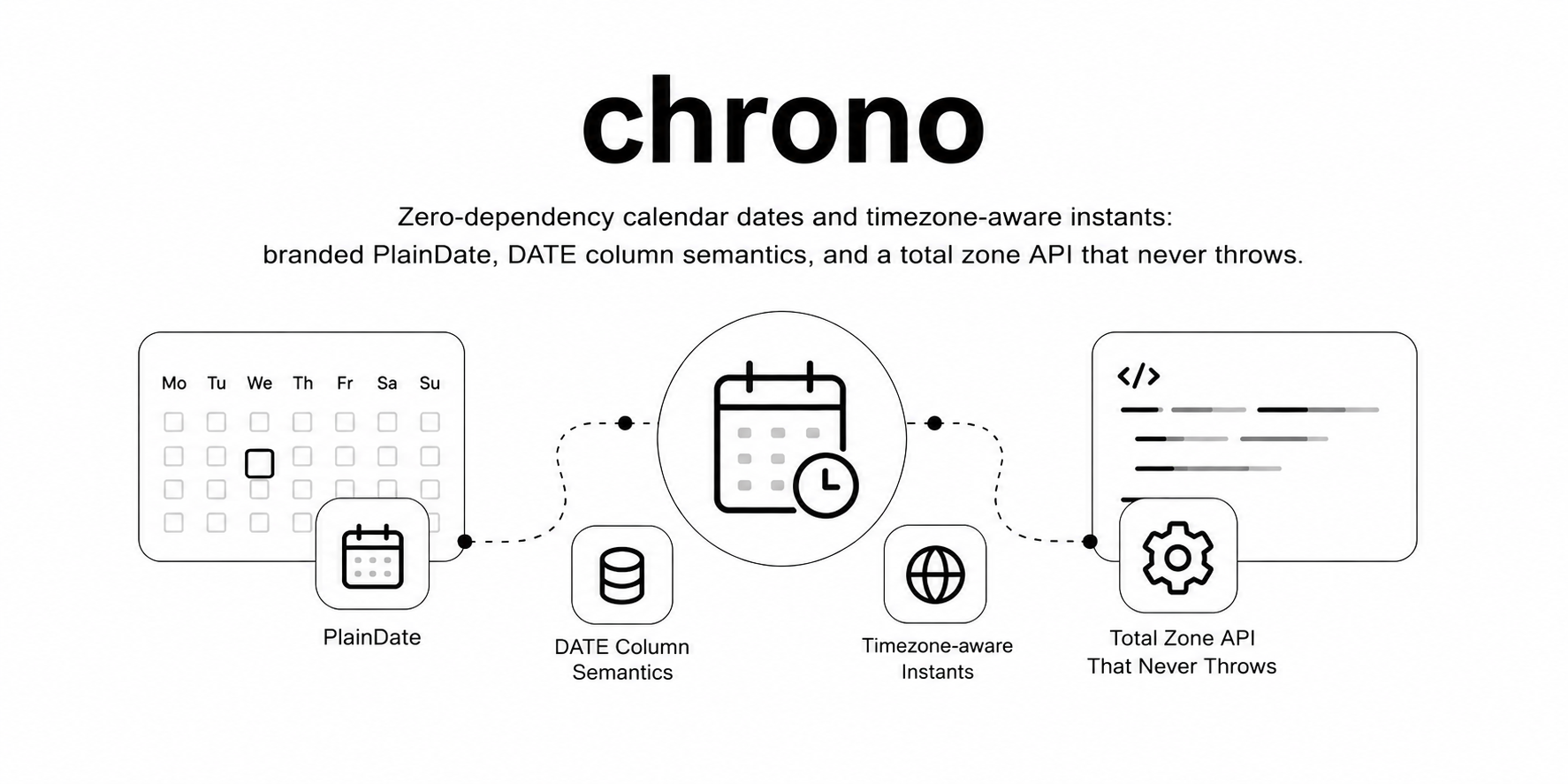
Zero-dependency calendar dates and timezone-aware instants, built on native Intl.



The API is total — it never throws. Invalid input at the boundary returns null; inside the domain every operation returns a valid value. TypeScript forces you to handle the null exactly once, where the data enters. After that, failure is unrepresentable.
PlainDate— a branded'YYYY-MM-DD'string for pure calendar days: the exact semantics of a SQLDATEcolumn. Serializes for free across RSC/JSON, compares natively with<>===, and mixing it with instants is a compile error.zone(timeZone)— binds an IANA zone (plus locale and week start) once, and answers the only questions that actually need a zone: which day contains this instant, and which instant starts that day.
Install
bun add @zxkit/chronoUsage
One boundary in, then everything is infallible:
import { addMonths, diffDays, parsePlainDate, startOfMonth, toUtcMidnight } from '@zxkit/chrono'

// boundary: DB rows, user input, URL params — null instead of throw
const due = parsePlainDate(row.dueDate) // Date @ UTC midnight → PlainDate | null
if (!due) return badRequest()
const from = parsePlainDate(searchParams.from) ?? startOfMonth(due)

// domain: total, no failure paths
addMonths(due, 1) // clamps: Jan 31 + 1 → Feb 28/29
diffDays(due, from)
due < from // native comparison
toUtcMidnight(due) // → Date, ready to write back to a DATE column
Zone-dependent questions go through a configured zone:
import { zone } from '@zxkit/chrono'

const tz = zone('America/New_York', { locale: 'en-US' })

tz.today() // PlainDate of the day right now, in that zone
tz.dayOf(order.paidAt) // day containing that instant (null on garbage)
tz.startOfDay() // instant of today's local midnight — timestamp filters
tz.toInstant(due, '14:30') // 14:30 local wall clock of that day, as an instant
tz.isPast(due) // due < tz.today()
tz.format(due) // 'July 1, 2026'
tz.formatRange(from, to) // 'July 1 – 15, 2026'
tz.formatTime(order.paidAt) // '14:05'
tz.formatRelative(order.paidAt) // '5 minutes ago'
Query ranges come precomputed — the half-open [gte, lt) shape Prisma-style filters expect:
db.order.aggregate({ where: { paidAt: tz.monthRange() } }) // current local month
db.order.findMany({ where: { paidAt: tz.dayRange(day) } }) // one local day
db.order.findMany({ where: { paidAt: tz.rangeBetween(from, to) } }) // inclusive [from, to]

// DATE columns compare against UTC midnights, not zone instants:
db.invoice.findMany({ where: { issuedOn: toUtcRange(from, to) } }) // { gte, lte }
Recommended app adapter — the only place that knows your app's zone:
// server/app-date.ts
import { zone } from '@zxkit/chrono'

export const tz = zone(process.env.APP_TZ ?? 'America/New_York', {
  locale: 'en-US',
})

export { addDays, addMonths, diffDays, parsePlainDate, toUtcMidnight } from '@zxkit/chrono'
export type { PlainDate } from '@zxkit/chrono'
Why it can't fail
| Input | Behavior |
|---|---|
parsePlainDate('2026-02-30'), garbage strings, Invalid Date, NaN |
null — decide the fallback once, at the boundary |
plainDate(2026, 13, 1) |
null |
addDays(pd, NaN), addMonths(pd, 1e12), results outside year 1-9999 |
returns pd unchanged |
formatPlain(pd, '!!bad-locale!!'), conflicting Intl options |
falls back to the ISO string |
zone('Mars/Olympus_Mons') |
resolves to 'UTC'; detect with isValidTimeZone() or .timeZone |
tz.dayOf('garbage'), tz.formatTime(NaN) |
null |
| DST transitions at midnight (skipped or repeated hour) | startOfDay returns the first existing instant of the day |
API
PlainDate (pure, no timezone)
| Function | Notes |
|---|---|
parsePlainDate(value) |
the boundary: 'YYYY-MM-DD', Date, or epoch millis (UTC components) → PlainDate | null |
plainDate(y, m, d) |
components (m 1-12) → PlainDate | null |
isPlainDate(v) |
type guard; validates shape and that the day exists |
toParts(pd) / toUtcMidnight(pd) / dayOfWeek(pd) |
{ year, month, day } / Date for DATE columns / ISO 1-7 |
compare, isSameDay, isSameMonth, isSameYear, isBefore, isAfter, isSameOrBefore, isSameOrAfter, minDate, maxDate, clampDate, isBetween |
total order — plain string comparison |
addDays, addMonths, addYears, diffDays, diffMonths, diffYears |
UTC-epoch arithmetic; month/year ops clamp end of month |
startOfMonth, endOfMonth, startOfWeek, endOfWeek, startOfYear, endOfYear |
period boundaries |
eachDay, eachMonth, toUtcRange |
iteration and inclusive { gte, lte } bounds for DATE columns |
formatPlain(pd, locale?, opts?) / formatPlainRange(from, to, locale?, opts?) |
Intl pinned to UTC so the day never shifts |
zone(timeZone, { locale?, weekStartsOn? })
| Member | Notes |
|---|---|
today() |
PlainDate in the zone |
dayOf(instant) |
day containing the instant → PlainDate | null |
startOfDay(pd?) / startOfWeek(pd?) |
local midnight as an instant; default today; DST-gap safe |
toInstant(pd, time?) |
local wall clock ('HH:mm[:ss]') → instant; null on bad time |
dayRange(pd?) / weekRange(pd?) / monthRange(pd?) / yearRange(pd?) / rangeBetween(from, to) |
half-open { gte, lt } instant ranges for timestamp filters |
isToday(pd) / isPast(pd) / isFuture(pd) |
relative to today() |
format(pd, opts?) / formatRange(from, to, opts?) / formatTime(instant, opts?) / formatInstant(instant, opts?) |
locale preset; instant formatters return null on invalid input |
formatRelative(instant, { now? }) |
Intl.RelativeTimeFormat, numeric: 'auto' ('5 minutes ago', 'tomorrow') |
Free helpers: parseInstant(value) (the instant boundary — Date | null, rejects null/objects that new Date would coerce), isValidTimeZone(tz), formatElapsed(from, to?) ('5m', '1h 30m').
Validating at the edge (zod)
import { isPlainDate, type PlainDate } from '@zxkit/chrono'

const schema = z.object({
  dueDate: z.custom<PlainDate>(isPlainDate, 'Invalid date'),
})
License
MIT