
audio-filter 

Canonical audio filter implementations.
Weighting Auditory | Speech EQ Effect |
Install
npm install audio-filter// import everything
import * as filter from 'audio-filter'
// import by domain
import { aWeighting, kWeighting } from 'audio-filter/weighting'
import { gammatone, melBank } from 'audio-filter/auditory'
import { moogLadder, oberheim } from 'audio-filter/analog'
import { vocoder, lpcAnalysis } from 'audio-filter/speech'
import { parametricEq, crossover, baxandall, tilt, lowShelf, highShelf } from 'audio-filter/eq'
import { dcBlocker, notch, lowpass, highpass, bandpass, resonator } from 'audio-filter/effect'API
All filters share one shape:
filter(buffer, params) // → buffer (modified in-place)Takes an Array/Float32Array/Float64Array, modifies it in-place, returns it. Pass the same params object on every call to persist state across blocks automatically:
let params = { fc: 1000, resonance: 0.5, fs: 44100 }
for (let buf of stream) moogLadder(buf, params)
For frequency analysis, weighting filters expose a .coefs(fs) method returning a second-order sections (SOS) array — [{b0, b1, b2, a1, a2}, ...], one biquad per section — for use with digital-filter:
import { freqz, mag2db } from 'digital-filter/core'

let sos  = aWeighting.coefs(44100)
let resp = freqz(sos, 2048, 44100)
let db   = mag2db(resp.magnitude)
Weighting
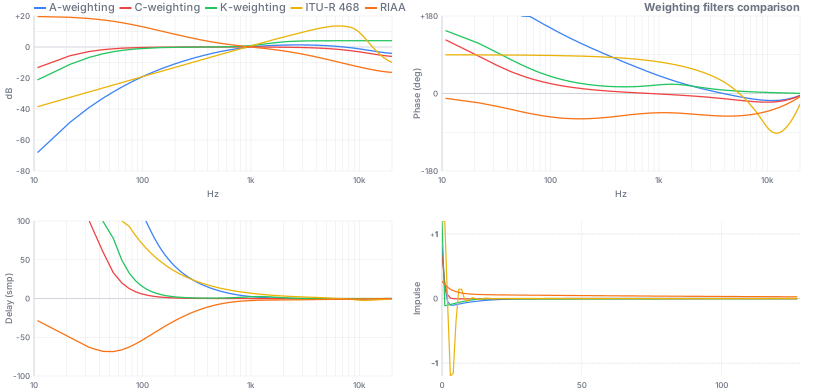
Standard measurement curves. Each is defined by a standards body to a specific curve shape and normalization.
| filter | standard | normalized |
|---|---|---|
aWeighting |
IEC 61672-1:2013 | 0 dB at 1 kHz |
cWeighting |
IEC 61672-1:2013 | 0 dB at 1 kHz |
kWeighting |
ITU-R BS.1770-4:2015 | — |
itu468 |
ITU-R BS.468-4:1986 | +12.2 dB at 6.3 kHz |
riaa |
RIAA 1954 / IEC 60098 | 0 dB at 1 kHz |
A-weighting
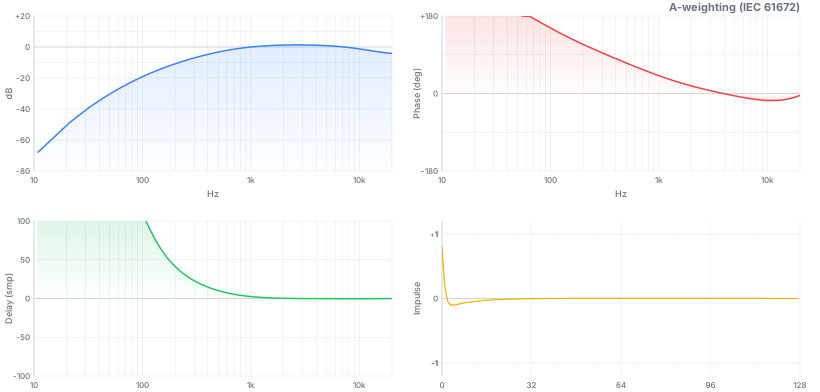
Models how the ear perceives loudness — attenuates low and very high frequencies.
Transfer function: $H(s) = \frac{Ks^4}{(s+\omega_1)^2(s+\omega_2)(s+\omega_3)(s+\omega_4)^2}$
Poles: $\omega_1 = 2\pi \cdot 20.6,\text{Hz}$, $\omega_2 = 2\pi \cdot 107.7,\text{Hz}$, $\omega_3 = 2\pi \cdot 737.9,\text{Hz}$, $\omega_4 = 2\pi \cdot 12194,\text{Hz}$
Implementation: matched z-transform ($z_k = e^{s_k/f_s}$), 3 SOS sections — no frequency warping near Nyquist
Normalization: 0 dB at 1 kHz (IEC requirement)
import { aWeighting } from 'audio-filter/weighting'

let p = { fs: 44100 }
for (let buf of stream) aWeighting(buf, p) // A-weighted streamStandard: IEC 61672-1:2013[^1]
Use when: measuring SPL, noise, OSHA compliance, audio quality
Not for: loudness in broadcast (use K-weighting), noise annoyance (use ITU-468)
C-weighting
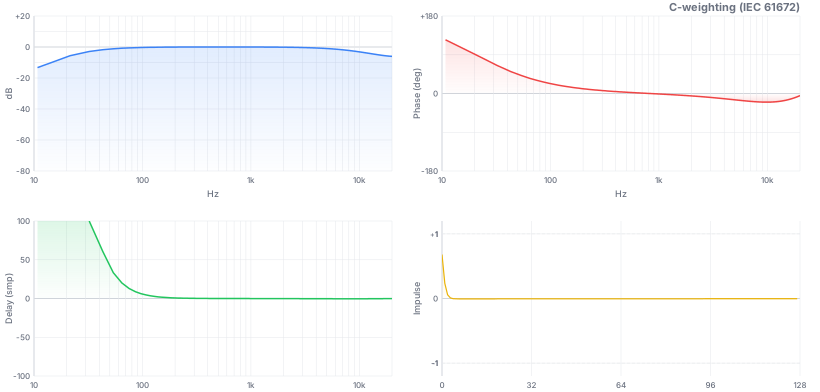
Like A-weighting but flatter — less rolloff at low and high frequencies.
Transfer function: $H(s) = \frac{Ks^2}{(s+\omega_1)^2(s+\omega_4)^2}$
Poles: $\omega_1 = 2\pi \cdot 20.6,\text{Hz}$, $\omega_4 = 2\pi \cdot 12194,\text{Hz}$ (same as A-weighting outer poles)
Implementation: matched z-transform, 2 SOS sections
cWeighting(buffer, { fs: 44100 })Standard: IEC 61672-1:2013[^1]
Use when: peak sound level measurement, where A-weighting over-penalizes bass
Compared to A: rolls off below 31.5 Hz and above 8 kHz; flat 31.5 Hz–8 kHz
K-weighting
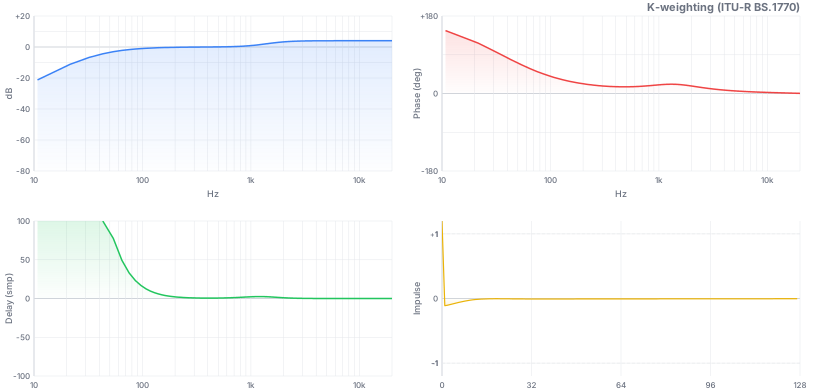
The loudness measurement curve — a high shelf plus a highpass. Used to compute LUFS.
Stage 1: pre-filter — high shelf +4 dB above ~1.5 kHz (head diffraction simulation)
Stage 2: RLB highpass — 2nd-order Butterworth at ~38 Hz (removes sub-bass)
Exact coefficients at 48 kHz: specified in BS.1770 Annex 1; this implementation uses them verbatim
import { kWeighting } from 'audio-filter/weighting'

kWeighting(buffer, { fs: 48000 })   // exact ITU-R BS.1770 coefficients
kWeighting(buffer, { fs: 44100 }) // approximated via biquad designStandard: ITU-R BS.1770-4:2015[^2], EBU R128
Use when: computing integrated loudness (LUFS/LKFS), broadcast loudness normalization
Not for: A-weighted SPL measurement (different shape, different standard)
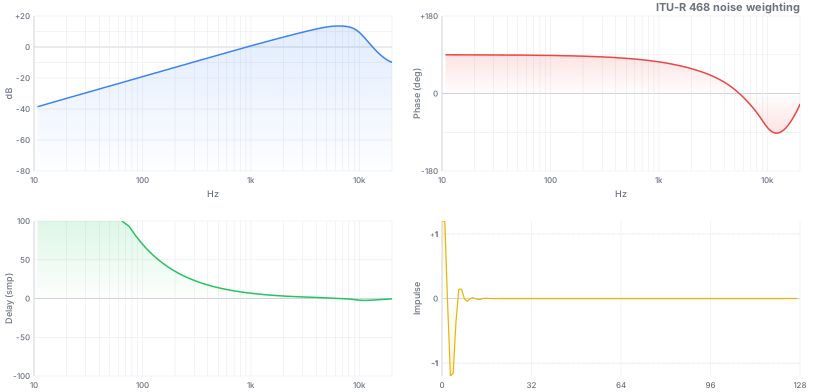
ITU-R 468
Peaked noise weighting — peaks at +12.2 dB near 6.3 kHz — models how humans actually perceive noise annoyance.
Shape: rises steeply from 31.5 Hz, peaks at +12.2 dB at 6.3 kHz, rolls off above 10 kHz
Implementation: practical IIR approximation via cascaded biquads, within ~1 dB of spec
itu468(buffer, { fs: 48000 })Standard: ITU-R BS.468-4:1986[^3] (original CCIR 468, 1968)
Rationale: human hearing is more sensitive to short noise bursts than sine tones; 468 weights accordingly
Use when: measuring noise in broadcast equipment, tape noise, hum and hiss
Compared to A-weighting: 6.3 kHz peak makes it harsher on hiss; preferred in European broadcast
RIAA
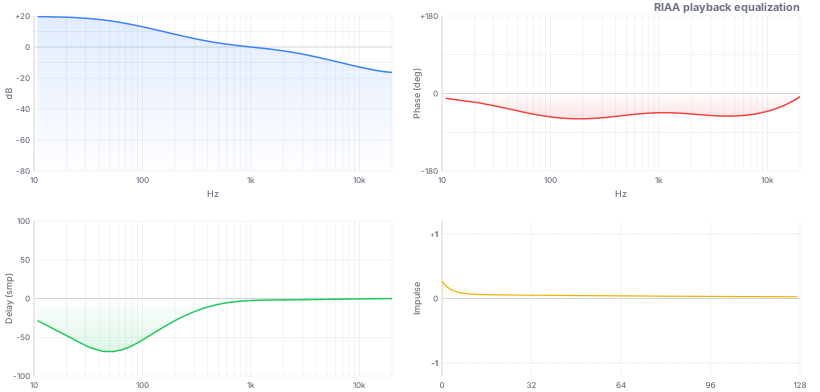
Playback equalization for vinyl records — a shelving curve with three time constants.
Transfer function: $H(s) = \frac{1 + sT_2}{(1 + sT_1)(1 + sT_3)}$
Time constants: $T_1 = 3180,\mu\text{s}$ (50.05 Hz pole), $T_2 = 318,\mu\text{s}$ (500.5 Hz zero), $T_3 = 75,\mu\text{s}$ (2122 Hz pole)
Implementation: 1 SOS section via bilinear transform, normalized 0 dB at 1 kHz
import { riaa } from 'audio-filter/weighting'

riaa(phonoSignal, { fs: 44100 }) // correct vinyl playbackStandard: RIAA 1954, IEC 60098:1987[^4]
Purpose: playback de-emphasis undoes the mastering pre-emphasis applied during vinyl cutting
Shape: boosts bass ~+20 dB at 20 Hz, rolls off treble; at playback restores flat response
Auditory
Models of the human auditory system — how the cochlea and brain decompose sound into frequency channels. Used in psychoacoustics, music information retrieval, and hearing aid design.
Gammatone
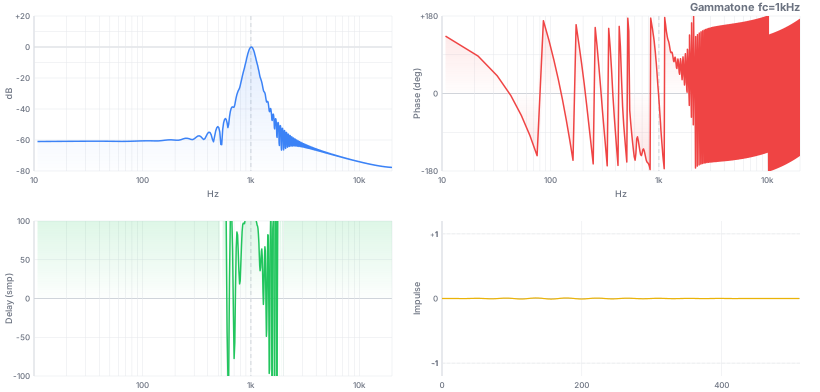
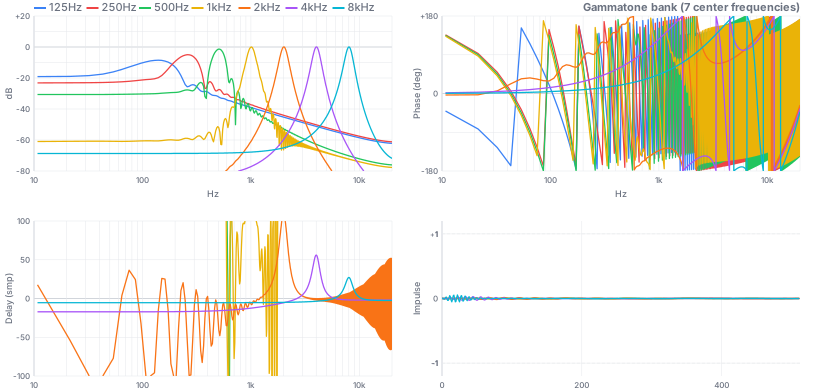
The cochlear filter — bandpass tuned to one frequency, decaying oscillation, mimics an inner hair cell.
Model: cascade of complex one-pole filters; 4th-order is the standard cochlear approximation
Bandwidth: $\text{ERB} = 24.7\left(\frac{4.37 f_c}{1000} + 1\right),\text{Hz}$
Implementation: complex resonator with gain normalization to 0 dB at $f_c$
import { gammatone } from 'audio-filter/auditory'

let params = { fc: 1000, fs: 44100 }
gammatone(buffer, params) // bandpass at 1 kHz with cochlear envelopeOrigin: Patterson et al. (1992)[^5]
Use when: cochlear modeling, auditory scene analysis, psychoacoustic feature extraction
Compared to Butterworth bandpass: gammatone has asymmetric temporal envelope matching biological data
Reuse params across blocks — state in params._s, gain cached in params._gain.
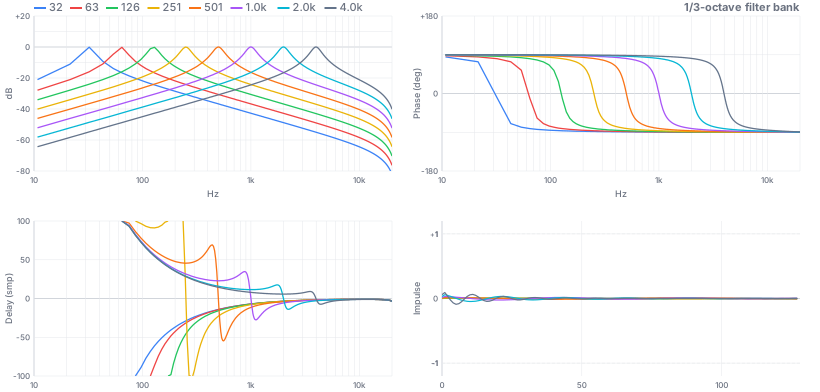
Octave bank
ISO/IEC fractional-octave filter bank — the standard for acoustic measurement and spectrum analysis.
Center frequencies: ISO 266 series — $f_c = 1000 \cdot G^{k/n}$, $G = 10^{3/10}$
Bandwidth: each band spans $f_c \cdot G^{-1/(2n)}$ to $f_c \cdot G^{+1/(2n)}$
1/1 octave: 10 bands (31.5–16 kHz) — coarse; 1/3 octave: 30 bands — standard; 1/6+: psychoacoustics
Returns: array of { fc, coefs } — each band is a biquad bandpass section
import { octaveBank } from 'audio-filter/auditory'
import { filter } from 'digital-filter'

let bands = octaveBank(3, 44100)   // 1/3-octave, 30+ bands
for (let band of bands) {
  let buf = Float64Array.from(signal)
  filter(buf, { coefs: band.coefs })
  spectrum.push({ fc: band.fc, energy: rms(buf) })
}Standard: IEC 61260-1:2014[^6], ANSI S1.11:2004
Use when: acoustic measurement, noise assessment, spectrum visualization
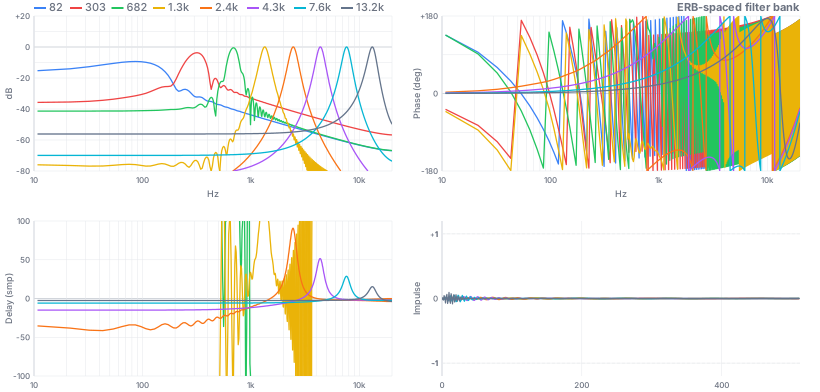
ERB bank
Equivalent Rectangular Bandwidth scale — how the auditory system actually spaces its channels.
ERB formula: $\text{ERB}(f_c) = 24.7\left(\frac{4.37 f_c}{1000} + 1\right)$
Spacing: ~1 ERB between adjacent channels — logarithmic above 1 kHz, more linear below
Returns: array of { fc, erb, bw } descriptors; apply gammatone at each fc for the filter bank
import { erbBank, gammatone } from 'audio-filter/auditory'

let bands  = erbBank(44100)
let states = bands.map(b => ({ fc: b.fc, fs: 44100 }))

for (let buf of stream) {
  let channels = bands.map((_, i) => {
    let b = Float64Array.from(buf)
    gammatone(b, states[i])
    return b
  })
}Origin: Moore & Glasberg (1983, 1990)[^7]
Use when: speech processing, hearing models, auditory feature extraction
Compared to Bark: ERB is more accurate above 500 Hz; Bark is the psychoacoustic masking model
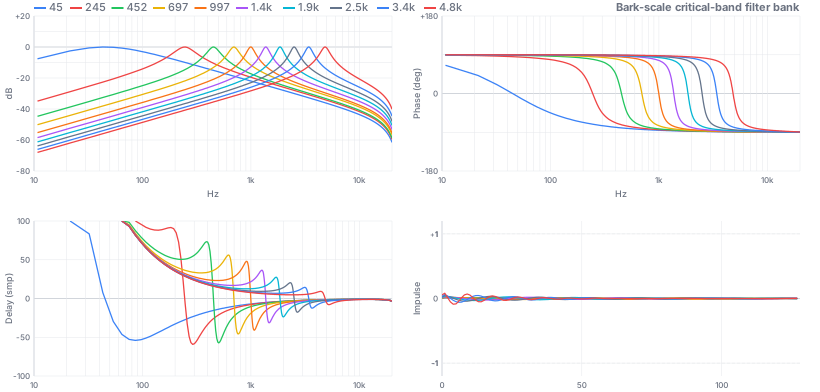
Bark bank
Zwicker's 24 critical bands — the psychoacoustic foundation of perceptual audio coding.
Scale: 24 bands spanning 20 Hz–20 kHz; named after Heinrich Barkhausen
Band widths: ~100 Hz wide below 500 Hz; ~20% of center frequency above
Returns: array of { bark, fLow, fHigh, fc, coefs } — each band is a biquad bandpass section
import { barkBank } from 'audio-filter/auditory'
import { filter } from 'digital-filter'

let bands = barkBank(44100)   // 24 critical bands
for (let band of bands) {
  let buf = Float64Array.from(signal)
  filter(buf, { coefs: band.coefs })
  excitation[band.bark] = rms(buf)
}Origin: Zwicker (1961)[^8]
Use when: perceptual audio coding (MP3/AAC use Bark-like groupings), loudness models, masking
Compared to ERB: Bark bands are wider and fewer; ERB is more accurate for hearing science
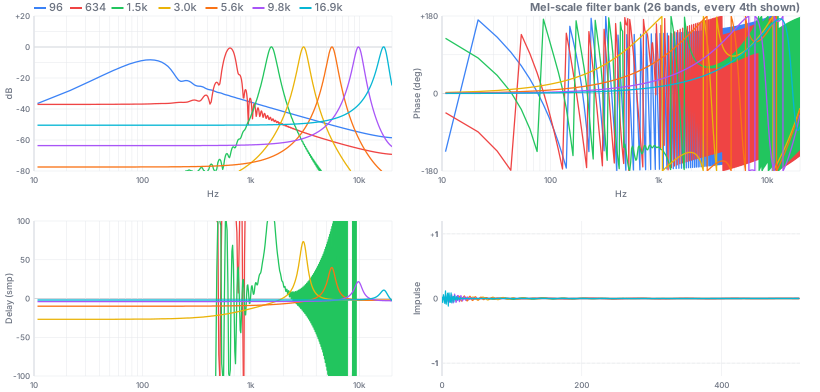
Mel bank
Mel-frequency triangular filter bank — the standard front-end for speech recognition and music information retrieval.
Scale: $\text{mel}(f) = 2595 \log_{10}(1 + f/700)$ (O'Shaughnessy variant)[^18]
Bands: equally spaced in mel scale; each band is a triangle spanning 3 adjacent mel points
Returns: array of { fc, fLow, fHigh, mel } — band descriptors for MFCC computation
import { melBank } from 'audio-filter/auditory'

let bands = melBank(44100)                          // 26 bands (default)
let bands = melBank(16000, { nFilters: 40 })        // 40 bands, telephony rate
let bands = melBank(44100, { fmin: 300, fmax: 8000 })
Use when: MFCC feature extraction, speech recognition, music genre classification, audio fingerprinting
Compared to ERB/Bark: mel is the most widely used in ML; ERB is more physiologically accurate
Analog
Discrete-time models of analog circuits — each named after the hardware it replicates. Nonlinear, stateful, process in-place. The filters in synthesizers.
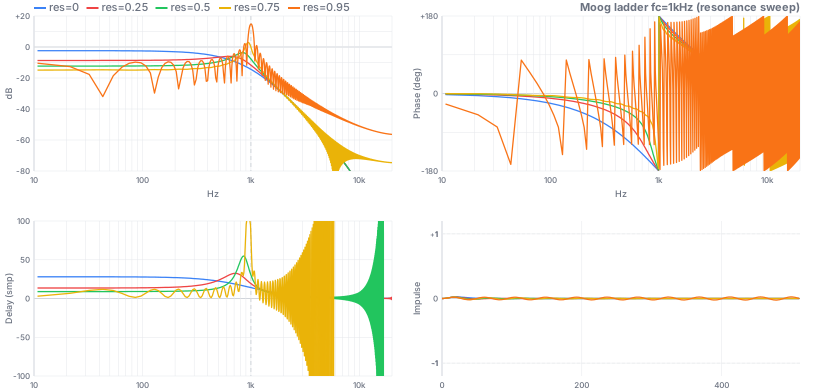
Moog ladder
Robert Moog's 4-pole transistor ladder, 1965 — the most imitated filter in electronic music.
Circuit: 4 cascaded one-pole transistor ladder sections, global feedback from output to input
Implementation: Zero-delay feedback (ZDF) via trapezoidal integration — Zavalishin (2012)[^9], Ch. 6
Response: $-24,\text{dB/oct}$ lowpass; resonance peak at $f_c$; self-oscillation (sine wave) at resonance=1
Nonlinearity: $\tanh$ saturation at input (transistor ladder characteristic)
import { moogLadder } from 'audio-filter/analog'

let params = { fc: 800, resonance: 0.7, fs: 44100 }
moogLadder(buffer, params)

// Self-oscillation — runs indefinitely from a single impulse
let silent = new Float64Array(4096); silent[0] = 0.01
moogLadder(silent, { fc: 1000, resonance: 1, fs: 44100 })Patent: Moog (1965) US3475623[^10]
vs Diode ladder: Moog saturates only at input; diode saturates at each stage — different character at high resonance
Diode ladder
Roland TB-303 / EMS VCS3 style — per-stage saturation gives the characteristic acid "squelch".
Circuit: Roland TB-303, EMS VCS3, EDP Wasp
Key difference from Moog: $\tanh$ nonlinearity at each of 4 stages, not just input; feedback is a weighted sum of all stage outputs
Character: preserves bass at high resonance; more "squelchy" and aggressive than Moog
Implementation: ZDF — Zavalishin (2012)[^9]; Pirkle (2019)[^11], Ch. 10
Stability: stable up to resonance=0.95; bounded output
import { diodeLadder } from 'audio-filter/analog'

let params = { fc: 500, resonance: 0.8, fs: 44100 }
diodeLadder(buffer, params)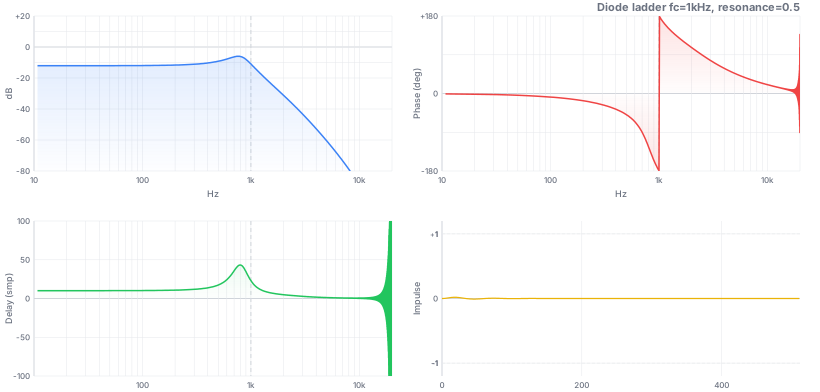
Korg35
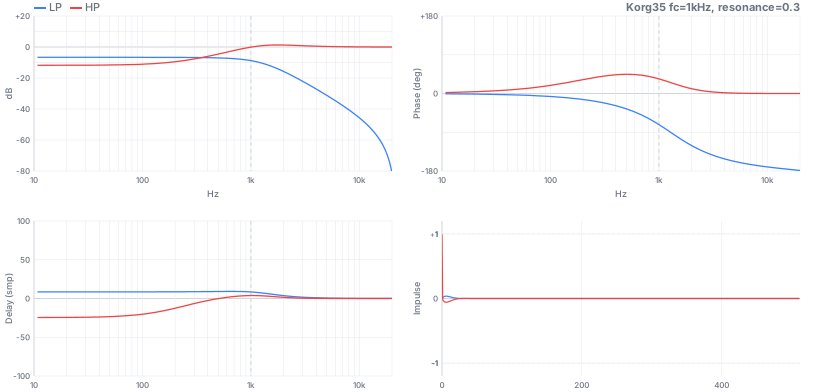
Korg MS-10/MS-20, 1978 — 2-pole filter with lowpass and complementary highpass outputs.
Topology: 2 cascaded one-pole sections with nonlinear feedback; HP = input − LP
Response: $-12,\text{dB/oct}$; aggressive resonance due to nonlinear feedback; both LP and HP from one circuit
import { korg35 } from 'audio-filter/analog'

korg35(buffer, { fc: 1000, resonance: 0.5, type: 'lowpass',  fs: 44100 })
korg35(buffer, { fc: 1000, resonance: 0.5, type: 'highpass', fs: 44100 })Circuit: Korg MS-10/MS-20 (1978)
Analysis: Stilson & Smith (1996)[^12]; Zavalishin (2012)[^9], Ch. 5
vs Moog ladder: 2-pole ($-12,\text{dB/oct}$) vs 4-pole ($-24,\text{dB/oct}$); Korg35 has complementary HP mode
Oberheim
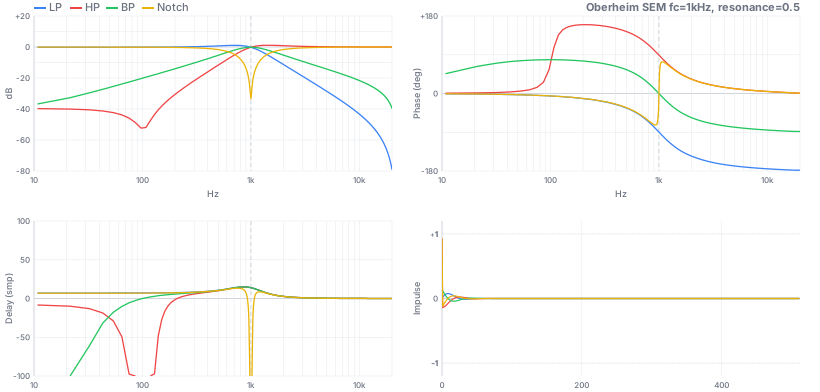
Oberheim SEM (1974) — 2-pole state-variable filter with four modes from one circuit.
Topology: 2 trapezoidal integrators with nonlinear feedback; multimode output (LP/HP/BP/notch)
Response: $-12,\text{dB/oct}$; warm, musical resonance; continuous mode morphing
Implementation: ZDF — Zavalishin (2012)[^9], Ch. 4–5; $\tanh$ saturation on integrator states
import { oberheim } from 'audio-filter/analog'

oberheim(buffer, { fc: 1000, resonance: 0.5, type: 'lowpass',  fs: 44100 })
oberheim(buffer, { fc: 1000, resonance: 0.5, type: 'highpass', fs: 44100 })
oberheim(buffer, { fc: 1000, resonance: 0.5, type: 'bandpass', fs: 44100 })
oberheim(buffer, { fc: 1000, resonance: 0.5, type: 'notch', fs: 44100 })Circuit: Oberheim SEM (1974), Two Voice, Four Voice, Eight Voice
vs Moog/Korg: 2-pole like Korg35 but true state-variable topology; LP/HP/BP/notch from one circuit; warmer resonance character
Speech
Filters that model or process the human vocal tract — from vowel synthesis to spectral voice coding.
Formant
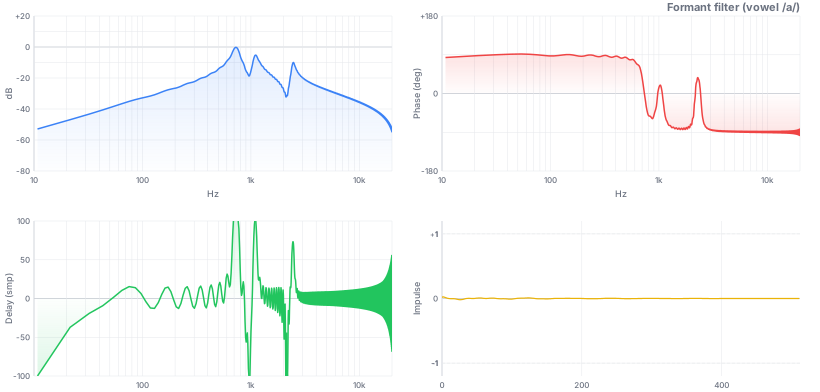
Parallel resonator bank — each peak models one vocal tract resonance (formant).
Model: parallel combination of second-order resonators, each modeling one vocal tract mode
Formant frequencies: determined by vocal tract shape; F1 controls vowel openness, F2 controls front/back
Typical ranges: F1: 250–850 Hz, F2: 850–2500 Hz, F3: 1700–3500 Hz
Implementation: uses resonator internally — constant peak-gain bandpass per formant
Defaults: F1=730 Hz, F2=1090 Hz, F3=2440 Hz (open vowel /a/)
import { formant } from 'audio-filter/speech'

formant(excitation, { fs: 44100 })   // vowel /a/ (default)

formant(excitation, {
  formants: [{ fc: 270, bw: 60, gain: 1 }, { fc: 2290, bw: 90, gain: 0.5 }],
  fs: 44100
})   // vowel /i/
Use when: speech synthesis, singing synthesis, vocal effects, acoustic phonetics
Not a substitute for: LPC synthesis, which estimates formants automatically from a speech signal
Vocoder
Channel vocoder — transfers the spectral envelope of one sound onto the pitched content of another.
Note: takes two separate buffers, returns a new buffer (does not modify in-place).
Principle: analyze modulator into N bands → extract envelope per band → multiply with filtered carrier → sum
Implementation: N parallel bandpass filters on both signals; envelope follower per modulator band
Band count: 8 = robotic effect; 16 = classic vocoder sound; 32+ = more speech intelligibility
import { vocoder } from 'audio-filter/speech'

// carrier: pitched source (sawtooth, buzz, noise...)
// modulator: signal whose spectral shape to impose (voice, instrument...)
let output = vocoder(carrier, modulator, { bands: 16, fs: 44100 })Inventor: Dudley (1939)[^13], Bell Labs
Use when: voice effects, talkbox simulation, cross-synthesis, spectral morphing
LPC
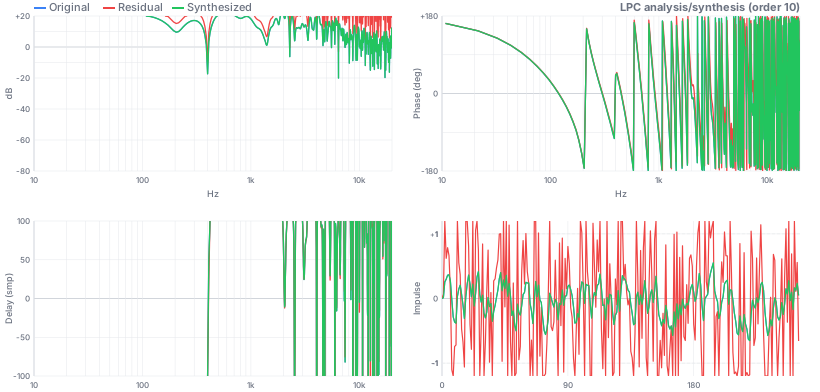
Linear Predictive Coding — estimates the vocal tract transfer function from a speech signal.
Analysis: autocorrelation method + Levinson-Durbin recursion → LPC coefficients + residual
Synthesis: all-pole filter reconstructs signal from residual excitation
Round-trip: lpcAnalysis → lpcSynthesize recovers the original signal exactly
import { lpcAnalysis, lpcSynthesize } from 'audio-filter/speech'

// Analysis: extract vocal tract model
let { coefs, gain, residual } = lpcAnalysis(speechFrame, { order: 12 })

// Synthesis: reconstruct from residual
lpcSynthesize(residual, { coefs, gain })   // residual → reconstructed speech

// Modify pitch: replace residual with different excitation
let buzz = generatePulseTrainAtNewPitch()
lpcSynthesize(buzz, { coefs, gain }) // speech at new pitchOrigin: Atal & Hanauer (1971)[^19]; foundation of CELP, GSM, and modern speech codecs
Use when: speech coding, pitch modification, voice conversion, formant estimation, speech analysis
EQ
Equalization and frequency routing — from parametric studio EQ to speaker crossover networks.
Graphic EQ
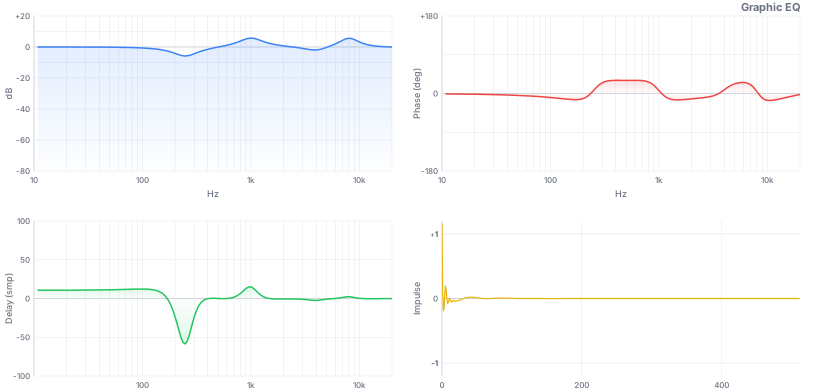
10-band ISO octave equalizer — fixed center frequencies, gain per band.
Implementation: parallel biquad peaking filters, one per band; gains combined additively
Band spacing: 1-octave intervals — $f_k = 1000 \cdot 2^k,\text{Hz}$
Bands: 31.25, 62.5, 125, 250, 500, 1000, 2000, 4000, 8000, 16000 Hz
import { graphicEq } from 'audio-filter/eq'

graphicEq(buffer, {
  gains: { 125: -3, 1000: +6, 8000: +2 },
  fs: 44100
})Standard: ISO 266:1997 center frequencies
Use when: quick tonal shaping, DJ mixers, consumer audio, live sound
vs Parametric EQ: fixed centers but simpler — no per-band frequency or Q control
Parametric EQ
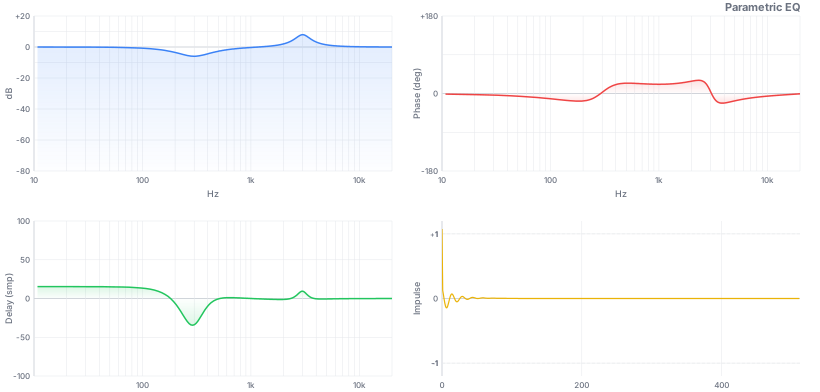
N-band EQ with fully adjustable frequency, Q, and gain per band.
Implementation: cascaded biquad sections — one per band; peak uses peaking EQ biquad, shelves use Zölzer shelf design[^16]
Band types: peak (bell curve at $f_c$), lowshelf (boost/cut below $f_c$), highshelf (boost/cut above $f_c$)
import { parametricEq } from 'audio-filter/eq'

parametricEq(buffer, {
  bands: [
    { fc: 80,   Q: 0.7, gain: +4,  type: 'lowshelf'  },
    { fc: 1000, Q: 2.0, gain: -3,  type: 'peak'      },
    { fc: 8000, Q: 0.7, gain: +2,  type: 'highshelf' },
  ],
  fs: 44100
})
Use when: studio mixing, mastering, precise tonal correction
vs Graphic EQ: fully adjustable $f_c$, Q, and gain per band; no fixed centers
Crossover
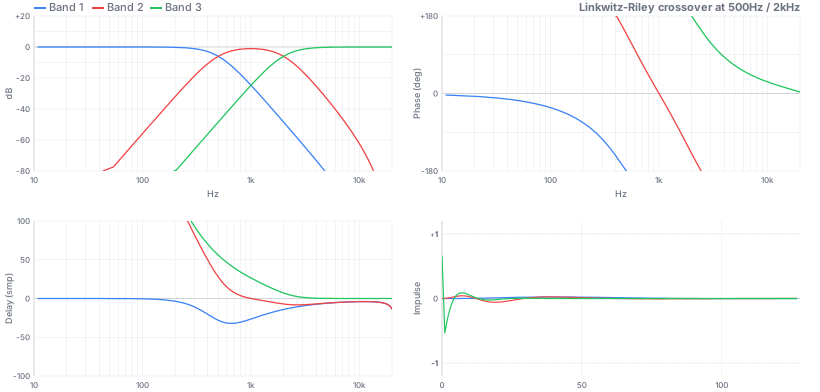
Linkwitz-Riley crossover network — splits audio into N frequency bands with flat magnitude sum.
Filter type: cascade of two Butterworth filters of half the specified order
Property: LR4 (order=4) bands sum to flat magnitude response with correct phase alignment
Orders: LR2 ($-12,\text{dB/oct}$), LR4 ($-24,\text{dB/oct}$, most common), LR8 ($-48,\text{dB/oct}$)
Returns: SOS[][] — one SOS array per band
import { crossover } from 'audio-filter/eq'
import { filter } from 'digital-filter'

let bands = crossover([500, 5000], 4, 44100)   // 3 bands: lo / mid / hi

let lo  = Float64Array.from(buffer); filter(lo,  { coefs: bands[0] })
let mid = Float64Array.from(buffer); filter(mid, { coefs: bands[1] })
let hi = Float64Array.from(buffer); filter(hi, { coefs: bands[2] })Designers: Linkwitz & Riley (1976)[^14]
Use when: speaker system design, multi-band dynamics, band splitting for separate processing
Crossfeed
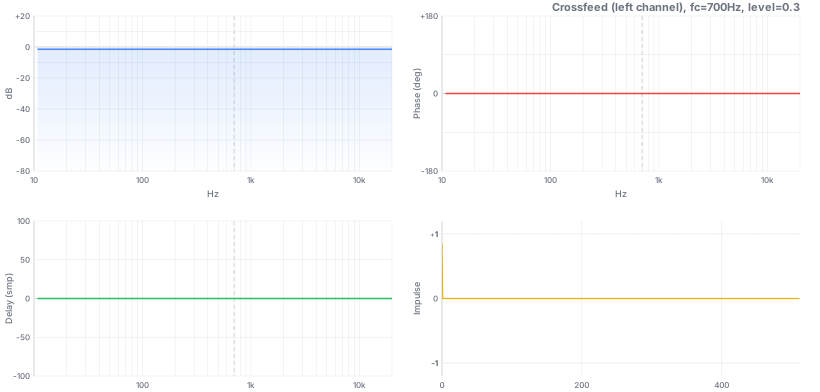
Headphone crossfeed — mixes a filtered copy of each channel into the other to reduce in-head localization.
Takes two separate channel buffers, modifies both in-place.
Problem: speaker playback has inter-channel crosstalk and head shadowing; headphones remove these, causing an unnatural "in-head" stereo image
Solution: add a lowpass-filtered, attenuated copy of each channel to the opposite channel, simulating crosstalk and head diffraction
fc: models the head-shadow lowpass (~700 Hz is typical); level: 0.3 = mild, 0.5 = strong
import { crossfeed } from 'audio-filter/eq'

crossfeed(left, right, { fc: 700, level: 0.3, fs: 44100 })Origin: Bauer (1961)[^15]; BS2B (Bauer Stereophonic-to-Binaural) algorithm
Shelving
Standalone low-shelf and high-shelf filters — boost or cut below/above a corner frequency.
Low shelf: $H(s) = A \cdot \frac{s/\omega_c + \sqrt{A}}{s/(\omega_c\sqrt{A}) + 1}$ — RBJ biquad shelf design
High shelf: same topology, mirrored in frequency
Q / slope: $Q = 0.707$ gives maximally-flat transition; lower Q gives a gentler, wider slope
import { lowShelf, highShelf } from 'audio-filter/eq'

lowShelf(buffer,  { fc: 200,  gain: +6, Q: 0.707, fs: 44100 })   // bass boost
highShelf(buffer, { fc: 4000, gain: -3, Q: 0.707, fs: 44100 })   // treble cut
Use when: correcting speaker/room low-end buildup, air-band top-end addition, mastering bus
vs Parametric EQ: shelf is a single-band operation with a cleaner API — use when you don't need bell curves
Baxandall
Bass/treble tone control — the canonical two-knob EQ in amplifiers, mixers, and guitar pedals since 1952.
Bass: low shelf around fBass (default 250 Hz)
Treble: high shelf around fTreble (default 4 kHz)
Independence: bass and treble controls are cascaded, not interactive — each shelf is independent
import { baxandall } from 'audio-filter/eq'

baxandall(buffer, { bass: +6, treble: -3, fs: 44100 })                           // default pivot freqs
baxandall(buffer, { bass: +4, treble: +2, fBass: 300, fTreble: 6000, fs: 44100 }) // custom pivotsOrigin: Peter Baxandall (1952)[^20]
Use when: amp/mixer tone stack simulation, consumer audio tone controls, guitar pedal EQ
vs Parametric EQ: intentionally limited to two knobs — the constraint is the point
Tilt EQ
See-saw around a pivot frequency — one knob trades bass for treble symmetrically.
Positive gain: bass up / treble down — warms up a bright signal
Negative gain: treble up / bass down — brightens a dull signal
Pivot: frequency that stays at 0 dB (default 1 kHz)
import { tilt } from 'audio-filter/eq'

tilt(buffer, { gain: +4, pivot: 1000, fs: 44100 })   // warm up
tilt(buffer, { gain: -3, pivot: 1000, fs: 44100 })   // brighten
Use when: quick tonal correction on a mix bus or stereo source with a single parameter
vs Baxandall: tilt is one knob not two — bass and treble always move equal and opposite
Effect
Signal conditioning and spectral shaping — single-purpose filters with well-defined transfer functions.
DC blocker
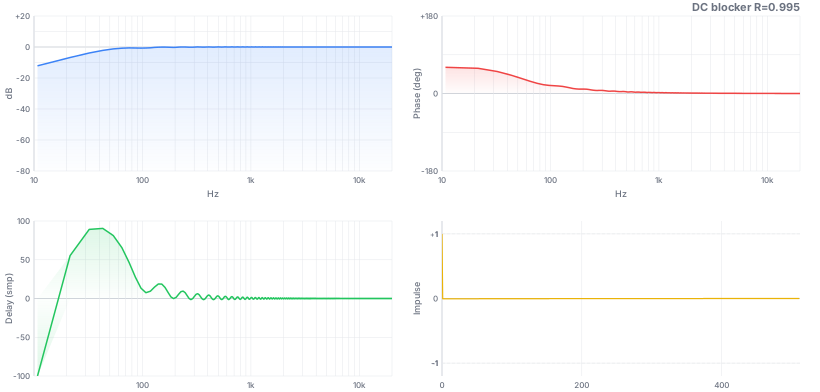
Removes DC offset — the simplest useful filter.
$H(z) = \dfrac{1 - z^{-1}}{1 - Rz^{-1}}$
Topology: zero at $z = 1$ (DC), pole at $z = R$
Cutoff: $f_c \approx \frac{(1-R) f_s}{2\pi}$ — $R = 0.995$ gives ~22 Hz at 44.1 kHz
import { dcBlocker } from 'audio-filter/effect'

let params = { R: 0.995 }
dcBlocker(buffer, params)
Use when: removing DC bias before processing, preventing lowpass filter saturation
Comb filter
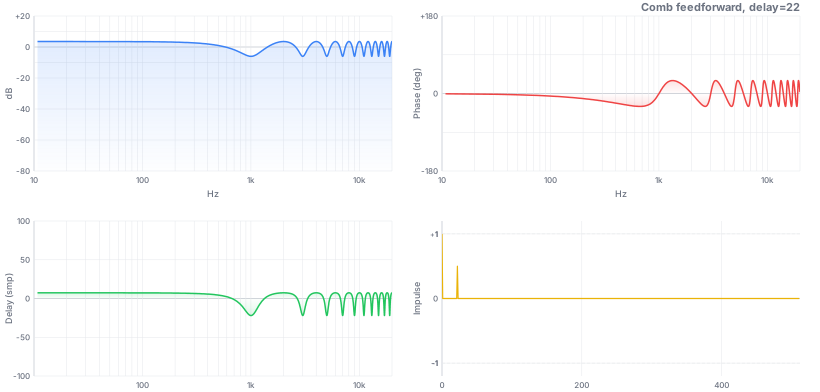
Adds a delayed copy of the signal to itself — notches and peaks at harmonics of $f_s / D$.
Feedforward: $H(z) = 1 + g \cdot z^{-D}$ — notches at $f = \frac{(2k+1) f_s}{2D}$
Feedback: $H(z) = \dfrac{1}{1 - g \cdot z^{-D}}$ — peaks at $f = \frac{k \cdot f_s}{D}$
import { comb } from 'audio-filter/effect'

comb(buffer, { delay: 100, gain: 0.6, type: 'feedback' })
Use when: flanging, chorus (with modulated delay), Karplus-Strong string synthesis, room mode modeling
Allpass
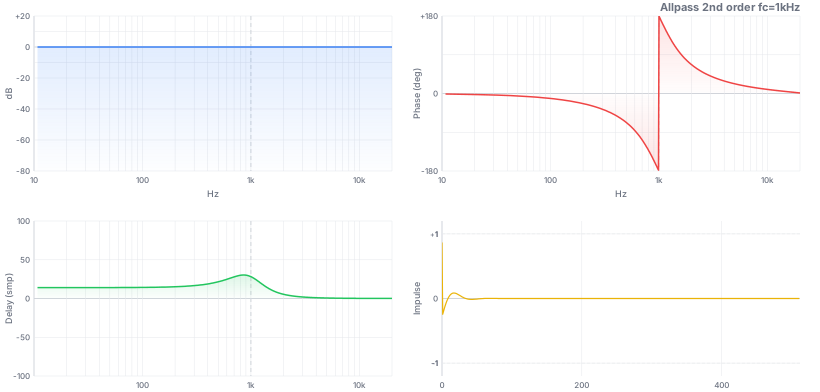
Unity magnitude at all frequencies — shifts phase only. First and second order.
First order: $H(z) = \dfrac{a + z^{-1}}{1 + a z^{-1}}$ — pole at $z = -a$, 180° phase shift at Nyquist
Second order: $H(z) = \dfrac{d - 2R\cos(\omega_0)z^{-1} + R^2 z^{-2}}{1 - 2R\cos(\omega_0)z^{-1} + R^2 z^{-2}}$ — 360° phase shift around $\omega_0$
import { allpass } from 'audio-filter/effect'

allpass.first(buffer, { a: 0.5 })                          // coefficient a
allpass.second(buffer, { fc: 1000, Q: 1, fs: 44100 })      // center fc, quality Q
Use when: phase equalization, reverb building blocks (Schroeder reverb), stereo widening
Pre-emphasis / de-emphasis
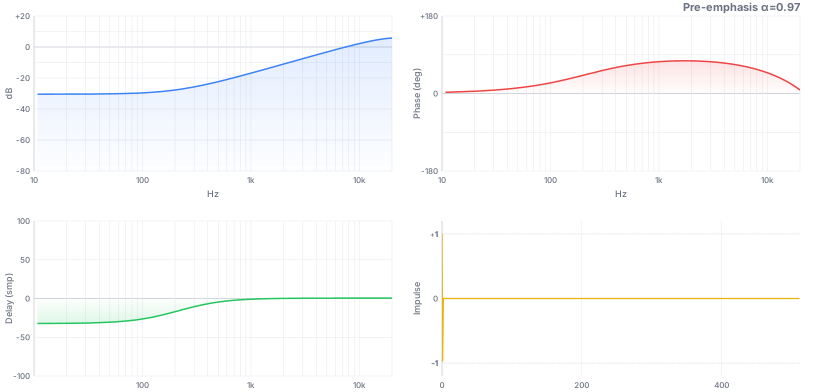
First-order highpass (emphasis) and its inverse (de-emphasis) — used before and after coding or transmission.
$H(z) = 1 - \alpha z^{-1}$ (emphasis) / $H(z) = \dfrac{1}{1 - \alpha z^{-1}}$ (de-emphasis)
Rolloff: emphasis boosts above $f_c = \frac{(1-\alpha) f_s}{2\pi}$ — $\alpha = 0.97$ gives ~420 Hz at 44.1 kHz
Inverse pair: deemphasis exactly cancels emphasis — $H_e(z) \cdot H_d(z) = 1$
import { emphasis, deemphasis } from 'audio-filter/effect'

emphasis(buffer, { alpha: 0.97 })    // before encoding
deemphasis(buffer, { alpha: 0.97 })  // after decoding — exact inverse
Use when: speech coding (GSM, AMR uses $\alpha = 0.97$), tape recording, FM broadcasting
Lowpass
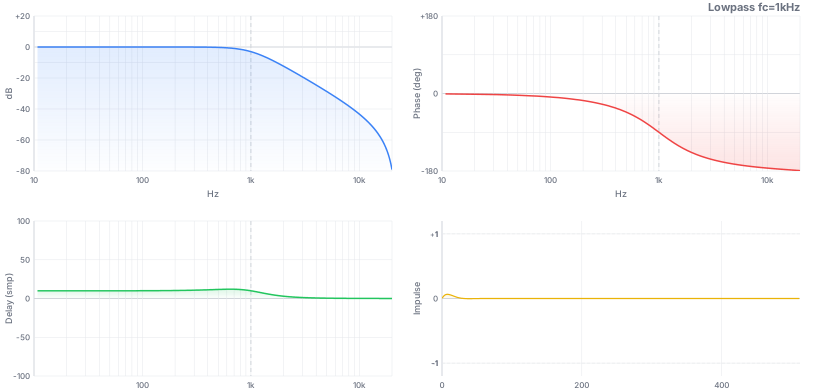
Removes everything above cutoff frequency — the most common filter in audio.
Order 2 (default): RBJ biquad lowpass — $-12,\text{dB/oct}$
Order 4+: Butterworth cascaded SOS — $-6n,\text{dB/oct}$ where $n$ = order
import { lowpass } from 'audio-filter/effect'

lowpass(buffer, { fc: 2000, fs: 44100 })                // 2nd-order (default)
lowpass(buffer, { fc: 2000, order: 4, fs: 44100 })      // 4th-order Butterworth
lowpass(buffer, { fc: 2000, Q: 1.5, fs: 44100 })        // resonant
Use when: anti-aliasing, smoothing, removing hiss, synth subtractive filtering
vs Moog ladder: lowpass is a clean linear filter; Moog adds nonlinear saturation and self-oscillation
Highpass
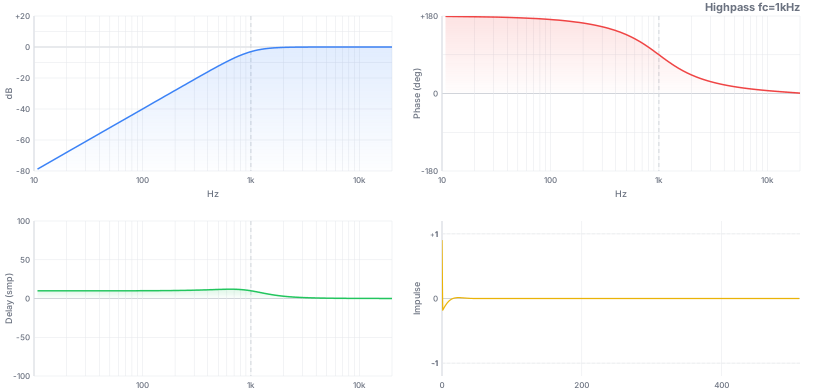
Removes everything below cutoff frequency — DC removal, rumble elimination.
Order 2 (default): RBJ biquad highpass — $-12,\text{dB/oct}$
Order 4+: Butterworth cascaded SOS — $-6n,\text{dB/oct}$ where $n$ = order
import { highpass } from 'audio-filter/effect'

highpass(buffer, { fc: 80, fs: 44100 })                 // rumble filter
highpass(buffer, { fc: 80, order: 4, fs: 44100 })       // steeper rolloff
Use when: removing rumble, mic handling noise, subsonic content before dynamics processing
vs DC blocker: highpass has adjustable cutoff and slope; DC blocker is simpler, lighter, fixed near 0 Hz
Bandpass
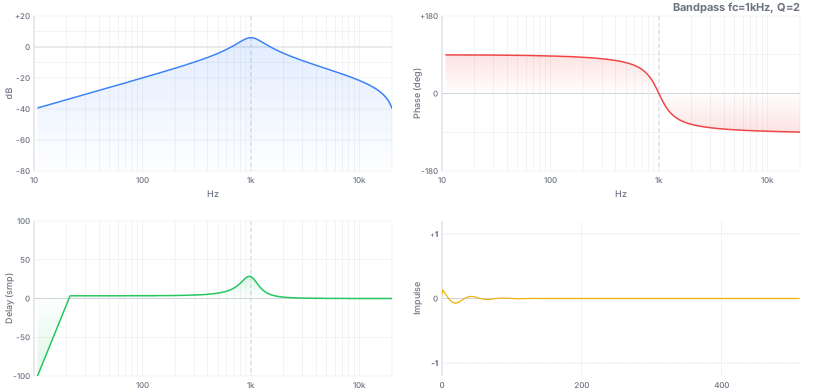
Passes frequencies around center frequency, rejects the rest — constant 0 dB peak gain.
Implementation: RBJ biquad bandpass (constant peak, Q controls width)
import { bandpass } from 'audio-filter/effect'

bandpass(buffer, { fc: 1000, Q: 5, fs: 44100 })         // narrow
bandpass(buffer, { fc: 1000, Q: 0.5, fs: 44100 })       // wide
Use when: isolating frequency regions, radio effect, walkie-talkie simulation, band splitting
vs Resonator: bandpass is RBJ biquad (standard); resonator has constant peak gain — use resonator for modal synthesis
Notch
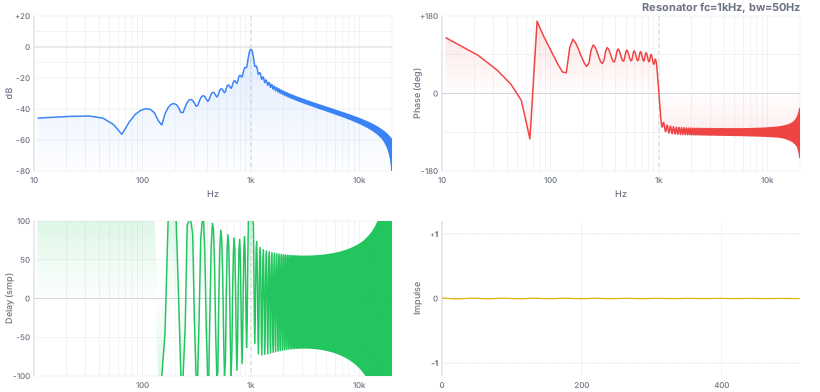
Constant peak-gain bandpass — peak amplitude stays fixed regardless of bandwidth.
$H(z) = \dfrac{1 - R^2}{1 - 2R\cos(\omega_0)z^{-1} + R^2 z^{-2}}$
Pole radius: $R = e^{-\pi \cdot bw / f_s}$ — controls bandwidth; $bw \to 0$ gives infinite Q
Peak gain: always 0 dB by construction — $(1 - R^2)$ normalizes the peak
import { resonator } from 'audio-filter/effect'

resonator(buffer, { fc: 440, bw: 20, fs: 44100 })
Use when: additive synthesis (bells, gongs), modal synthesis, formant bank building
vs Peaking EQ: resonator has fixed 0 dB peak; peaking EQ has variable gain — use resonator for synthesis, EQ for mixing
Notch
Band-reject filter — unity gain everywhere except a deep null at fc.
$H(z) = \dfrac{1 - 2\cos(\omega_0)z^{-1} + z^{-2}}{1 - 2\cos(\omega_0)z^{-1}(1-\alpha) + (1-2\alpha)z^{-2}}$
Q: controls notch width — $Q = 30$ is narrow (hum removal); $Q = 5$ is wider (resonance suppression)
Zeros: on the unit circle at $\pm\omega_0$ — exact null, independent of Q
import { notch } from 'audio-filter/effect'

notch(buffer, { fc: 50,   Q: 30, fs: 44100 })   // remove 50 Hz mains hum
notch(buffer, { fc: 1000, Q: 10, fs: 44100 })   // suppress a resonance
Use when: mains hum removal (50/60 Hz), feedback cancellation, room mode suppression
vs Parametric EQ with negative gain: notch reaches −∞ dB exactly at fc; peaking EQ has finite attenuation
Pink noise
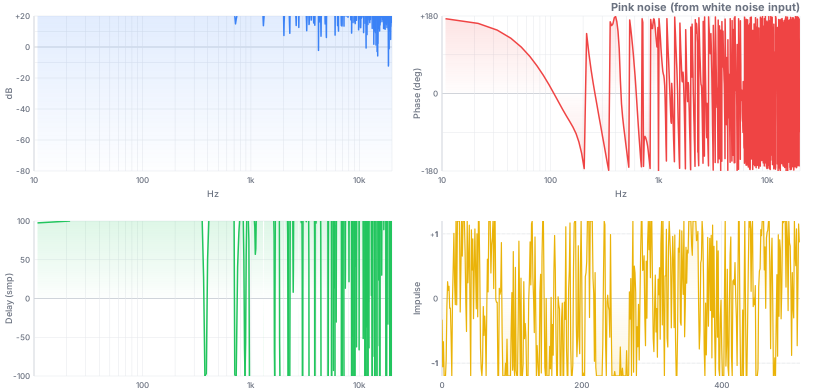
Shapes white noise to $1/f$ spectrum — equal energy per octave.
Spectrum: power spectral density $S(f) \propto 1/f$ — $-3,\text{dB/oct}$ slope, equal energy per octave
Implementation: Voss-McCartney algorithm — sum of white noise sources at octave-spaced update rates; approximated by cascaded first-order IIR filters
import { pinkNoise } from 'audio-filter/effect'

let buf = new Float64Array(1024)
for (let i = 0; i < buf.length; i++) buf[i] = Math.random() * 2 - 1
pinkNoise(buf, {})   // white → pink (−3 dB/oct spectral slope)
Use when: noise testing, psychoacoustic masking reference, procedural audio, natural-sounding noise
vs White noise: white noise has equal energy per Hz ($-0,\text{dB/oct}$); pink is perceptually flat
Spectral tilt
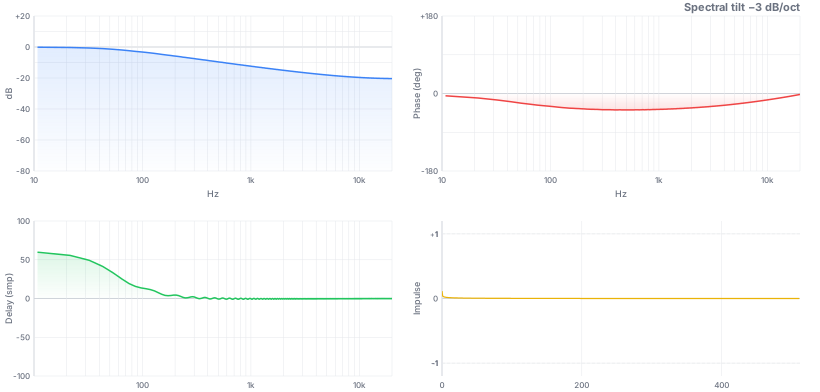
Applies a constant dB/octave slope — tilts the entire spectrum.
Model: first-order IIR approximation of fractional power-law spectrum $S(f) \propto f^\alpha$
slope: $\alpha = -3,\text{dB/oct}$ gives pink noise character; $-6,\text{dB/oct}$ gives brownian/red noise
import { spectralTilt } from 'audio-filter/effect'

spectralTilt(buffer, { slope: -3, fs: 44100 })   // −3 dB/oct: brownian noise character
spectralTilt(buffer, { slope: +3, fs: 44100 })   // +3 dB/oct: pre-emphasis for coding
Use when: matching microphone/speaker frequency responses, spectral coloring, noise synthesis
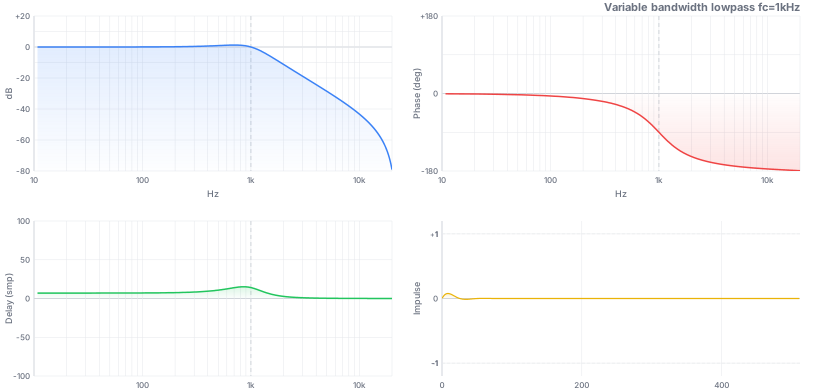
Variable bandwidth
Lowpass with continuously variable bandwidth — smooth parameter automation without discontinuities.
Implementation: biquad lowpass with per-sample coefficient update using smooth interpolation
Property: no discontinuity when $f_c$ or $Q$ change — avoids clicks from abrupt coefficient jumps
import { variableBandwidth } from 'audio-filter/effect'

variableBandwidth(buffer, { fc: 2000, Q: 1.0, fs: 44100 })
Use when: LFO-modulated filter cutoff, automated EQ sweeps, smooth filter animation
vs Direct biquad: recalculating biquad coefficients per sample causes zipper noise; variable bandwidth avoids this
Filter selection guide
| I need to... | Use |
|---|---|
| Measure SPL or noise level | aWeighting (general), cWeighting (peak), itu468 (broadcast noise) |
| Measure loudness (LUFS/LU) | kWeighting |
| Decode vinyl audio | riaa |
| Model the cochlea / auditory system | gammatone, erbBank |
| Analyze a spectrum in octave bands | octaveBank |
| Psychoacoustic analysis / masking model | barkBank |
| MFCC / speech recognition features | melBank |
| Synth filter — warmth and resonance | moogLadder |
| Synth filter — acid / squelch | diodeLadder |
| Synth filter — 2-pole LP + HP | korg35 |
| Synth filter — multimode SVF | oberheim |
| Synthesize vowel sounds | formant |
| Transfer one sound's spectral shape to another | vocoder |
| Analyze/resynthesize speech, change pitch | lpcAnalysis / lpcSynthesize |
| Studio EQ at fixed ISO frequencies | graphicEq |
| Studio EQ with full per-band control | parametricEq |
| Split audio for multi-way speakers | crossover |
| Improve headphone stereo imaging | crossfeed |
| Bass/treble tone control | baxandall |
| One-knob tonal tilt | tilt |
| Standalone bass or treble shelf | lowShelf / highShelf |
| Remove DC offset | dcBlocker |
| Remove mains hum / suppress resonance | notch |
| Clean lowpass / anti-alias | lowpass |
| Remove rumble / subsonic content | highpass |
| Isolate a frequency band | bandpass |
| Create resonant combing | comb |
| Phase-shift without changing magnitude | allpass.first, allpass.second |
| Pre-process for audio coding | emphasis / deemphasis |
| Modal synthesis (bells, drums, rooms) | resonator |
| Generate pink / brown noise | pinkNoise + spectralTilt |
| Tilt spectrum for noise synthesis | spectralTilt |
| Smooth automated filter sweeps | variableBandwidth |
FAQ
Why does my filter click when I change fc or Q?
Biquad coefficients change discontinuously between samples. Use variableBandwidth for smooth automated sweeps, or crossfade.
Why does my Moog/Diode filter blow up?
resonance=1 on Moog is intentional self-oscillation. Diode ladder is stable up to 0.95. Limit input gain before high resonance.
Does mutating params between calls reset state?
No — mutating the same object (params.fc = newFc) preserves state. Replacing the object (params = { fc: newFc }) loses it.
Why does .coefs(fs) return an SOS array instead of one biquad?
A-weighting needs 3 second-order sections; a single biquad can't represent a 6-pole response. Pass SOS arrays to digital-filter's filter() or freqz().
What sample rate should I use for accurate A-weighting? 96 kHz for IEC Class 1 across the full 20 Hz–20 kHz range. At 48 kHz error grows above 10 kHz (~1 dB at 10 kHz, ~4 dB at 20 kHz).
Recipes
Chain filters
let p1 = { fc: 200, fs: 44100 }
let p2 = { R: 0.995 }
for (let buf of stream) {
  dcBlocker(buf, p2)   // DC removal first
  moogLadder(buf, p1)
}
Stereo — independent state per channel
let pL = { fc: 1000, fs: 44100 }
let pR = { fc: 1000, fs: 44100 }
for (let [L, R] of stereoStream) {
  moogLadder(L, pL)
  moogLadder(R, pR)
}
Frequency analysis
import { freqz, mag2db } from 'digital-filter'

let sos = aWeighting.coefs(44100)
let { magnitude } = freqz(sos, 4096, 44100)
let db = mag2db(magnitude)   // dB at 4096 frequencies, 20 Hz–Nyquist
Multi-band split
let bands = crossover([500, 5000], 4, 44100)   // lo / mid / hi
let [lo, mid, hi] = bands.map(coefs => {
  let buf = Float64Array.from(input)   // copy — filter is in-place
  filter(buf, { coefs })
  return buf
})
// process independently, then sum
Notch out mains hum
let p = { fc: 50, Q: 30, fs: 44100 }
for (let buf of stream) notch(buf, p)   // removes 50 Hz hum, flat elsewhere
Automate cutoff without clicks
let p = { fc: 200, Q: 1.0, fs: 44100 }
for (let buf of stream) {
  p.fc = 200 + lfo() * 1800   // mutate in-place — state preserved
  variableBandwidth(buf, p)
}
Pitfalls
New params object on every call — state resets each block
// Wrong
for (let buf of stream) moogLadder(buf, { fc: 1000, fs: 44100 })

// Right — create once, reuse
let p = { fc: 1000, fs: 44100 }
for (let buf of stream) moogLadder(buf, p)
Shared params for stereo — channels corrupt each other's state
// Wrong
let p = { fc: 1000, fs: 44100 }
for (let [L, R] of stream) { moogLadder(L, p); moogLadder(R, p) }

// Right — one object per channel
let pL = { fc: 1000, fs: 44100 }, pR = { fc: 1000, fs: 44100 }
for (let [L, R] of stream) { moogLadder(L, pL); moogLadder(R, pR) }
Filtering the same buffer twice for multi-band — second band sees pre-filtered input
// Wrong
filter(buffer, { coefs: bands[0] })
filter(buffer, { coefs: bands[1] })   // input already filtered!

// Right — copy per band
let bufs = bands.map(b => { let c = Float64Array.from(buffer); filter(c, { coefs: b.coefs }); return c })
Omitting fs — silently uses 44100 Hz math on 48000 Hz audio
// Wrong — wrong cutoffs at 48 kHz
moogLadder(buffer, { fc: 1000 })

// Right
moogLadder(buffer, { fc: 1000, fs: 48000 })
See also
- audio-effect — audio effects: phaser, flanger, chorus, wah, compressor, reverb, delay, and more
- digital-filter — general-purpose filter design: Butterworth, Chebyshev, Bessel, Elliptic, FIR, and more
- audio-decode — decode audio files to PCM buffers
- audio-speaker — output PCM audio to system speakers
- Web Audio API — browser built-in audio; basic biquad shapes only, requires
AudioContext
[^1]: IEC 61672-1:2013, Electroacoustics — Sound level meters — Part 1: Specifications. Supersedes IEC 651:1979.
[^2]: ITU-R BS.1770-4:2015, Algorithms to measure audio programme loudness and true-peak audio level. Adopted by EBU R128.
[^3]: ITU-R BS.468-4:1986, Measurement of audio-frequency noise voltage level in sound broadcasting. Originally CCIR 468, 1968.
[^4]: RIAA standard (1954); IEC 60098:1987, Analogue audio disk records and reproducing equipment.
[^5]: Patterson, R.D., Robinson, K., Holdsworth, J., McKeown, D., Zhang, C. & Allerhand, M. (1992). "Complex sounds and auditory images." Auditory Physiology and Perception, Pergamon, pp. 429–446.
[^6]: IEC 61260-1:2014, Electroacoustics — Octave-band and fractional-octave-band filters — Part 1: Specifications. ANSI S1.11:2004.
[^7]: Moore, B.C.J. & Glasberg, B.R. (1983). "Suggested formulae for calculating auditory-filter bandwidths and excitation patterns." JASA 74(3), pp. 750–753. Updated 1990.
[^8]: Zwicker, E. (1961). "Subdivision of the audible frequency range into critical bands." JASA 33(2), p. 248.
[^9]: Zavalishin, V. (2012). The Art of VA Filter Design. Native Instruments.
[^10]: Moog, R.A. (1965). Voltage controlled electronic music modules. Patent US3475623.
[^11]: Pirkle, W.C. (2019). Designing Audio Effect Plugins in C++, 2nd ed. Routledge.
[^12]: Stilson, T. & Smith, J.O. (1996). "Analyzing the Moog VCF with considerations for digital implementation." Proc. ICMC.
[^13]: Dudley, H. (1939). "The vocoder." Bell Laboratories Record 17, pp. 122–126. Patent US2151091.
[^14]: Linkwitz, S. & Riley, R. (1976). "Active Crossover Networks for Non-Coincident Drivers." JAES 24(1), pp. 2–8.
[^15]: Bauer, B.B. (1961). "Stereophonic Earphones and Binaural Loudspeakers." JAES 9(2), pp. 148–151.
[^16]: Zölzer, U. (2011). DAFX: Digital Audio Effects, 2nd ed. Wiley.
[^18]: O'Shaughnessy, D. (2000). Speech Communications: Human and Machine, 2nd ed. IEEE Press.
[^19]: Atal, B.S. & Hanauer, S.L. (1971). "Speech Analysis and Synthesis by Linear Prediction of the Speech Wave." JASA 50(2B), pp. 637–655.
[^20]: Baxandall, P.J. (1952). "Transistor Tone-Control Design." Wireless World 58(10), pp. 402–405.