
chorograph
Architecture maps drawn from your doc comments.


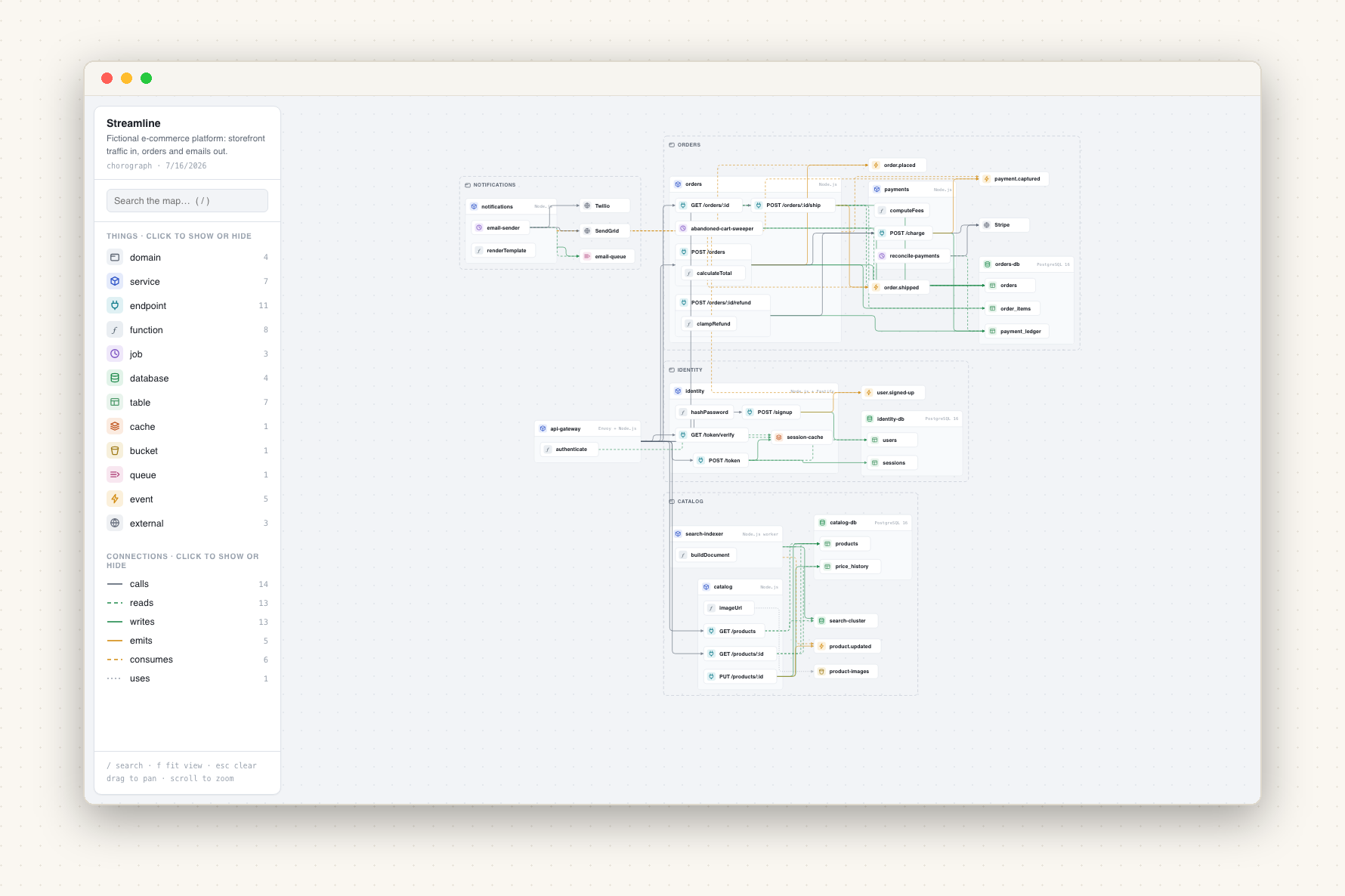
Describe your system in the comments you already write. chorograph parses them statically (nothing imported, nothing executed) and renders a self-contained HTML map, down to individual functions. Your code needs no imports, no wrappers, no config. And because every reference must resolve, a rename or deletion fails the next render with the exact file and line, so the map can't quietly rot.
/**
 * Places an order and charges it synchronously.
 * @endpoint POST /orders
 * @writes orders-db.orders
 * @emits order.placed so notifications and analytics can react
 * @calls payments.post-charge charge at checkout, in-process for now
 */
export async function placeOrder(items: OrderItem[]): Promise<Order> {
  // your real code, untouched
}
npx chorograph render srcQuick start
Three kinds of comments and you have a map:
// 1. Anchor: once, in any file. Free-standing comments are fine.
/** @system Acme */
/** @domain Commerce */
/** @external Stripe in:Commerce */

// 2. Infrastructure: where it's configured.
/** @database orders-db in:Commerce tech:"PostgreSQL 16" tables:orders,order_items */
export const db = createPool(process.env.ORDERS_DB_URL);

/** @event order.placed in:Commerce */

// 3. Each service: top of its file. Endpoints, functions, and jobs below attach automatically.
/**
 * Owns the order lifecycle from cart to fulfilment.
 * @service orders in:Commerce tech:Node.js
 * @consumes payment.captured marks the order paid
 */
npx chorograph render src writes .chorograph/graph.json and report.html (no network dependencies; open it anywhere, commit it, send it). chorograph serve src re-scans on every browser refresh. examples/streamline/ is a full working example.
The grammar
One comment declares one node; its prose becomes the description. Edge tags in the same comment declare connections, and text after the target becomes the label: the why.
| tag | declares |
|---|---|
@system / @domain |
the map's title, a bounded context |
@service name |
a deployable process |
@module |
a code grouping: package, library, class (name inferred from the code) |
@endpoint POST /orders |
an API surface |
@fn / @job |
a significant function / background work (name inferred from the code) |
@database name tables:a,b |
a database and its tables |
@table / @cache / @bucket / @queue |
state and transport |
@event order.placed |
a named domain event |
@external Stripe |
a third party you don't operate |
@of parent |
file directive: everything below attaches to parent |
Edges: @calls, @reads, @writes, @emits, @consumes, @uses. Target by name, dotted when ambiguous (orders-db.orders).
Containment nests as deep as the design does: services hold modules, endpoints, jobs, and private infrastructure; modules hold the functions of a package or class; endpoints hold the functions that implement them; functions decompose into functions. Parents come from an explicit in:/of: key, the file's context, or a file-level @of, which is how one service spreads across routes/*.ts files — and how full-coverage maps organize every documented function in a codebase.
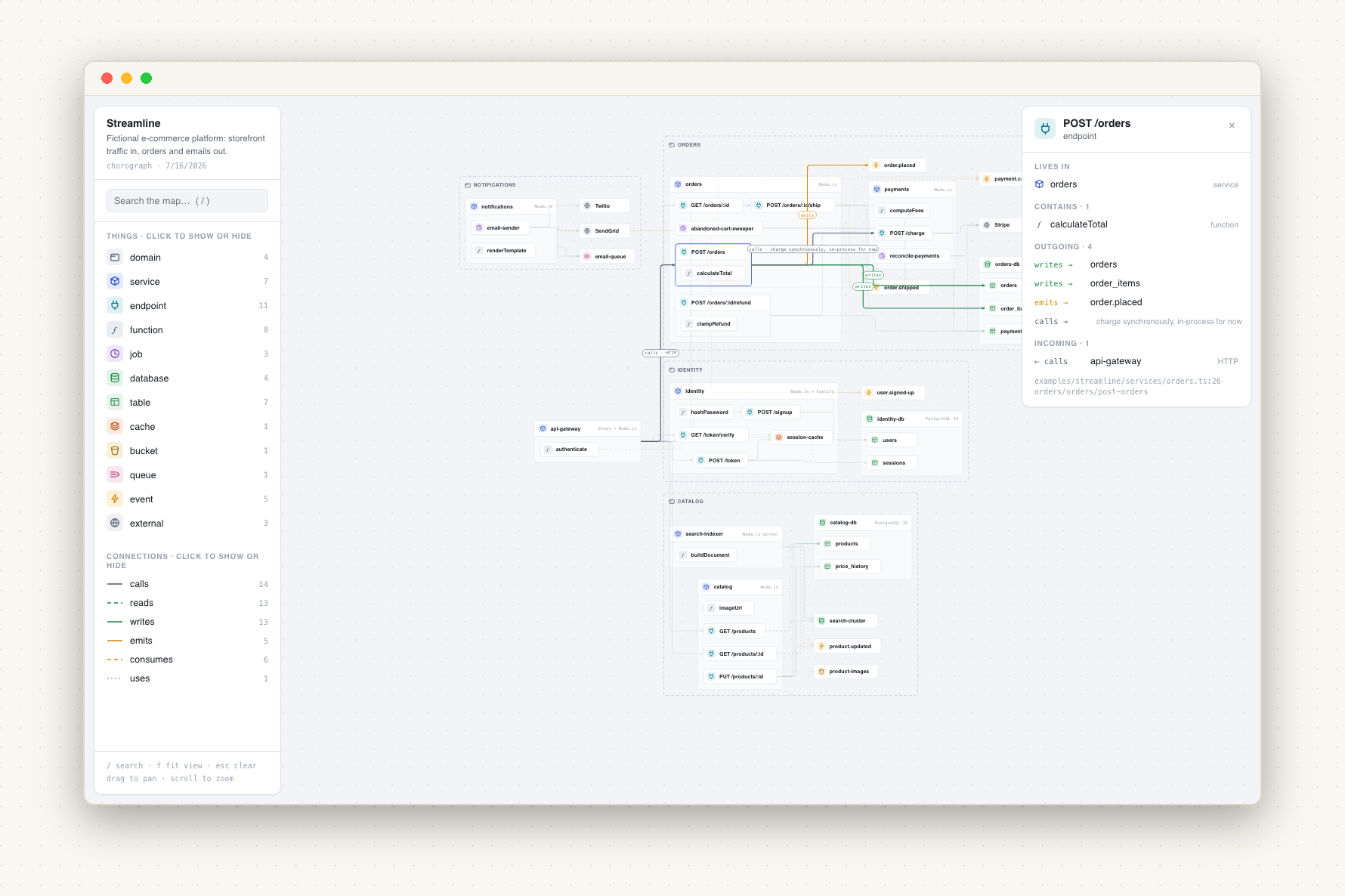
In the viewer, the layout is deterministic and nothing hides silently: small maps draw everything at once, and full-coverage maps start folded to their top-level boxes — each folded box shows how much is inside, and double-clicking unfolds it one level at a time. The legend filters, hover previews a node, click pins its detail card with the declaring file:line, and / searches with results that jump (and unfold) straight to the match.
For coding agents
There's an agent skill that teaches agents the grammar, so the map stays current as a side effect of normal documentation. Install it into your own project with the skills CLI:
npx skills add flancast90/ChorographAnyone cloning this repo gets it automatically: the skill is committed under .agents/skills/ and .claude/skills/, where Cursor, Claude Code, and friends pick it up.
The contract
graph.json is a stable, language-neutral format defined by a standard JSON Schema, spec/graph.schema.json; the tag vocabulary and containment rules live beside it in spec/grammar.json. The TypeScript bindings are generated from the spec with off-the-shelf tooling, and implementations in other languages build on the same two files — see spec/README.md.
Contributing
pnpm install && pnpm example gets you a rendered map in under a minute; pnpm typecheck && pnpm test is the gate. CONTRIBUTING.md has the conventions, AGENTS.md the agent version, and docs/design-principles.md the taste. Releases are automatic: merge a version bump to main and CI publishes to npm.