
cnfast


Fast drop-in replacement for cn.
cnfast runs 3.2x faster on average than clsx + tailwind-merge, up to 7x with tagged templates, with byte-identical output. Same API, no code changes.
import { cn } from "cnfast";

cn("px-2 py-1", isActive && "px-4", { "text-red-500": hasError });
// "py-1 px-4 text-red-500"
Install
npm install cnfastMigrate an existing clsx, classnames, or tailwind-merge project in one command:
npx cnfast migrateOn a shadcn/ui project, add or replace your cn utility through the registry. This rewrites lib/utils.ts to re-export cnfast and installs the package:
npx shadcn@latest add aidenybai/cnfast/cnUsage
Swap the shadcn/ui cn helper for cnfast:
// before
import { clsx, type ClassValue } from "clsx";
import { twMerge } from "tailwind-merge";
export const cn = (...inputs: ClassValue[]) => twMerge(clsx(inputs));

// after
export { cn } from "cnfast";
cnfast also exports clsx, twMerge, and twJoin.
Going even faster
As a tagged template, cn caches by call-site identity: a stable call site runs 2.6x faster than the cn(...) call form and 7x faster than clsx + tailwind-merge.
cn`px-2 px-4 ${isActive && "bg-blue-500"}`; // "px-4 bg-blue-500"Comparing against cn
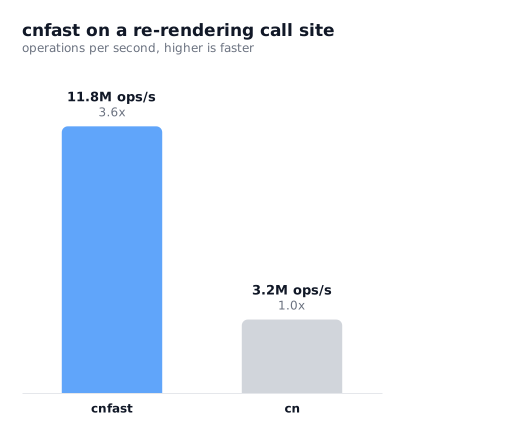
cnfast produces byte-identical output to clsx + tailwind-merge, then does that work faster. On a re-rendering call site, the tagged-template form pulls furthest ahead:
Across the wider suite, operations per second on Bun, best-of-3:
| Workload | clsx + tailwind-merge | cnfast | Speedup |
|---|---|---|---|
| Cached re-render | 2,192 ops/s | 2,925 ops/s | 1.33x |
| Merge engine, cold | 473 ops/s | 2,153 ops/s | 4.55x |
| Component corpus | 682 ops/s | 2,421 ops/s | 3.55x |
| Page render | 3,047 ops/s | 5,614 ops/s | 1.84x |
| Live data grid | 128 ops/s | 231 ops/s | 1.81x |
Corpus and page rows are geometric means across 53 Tailwind apps and 8 captured pages; cached/cold/grid rows are single workloads. Across 65 workloads the geometric mean is 3.17x, with 0 mismatches over 113,291 real-world call groups. The bundle is 9.04 KB gzipped against 8.45 KB for the baseline.
cn runs once per element, so its cost scales with how much you render. Server-rendering a large page calls it across the whole tree, and a client app that re-renders often (data grids, virtualized tables, live dashboards) calls it thousands of times per second. A faster cn keeps those busy frames inside budget. On a small or rarely-updated page, the saving disappears into noise.
See the benchmark suite for the full breakdown and the architecture guide for how it works.
Credits
cnfast adapts MIT-licensed code from clsx (Luke Edwards) and tailwind-merge (Dany Castillo). See LICENSE.
License
MIT