




fastest-validator 

The fastest JS validator library for NodeJS | Browser | Deno.
Key features
- blazing fast! Really!
- 20+ built-in validators
- many sanitizations
- custom validators & aliases
- nested objects & array handling
- strict object validation
- multiple validators
- customizable error messages
- programmable error object
- no dependencies
- unit tests & 100% coverage
How fast?
Very fast! 8 million validations/sec (on Intel i7-4770K, Node.JS: 12.14.1)
√ validate 8,678,752 rpsCompared to other popular libraries:
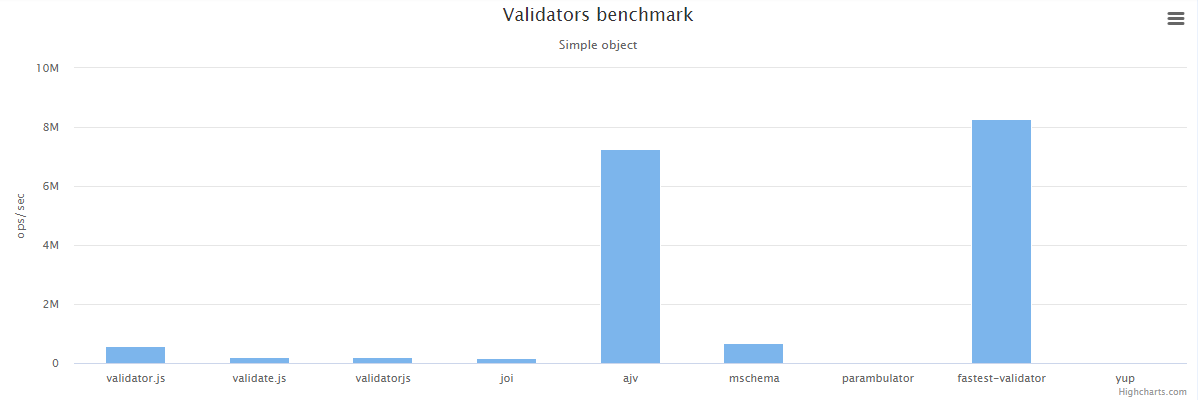
50x faster than Joi.
Would you like to test it?
$ git clone https://github.com/icebob/fastest-validator.git
$ cd fastest-validator
$ npm install
$ npm run bench
Approach
In order to achieve lowest cost/highest performance redaction fastest-validator creates and compiles functions using the Function constructor. It's important to distinguish this from the dangers of a runtime eval, no user input is involved in creating the validation schema that compiles into the function. This is as safe as writing code normally and having it compiled by V8 in the usual way.
Installation
NPM
You can install it via NPM.
$ npm i fastest-validator --saveor
$ yarn add fastest-validatorUsage
Validate
The first step is to compile the schema to a compiled "checker" function. After that, to validate your object, just call this "checker" function.
This method is the fastest.
const Validator = require("fastest-validator");

const v = new Validator();

const schema = {
    id: { type: "number", positive: true, integer: true },
    name: { type: "string", min: 3, max: 255 },
    status: "boolean" // short-hand def
};

const check = v.compile(schema);

console.log("First:", check({ id: 5, name: "John", status: true }));
// Returns: true

console.log("Second:", check({ id: 2, name: "Adam" }));
/* Returns an array with errors:
    [
        {
            type: 'required',
            field: 'status',
            message: 'The \'status\' field is required!'
        }
    ]
*/Halting
If you want to halt immediately after the first error:
const v = new Validator({ haltOnFirstError: true });Browser usage
<script src="https://unpkg.com/fastest-validator"></script>const v = new FastestValidator();
const schema = {
id: { type: "number", positive: true, integer: true },
name: { type: "string", min: 3, max: 255 },
status: "boolean" // short-hand def
};
const check = v.compile(schema);
console.log(check({ id: 5, name: "John", status: true }));
// Returns: trueDeno usage
With esm.sh, now Typescript is supported
import FastestValidator from "https://esm.sh/fastest-validator@1"

const v = new FastestValidator();
const check = v.compile({
    name: "string",
    age: "number",
});

console.log(check({ name: "Erf", age: 18 })); //true
Supported frameworks
- Moleculer: Natively supported
- Fastify: By using fastify-fv
- Express: By using fastest-express-validator
Optional, Required & Nullable fields
Optional
Every field in the schema will be required by default. If you'd like to define optional fields, set optional: true.
const schema = {
    name: { type: "string" }, // required
    age: { type: "number", optional: true }
}

const check = v.compile(schema);

check({ name: "John", age: 42 }); // Valid
check({ name: "John" }); // Valid
check({ age: 42 }); // Fail because name is required
Nullable
If you want disallow undefined value but allow null value, use nullable instead of optional.
const schema = {
    age: { type: "number", nullable: true }
}

const check = v.compile(schema);

check({ age: 42 }); // Valid
check({ age: null }); // Valid
check({ age: undefined }); // Fail because undefined is disallowed
check({}); // Fail because undefined is disallowed
Nullable and default values
null is a valid input for nullable fields that has default value.
const schema = {
   about: { type: "string", nullable: true, default: "Hi! I'm using javascript" }
}

const check = v.compile(schema)

const object1 = { about: undefined }
check(object1) // Valid
object1.about // is "Hi! I'm using javascript"

const object2 = { about: null }
check(object2) // valid
object2.about // is null

check({ about: "Custom" }) // Valid
Considering null as a value
In specific case, you may want to consider null as a valid input even for a required field.
It's useful in cases you want a field to be:
requiredandnullwithout specifyingnullable: truein its definition.requiredand notnullby specifyingnullable: falsein its definition.optionalbut specifically notnull.
To be able to achieve this you'll have to set the considerNullAsAValue validator option to true.
const v = new Validator({considerNullAsAValue: true});

const schema = {foo: {type: "number"}, bar: {type: "number", optional: true, nullable: false}, baz: {type: "number", nullable: false}};
const check = v.compile(schema);

const object1 = {foo: null, baz: 1};
check(object1); // valid (foo is required and can be null)

const object2 = {foo: 3, bar: null, baz: 1};
check(object2); // not valid (bar is optional but can't be null)

const object3 = {foo: 3, baz: null};
check(object3); // not valid (baz is required but can't be null)
With this option set all fields will be considered nullable by default.
Strict validation
Object properties which are not specified on the schema are ignored by default. If you set the $strict option to true any additional properties will result in an strictObject error.
const schema = {
    name: { type: "string" }, // required
    $strict: true // no additional properties allowed
}

const check = v.compile(schema);

check({ name: "John" }); // Valid
check({ name: "John", age: 42 }); // Fail
Remove additional fields
To remove the additional fields in the object, set $strict: "remove".
Multiple validators
It is possible to define more validators for a field. In this case, only one validator needs to succeed for the field to be valid.
const schema = {
    cache: [
        { type: "string" },
        { type: "boolean" }
    ]
}

const check = v.compile(schema);

check({ cache: true }); // Valid
check({ cache: "redis://" }); // Valid
check({ cache: 150 }); // Fail
Root element schema
Basically the validator expects that you want to validate a Javascript object. If you want others, you can define the root level schema, as well. In this case set the $root: true property.
Example to validate a string variable instead of object
const schema = {
    $root: true,
    type: "string",
    min: 3,
    max: 6
};

const check = v.compile(schema);

check("John"); // Valid
check("Al"); // Fail, too short.
Sanitizations
The library contains several sanitizers. Please note, the sanitizers change the original checked object.
Default values
The most common sanitizer is the default property. With it, you can define a default value for all properties. If the property value is null* or undefined, the validator set the defined default value into the property.
Static Default value example:
const schema = {
    roles: { type: "array", items: "string", default: ["user"] },
    status: { type: "boolean", default: true },
};

const check = v.compile(schema);

const obj = {}

check(obj); // Valid
console.log(obj);
/*
{
    roles: ["user"],
    status: true
}
*/
Dynamic Default value:
Also you can use dynamic default value by defining a function that returns a value. For example, in the following code, if createdAt field not defined in object`, the validator sets the current time into the property:
const schema = {
    createdAt: {
        type: "date",
        default: (schema, field, parent, context) => new Date()
    }
};

const check = v.compile(schema);

const obj = {}

check(obj); // Valid
console.log(obj);
/*
{
    createdAt: Date(2020-07-25T13:17:41.052Z)
}
*/
Shorthand definitions
You can use string-based shorthand validation definitions in the schema.
const schema = {
    password: "string|min:6",
    age: "number|optional|integer|positive|min:0|max:99", // additional properties
    state: ["boolean", "number|min:0|max:1"] // multiple types
}
Array of X
const schema = {
    foo: "string[]" // means array of string
}

const check = v.compile(schema);

check({ foo: ["bar"] }) // true
Nested objects
const schema = {
   dot: {
      $type: "object",
      x: "number",  // object props here
      y: "number",  // object props here
   },
   circle: {
      $type: "object|optional", // using other shorthands
      o: {
         $type: "object",
         x: "number",
         y: "number",
      },
      r: "number"
   }
};
Alias definition
You can define custom aliases.
v.alias('username', {
    type: 'string',
    min: 4,
    max: 30
    // ...
});

const schema = {
    username: "username|max:100", // Using the 'username' alias
    password: "string|min:6",
}
Default options
You can set default rule options.
const v = new FastestValidator({
    defaults: {
        object: {
            strict: "remove"
        }
    }
});
Label Option
You can use label names in error messages instead of property names.
const schema = {
	email: { type: "email", label: "Email Address" },
};
const check = v.compile(schema);

console.log(check({ email: "notAnEmail" }));

/* Returns
[
  {
    type: 'email',
    message: "The 'Email Address' field must be a valid e-mail.",
    field: 'email',
    actual: 'notAnEmail',
    label: 'Email Address'
  }
]
*/
Built-in validators
any
This does not do type validation. Accepts any types.
const schema = {
    prop: { type: "any" }
}

const check = v.compile(schema)

check({ prop: true }); // Valid
check({ prop: 100 }); // Valid
check({ prop: "John" }); // Valid
array
This is an Array validator.
Simple example with strings:
const schema = {
    roles: { type: "array", items: "string" }
}
const check = v.compile(schema)

check({ roles: ["user"] }); // Valid
check({ roles: [] }); // Valid
check({ roles: "user" }); // Fail
Example with only positive numbers:
const schema = {
    list: { type: "array", min: 2, items: {
        type: "number", positive: true, integer: true
    } }
}
const check = v.compile(schema)

check({ list: [2, 4] }); // Valid
check({ list: [1, 5, 8] }); // Valid
check({ list: [1] }); // Fail (min 2 elements)
check({ list: [1, -7] }); // Fail (negative number)
Example with an object list:
const schema = {
    users: { type: "array", items: {
        type: "object", props: {
            id: { type: "number", positive: true },
            name: { type: "string", empty: false },
            status: "boolean"
        }
    } }
}
const check = v.compile(schema)

check({
    users: [
        { id: 1, name: "John", status: true },
        { id: 2, name: "Jane", status: true },
        { id: 3, name: "Bill", status: false }
    ]
}); // Valid
Example for enum:
const schema = {
    roles: { type: "array", items: "string", enum: [ "user", "admin" ] }
}

const check = v.compile(schema)

check({ roles: ["user"] }); // Valid
check({ roles: ["user", "admin"] }); // Valid
check({ roles: ["guest"] }); // Fail
Example for unique:
const schema = {
    roles: { type: "array", unique: true }
}
const check = v.compile(schema);

check({ roles: ["user"] }); // Valid
check({ roles: [{role:"user"},{role:"admin"},{role:"user"}] }); // Valid
check({ roles: ["user", "admin", "user"] }); // Fail
check({ roles: [1, 2, 1] }); // Fail
Example for convert:
const schema = {
    roles: { type: "array", items: 'string', convert: true }
}
const check = v.compile(schema);

check({ roles: ["user"] }); // Valid
check({ roles: "user" }); // Valid
// After both validation: roles = ["user"]
Properties
| Property | Default | Description |
|---|---|---|
empty |
true |
If true, the validator accepts an empty array []. |
min |
null |
Minimum count of elements. |
max |
null |
Maximum count of elements. |
length |
null |
Fix count of elements. |
contains |
null |
The array must contain this element too. |
unique |
null |
The array must be unique (array of objects is always unique). |
enum |
null |
Every element must be an element of the enum array. |
items |
null |
Schema for array items. |
convert |
null |
Wrap value into array if different type provided |
boolean
This is a Boolean validator.
const schema = {
    status: { type: "boolean" }
}
const check = v.compile(schema);

check({ status: true }); // Valid
check({ status: false }); // Valid
check({ status: 1 }); // Fail
check({ status: "true" }); // Fail
Properties
| Property | Default | Description |
|---|---|---|
convert |
false |
if true and the type is not Boolean, it will be converted. 1, "true", "1", "on" will be true. 0, "false", "0", "off" will be false. It's a sanitizer, it will change the value in the original object. |
Example for convert:
const schema = {
    status: { type: "boolean", convert: true}
};

const check = v.compile(schema);

check({ status: "true" }); // Valid
class
This is a Class validator to check the value is an instance of a Class.
const schema = {
    rawData: { type: "class", instanceOf: Buffer }
}
const check = v.compile(schema);

check({ rawData: Buffer.from([1, 2, 3]) }); // Valid
check({ rawData: 100 }); // Fail
Properties
| Property | Default | Description |
|---|---|---|
instanceOf |
null |
Checked Class. |
currency
This is a Currency validator to check if the value is a valid currency string.
const schema = {
money_amount: { type: "currency", currencySymbol: '
Properties
Property
Default
Description
currencySymbolnullThe currency symbol expected in string (as prefix).
symbolOptionalfalseToggle to make the symbol optional in string, although, if present it would only allow the currencySymbol.
thousandSeparator,Thousand place separator character.
decimalSeparator.Decimal place character.
customRegexnullCustom regular expression, to validate currency strings (For eg: /[0-9]*/g).
date
This is a Date validator.
const schema = {
dob: { type: "date" }
}
const check = v.compile(schema);
check({ dob: new Date() }); // Valid
check({ dob: new Date(1488876927958) }); // Valid
check({ dob: 1488876927958 }); // Fail
Properties
Property
Default
Description
convertfalseif true and the type is not Date, try to convert with new Date(). It's a sanitizer, it will change the value in the original object.
Example for convert:
const schema = {
dob: { type: "date", convert: true}
};
const check = v.compile(schema);
check({ dob: 1488876927958 }, ); // Valid
email
This is an e-mail address validator.
const schema = {
email: { type: "email" }
}
const check = v.compile(schema);
check({ email: "john.doe@gmail.com" }); // Valid
check({ email: "james.123.45@mail.co.uk" }); // Valid
check({ email: "abc@gmail" }); // Fail
Properties
Property
Default
Description
emptyfalseIf true, the validator accepts an empty array "".
modequickChecker method. Can be quick or precise.
normalizefalseNormalize the e-mail address (trim & lower-case). It's a sanitizer, it will change the value in the original object.
minnullMinimum value length.
maxnullMaximum value length.
enum
This is an enum validator.
const schema = {
sex: { type: "enum", values: ["male", "female"] }
}
const check = v.compile(schema);
check({ sex: "male" }); // Valid
check({ sex: "female" }); // Valid
check({ sex: "other" }); // Fail
Properties
Property
Default
Description
valuesnullThe valid values.
equal
This is an equal value validator. It checks a value with a static value or with another property.
Example with static value:
const schema = {
agreeTerms: { type: "equal", value: true, strict: true } // strict means `===`
}
const check = v.compile(schema);
check({ agreeTerms: true }); // Valid
check({ agreeTerms: false }); // Fail
Example with other field:
const schema = {
password: { type: "string", min: 6 },
confirmPassword: { type: "equal", field: "password" }
}
const check = v.compile(schema);
check({ password: "123456", confirmPassword: "123456" }); // Valid
check({ password: "123456", confirmPassword: "pass1234" }); // Fail
Properties
Property
Default
Description
valueundefinedThe expected value. It can be any primitive types.
strictfalseif true, it uses strict equal === for checking.
forbidden
This validator returns an error if the property exists in the object.
const schema = {
password: { type: "forbidden" }
}
const check = v.compile(schema);
check({ user: "John" }); // Valid
check({ user: "John", password: "pass1234" }); // Fail
Properties
Property
Default
Description
removefalseIf true, the value will be removed in the original object. It's a sanitizer, it will change the value in the original object.
Example for remove:
const schema = {
user: { type: "string" },
token: { type: "forbidden", remove: true }
};
const check = v.compile(schema);
const obj = {
user: "John",
token: "123456"
}
check(obj); // Valid
console.log(obj);
/*
{
user: "John",
token: undefined
}
*/
function
This a Function type validator.
const schema = {
show: { type: "function" }
}
const check = v.compile(schema);
check({ show: function() {} }); // Valid
check({ show: Date.now }); // Valid
check({ show: "function" }); // Fail
luhn
This is an Luhn validator.
Luhn algorithm checksum
Credit Card numbers, IMEI numbers, National Provider Identifier numbers and others
const schema = {
cc: { type: "luhn" }
}
const check = v.compile(schema);
check({ cc: "452373989901198" }); // Valid
check({ cc: 452373989901198 }); // Valid
check({ cc: "4523-739-8990-1198" }); // Valid
check({ cc: "452373989901199" }); // Fail
mac
This is an MAC addresses validator.
const schema = {
mac: { type: "mac" }
}
const check = v.compile(schema);
check({ mac: "01:C8:95:4B:65:FE" }); // Valid
check({ mac: "01:c8:95:4b:65:fe"); // Valid
check({ mac: "01C8.954B.65FE" }); // Valid
check({ mac: "01c8.954b.65fe"); // Valid
check({ mac: "01-C8-95-4B-65-FE" }); // Valid
check({ mac: "01-c8-95-4b-65-fe" }); // Valid
check({ mac: "01C8954B65FE" }); // Fail
multi
This is a multiple definitions validator.
const schema = {
status: { type: "multi", rules: [
{ type: "boolean" },
{ type: "number" }
], default: true }
}
const check = v.compile(schema);
check({ status: true }); // Valid
check({ status: false }); // Valid
check({ status: 1 }); // Valid
check({ status: 0 }); // Valid
check({ status: "yes" }); // Fail
Shorthand multiple definitions:
const schema = {
status: [
"boolean",
"number"
]
}
const check = v.compile(schema);
check({ status: true }); // Valid
check({ status: false }); // Valid
check({ status: 1 }); // Valid
check({ status: 0 }); // Valid
check({ status: "yes" }); // Fail
number
This is a Number validator.
const schema = {
age: { type: "number" }
}
const check = v.compile(schema);
check({ age: 123 }); // Valid
check({ age: 5.65 }); // Valid
check({ age: "100" }); // Fail
Properties
Property
Default
Description
minnullMinimum value.
maxnullMaximum value.
equalnullFixed value.
notEqualnullCan't be equal to this value.
integerfalseThe value must be a non-decimal value.
positivefalseThe value must be greater than zero.
negativefalseThe value must be less than zero.
convertfalseif true and the type is not Number, it's converted with Number(). It's a sanitizer, it will change the value in the original object.
object
This is a nested object validator.
const schema = {
address: { type: "object", strict: true, props: {
country: { type: "string" },
city: "string", // short-hand
zip: "number" // short-hand
} }
}
const check = v.compile(schema);
check({
address: {
country: "Italy",
city: "Rome",
zip: 12345
}
}); // Valid
check({
address: {
country: "Italy",
city: "Rome"
}
}); // Fail ("The 'address.zip' field is required!")
check({
address: {
country: "Italy",
city: "Rome",
zip: 12345,
state: "IT"
}
}); // Fail ("The 'address.state' is an additional field!")
Properties
Property
Default
Description
strictfalseIf true any properties which are not defined on the schema will throw an error. If remove all additional properties will be removed from the original object. It's a sanitizer, it will change the original object.
minPropsnullIf set to a number N, will throw an error if the object has fewer than N properties.
maxPropsnullIf set to a number N, will throw an error if the object has more than N properties.
schema = {
address: { type: "object", strict: "remove", props: {
country: { type: "string" },
city: "string", // short-hand
zip: "number" // short-hand
} }
}
let obj = {
address: {
country: "Italy",
city: "Rome",
zip: 12345,
state: "IT"
}
};
const check = v.compile(schema);
check(obj); // Valid
console.log(obj);
/*
{
address: {
country: "Italy",
city: "Rome",
zip: 12345
}
}
*/
schema = {
address: {
type: "object",
minProps: 2,
props: {
country: { type: "string" },
city: { type: "string", optional: true },
zip: { type: "number", optional: true }
}
}
}
const check = v.compile(schema);
obj = {
address: {
country: "Italy",
city: "Rome",
zip: 12345,
state: "IT"
}
}
check(obj); // Valid
obj = {
address: {
country: "Italy",
}
}
check(obj); // Fail
// [
// {
// type: 'objectMinProps',
// message: "The object 'address' must contain at least 2 properties.",
// field: 'address',
// expected: 2,
// actual: 1
// }
// ]
record
This validator allows to check an object with arbitrary keys.
const schema = {
surnameGroups: {
type: 'record',
key: { type: 'string', alpha: true },
value: { type: 'array', items: 'string' }
}
};
const check = v.compile(schema);
check({ surnameGroups: { Doe: ['Jane', 'John'], Williams: ['Bill'] } }); // Valid
check({ surnameGroups: { Doe1: ['Jane', 'John'] } }); // Fail
check({ surnameGroups: { Doe: [1, 'Jane'] } }); // Fail
Properties
Property
Default
Description
keystringKey validation rule (It is reasonable to use only the string rule).
valueanyValue validation rule.
string
This is a String validator.
const schema = {
name: { type: "string" }
}
const check = v.compile(schema);
check({ name: "John" }); // Valid
check({ name: "" }); // Valid
check({ name: 123 }); // Fail
Properties
Property
Default
Description
emptytrueIf true, the validator accepts an empty string "".
minnullMinimum value length.
maxnullMaximum value length.
lengthnullFixed value length.
patternnullRegex pattern.
containsnullThe value must contain this text.
enumnullThe value must be an element of the enum array.
alphanullThe value must be an alphabetic string.
numericnullThe value must be a numeric string.
alphanumnullThe value must be an alphanumeric string.
alphadashnullThe value must be an alphabetic string that contains dashes.
hexnullThe value must be a hex string.
singleLinenullThe value must be a single line string.
base64nullThe value must be a base64 string.
trimnullIf true, the value will be trimmed. It's a sanitizer, it will change the value in the original object.
trimLeftnullIf true, the value will be left trimmed. It's a sanitizer, it will change the value in the original object.
trimRightnullIf true, the value will be right trimmed. It's a sanitizer, it will change the value in the original object.
padStartnullIf it's a number, the value will be left padded. It's a sanitizer, it will change the value in the original object.
padEndnullIf it's a number, the value will be right padded. It's a sanitizer, it will change the value in the original object.
padChar" "The padding character for the padStart and padEnd.
lowercasenullIf true, the value will be lower-cased. It's a sanitizer, it will change the value in the original object.
uppercasenullIf true, the value will be upper-cased. It's a sanitizer, it will change the value in the original object.
localeLowercasenullIf true, the value will be locale lower-cased. It's a sanitizer, it will change the value in the original object.
localeUppercasenullIf true, the value will be locale upper-cased. It's a sanitizer, it will change the value in the original object.
convertfalseif true and the type is not a String, it's converted with String(). It's a sanitizer, it will change the value in the original object.
Sanitization example
const schema = {
username: { type: "string", min: 3, trim: true, lowercase: true}
}
const check = v.compile(schema);
const obj = {
username: " Icebob "
};
check(obj); // Valid
console.log(obj);
/*
{
username: "icebob"
}
*/
tuple
This validator checks if a value is an Array with the elements order as described by the schema.
Simple example:
const schema = { list: "tuple" };
const check = v.compile(schema);
check({ list: [] }); // Valid
check({ list: [1, 2] }); // Valid
check({ list: ["RON", 100, true] }); // Valid
check({ list: 94 }); // Fail (not an array)
Example with items:
const schema = {
grade: { type: "tuple", items: ["string", "number"] }
}
const check = v.compile(schema);
check({ grade: ["David", 85] }); // Valid
check({ grade: [85, "David"] }); // Fail (wrong position)
check({ grade: ["Cami"] }); // Fail (require 2 elements)
Example with a more detailed schema:
const schema = {
location: { type: "tuple", items: [
"string",
{ type: "tuple", empty: false, items: [
{ type: "number", min: 35, max: 45 },
{ type: "number", min: -75, max: -65 }
] }
] }
}
const check = v.compile(schema);
check({ location: ['New York', [40.7127281, -74.0060152]] }); // Valid
check({ location: ['New York', [50.0000000, -74.0060152]] }); // Fail
check({ location: ['New York', []] }); // Fail (empty array)
Properties
Property
Default
Description
emptytrueIf true, the validator accepts an empty array [].
itemsundefinedExact schema of the value items
url
This is an URL validator.
const schema = {
url: { type: "url" }
}
const check = v.compile(schema);
check({ url: "http://google.com" }); // Valid
check({ url: "https://github.com/icebob" }); // Valid
check({ url: "www.facebook.com" }); // Fail
Properties
Property
Default
Description
emptyfalseIf true, the validator accepts an empty string "".
uuid
This is an UUID validator.
const schema = {
uuid: { type: "uuid" }
}
const check = v.compile(schema);
check({ uuid: "00000000-0000-0000-0000-000000000000" }); // Valid Nil UUID
check({ uuid: "10ba038e-48da-487b-96e8-8d3b99b6d18a" }); // Valid UUIDv4
check({ uuid: "9a7b330a-a736-51e5-af7f-feaf819cdc9f" }); // Valid UUIDv5
check({ uuid: "10ba038e-48da-487b-96e8-8d3b99b6d18a", version: 5 }); // Fail
Properties
Property
Default
Description
versionnullUUID version in range 0-6. The null disables version checking.
objectID
You can validate BSON/MongoDB ObjectID's
const { ObjectID } = require("mongodb") // or anywhere else
const schema = {
id: {
type: "objectID",
ObjectID // passing the ObjectID class
}
}
const check = v.compile(schema);
check({ id: "5f082780b00cc7401fb8e8fc" }) // ok
check({ id: new ObjectID() }) // ok
check({ id: "5f082780b00cc7401fb8e8" }) // Error
Pro tip: By using defaults props for objectID rule, No longer needed to pass ObjectID class in validation schema:
const { ObjectID } = require("mongodb") // or anywhere else
const v = new Validator({
defaults: {
objectID: {
ObjectID
}
}
})
const schema = {
id: "objectID"
}
Properties
Property
Default
Description
convertfalseIf true, the validator converts ObjectID HexString representation to ObjectID instance, if hexString the validator converts to HexString
Custom validator
You can also create your custom validator.
const v = new Validator({
messages: {
// Register our new error message text
evenNumber: "The '{field}' field must be an even number! Actual: {actual}"
}
});
// Register a custom 'even' validator
v.add("even", function({ schema, messages }, path, context) {
return {
source: `
if (value % 2 != 0)
${this.makeError({ type: "evenNumber", actual: "value", messages })}
return value;
`
};
});
const schema = {
name: { type: "string", min: 3, max: 255 },
age: { type: "even" }
};
const check = v.compile(schema);
console.log(check({ name: "John", age: 20 }, schema));
// Returns: true
console.log(check({ name: "John", age: 19 }, schema));
/* Returns an array with errors:
[{
type: 'evenNumber',
expected: null,
actual: 19,
field: 'age',
message: 'The \'age\' field must be an even number! Actual: 19'
}]
*/
Or you can use the custom type with an inline checker function:
const v = new Validator({
useNewCustomCheckerFunction: true, // using new version
messages: {
// Register our new error message text
weightMin: "The weight must be greater than {expected}! Actual: {actual}"
}
});
const schema = {
name: { type: "string", min: 3, max: 255 },
weight: {
type: "custom",
minWeight: 10,
check(value, errors, schema) {
if (value < minWeight) errors.push({ type: "weightMin", expected: schema.minWeight, actual: value });
if (value > 100) value = 100
return value
}
}
};
const check = v.compile(schema);
console.log(check({ name: "John", weight: 50 }, schema));
// Returns: true
console.log(check({ name: "John", weight: 8 }, schema));
/* Returns an array with errors:
[{
type: 'weightMin',
expected: 10,
actual: 8,
field: 'weight',
message: 'The weight must be greater than 10! Actual: 8'
}]
*/
const o = { name: "John", weight: 110 }
console.log(check(o, schema));
/* Returns: true
o.weight is 100
*/
Please note: the custom function must return the value. It means you can also sanitize it.
Custom validation for built-in rules
You can define a custom function in the schema for built-in rules. With it you can extend any built-in rules.
const v = new Validator({
useNewCustomCheckerFunction: true, // using new version
messages: {
// Register our new error message text
phoneNumber: "The phone number must be started with '+'!"
}
});
const schema = {
name: { type: "string", min: 3, max: 255 },
phone: { type: "string", length: 15, custom: (v, errors) => {
if (!v.startsWith("+")) errors.push({ type: "phoneNumber" })
return v.replace(/[^\d+]/g, ""); // Sanitize: remove all special chars except numbers
}
}
};
const check = v.compile(schema);
console.log(check({ name: "John", phone: "+36-70-123-4567" }));
// Returns: true
console.log(check({ name: "John", phone: "36-70-123-4567" }));
/* Returns an array with errors:
[{
message: "The phone number must be started with '+'!",
field: 'phone',
type: 'phoneNumber'
}]
*/
Please note: the custom function must return the value. It means you can also sanitize it.
Chaining custom functions and global definitions
You can define the custom property as an array of functions, allowing you to chain various validation logics.
Additionally, you can define custom functions globally, making them reusable.
let v = new Validator({
debug: true,
useNewCustomCheckerFunction: true,
messages: {
// Register our new error message text
evenNumber: "The '{field}' field must be an even number! Actual: {actual}",
realNumber: "The '{field}' field must be a real number! Actual: {actual}",
notPermitNumber: "The '{field}' cannot have the value {actual}",
compareGt: "The '{field}' field must be greater than {gt}! Actual: {actual}",
compareGte: "The '{field}' field must be greater than or equal to {gte}! Actual: {actual}",
compareLt: "The '{field}' field must be less than {lt}! Actual: {actual}",
compareLte: "The '{field}' field must be less than or equal to {lte}! Actual: {actual}"
},
customFunctions:{
even: (value, errors)=>{
if(value % 2 != 0 ){
errors.push({ type: "evenNumber", actual: value });
}
return value;
},
real: (value, errors)=>{
if(value <0 ){
errors.push({ type: "realNumber", actual: value });
}
return value;
},
compare: (value, errors, schema)=>{
if( typeof schema.custom.gt==="number" && value <= schema.custom.gt ){
errors.push({ type: "compareGt", actual: value, gt: schema.custom.gt });
}
if( typeof schema.custom.gte==="number" && value < schema.custom.gte ){
errors.push({ type: "compareGte", actual: value, gte: schema.custom.gte });
}
if( typeof schema.custom.lt==="number" && value >= schema.custom.lt ){
errors.push({ type: "compareLt", actual: value, lt: schema.custom.lt });
}
if( typeof schema.custom.lte==="number" && value > schema.custom.lte ){
errors.push({ type: "compareLte", actual: value, lte: schema.custom.lte });
}
return value;
}
}
});
const schema = {
people:{
type: "number",
custom: [
"compare|gte:-100|lt:200", // extended definition with additional parameters - equal to: {type:"compare",gte:-100, lt:200},
"even",
"real",
function (value, errors){
if(value === "3" ){
errors.push({ type: "notPermitNumber", actual: value });
}
return value;
}
]
}
};
console.log(v.validate({people:-200}, schema));
console.log(v.validate({people:200}, schema));
console.log(v.validate({people:5}, schema));
console.log(v.validate({people:-5}, schema));
console.log(v.validate({people:3}, schema));
Asynchronous custom validations
You can also use async custom validators. This can be useful if you need to check something in a database or in a remote location.
In this case you should use async/await keywords, or return a Promise in the custom validator functions.
This implementation uses async/await keywords. So this feature works only on environments which supports async/await:
- Chrome > 55
- Firefox > 52
- Edge > 15
- NodeJS > 8.x (or 7.6 with harmony)
- Deno (all versions)
To enable async mode, you should set $async: true in the root of your schema.
Example with custom checker function
const v = new Validator({
useNewCustomCheckerFunction: true, // using new version
messages: {
// Register our new error message text
unique: "The username is already exist"
}
});
const schema = {
$async: true,
name: { type: "string" },
username: {
type: "string",
min: 2,
custom: async (v, errors) => {
// E.g. checking in the DB that the value is unique.
const res = await DB.checkUsername(v);
if (!res)
errors.push({ type: "unique", actual: value });
return v;
}
}
// ...
};
const check = v.compile(schema);
const res = await check(user);
console.log("Result:", res);
The compiled check function contains an async property, so you can check if it returns a Promise or not.
const check = v.compile(schema);
console.log("Is async?", check.async);
Meta information for custom validators
You can pass any extra meta information for the custom validators which is available via context.meta.
const schema = {
name: { type: "string", custom: (value, errors, schema, name, parent, context) => {
// Access to the meta
return context.meta.a;
} },
};
const check = v.compile(schema);
const res = check(obj, {
// Passes meta information
meta: { a: "from-meta" }
});
Custom error messages (l10n)
You can set your custom messages in the validator constructor.
const Validator = require("fastest-validator");
const v = new Validator({
messages: {
stringMin: "A(z) '{field}' mező túl rövid. Minimum: {expected}, Jelenleg: {actual}",
stringMax: "A(z) '{field}' mező túl hosszú. Minimum: {expected}, Jelenleg: {actual}"
}
});
const schema = {
name: { type: "string", min: 6 }
}
const check = v.compile(schema);
check({ name: "John" });
/* Returns:
[
{
type: 'stringMin',
expected: 6,
actual: 4,
field: 'name',
message: 'A(z) \'name\' mező túl rövid. Minimum: 6, Jelenleg: 4'
}
]
*/
Personalised Messages
Sometimes the standard messages are too generic. You can customize messages per validation type per field:
const Validator = require("fastest-validator");
const v = new Validator();
const schema = {
firstname: {
type: "string",
min: 6,
messages: {
string: "Please check your firstname",
stringMin: "Your firstname is too short"
}
},
lastname: {
type: "string",
min: 6,
messages: {
string: "Please check your lastname",
stringMin: "Your lastname is too short"
}
}
}
const check = v.compile(schema);
check({ firstname: "John", lastname: 23 });
/* Returns:
[
{
type: 'stringMin',
expected: 6,
actual: 4,
field: 'firstname',
message: 'Your firstname is too short'
},
{
type: 'string',
expected: undefined,
actual: undefined,
field: 'lastname',
message: 'Please check your lastname'
}
]
*/
Plugins
You can apply plugins:
// Plugin Side
function myPlugin(validator){
// you can modify validator here
// e.g.: validator.add(...)
}
// Validator Side
const v = new Validator();
v.plugin(myPlugin)
Message types
Name
Default text
requiredThe '{field}' field is required.
stringThe '{field}' field must be a string.
stringEmptyThe '{field}' field must not be empty.
stringMinThe '{field}' field length must be greater than or equal to {expected} characters long.
stringMaxThe '{field}' field length must be less than or equal to {expected} characters long.
stringLengthThe '{field}' field length must be {expected} characters long.
stringPatternThe '{field}' field fails to match the required pattern.
stringContainsThe '{field}' field must contain the '{expected}' text.
stringEnumThe '{field}' field does not match any of the allowed values.
stringNumericThe '{field}' field must be a numeric string.
stringAlphaThe '{field}' field must be an alphabetic string.
stringAlphanumThe '{field}' field must be an alphanumeric string.
stringAlphadashThe '{field}' field must be an alphadash string.
stringHexThe '{field}' field must be a hex string.
stringSingleLineThe '{field}' field must be a single line string.
stringBase64The '{field}' field must be a base64 string.
numberThe '{field}' field must be a number.
numberMinThe '{field}' field must be greater than or equal to {expected}.
numberMaxThe '{field}' field must be less than or equal to {expected}.
numberEqualThe '{field}' field must be equal to {expected}.
numberNotEqualThe '{field}' field can't be equal to {expected}.
numberIntegerThe '{field}' field must be an integer.
numberPositiveThe '{field}' field must be a positive number.
numberNegativeThe '{field}' field must be a negative number.
arrayThe '{field}' field must be an array.
arrayEmptyThe '{field}' field must not be an empty array.
arrayMinThe '{field}' field must contain at least {expected} items.
arrayMaxThe '{field}' field must contain less than or equal to {expected} items.
arrayLengthThe '{field}' field must contain {expected} items.
arrayContainsThe '{field}' field must contain the '{expected}' item.
arrayUniqueThe '{actual}' value in '{field}' field does not unique the '{expected}' values.
arrayEnumThe '{actual}' value in '{field}' field does not match any of the '{expected}' values.
tupleThe '{field}' field must be an array.
tupleEmptyThe '{field}' field must not be an empty array.
tupleLengthThe '{field}' field must contain {expected} items.
booleanThe '{field}' field must be a boolean.
functionThe '{field}' field must be a function.
dateThe '{field}' field must be a Date.
dateMinThe '{field}' field must be greater than or equal to {expected}.
dateMaxThe '{field}' field must be less than or equal to {expected}.
forbiddenThe '{field}' field is forbidden.
emailThe '{field}' field must be a valid e-mail.
emailEmptyThe '{field}' field must not be empty.
emailMinThe '{field}' field length must be greater than or equal to {expected} characters long.
emailMaxThe '{field}' field length must be less than or equal to {expected} characters long.
urlThe '{field}' field must be a valid URL.
enumValueThe '{field}' field value '{expected}' does not match any of the allowed values.
equalValueThe '{field}' field value must be equal to '{expected}'.
equalFieldThe '{field}' field value must be equal to '{expected}' field value.
objectThe '{field}' must be an Object.
objectStrictThe object '{field}' contains forbidden keys: '{actual}'.
objectMinProps"The object '{field}' must contain at least {expected} properties.
objectMaxProps"The object '{field}' must contain {expected} properties at most.
uuidThe '{field}' field must be a valid UUID.
uuidVersionThe '{field}' field must be a valid UUID version provided.
macThe '{field}' field must be a valid MAC address.
luhnThe '{field}' field must be a valid checksum luhn.
Message fields
Name
Description
fieldThe field name
expectedThe expected value
actualThe actual value
Pass custom metas
In some case, you will need to do something with the validation schema .
Like reusing the validator to pass custom settings, you can use properties starting with $
const check = v.compile({
$name: 'Person',
$description: 'write a description about this schema',
firstName: { type: "string" },
lastName: { type: "string" },
birthDate: { type: "date" }
});
Development
npm run dev
Test
npm test
Coverage report
-----------------|----------|----------|----------|----------|-------------------|
File | % Stmts | % Branch | % Funcs | % Lines | Uncovered Line #s |
-----------------|----------|----------|----------|----------|-------------------|
All files | 100 | 97.73 | 100 | 100 | |
lib | 100 | 100 | 100 | 100 | |
messages.js | 100 | 100 | 100 | 100 | |
validator.js | 100 | 100 | 100 | 100 | |
lib/helpers | 100 | 100 | 100 | 100 | |
deep-extend.js | 100 | 100 | 100 | 100 | |
flatten.js | 100 | 100 | 100 | 100 | |
lib/rules | 100 | 96.43 | 100 | 100 | |
any.js | 100 | 100 | 100 | 100 | |
array.js | 100 | 100 | 100 | 100 | |
boolean.js | 100 | 100 | 100 | 100 | |
custom.js | 100 | 50 | 100 | 100 | 6 |
date.js | 100 | 100 | 100 | 100 | |
email.js | 100 | 100 | 100 | 100 | |
enum.js | 100 | 50 | 100 | 100 | 6 |
equal.js | 100 | 100 | 100 | 100 | |
forbidden.js | 100 | 100 | 100 | 100 | |
function.js | 100 | 100 | 100 | 100 | |
luhn.js | 100 | 100 | 100 | 100 | |
mac.js | 100 | 100 | 100 | 100 | |
multi.js | 100 | 100 | 100 | 100 | |
number.js | 100 | 100 | 100 | 100 | |
object.js | 100 | 100 | 100 | 100 | |
string.js | 100 | 95.83 | 100 | 100 | 55,63 |
tuple.js | 100 | 100 | 100 | 100 | |
url.js | 100 | 100 | 100 | 100 | |
uuid.js | 100 | 100 | 100 | 100 | |
-----------------|----------|----------|----------|----------|-------------------|
Contribution
Please send pull requests improving the usage and fixing bugs, improving documentation and providing better examples, or providing some tests, because these things are important.
License
fastest-validator is available under the MIT license.
Contact
Copyright (C) 2019 Icebob


}
}
const check = v.compile(schema);
check({ money_amount: '$12.99'}); // Valid
check({ money_amount: '$0.99'}); // Valid
check({ money_amount: '$12,345.99'}); // Valid
check({ money_amount: '$123,456.99'}); // Valid
check({ money_amount: '$1234,567.99'}); // Fail
check({ money_amount: '$1,23,456.99'}); // Fail
check({ money_amount: '$12,34.5.99' }); // FailProperties
| Property | Default | Description |
|---|---|---|
| __INLINE_CODE_80__ | __INLINE_CODE_81__ | The currency symbol expected in string (as prefix). |
| __INLINE_CODE_82__ | __INLINE_CODE_83__ | Toggle to make the symbol optional in string, although, if present it would only allow the currencySymbol. |
| __INLINE_CODE_84__ | __INLINE_CODE_85__ | Thousand place separator character. |
| __INLINE_CODE_86__ | __INLINE_CODE_87__ | Decimal place character. |
| __INLINE_CODE_88__ | __INLINE_CODE_89__ | Custom regular expression, to validate currency strings (For eg: /[0-9]*/g). |
__INLINE_CODE_90__
This is a __INLINE_CODE_91__ validator.
__CODE_BLOCK_35__Properties
| Property | Default | Description |
|---|---|---|
| __INLINE_CODE_92__ | __INLINE_CODE_93__ | if __INLINE_CODE_94__ and the type is not __INLINE_CODE_95__, try to convert with __INLINE_CODE_96__. It's a sanitizer, it will change the value in the original object. |
Example for __INLINE_CODE_97__:
__CODE_BLOCK_36____INLINE_CODE_98__
This is an e-mail address validator.
__CODE_BLOCK_37__Properties
| Property | Default | Description |
|---|---|---|
| __INLINE_CODE_99__ | __INLINE_CODE_100__ | If __INLINE_CODE_101__, the validator accepts an empty array __INLINE_CODE_102__. |
| __INLINE_CODE_103__ | __INLINE_CODE_104__ | Checker method. Can be __INLINE_CODE_105__ or __INLINE_CODE_106__. |
| __INLINE_CODE_107__ | __INLINE_CODE_108__ | Normalize the e-mail address (trim & lower-case). It's a sanitizer, it will change the value in the original object. |
| __INLINE_CODE_109__ | __INLINE_CODE_110__ | Minimum value length. |
| __INLINE_CODE_111__ | __INLINE_CODE_112__ | Maximum value length. |
__INLINE_CODE_113__
This is an enum validator.
__CODE_BLOCK_38__Properties
| Property | Default | Description |
|---|---|---|
| __INLINE_CODE_114__ | __INLINE_CODE_115__ | The valid values. |
__INLINE_CODE_116__
This is an equal value validator. It checks a value with a static value or with another property.
Example with static value:
__CODE_BLOCK_39__Example with other field:
__CODE_BLOCK_40__Properties
| Property | Default | Description |
|---|---|---|
| __INLINE_CODE_117__ | __INLINE_CODE_118__ | The expected value. It can be any primitive types. |
| __INLINE_CODE_119__ | __INLINE_CODE_120__ | if __INLINE_CODE_121__, it uses strict equal __INLINE_CODE_122__ for checking. |
__INLINE_CODE_123__
This validator returns an error if the property exists in the object.
__CODE_BLOCK_41__Properties
| Property | Default | Description |
|---|---|---|
| __INLINE_CODE_124__ | __INLINE_CODE_125__ | If __INLINE_CODE_126__, the value will be removed in the original object. It's a sanitizer, it will change the value in the original object. |
Example for __INLINE_CODE_127__:
__CODE_BLOCK_42____INLINE_CODE_128__
This a __INLINE_CODE_129__ type validator.
__CODE_BLOCK_43____INLINE_CODE_130__
This is an Luhn validator. Luhn algorithm checksum Credit Card numbers, IMEI numbers, National Provider Identifier numbers and others
__CODE_BLOCK_44____INLINE_CODE_131__
This is an MAC addresses validator.
__CODE_BLOCK_45____INLINE_CODE_132__
This is a multiple definitions validator.
__CODE_BLOCK_46__Shorthand multiple definitions:
__CODE_BLOCK_47____INLINE_CODE_133__
This is a __INLINE_CODE_134__ validator.
__CODE_BLOCK_48__Properties
| Property | Default | Description |
|---|---|---|
| __INLINE_CODE_135__ | __INLINE_CODE_136__ | Minimum value. |
| __INLINE_CODE_137__ | __INLINE_CODE_138__ | Maximum value. |
| __INLINE_CODE_139__ | __INLINE_CODE_140__ | Fixed value. |
| __INLINE_CODE_141__ | __INLINE_CODE_142__ | Can't be equal to this value. |
| __INLINE_CODE_143__ | __INLINE_CODE_144__ | The value must be a non-decimal value. |
| __INLINE_CODE_145__ | __INLINE_CODE_146__ | The value must be greater than zero. |
| __INLINE_CODE_147__ | __INLINE_CODE_148__ | The value must be less than zero. |
| __INLINE_CODE_149__ | __INLINE_CODE_150__ | if __INLINE_CODE_151__ and the type is not __INLINE_CODE_152__, it's converted with __INLINE_CODE_153__. It's a sanitizer, it will change the value in the original object. |
__INLINE_CODE_154__
This is a nested object validator.
__CODE_BLOCK_49__Properties
| Property | Default | Description |
|---|---|---|
| __INLINE_CODE_155__ | __INLINE_CODE_156__ | If __INLINE_CODE_157__ any properties which are not defined on the schema will throw an error. If __INLINE_CODE_158__ all additional properties will be removed from the original object. It's a sanitizer, it will change the original object. |
| __INLINE_CODE_159__ | __INLINE_CODE_160__ | If set to a number N, will throw an error if the object has fewer than N properties. |
| __INLINE_CODE_161__ | __INLINE_CODE_162__ | If set to a number N, will throw an error if the object has more than N properties. |
__INLINE_CODE_163__
This validator allows to check an object with arbitrary keys.
__CODE_BLOCK_52__Properties
| Property | Default | Description |
|---|---|---|
| __INLINE_CODE_164__ | __INLINE_CODE_165__ | Key validation rule (It is reasonable to use only the __INLINE_CODE_166__ rule). |
| __INLINE_CODE_167__ | __INLINE_CODE_168__ | Value validation rule. |
__INLINE_CODE_169__
This is a __INLINE_CODE_170__ validator.
__CODE_BLOCK_53__Properties
| Property | Default | Description |
|---|---|---|
| __INLINE_CODE_171__ | __INLINE_CODE_172__ | If __INLINE_CODE_173__, the validator accepts an empty string __INLINE_CODE_174__. |
| __INLINE_CODE_175__ | __INLINE_CODE_176__ | Minimum value length. |
| __INLINE_CODE_177__ | __INLINE_CODE_178__ | Maximum value length. |
| __INLINE_CODE_179__ | __INLINE_CODE_180__ | Fixed value length. |
| __INLINE_CODE_181__ | __INLINE_CODE_182__ | Regex pattern. |
| __INLINE_CODE_183__ | __INLINE_CODE_184__ | The value must contain this text. |
| __INLINE_CODE_185__ | __INLINE_CODE_186__ | The value must be an element of the __INLINE_CODE_187__ array. |
| __INLINE_CODE_188__ | __INLINE_CODE_189__ | The value must be an alphabetic string. |
| __INLINE_CODE_190__ | __INLINE_CODE_191__ | The value must be a numeric string. |
| __INLINE_CODE_192__ | __INLINE_CODE_193__ | The value must be an alphanumeric string. |
| __INLINE_CODE_194__ | __INLINE_CODE_195__ | The value must be an alphabetic string that contains dashes. |
| __INLINE_CODE_196__ | __INLINE_CODE_197__ | The value must be a hex string. |
| __INLINE_CODE_198__ | __INLINE_CODE_199__ | The value must be a single line string. |
| __INLINE_CODE_200__ | __INLINE_CODE_201__ | The value must be a base64 string. |
| __INLINE_CODE_202__ | __INLINE_CODE_203__ | If __INLINE_CODE_204__, the value will be trimmed. It's a sanitizer, it will change the value in the original object. |
| __INLINE_CODE_205__ | __INLINE_CODE_206__ | If __INLINE_CODE_207__, the value will be left trimmed. It's a sanitizer, it will change the value in the original object. |
| __INLINE_CODE_208__ | __INLINE_CODE_209__ | If __INLINE_CODE_210__, the value will be right trimmed. It's a sanitizer, it will change the value in the original object. |
| __INLINE_CODE_211__ | __INLINE_CODE_212__ | If it's a number, the value will be left padded. It's a sanitizer, it will change the value in the original object. |
| __INLINE_CODE_213__ | __INLINE_CODE_214__ | If it's a number, the value will be right padded. It's a sanitizer, it will change the value in the original object. |
| __INLINE_CODE_215__ | __INLINE_CODE_216__ | The padding character for the __INLINE_CODE_217__ and __INLINE_CODE_218__. |
| __INLINE_CODE_219__ | __INLINE_CODE_220__ | If __INLINE_CODE_221__, the value will be lower-cased. It's a sanitizer, it will change the value in the original object. |
| __INLINE_CODE_222__ | __INLINE_CODE_223__ | If __INLINE_CODE_224__, the value will be upper-cased. It's a sanitizer, it will change the value in the original object. |
| __INLINE_CODE_225__ | __INLINE_CODE_226__ | If __INLINE_CODE_227__, the value will be locale lower-cased. It's a sanitizer, it will change the value in the original object. |
| __INLINE_CODE_228__ | __INLINE_CODE_229__ | If __INLINE_CODE_230__, the value will be locale upper-cased. It's a sanitizer, it will change the value in the original object. |
| __INLINE_CODE_231__ | __INLINE_CODE_232__ | if __INLINE_CODE_233__ and the type is not a __INLINE_CODE_234__, it's converted with __INLINE_CODE_235__. It's a sanitizer, it will change the value in the original object. |
Sanitization example
__CODE_BLOCK_54____INLINE_CODE_236__
This validator checks if a value is an __INLINE_CODE_237__ with the elements order as described by the schema.
Simple example:
__CODE_BLOCK_55__Example with items:
__CODE_BLOCK_56__Example with a more detailed schema:
__CODE_BLOCK_57__Properties
| Property | Default | Description |
|---|---|---|
| __INLINE_CODE_238__ | __INLINE_CODE_239__ | If __INLINE_CODE_240__, the validator accepts an empty array __INLINE_CODE_241__. |
| __INLINE_CODE_242__ | __INLINE_CODE_243__ | Exact schema of the value items |
__INLINE_CODE_244__
This is an URL validator.
__CODE_BLOCK_58__Properties
| Property | Default | Description |
|---|---|---|
| __INLINE_CODE_245__ | __INLINE_CODE_246__ | If __INLINE_CODE_247__, the validator accepts an empty string __INLINE_CODE_248__. |
__INLINE_CODE_249__
This is an UUID validator.
__CODE_BLOCK_59__Properties
| Property | Default | Description |
|---|---|---|
| __INLINE_CODE_250__ | __INLINE_CODE_251__ | UUID version in range 0-6. The __INLINE_CODE_252__ disables version checking. |
__INLINE_CODE_253__
You can validate BSON/MongoDB ObjectID's
__CODE_BLOCK_60__Pro tip: By using defaults props for objectID rule, No longer needed to pass __INLINE_CODE_254__ class in validation schema:
__CODE_BLOCK_61__Properties
| Property | Default | Description |
|---|---|---|
| __INLINE_CODE_255__ | __INLINE_CODE_256__ | If __INLINE_CODE_257__, the validator converts ObjectID HexString representation to ObjectID __INLINE_CODE_258__, if __INLINE_CODE_259__ the validator converts to HexString |
Custom validator
You can also create your custom validator.
__CODE_BLOCK_62__Or you can use the __INLINE_CODE_260__ type with an inline checker function:
__CODE_BLOCK_63__Please note: the custom function must return the __INLINE_CODE_261__. It means you can also sanitize it.
Custom validation for built-in rules
You can define a __INLINE_CODE_262__ function in the schema for built-in rules. With it you can extend any built-in rules.
__CODE_BLOCK_64__Please note: the custom function must return the __INLINE_CODE_263__. It means you can also sanitize it.
Chaining custom functions and global definitions
You can define the __INLINE_CODE_264__ property as an array of functions, allowing you to chain various validation logics.
Additionally, you can define custom functions globally, making them reusable.
__CODE_BLOCK_65__Asynchronous custom validations
You can also use async custom validators. This can be useful if you need to check something in a database or in a remote location. In this case you should use __INLINE_CODE_265__ keywords, or return a __INLINE_CODE_266__ in the custom validator functions.
This implementation uses __INLINE_CODE_267__ keywords. So this feature works only on environments which supports async/await:
- Chrome > 55
- Firefox > 52
- Edge > 15
- NodeJS > 8.x (or 7.6 with harmony)
- Deno (all versions)
To enable async mode, you should set __INLINE_CODE_268__ in the root of your schema.
Example with custom checker function
__CODE_BLOCK_66__The compiled __INLINE_CODE_269__ function contains an __INLINE_CODE_270__ property, so you can check if it returns a __INLINE_CODE_271__ or not.
__CODE_BLOCK_67__Meta information for custom validators
You can pass any extra meta information for the custom validators which is available via __INLINE_CODE_272__.
__CODE_BLOCK_68__Custom error messages (l10n)
You can set your custom messages in the validator constructor.
__CODE_BLOCK_69__Personalised Messages
Sometimes the standard messages are too generic. You can customize messages per validation type per field:
__CODE_BLOCK_70__Plugins
You can apply plugins:
__CODE_BLOCK_71__Message types
| Name | Default text |
|---|---|
| __INLINE_CODE_273__ | The '{field}' field is required. |
| __INLINE_CODE_274__ | The '{field}' field must be a string. |
| __INLINE_CODE_275__ | The '{field}' field must not be empty. |
| __INLINE_CODE_276__ | The '{field}' field length must be greater than or equal to {expected} characters long. |
| __INLINE_CODE_277__ | The '{field}' field length must be less than or equal to {expected} characters long. |
| __INLINE_CODE_278__ | The '{field}' field length must be {expected} characters long. |
| __INLINE_CODE_279__ | The '{field}' field fails to match the required pattern. |
| __INLINE_CODE_280__ | The '{field}' field must contain the '{expected}' text. |
| __INLINE_CODE_281__ | The '{field}' field does not match any of the allowed values. |
| __INLINE_CODE_282__ | The '{field}' field must be a numeric string. |
| __INLINE_CODE_283__ | The '{field}' field must be an alphabetic string. |
| __INLINE_CODE_284__ | The '{field}' field must be an alphanumeric string. |
| __INLINE_CODE_285__ | The '{field}' field must be an alphadash string. |
| __INLINE_CODE_286__ | The '{field}' field must be a hex string. |
| __INLINE_CODE_287__ | The '{field}' field must be a single line string. |
| __INLINE_CODE_288__ | The '{field}' field must be a base64 string. |
| __INLINE_CODE_289__ | The '{field}' field must be a number. |
| __INLINE_CODE_290__ | The '{field}' field must be greater than or equal to {expected}. |
| __INLINE_CODE_291__ | The '{field}' field must be less than or equal to {expected}. |
| __INLINE_CODE_292__ | The '{field}' field must be equal to {expected}. |
| __INLINE_CODE_293__ | The '{field}' field can't be equal to {expected}. |
| __INLINE_CODE_294__ | The '{field}' field must be an integer. |
| __INLINE_CODE_295__ | The '{field}' field must be a positive number. |
| __INLINE_CODE_296__ | The '{field}' field must be a negative number. |
| __INLINE_CODE_297__ | The '{field}' field must be an array. |
| __INLINE_CODE_298__ | The '{field}' field must not be an empty array. |
| __INLINE_CODE_299__ | The '{field}' field must contain at least {expected} items. |
| __INLINE_CODE_300__ | The '{field}' field must contain less than or equal to {expected} items. |
| __INLINE_CODE_301__ | The '{field}' field must contain {expected} items. |
| __INLINE_CODE_302__ | The '{field}' field must contain the '{expected}' item. |
| __INLINE_CODE_303__ | The '{actual}' value in '{field}' field does not unique the '{expected}' values. |
| __INLINE_CODE_304__ | The '{actual}' value in '{field}' field does not match any of the '{expected}' values. |
| __INLINE_CODE_305__ | The '{field}' field must be an array. |
| __INLINE_CODE_306__ | The '{field}' field must not be an empty array. |
| __INLINE_CODE_307__ | The '{field}' field must contain {expected} items. |
| __INLINE_CODE_308__ | The '{field}' field must be a boolean. |
| __INLINE_CODE_309__ | The '{field}' field must be a function. |
| __INLINE_CODE_310__ | The '{field}' field must be a Date. |
| __INLINE_CODE_311__ | The '{field}' field must be greater than or equal to {expected}. |
| __INLINE_CODE_312__ | The '{field}' field must be less than or equal to {expected}. |
| __INLINE_CODE_313__ | The '{field}' field is forbidden. |
| __INLINE_CODE_314__ | The '{field}' field must be a valid e-mail. |
| __INLINE_CODE_315__ | The '{field}' field must not be empty. |
| __INLINE_CODE_316__ | The '{field}' field length must be greater than or equal to {expected} characters long. |
| __INLINE_CODE_317__ | The '{field}' field length must be less than or equal to {expected} characters long. |
| __INLINE_CODE_318__ | The '{field}' field must be a valid URL. |
| __INLINE_CODE_319__ | The '{field}' field value '{expected}' does not match any of the allowed values. |
| __INLINE_CODE_320__ | The '{field}' field value must be equal to '{expected}'. |
| __INLINE_CODE_321__ | The '{field}' field value must be equal to '{expected}' field value. |
| __INLINE_CODE_322__ | The '{field}' must be an Object. |
| __INLINE_CODE_323__ | The object '{field}' contains forbidden keys: '{actual}'. |
| __INLINE_CODE_324__ | "The object '{field}' must contain at least {expected} properties. |
| __INLINE_CODE_325__ | "The object '{field}' must contain {expected} properties at most. |
| __INLINE_CODE_326__ | The '{field}' field must be a valid UUID. |
| __INLINE_CODE_327__ | The '{field}' field must be a valid UUID version provided. |
| __INLINE_CODE_328__ | The '{field}' field must be a valid MAC address. |
| __INLINE_CODE_329__ | The '{field}' field must be a valid checksum luhn. |
Message fields
| Name | Description |
|---|---|
| __INLINE_CODE_330__ | The field name |
| __INLINE_CODE_331__ | The expected value |
| __INLINE_CODE_332__ | The actual value |
Pass custom metas
In some case, you will need to do something with the validation schema . Like reusing the validator to pass custom settings, you can use properties starting with __INLINE_CODE_333__
__CODE_BLOCK_72__Development
__CODE_BLOCK_73__Test
__CODE_BLOCK_74__Coverage report
__CODE_BLOCK_75__Contribution
Please send pull requests improving the usage and fixing bugs, improving documentation and providing better examples, or providing some tests, because these things are important.
License
fastest-validator is available under the MIT license.
Contact
Copyright (C) 2019 Icebob