

js-message
A tiny, normalized JavaScript and JSON message envelope for every runtime boundary.
Documentation · Why js-message · Get started · API · Protocol · Browser · Examples · Playground · Performance · Testing · Migration





Version: js-message 3.1.1 requires Node.js 22.13 or newer and gives ESM and CommonJS the same synchronous constructor.
js-message keeps the transport contract deliberately small:
{
    type: 'event.or.message.name',
    data: { any: 'JSON-safe payload' }
}
Create the same shape in Node.js, browsers, WebSockets, workers, IPC, fetch, Electron, or any other JavaScript host. The package has no runtime dependencies, build, transpiler, or framework binding.
Install
npm install js-messageQuick start
import Message from 'js-message';

const outgoing = new Message();
outgoing.type = 'user.updated';
outgoing.data = {
    id: 42,
    active: true
};

socket.send(outgoing.JSON);
Load the value at the other boundary:
const incoming = new Message(receivedValue);

if (incoming.type === 'error') {
    console.error(incoming.data.err);
} else {
    route(incoming.type, incoming.data);
}
The constructor and load() accept either a JSON string or an existing message object. Senders may omit type, data, or both; missing fields remain undefined instead of becoming validation errors.
Contract
| Surface | Behavior |
|---|---|
new Message([input]) |
Creates fresh type and data fields; optionally loads an envelope. |
message.type |
Mutable message or event discriminator. Defaults to ''. |
message.data |
Mutable payload. Defaults to a fresh {} per instance. |
message.JSON |
Normalized JSON string; keys whose values are undefined follow native omission rules. |
message.toJSON() |
Plain { type, data } object for structured-clone transports and JSON.stringify. |
message.load(input) |
Parses text or copies available message fields; returns undefined for legacy compatibility. |
Fields are optional at load boundaries. For example, a signal that needs no payload stays small:
new Message('{"type":"ping"}').JSON === '{"type":"ping"}';Malformed or uncoercible input produces a recoverable error message:
{
    type: 'error',
    data: {
        message: 'Invalid JSON response format',
        err: new SyntaxError('…'),
        response: originalInput
    }
}
The live err remains an Error. Its JSON form includes name and message instead of collapsing to {} when the preserved response is JSON-safe. A cyclic or BigInt response still follows native JSON behavior and throws.
Imports
// ESM
import Message, { Message as NamedMessage } from 'js-message';

// Supported direct module path
import LegacyMessage from 'js-message/Message.js';
Native browser ESM
js-message works with bundlers and without a bundler. Bundlers resolve the bare package import normally. Native browser ESM resolves the same import through a standard import map, with no build or transpilation step:
<script type="importmap">
{
    "imports": {
        "js-message": "./node_modules/js-message/index.js"
    }
}
</script>
<script type="module">
    import Message from 'js-message';

    const message = new Message({
        type: 'page.ready',
        data: { ok: true }
    });
</script>
Import-map URLs are relative to the HTML document. Serve the page over HTTP(S), and configure the server to expose the mapped node_modules files. Loading the page from file:// is not supported. js-message has zero runtime dependencies, so this complete map needs no dependency entries or scoped override; if that changes, the map must include every bare runtime dependency and preserve any nested dependency boundary with a scope.
// CommonJS — the same Message.js constructor, not a duplicate build
const Message = require('js-message');
For a classic browser script:
<script src="./node_modules/js-message/js-message-vanilla.js"></script>
<script>
    const message = new Message({
        type: 'page.ready',
        data: { ok: true }
    });
</script>
The global entry assigns globalThis.Message and is tested against the ES-module contract.
Node.js 22.13 and newer can synchronously require() this package's native ES module without an experimental warning. ESM and CommonJS therefore share one source file and one constructor identity.
Why js-message
Normalize once. Move messages anywhere.
- Keep transport code focused on one tiny
{ type, data }convention without imposing a payload schema. - Omit fields that a signal does not need—no dummy
data: {}payload on the wire. - Share one constructor identity between ESM and CommonJS, with the same API available as a classic browser script.
- Recover malformed input as inspectable message data instead of scattering parser
try/catchblocks through an application. - Ship zero runtime dependencies, no generated Node build, and no framework binding.
See the complete decision guide.
Performance
Less validation. More message. Version 3.1 restores assignment semantics and removes the duplicate strict-envelope pass from 3.0.
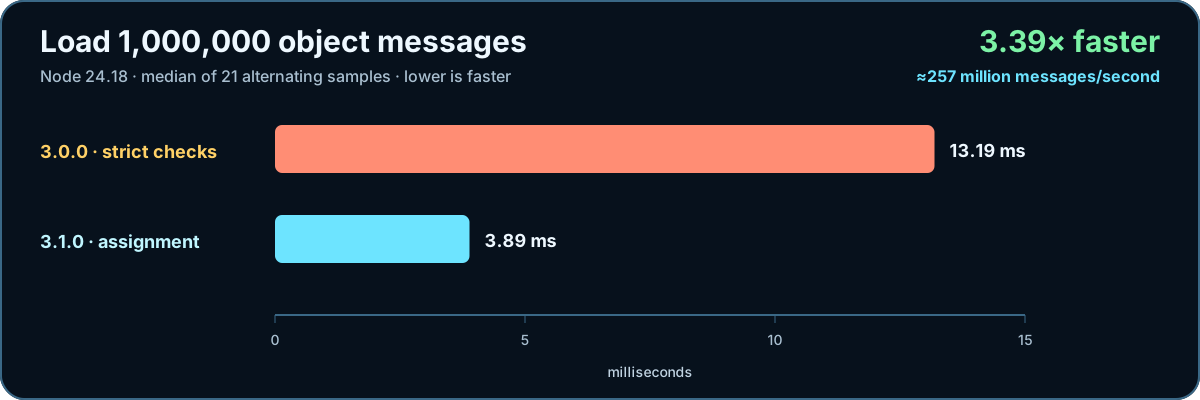
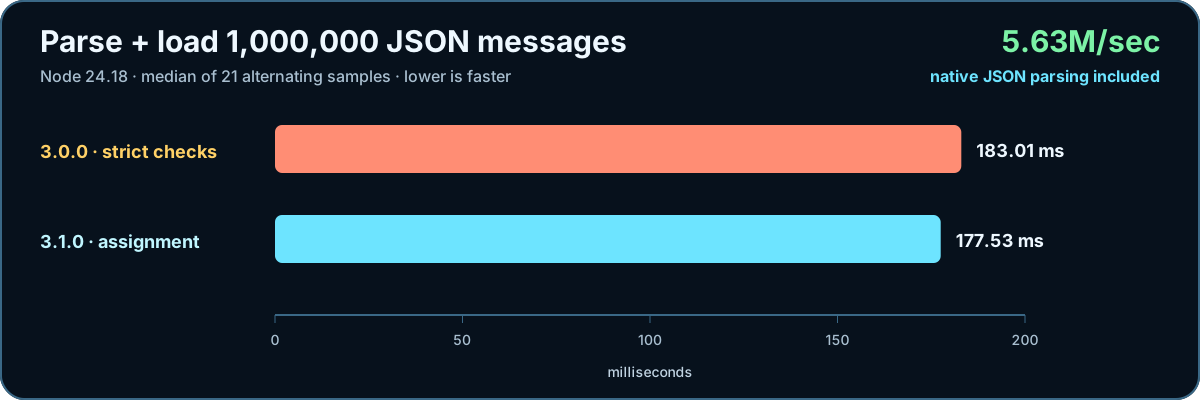
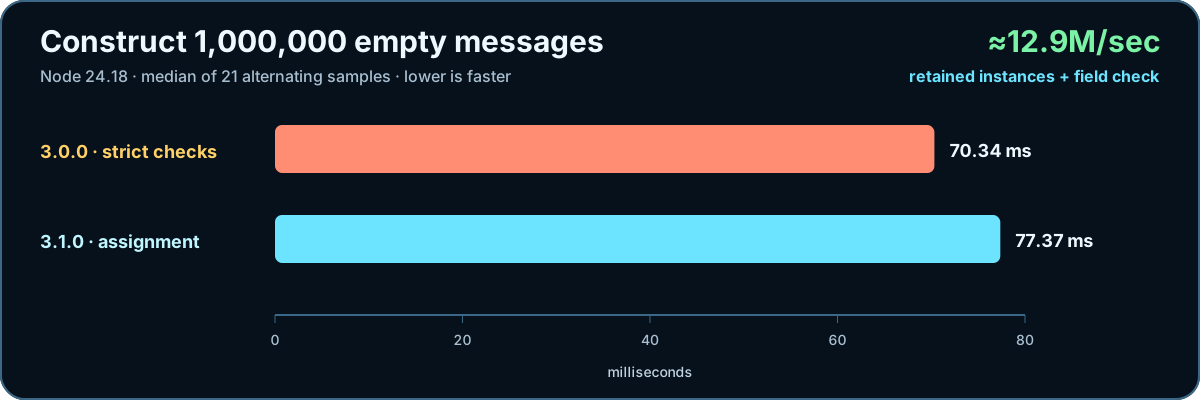
The benchmark uses Node 24.18, one million operations, and the median of 21 alternating samples. Review the method and recorded results.
Verification
Five focused suites use vanilla-test to run 83 nonduplicated shared checks from the same untransformed module in Node.js and Chrome. Chrome adds twelve distinct playground integration checks without inflating that shared count. The shared inventory imports js-message by its bare package name: Node resolves package self-references, while real Chrome resolves that same name through the checked-in native import map. CI also executes real ESM and CommonJS imports from the packed npm artifact, verifies the dependency tree and both production and full npm audits, checks documentation and the declared runtime floor, and enforces native coverage.
npm ci
npm test
npm run test:unit
npm run test:functional
npm run test:behavioral
npm run test:integration
npm run test:regression
npm run test:playground
npm run coverage:node
npm run coverage:chrome
npm run test:package
npm run benchmark
npm start
The package, development tools, and coverage require Node.js 22.13 or newer. CI runs the complete suite at that exact floor and runs Node 24 across Linux, macOS, and Windows.