
Quickstart · Rules · vs. Semgrep · JSON / SARIF · Adopt in CI · Agents · Rule Docs





Built by luislozoya.com — Shipping AI features without shipping the vulnerabilities
Project page
·
Issues
·
npm
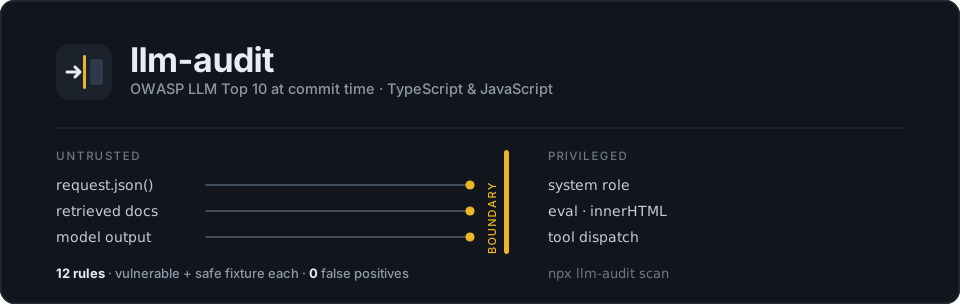
Static analysis for TypeScript and JavaScript LLM-application code. OWASP LLM Top 10 at commit time. A complement to Semgrep's
p/ai-best-practicesfor the TS/JS ecosystem the upstream pack does not cover.
A focused Semgrep rule pack and CLI for catching the security failure modes that appear in TypeScript and JavaScript code shipped by AI coding assistants (and humans) when integrating LLM features. Runs locally before commits and in CI.
Why not just p/ai-best-practices?
Because it does not scan TypeScript. Semgrep's official AI pack is real and good — it is simply Python-first. Run both; they do not overlap.
llm-audit |
Semgrep p/ai-best-practices |
|
|---|---|---|
| JS / TS rules | 12 | 0 of 27 |
| Language focus | TypeScript, TSX, JavaScript | Python (13), generic config (11), Bash (3) |
| Findings on this repo's TS/TSX fixtures | 40 | 0 — every target filtered out before scanning |
| False positives on the safe fixtures | 0 | n/a |
| Mapped to | OWASP LLM Top 10 | AI best practices, agent + MCP config hygiene |
| Install | npm i -D llm-audit |
semgrep --config p/ai-best-practices |
| Output formats | human, JSON envelope (schemaVersion: 1), SARIF 2.1.0 |
Semgrep native, SARIF |
| Runs at | pre-commit hook + CI | CI |
| License | MIT | LGPL-2.1 (rules) |
Reproduce the top three rows yourself in under a minute:
git clone https://github.com/Javierlozo/llm-audit.git && cd llm-audit

# Semgrep's AI pack against the same TypeScript fixtures: 0 targets, 0 findings.
semgrep --config p/ai-best-practices test/fixtures/ --metrics=off

# llm-audit against them: 12 rules, 40 matches, 0 false positives.
npm test
Full methodology, the other OSS scanners, and the commercial landscape are in
docs/COMPETITIVE-LANDSCAPE.md — including the
tools that are not competitors (Lakera, Garak, LLM Guard and friends are
runtime guardrails, a different stage entirely).
Status: the v1 rule set is complete. Twelve rules implemented with
vulnerable + safe fixtures, all green against npm test. See docs/RULES.md
for what's shipped and what's planned, docs/BRIEF.md for
the project pitch, docs/AI-FAILURE-MODES.md for
the long-form rationale behind each rule, and
docs/COMPETITIVE-LANDSCAPE.md for the
empirical comparison against p/ai-best-practices and other LLM-security
tooling.
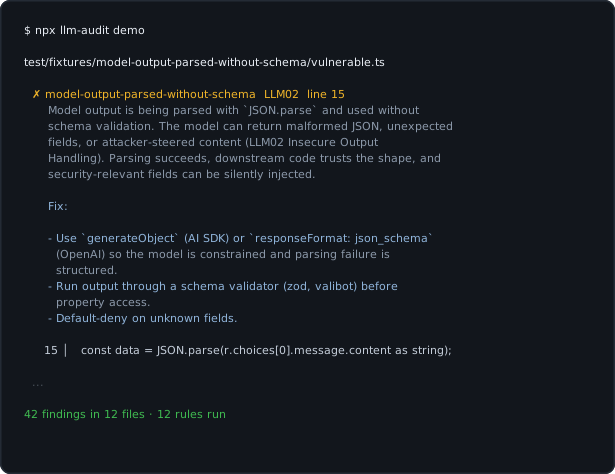
Real output from npx llm-audit demo. Every finding carries its OWASP mapping, the risk, and the fix.
Quickstart
You just ran npm i llm-audit. Now what?
# 1. Install the engine (one-time, system-wide).
brew install semgrep        # or: pipx install semgrep

# 2. Sanity-check setup. Lists missing dependencies and how to fix them.
npx llm-audit doctor

# 3. See what the rules catch in 5 seconds. No setup in your repo.
npx llm-audit demo

# 4. Run on your own code.
npx llm-audit scan
That's enough to evaluate whether llm-audit is worth adopting. To make
it permanent, see Adopt in your project below.
Machine-readable output (CI, agents, dashboards)
scan supports two structured output formats for non-human consumers:
# Versioned JSON envelope (stable schema, schemaVersion: 1).
# Useful for AI agents (Claude Code, Cursor) and custom dashboards.
npx llm-audit scan --json src > findings.json

# SARIF 2.1.0, the standard for security-tool output.
# Upload directly to GitHub Code Scanning via codeql-action/upload-sarif.
npx llm-audit scan --sarif src > findings.sarif
JSON envelope shape:
{
  "schemaVersion": 1,
  "tool": { "name": "llm-audit", "version": "0.2.0" },
  "scannedPaths": ["src"],
  "summary": { "findings": 0 },
  "findings": [
    {
      "ruleId": "model-output-parsed-without-schema",
      "severity": "WARNING",
      "owasp": "LLM02",
      "cwe": ["CWE-20"],
      "path": "src/app/api/route.ts",
      "startLine": 61,
      "endLine": 61,
      "message": "Model output is being parsed with `JSON.parse`...",
      "lines": "..."
    }
  ]
}
scan exits 0 when there are no findings, 1 when there are, regardless
of output format.
Using with Claude Code, Cursor, or Codex CLI
llm-audit is built for the exact problem AI coding assistants quietly
introduce, so the highest-leverage place to invoke it is from inside the
assistant itself. Two integration paths.
1. Install the Claude Code skill (recommended)
Drop a project-local SKILL.md into .claude/skills/llm-audit/ so any
agent that reads the universal skill format (Claude Code, Cursor, Codex
CLI, Antigravity, Gemini CLI) picks it up automatically:
npx llm-audit init --skill        # hook + workflow + skill
npx llm-audit init --skill-only   # just the skill
The skill tells the agent when to invoke llm-audit (when editing
files that import openai, @anthropic-ai/sdk, ai, @ai-sdk/*, etc.),
how to invoke it (npx llm-audit scan --json), and how to
interpret each rule's findings with the canonical fix per OWASP entry.
2. Manual rule for users who don't want the skill file
If you'd rather not commit a .claude/skills/ file to your repo, paste
this into your agent rules (CLAUDE.md, .cursorrules, AGENTS.md,
or your tool's equivalent) instead:
Before committing any change that touches LLM-integrated code (imports from
openai,@anthropic-ai/sdk,ai,@ai-sdk/*, or any file callingchat.completions.create/messages.create/generateText/streamText), runnpx llm-audit scan --jsonagainst the changed paths. Treat thefindingsarray as the authoritative list of issues to fix. Each finding hasruleId,owasp,severity,path,startLine,endLine, andmessage. Fix the code per the message, then re-run until the array is empty. Never bypass the rule by suppressing the finding.
Either path works. The skill is a strict superset (more context for the agent, automatic loading) but requires the file to live in your repo.
The JSON envelope is a stable contract (schemaVersion: 1), so agents
can rely on the field names without breaking on a future release.
Versions and updates
llm-audit does not check for updates on every run. No background
network calls, no daily cache files, no surprise. The trade-off: you
won't be notified of new versions automatically.
To check whether you're current, run:
npx llm-audit doctordoctor makes one on-demand request to the npm registry and prints
either is up to date or is out of date (latest is N.N.N) with the
upgrade command. Same network call you'd make manually with
npm view llm-audit version, just packaged into the diagnostic.
To upgrade:
npm i llm-audit@latestAdopt in your project
llm-audit init writes two things: a husky pre-commit hook (local, runs
on every commit) and a GitHub Action workflow (CI, runs on PRs and
pushes). Before writing the local hook, init asks for confirmation —
press Enter to accept the default, type n to skip the hook and keep
just the GitHub Action.
npx llm-audit init                     # prompts: Install pre-commit hook? [Y/n]
npx llm-audit init -y                  # skip the prompt, accept default
npx llm-audit init --skill             # also install the Claude Code skill

# If husky isn't already in this project, finish the setup:
npm i -D husky
npm pkg set scripts.prepare='husky'
npm run prepare
Non-interactive callers (CI, scripts, piped stdin) skip the prompt and accept the default automatically — no hangs.
Don't run npx husky init after llm-audit init: it conflicts with the
pre-commit file llm-audit init just wrote. The three lines above use
husky v9's manual setup, which doesn't have that conflict.
llm-audit init refuses to overwrite existing files; pass --force if
you really mean it. Threat model and rationale in
docs/SECURITY-AUDIT.md.
Pinning the version in CI
The bundled GitHub Action runs npx llm-audit scan, which resolves the
latest published version from npm at workflow run time unless llm-audit
is in your devDependencies. The husky pre-commit hook uses
npx --no-install and won't fetch the package implicitly.
If you want CI to use a reviewed version rather than whatever is current on the registry, either add it to your dev dependencies:
npm i -D llm-audit…or pin a version directly in the workflow file:
- run: npx llm-audit@0.2.0 scanWhy
The strongest existing rule pack — Semgrep's official
p/ai-best-practices —
ships 27 rules: 13 Python, 11 generic configs (MCP, Claude Code settings),
3 Bash hook rules, and zero JavaScript or TypeScript rules. Run it
against a Next.js + Vercel AI SDK repo and it returns nothing.
The TypeScript / JavaScript LLM-app ecosystem (Vercel AI SDK, OpenAI /
Anthropic JS SDKs, Next.js route handlers, Server Actions, AI Gateway) is
genuinely underweighted in the static-analysis tooling that exists today.
llm-audit fills that gap, with each rule mapped explicitly to an
OWASP Top 10 for LLM Applications
category.
Patterns covered:
- User input flowing into an LLM
systemrole or prompt template - Model output piped into
eval,dangerouslySetInnerHTML, or shell JSON.parseon raw model output without a schema validator- Hardcoded LLM API keys in source
The full rule list is in docs/RULES.md.
Run rules directly with Semgrep (no install needed)
If you don't want to install the package, the rule pack itself is a plain Semgrep configuration:
semgrep --config node_modules/llm-audit/rules .Rules
Twelve rules, each mapped to an OWASP Top 10 for LLM Applications
entry and backed by a vulnerable + safe fixture in test/fixtures/<rule-id>/.
| ID | OWASP | Summary |
|---|---|---|
untrusted-input-in-system-prompt |
LLM01 | User input placed into the LLM system role |
untrusted-input-concatenated-into-prompt-template |
LLM01 | User input interpolated into a single-string prompt with no role boundary |
untrusted-retrieval-context-in-system-role |
LLM01 | Retrieved documents given system authority — indirect prompt injection |
request-body-to-llm-without-schema |
LLM01 | Raw request body reaching an LLM call with no schema validation at the boundary |
llm-output-insecure-handling |
LLM02 | Model output flows into eval, raw HTML, or shell |
model-output-parsed-without-schema |
LLM02 | JSON.parse on model output without a schema validator on the path |
model-output-rendered-as-markdown-without-sanitization |
LLM02 | Markdown renderer with HTML enabled or sanitization disabled on model output |
hardcoded-llm-api-key |
LLM06 | Inline LLM provider API key in source |
secrets-in-prompt-context |
LLM06 | Environment secrets interpolated into prompt text sent to the provider |
system-prompt-leakage-in-client-bundle |
LLM07 | Prompt-shaped constants inside a 'use client' module, shipped to the browser |
tool-call-dispatch-without-allowlist |
LLM08 | Model-chosen tool name dispatched without an allowlist |
streaming-response-without-abort-handling |
LLM10 | Streaming call in a request handler with no signal forwarded |
Full rationale for each rule — what it catches, why an AI assistant tends to
write the pattern, and the canonical fix — is in docs/RULES.md.
The long-form writeup lives in docs/AI-FAILURE-MODES.md.
Project layout
rules/      Semgrep YAML rules, one per file
src/cli.mjs CLI entry: scan, init
templates/  Files installed by `llm-audit init` (husky hook, GH Action)
test/       Vulnerable + safe fixtures per rule
docs/       BRIEF.md (pitch), RULES.md (rule plan)
Author
Built by Luis Javier Lozoya.
License
MIT. See LICENSE.
Trademarks
llm-audit is an independent project and is not affiliated with or endorsed by
Semgrep, Inc. Semgrep is a trademark of Semgrep, Inc. References to the Semgrep
CLI and the p/ai-best-practices ruleset are nominative: they describe the
engine this project runs on and the public ruleset this project complements.