

Medusa Stats
MedusaJS | npm | Repository
Overview
medusa-stats is an analytics visualization plugin for Medusa that features:
- Pluggable statistics providers
- Views, options, and chart composition
- Composite statistics (statistics depending on other statistics)
- Statistics-triggered configurable alerts
- Admin UI with i18n support
- Widget for embedding statistics in the admin dashboard
- Caching for optimized performance
Installation
npm install medusa-stats
# or
yarn add medusa-stats
Configuration
Add the plugin to your medusa-config.ts:
modules: [
  {
    resolve: "medusa-stats/modules/statistics",
    dependencies: [ContainerRegistrationKeys.QUERY], // Query dependency is required for provider data access
    options: {
      providers: [
        {
          resolve: "medusa-stats/providers/common",
        },
      ],
    },
  },
],
plugins: [
  `medusa-stats`,
]
Basic Usage
The plugin provides a framework for defining and calculating statistics as well as an admin interface for their management and visualization. The primary goal of the module is to provide a flexible way to create custom statistics and views that suit your business needs, without being limited to predefined metrics.
The module can also be used out-of-the-box with pre-defined statistics providers and the admin interface.
Views
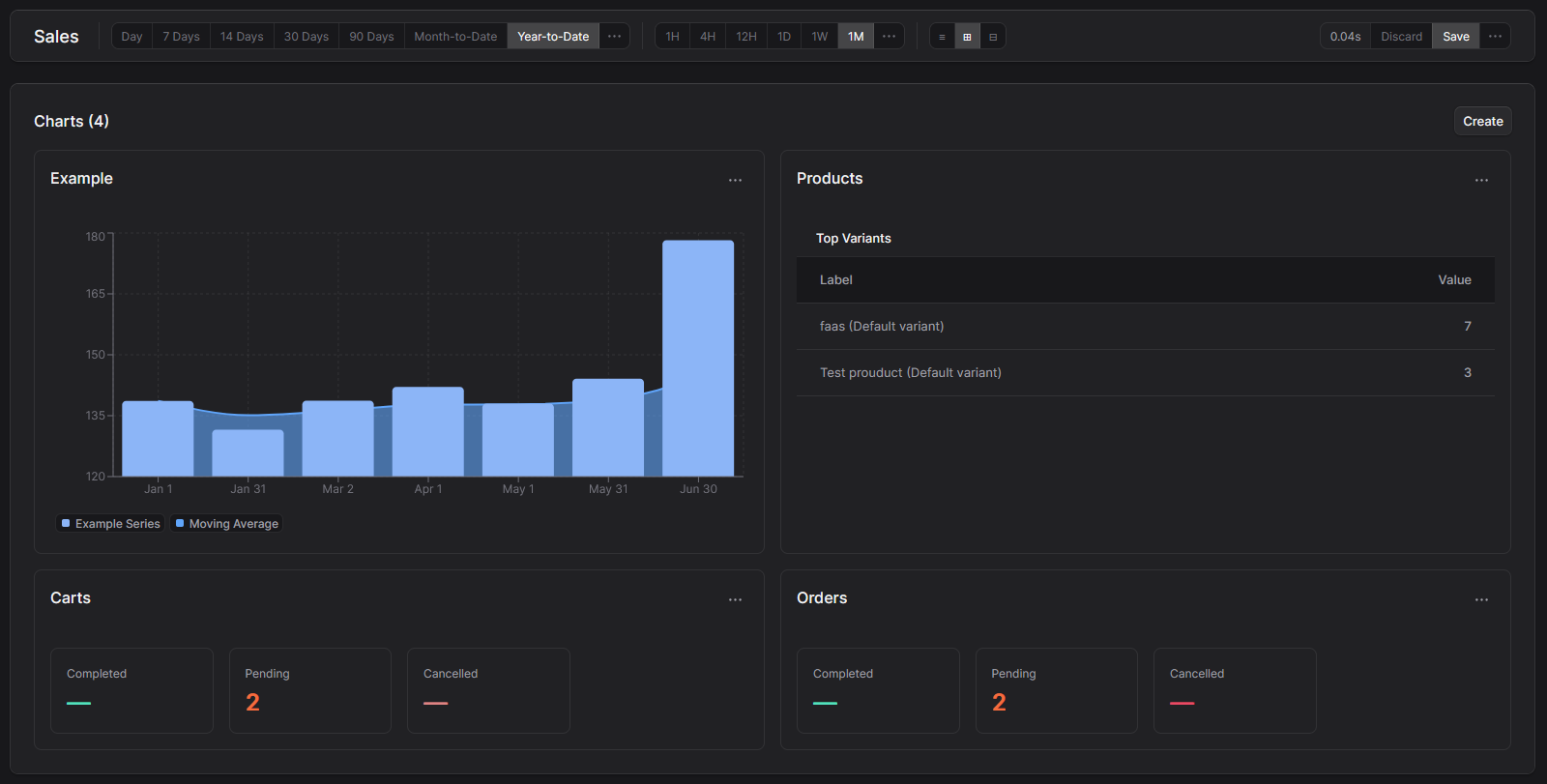
Views are collections of related statistics visualizations. They allow you to organize statistics in any way that suits your needs. Every chart in a view can display multiple statistical measurements, each based on a different statistic option. The view page includes a compact toolbar for switching period presets, interval settings, and grid layout sizes.
Options
Options are instances of statistics that are calculated with specific parameters. By changing an option's parameters, you can adjust the underlying statistic calculation.
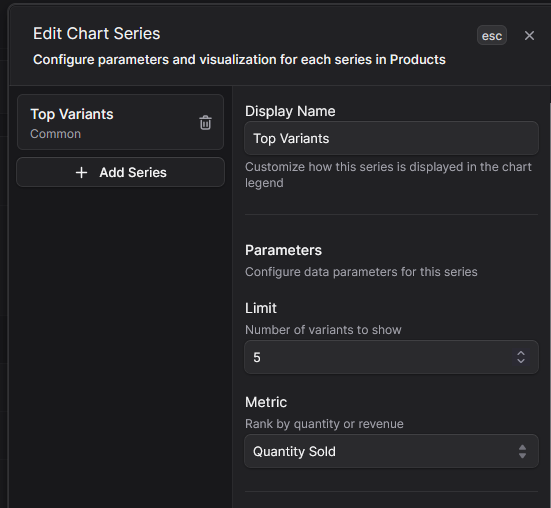
When editing, options can also be configured in terms of their visualization (chart type, series style, dimensions, colors, etc.), cache settings, and other parameters. Options can be saved as reusable Presets.
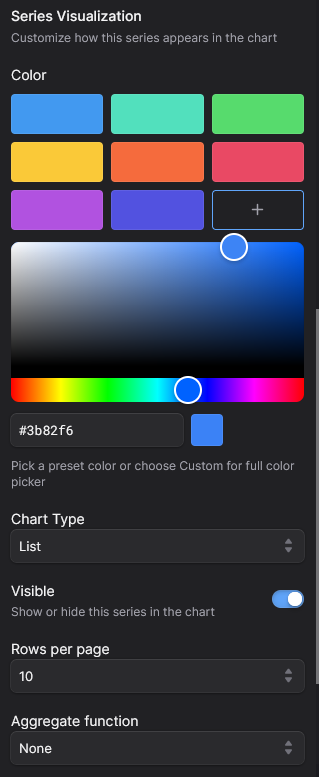
Chart Types
The module supports multiple built-in chart types, selectable per series:
| Type | Description |
|---|---|
2d |
Standard 2D chart (line, bar, area series) |
aggregate |
Summary cards showing the latest value per series |
list |
Paginated data table with optional aggregation row |
Custom chart types can be added by using LayoutComposer's widget injection. todo/layout composer seemed to crash randomly while testing due to invalid context data
Providers
Providers define what data is available via the providers. Each source is defined using the @StatFn decorator with a Zod parameter schema.
Add provider to project
Register your provider in medusa-config.ts under the medusa-stats module:
modules: [
  {
    resolve: "medusa-stats",
    options: {
      providers: [
        { resolve: "medusa-stats/providers/common" },
        { resolve: "medusa-stats/providers/composite" },
        { resolve: "./src/providers/statistics/my-provider" },
      ],
    },
  },
]
Included providers
medusa-stats includes two built-in providers:
medusa-stats/providers/common- General commerce statistics (orders, carts, sales, channels, regions, and related aggregates).
medusa-stats/providers/composite- Composite/stat-transform statistics that consume other statistic outputs.
- Included statistics:
moving_average,rate_of_change.
Creating a Statistics Provider
Create a provider class by extending AbstractStatisticsProvider and define each statistic as a method decorated with @StatFn. The decorator's StatOptions include a Zod schema for parameter validation, an optional preferred chart type, dimension hint, and arbitrary metadata.
Example: a total_cart_value statistic with a currency filter.
import { ModuleProvider } from "@medusajs/framework/utils"
import { z } from "zod"
import {
  AbstractStatisticsProvider,
  StatFn,
  createQueryTimeSeries,
  sum,
  type StatCalculationInput,
  type StatisticResult,
} from "medusa-stats"

const totalCartValueSchema = z.object({
  currency_code: z.string().optional(),
})

class MyStatisticsProvider extends AbstractStatisticsProvider {
  static identifier = "my-statistics"

  @StatFn("total_cart_value", {
    schema: totalCartValueSchema,
  })
  async totalCartValue({ parameters, ...input }: StatCalculationInput): Promise<StatisticResult> {
    const currencyCode = parameters.currency_code

    const timeSeries = await createQueryTimeSeries(this.query, input, {
      entity: "cart",
      fields: ["id", "created_at", "total"],
      filters: currencyCode ? { currency_code: currencyCode } : {},
    }, sum("total"))

    return { value: timeSeries }
  }
}

export default ModuleProvider("statistics", {
  services: [MyStatisticsProvider],
})
Helper Utilities
The package exports several data-processing utilities from medusa-stats:
| Function | Description |
|---|---|
createTimeSeries(data, start, end, interval, accumulator) |
Build a time series from raw data |
createQueryTimeSeries(query, input, queryParams, accumulator) |
Query + build a time series in one call |
groupBy(data, keySelector, aggregator?) |
Group data by a key with optional aggregation |
generateIntervals(start, end, interval) |
Generate interval timestamps for a period |
getIntervalBucket(date, periodStart, interval) |
Get the interval bucket for a given date |
count() |
Accumulator: count of items |
sum(field) |
Accumulator: sum of a field |
average(field, options?) |
Accumulator: average of a field |
Composite Statistics
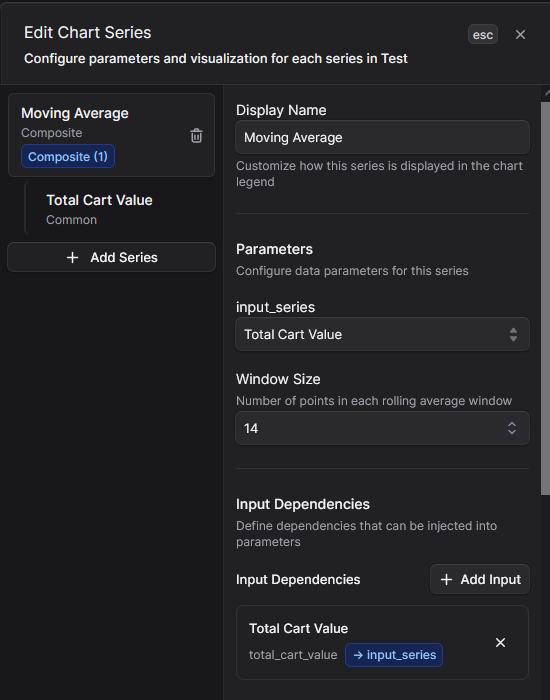
Composite statistics allow one option to use another option's output as an input. This is configured by setting Input Dependencies in the option editor — map a dependency to a parameter name.
Admin Usage
A stat option can be configured to receive another statistic's output in the Dependencies section when editing a stat instance in the admin dashboard.
Using composite fields in providers
To make a statistic composable, define a Zod schema for the input and use .meta({ type: "stat" }) to mark the field as a stat dependency. At runtime, that parameter receives the dependency's calculation result.
import { z } from "zod"
import { StatFn } from "medusa-stats"

const timeSeriesSchema = z.object({
  value: z.array(z.object({
    x: z.union([z.string(), z.date(), z.number()]),
    value: z.number(),
  }))
})

const movingAverageSchema = z.object({
  input_series: timeSeriesSchema.meta({ type: "stat" }),
  window_size: z.number().int().min(2).max(365).default(7),
})

class MyProvider extends AbstractStatisticsProvider {
  @StatFn("moving_average", {
    schema: movingAverageSchema,
  })
  async movingAverage({ parameters }: StatCalculationInput): Promise<StatisticResult> {
    const inputSeries = parameters.input_series.value
    // ... compute moving average
  }
}
Alerts
Alerts can be configured per option to trigger when conditions are met.
Features
- Absolute and comparative conditions
- Alert logs
- Scheduled evaluation job
- Event emission for custom handling
Emitted Events
To handle alert triggers, register a subscriber for the statistics.alert event type.
type StatisticsAlertEventData = {
  alert_id: string
  alert_name: string
  severity: "info" | "warning" | "critical"
  option_id: string
  current_value: number
  reference_value: number | null
  compare_value: number | [number, number]
  operator: "lt" | "gt" | "lte" | "gte" | "eq" | "neq" | "between"
  comparison_type: string
}
Caching
In order to optimize performance, statistic results are cached for a configurable amount of time. When a statistic is requested, the module first checks if a valid cached result exists and returns it if available. If not, it calculates the statistic, stores the result in the cache, and then returns it.
Cache Configuration
To use caching, CachingModule must be enabled in the Medusa project.
{
  resolve: "@medusajs/medusa/caching",
  options: {
    providers: [
      {
        resolve: "@medusajs/caching-redis",
        id: "caching-redis",
        is_default: true,
        options: {
          redisUrl: process.env.CACHE_REDIS_URL,
        },
      },
    ],
  },
},
The CachingModule's feature flag needs to be enabled as well:
in .env file:
MEDUSA_FF_CACHING=trueor
in medusa-config.ts:
featureFlags: {
  caching: true,
}
Internationalization (i18n)
The admin UI supports translation via the Medusa provided react-i18next package. Custom providers can provide translation keys for their functions and fields. The following keys are used for translation:
sp_<provider-id>.name- provider display namesp_<provider-id>.<stat-id>.name- function display namesp_<provider-id>.<stat-id>.description- function descriptionsp_<provider-id>.<stat-id>.fields.<field-name>.name- parameter field labelsp_<provider-id>.<stat-id>.fields.<field-name>.options.<value>- enum option label
General admin UI keys can also be translated, please see the src/admin/i18n folder for the english translation file.