
Mountebank Studio


A visual control surface for Mountebank. It talks to the admin API of any instance you point it at and gives you screens for the things you would otherwise hand-write as JSON: imposters, stubs, predicates, responses, proxy responses, behaviors, and the traffic each imposter has captured.
It also reads the mocks back out as a Postman collection — every imposter a folder, every stub a request that satisfies it — so what you have running is something you can fire at straight away. The download is on the Imposters screen, next to New Imposter.
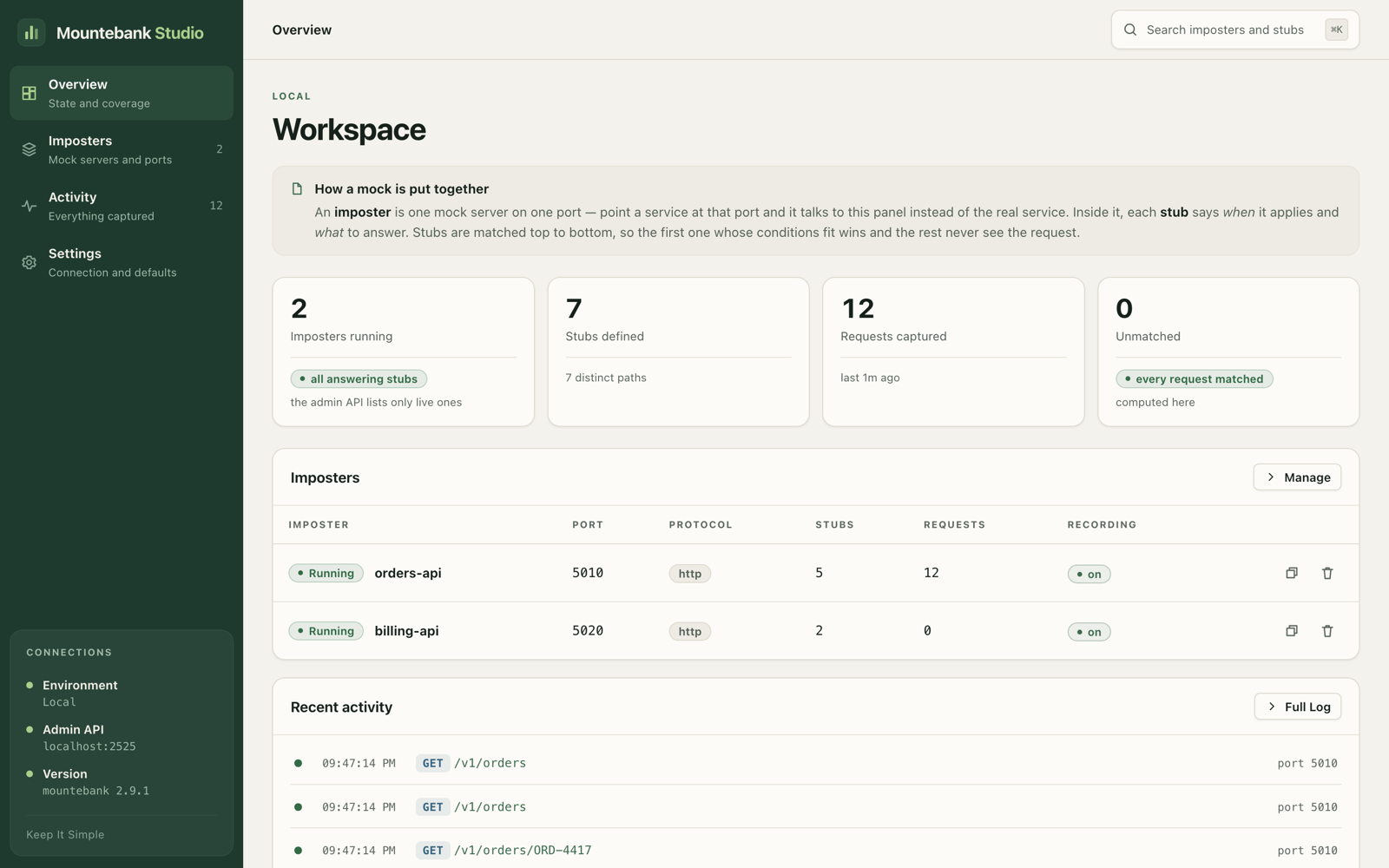
Two more screens
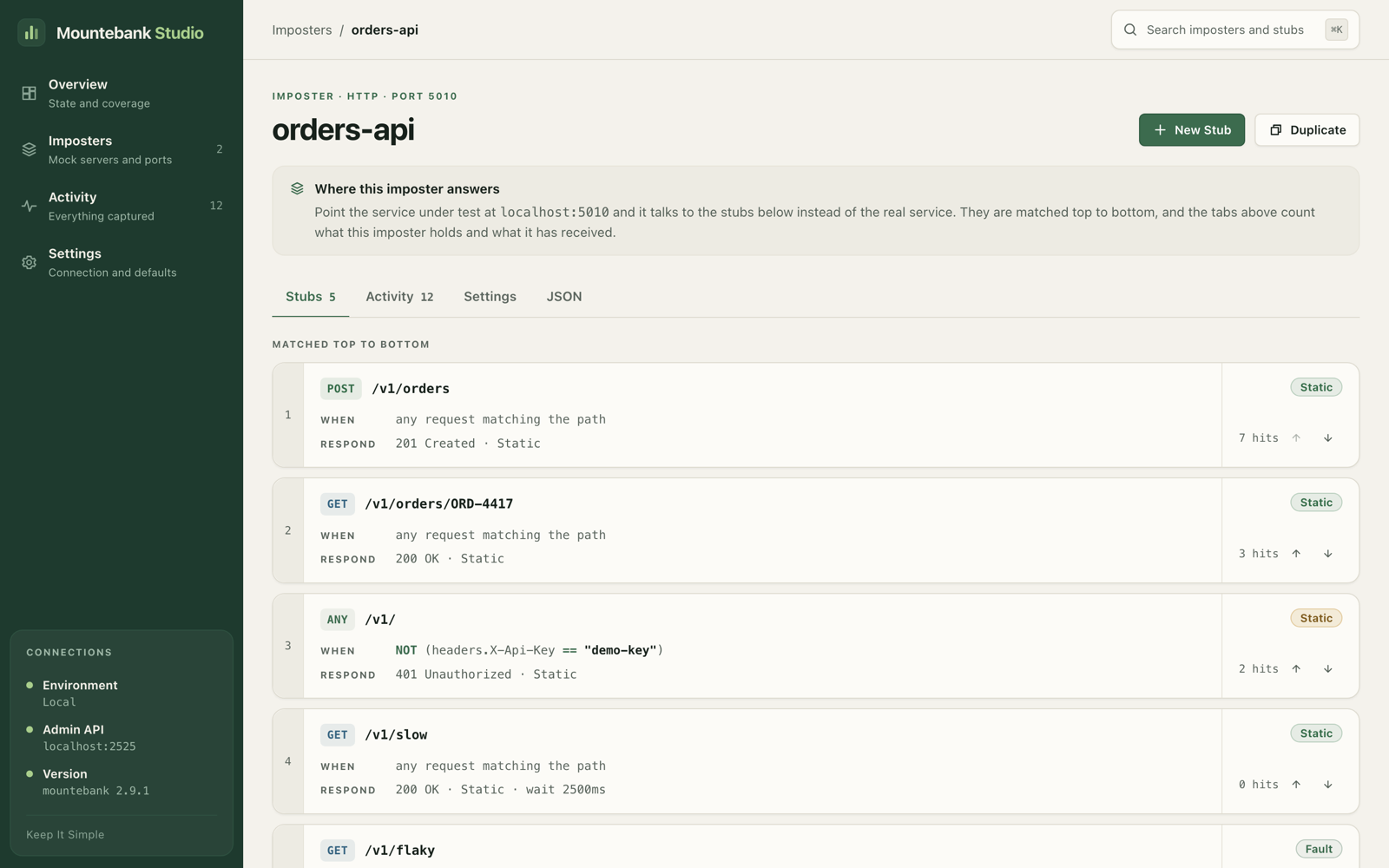
One imposter and its stubs, matched top to bottom, with the hit counts computed from the captured traffic. The third stub shows a negated header condition; the fourth carries a delay; the fifth breaks the connection instead of answering.
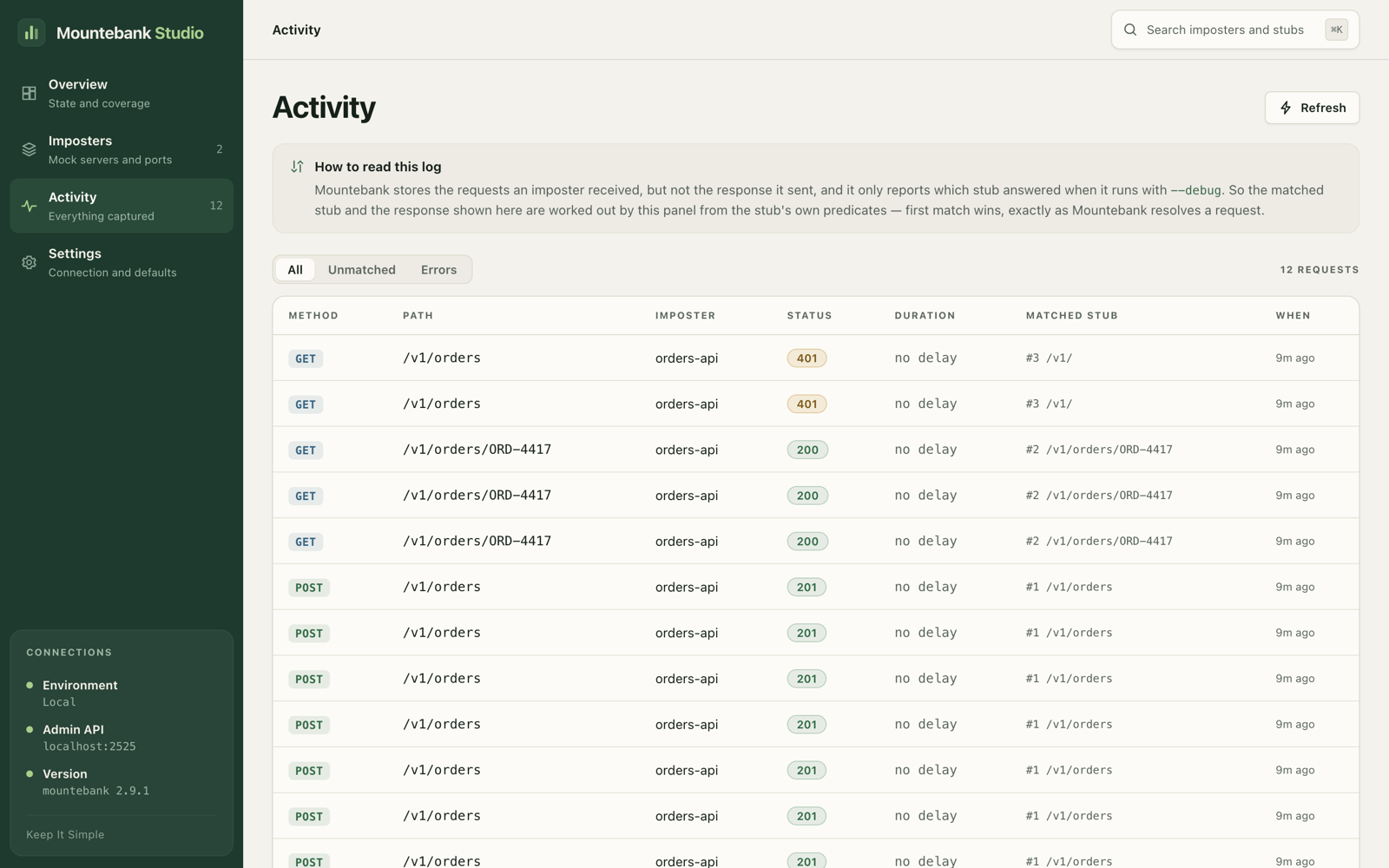
The traffic, with the stub that answered each request. Mountebank reports the
matched stub only with --debug, so the panel evaluates the predicates itself and says
so rather than implying the instance told it.
It is a shell, not a product for one team. It knows nothing about the service you are mocking. You add your own instances, and they live in your browser.
What it covers of Mountebank — feature by feature, what it carries without drawing, and how that was verified against the real package — is in COVERAGE.md.
Unofficial. Mountebank Studio is an independent project. It is not affiliated with, endorsed by, or sponsored by the mountebank project. Mountebank itself is MIT-licensed and is not redistributed here: the panel talks to an instance you run.
One command
npx mountebank-studioThat starts a Mountebank, serves the panel, and opens on a working instance. Nothing to configure, and nothing to allow: the panel and the instance share one origin, so the CORS question below never comes up. Ctrl-C stops both.
  Mountebank Studio        http://127.0.0.1:5273
  Started for you          http://127.0.0.1:2525 · mountebank 2.9.1
  Reached through          http://127.0.0.1:5273/mb/local — nothing is cross-origin
Useful flags: --port for the panel, --mb-port for the instance, --mb-url to use
an instance you already run instead of starting one, --allow-injection to let stubs
run JavaScript, --host 0.0.0.0 to expose the panel (read the warning it prints).
Mountebank is started bound to loopback with injection off, and its port is never
exposed — only the panel's is.
Installed, if you reach for it often
npm i -g mountebank-studioThen run it by name, from any directory:
mountebank-studioThe only difference from npx is that npx resolves the package on every run and this
resolves it once.
For an instance you cannot add --origin to
A Mountebank somebody else deployed will refuse the panel: the browser demands that
instance allow this page, and --origin belongs to whoever runs it.
Just add it as an environment. Paste its URL into Add Environment and press Test Connection: if it answers but refuses this page, the panel asks the host serving it to fetch it instead, and reports the route it will use. Nothing about that instance changes, nothing is typed twice, and no restart is involved. An environment you already have shows the same offer inside the error the first time a read fails — Reach it through this host.
The address you typed is left exactly as it is. It records where the instance is; the
route is worked out from what this host publishes at /mb/targets.json. Because the host
keeps its forwards in memory, the panel remembers which environments were reached that way
and asks again after a restart — so it survives one without a file on disk.
Only loopback may ask. Bound to a network with --host, the server refuses: an endpoint
that makes it fetch any URL it is handed would be a proxy for whoever can reach it.
You can also name the instance up front, which is the better fit for a script:
mountebank-studio --mb-url https://mountebank.example.comNo instance is started; /mb/local forwards to that one.
Add --insecure only if a certificate cannot be fixed. It turns off verification for that
upstream, which means anything between you and it can read and change these requests; the
banner says so while it is on.
Or pinned to a project, for a team
This one is different: it belongs inside a project — a directory that has a
package.json — and it fixes one version for everyone who checks that project out.
npm i -D mountebank-studio"scripts": { "mocks": "mountebank-studio" }npm run mocksnpm run only works where a package.json with that script exists; run it anywhere
else and npm answers ENOENT: no such file or directory ... package.json. A global
install is not part of this recipe — use the plain mountebank-studio command above.
Installing it as a runtime dependency does nothing useful either way: this is a program to run, not a library to import.
What survives a restart, and what does not
Mountebank keeps imposters in memory, so the instance started for you is empty every
time. To keep what you built, copy the JSON from Settings → Full configuration —
it is already in the shape --configfile expects — and start Mountebank yourself with
it:
mb start --configfile mocks.json
npx mountebank-studio --mb-url http://localhost:2525
The panel reaches it through this origin either way, so starting it yourself costs you no flags.
The environments you add are stored in the browser rather than on the machine, so a different browser — or cleared site data — meets the welcome screen again. What lives where is spelled out under Adding an environment.
Or from a checkout
yarn install
yarn dev          # http://localhost:5273
Then add your own instances. The panel starts with an empty list and opens on a welcome screen: add them one at a time and press Start to enter one. Everything is editable later under Settings.
How the panel reaches an instance
The build is a static page, so there is no server between you and a Mountebank admin API unless you put one there. That leaves two models, and an environment picks one just by how its target is written.
1 · Directly — for an instance you start yourself
Target is the instance's own URL:
https://mb.example.com or http://localhost:2525The browser calls that host from this page, which is cross-origin, so that instance has to allow this origin:
mb start --origin "http://localhost:5273"--origin is a pipe-separated allowlist and Mountebank echoes back whichever
origin matched, so the API opens to the pages you name rather than to the web:
mb start --origin "http://localhost:5273|https://mountebank-studio.example.com"Cheap and zero-infrastructure, and correct for a Mountebank on your own machine. It has one real limit: it only works on instances you can restart.
2 · Through this page's own host — for an instance somebody else deployed
Nothing to choose: the panel takes this route by itself whenever the host that
serves it says it forwards to that instance. Keep the instance's own URL in the
environment; routing is a fact about the deployment, not something a user should
have to know. (A path can still be entered by hand — /mb/stage — for a
deployment that forwards without publishing a map.)
Nothing is cross-origin, so CORS never enters the picture and the instance needs no flag, no restart and no change of any kind — which matters when a DevOps team owns it and "please add a browser flag to the mock server" is not a sustainable request.
Two things are needed on the host, and both live in one file. First the forwarding
itself — in production one location block, see deploy/nginx.conf:
location /mb/stage/ {
    proxy_pass https://mountebank.stg.example.com/;
    proxy_set_header Host mountebank.stg.example.com;
    proxy_http_version 1.1;
    proxy_buffering off;
}
Then the map, so the panel knows which path leads to which instance — one static location in production, and automatic in development:
location = /mb/targets.json {
    default_type application/json;
    add_header Cache-Control "no-store";
    return 200 '{"stage":"https://mountebank.stg.example.com"}';
}
# .env.local — comma-separated name=target pairs; the dev server publishes the map
MB_PROXY=stage=https://mb.stg.example.com,dev=https://mb.dev.example.comThe panel reads that map once, before its first request, and matches an environment
to a path by upstream URL. Matching by name would be a guess: an environment's
id is minted once from its label and outlives it, so /mb/stage can be live while
the environment called "stage" now points somewhere else — and following that guess
would silently show one instance's mocks as another's. No map means no forwarding
and every target is called directly.
MB_PROXY has no VITE_ prefix on purpose: it configures the dev server and is
never readable from client code.
The two models mix freely — one environment each way is normal.
A forwarded path is an open door. Whoever can reach it can rewrite those mocks, with none of the instance's own network restrictions in the way. Put the panel and its
/mb/*paths behind the same authentication as your other internal tools.
Either way, CORS is not access control
It is a rule browsers apply to scripts. Anything that can reach an instance over
the network — curl, another service, a script outside a browser — can call its
admin API whether or not your origin is on any list. If that matters, use
mb start --apikey <secret> and firewall the admin port.
When a read fails, the panel does not guess
A refused origin and a dead host reach a script as the same opaque error, so the
panel repeats the request as no-cors — the browser performs that one regardless,
and it resolves only if something actually answered (src/lib/mb/reach.ts). One
extra request, one verdict, shared by every screen and re-earned every 20 seconds:
- "Mountebank is up — but it will not answer this page" → it answered, and this
host does not forward to it, so add
--originor add a forwarding rule. - "Nothing is up at that address" → wrong URL, or the instance is down.
- For a
/pathtarget the CORS answer is never offered, because it cannot apply: the fault is the forwarding rule or the instance behind it.
Adding an environment
An environment is a record you create — on the welcome screen, or in Settings
once you are inside. It is runtime data, kept in
this browser under mountebank-studio-environments — never compiled in, never sent
anywhere. It holds:
| Field | What it is |
|---|---|
| Name | What the environment is called throughout the UI. |
| Admin API | Either an absolute http(s) URL of the instance's admin port (2525 by default, not an imposter's port), or a path on this origin (/mb/stage) that is forwarded to it. |
| Note | An optional caution shown next to the environment. |
That is the whole record. It carried two more fields once — a colour, and a read-only switch — and both are gone: the colour only tinted a dot, and the switch was a seatbelt the same person could unbuckle one screen away. Destructive actions confirm themselves instead, which is where the protection belongs.
The id derived from the name is the first segment of every route
(/<id>/imposters/4545), so a link lands whoever opens it in the right place.
Pre-provisioning with VITE_ENVIRONMENTS
To ship the panel already pointed at your instances, set VITE_ENVIRONMENTS to a
JSON array. It seeds the list once, on a fresh install; after that the user's
own edits win and the variable is never re-applied. Malformed entries are skipped
rather than crashing the app, so a typo cannot lock anyone out.
# .env.local — one line
VITE_ENVIRONMENTS=[{"id":"local","label":"Local","target":"http://localhost:2525"},{"id":"shared","label":"Shared sandbox","target":"https://mb.example.com","note":"Other people depend on these mocks."}]
label and target are required; id and note are optional. See .env.example for the annotated version.
Layout
src/
├── lib/
│   ├── environments.ts      what an environment is: shape, slug, validation, seeding
│   ├── mb/
│   │   ├── types.ts         Mb* = mountebank's wire format · the rest = the editable model
│   │   ├── model.ts         the lossless bridge between the two
│   │   ├── simpleForm.ts    the plain-language predicate form, and what it cannot express
│   │   ├── match.ts         which stub answered a recorded request
│   │   ├── client.ts        the admin API, called straight from the browser
│   │   └── __fixtures__/    synthetic replayable payloads the round-trip tests assert against
│   ├── queries.ts           TanStack Query hooks, keyed per environment
│   ├── summaries.ts         the WHEN / RESPOND stub summaries
│   └── format.ts            time, plurals, status names
├── store/
│   ├── useEnvironments.ts   the environment list, persisted in this browser
│   └── useStudio.ts         current environment, detail level, palette, toasts
├── styles/                  design tokens; every size and colour comes from here
├── ui/                      the primitive library
├── components/              shell: sidebar, topbar, environment switcher, command palette
└── views/                   one module per screen
Two conventions worth knowing before you touch anything
Every size and colour comes from a token. src/styles/tokens.css holds the
type scale (--fs-micro → --fs-h1) and the whole palette. Components use
var(--fs-sm), never 12.5px, and never a raw hex. It is the only way a panel
this dense stays visually consistent as it grows.
Icon sizes are set in CSS, per context — not at the call site, so they cannot drift: nav 18px, buttons 16px, small buttons 14px, table row actions 17px.
The model, and two things it protects you from
model.ts converts between Mountebank's JSON and the editable model in both
directions, and model.test.ts asserts round-trip identity across every construct
the editor claims to support. Two silent data-loss bugs are very easy to write
here, and both were caught that way.
1. A predicate holds several fields, not one. The idiomatic Mountebank predicate is a bag of fields compared together:
{ "equals": { "method": "POST", "path": "/v1/orders" } }An editor that models one field per predicate drops path on save, and the stub
then matches every path. So a predicate carries a list of conditions. Splitting
them into separate predicates would also be wrong: inside an or group it silently
turns an AND into an OR.
2. Values are compared by JSON type. {"equals":{"body":"00123456789"}} and
{"equals":{"body":123456789}} are different predicates. Inferring the type from
the text would retype a digits-only reference into a number on the first save, and
the stub would stop matching forever. Every condition therefore carries its JSON
type explicitly, shown in the editor as a str / num / bool / json chip.
guessType() only ever suggests.
Writes are also minimal: a field you never set is not sent, so opening and saving a stub does not rewrite keys that were never there.
Matched stub
Mountebank reports which stub answered a request only when the instance runs with
--debug. Unless yours does, the panel evaluates the predicates itself
(match.ts, mirroring Mountebank's semantics — first match wins, case-insensitive
unless caseSensitive, type-exact comparison) and labels the result as computed. A
stub containing a predicate the editor cannot model is marked as unconfirmed rather
than silently treated as a non-match.
For the same reason the panel never claims to show a response Mountebank sent: the request log stores requests only. Status and delay in the activity table are read from the matched stub, and say so.
Scripts
yarn dev            # dev server on :5273
yarn build          # typecheck + production bundle into dist/
yarn preview        # serve the build on :5273
yarn check:types    # tsc --noEmit
yarn tests          # vitest
yarn test:watch     # vitest, watching
yarn lint           # oxlint
yarn format         # prettier --write
Deploying
yarn build
# copy dist/ to your web root, then use deploy/nginx.conf
deploy/nginx.conf does two things: serves the build
(client-side routing via try_files, immutable caching for /assets) and carries a
commented location /mb/<name>/ block per environment. Uncomment one per instance
you want to reach and the panel needs nothing from the Mountebank side — see
How the panel reaches an instance. Protect
both the panel and its /mb/* paths with your usual authentication: together they
let anyone rewrite those mocks.
Releases
Version history is in CHANGELOG.md, and the package is on npm as
mountebank-studio.
Licence
Apache License 2.0 — see LICENSE and NOTICE.
That choice is deliberate. A permissive licence keeps the panel usable inside companies whose legal teams refuse copyleft, which is exactly where mock servers are needed most, and the patent grant is worth having for a corporate reader. Contributions come in under the same terms (Apache-2.0, section 5); see CONTRIBUTING.md.
Security reports go through the private channel in SECURITY.md, not a public issue — these mocks decide what a system under test believes.