
Reviewer lib
An automated code review tool that uses OpenAI to analyze and provide recommendations for code improvement and commenting in PR when received message from AI.





Installation
Requires Node.js 20+ (the library depends on
openaiv6).
npm install -D reviewer-libUsage
Notes: by default the library uses the OpenAI Chat Completions API with gpt-4o-mini.
You can pass any chat model (e.g. gpt-4o) as the model argument. Legacy instruct models
(any name ending in -instruct, such as gpt-3.5-turbo-instruct) are still supported and
are automatically routed to the older Completions API.
import { Reviewer} from 'reviewer-lib';

const reviewer = new Reviewer(apiKey); // OpenAI apikey
const code = `
function exampleFunction(x, y) {
  let result = x + y;
  return result;
}
`;

reviewer.submitCodeAssistanceMode(code)
   .then((feedback: string) => {
      console.log('Code Review Feedback:');
      console.log(feedback);
   })
   .catch((error: Error | string) => {
      console.error('Error:', error);
   });
Structured review (review)
review() returns typed findings instead of free text (chat models only), ready for
inline PR comments or a CI gate:
import { Reviewer, formatFindings, toReviewComments, hasBlockingFindings } from 'reviewer-lib';

const reviewer = new Reviewer(apiKey); // default model: gpt-4o-mini

// Pass asDiff: true to review a unified diff — findings then carry file + line.
const findings = await reviewer.review(diff, { asDiff: true });

console.log(formatFindings(findings));        // markdown summary for a PR comment
const comments = toReviewComments(findings);  // [{ path, line, body }] for GitHub inline comments
if (hasBlockingFindings(findings, 'high')) process.exit(1); // fail CI on high+ severity
Each Finding has: severity (critical | high | medium | low), category,
file, line, message, and suggestion.
CLI
The package ships a reviewer-lib command, so you can review without writing any glue code
(OPENAI_API_KEY must be set):
# review your working changes locally
git diff origin/main | npx reviewer-lib review --fail-on high

# review a diff file as JSON
npx reviewer-lib review --diff pr.diff --format json

# in CI: fetch a PR diff and post inline comments + a summary
#   (needs GITHUB_TOKEN and GITHUB_REPOSITORY)
npx reviewer-lib review --pr 54 --post --fail-on high
Flags: --diff <file>, --pr <number>, --post, --code, --model <name>,
--format text|json, --fail-on <severity>, --api-key <key>, --timeout <ms>,
--max-retries <n>. Run npx reviewer-lib --help for details.
Use as a GitHub Action
Add AI review to any repository in a few lines. The action reads the PR diff and posts
inline comments plus a summary. Add OPENAI_API_KEY to the repo secrets and give the job
pull-requests: write permission:
name: AI code review
on:
  pull_request:

permissions:
  pull-requests: write

jobs:
  review:
    runs-on: ubuntu-latest
    steps:
      - uses: JuliettKhar/reviewer-lib@v3
        with:
          openai-api-key: ${{ secrets.OPENAI_API_KEY }}
          fail-on: high        # optional: fail the check on high+ findings
Inputs: openai-api-key (required), github-token (default ${{ github.token }}),
pr-number (defaults to the event's PR), fail-on, model (default gpt-4o-mini),
version (reviewer-lib version to run, default latest).
To trigger it manually instead, use workflow_dispatch and pass pr-number.
Local usage (no CI)
Don't want a pipeline? Run reviews straight from your terminal — no install needed
(npx pulls the package on demand). Set your key once per shell:
export OPENAI_API_KEY=sk-...Review your uncommitted changes:
git diff | npx reviewer-lib reviewReview a whole branch before opening a PR (everything since main):
git diff main...HEAD | npx reviewer-lib review --fail-on highReview a single file, or get machine-readable output:
git diff -- src/app.ts | npx reviewer-lib review
git diff | npx reviewer-lib review --format json > review.json
Prefer a faster repeat experience? Install it globally: npm i -g reviewer-lib, then
drop the npx. You can also pass the key inline with --api-key instead of the env var.
Optional — review automatically before every push with a git hook. Save as
.git/hooks/pre-push and chmod +x it:
#!/bin/sh
git diff origin/main...HEAD | npx reviewer-lib review --fail-on high || {
  echo "reviewer-lib found blocking issues — push aborted (use 'git push --no-verify' to override)."
  exit 1
}
API
new Reviewer(apiKey, model, maxTokens). Creates a new Reviewer instance.
- Params:
apiKey (String): Your OpenAI API key.model (String): The model you want to use (default 'gpt-4o-mini'). Instruct models (*-instruct) route to the legacy Completions API automatically.maxTokens (Number): The maximum number of tokens for the response (default 1500).clientOptions (Object): Reliability options passed to the OpenAI client —maxRetries(default 3) andtimeoutin ms (default 120000). The SDK retries transient failures (429/5xx) with exponential backoff automatically.code (String): The code to analyze. Returns Promise: Suggestions for improving the code.temperature?: Controls the creativity and variety of the generated text. Values from 0 to 1.n?: The number of text variants the model should generate. The default value is 1.stop?: A list of sequences where the generation should stop. For example, ["\n", "END"].top_p?: Controls cumulative probability sampling. Values from 0 to 1. This is an alternative way to control creativity that focuses on the most likely tokens.frequency_penalty?: A number from 0 to 1. Reduces the probability of tokens that have already been used in the text. This helps reduce repetition.presence_penalty?: A number from 0 to 1. Increases the probability of tokens that have not yet been used. This helps introduce new topics and ideas.logprobs?: If set, returns the logarithms of the probabilities of all tokens when generating. This is useful for analyzing probabilities and choosing the best tokens.echo?: If set to true, returns the request along with the response. This can be useful for debugging.best_of?: Generate multiple variants and choose the best one. This is related to n, but allows you to get the best variant from a larger number of generated texts.logit_bias?: A map of tokens and values to control the probability of certain tokens. This allows you to influence the generation by encouraging or disallowing the use of certain words.
- Methods:
submitCodeAssistanceMode(code: string): Function, analyzes and provides recommendations for improving the code.
reviewer.submitCodeAssistanceMode(code).then(suggestions => {
  console.log('Review Suggestions:', suggestions);
});
Other Functions
review(input: string, options?: { asDiff?: boolean }): Structured review returningFinding[]via OpenAI Structured Outputs (chat models only). See Structured review above.submitCode(code: string): Function, analyzes and provides recommendations for improving the code. Uses the Chat Completions API by default; if the configured model is an instruct model (*-instruct), it routes to the legacy Completions API instead.getCurrentModels: Function, gets list of available AI models.historicalAnalysis(repoPath: string): A feature that analyzes the history of code changes and makes recommendations for improvements based on past changes.codeStyleRecommendations(code: string): Add a feature that provides recommendations for improving code style by following established style guides.securityAnalysis(code: string): A function that checks code for potential vulnerabilities and suggests solutions.generateTests(code: string): Function for automatic test generation based on provided code.optimizeCode(code: string): A function for suggesting optimizations in code in terms of performance and readability.generateDocumentation(code: string): A function that automatically generates comments or documentation for code.
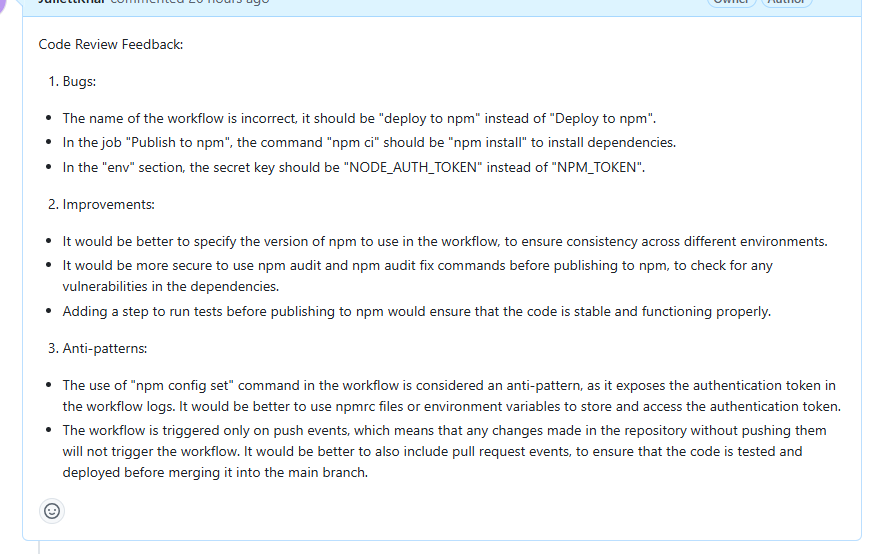
Feedback, integrated on CI/CD (example)
 References