
SentryBus
A general-purpose integration/service bus. Organizations plug their services in via config, dispatch events to the bus, and it routes each event to the right adapter — queuing and retrying automatically when the target service is down.
Table of Contents
- Overview
- Architecture
- How It Works
- Project Structure
- Prerequisites
- Installation
- Configuration
- Usage
- Core Concepts
- Scripts
- Extending SentryBus
- Design Decisions
- Known Gaps
- License
Overview
SentryBus sits between your application and the third-party services it integrates with (CRM, ledger, notifications, analytics, etc.). Instead of each service in your platform making direct HTTP calls to external APIs — with its own retry logic, error handling, and failure modes — everything routes through SentryBus.
The value proposition:
- One place to configure connection details, retry policies, rate limits, and circuit breakers for every integration.
- Events are queued persistently. If Zoho is down, the message waits in Redis and retries on a configurable backoff schedule. No data is lost.
- Each adapter retries independently. A Blnk failure doesn't block Zoho dispatch for the same event.
- Circuit breakers prevent hammering a downed service. Once a threshold is crossed, the bus stops calling that service, probes periodically, and resumes automatically when it's healthy.
Architecture
┌─────────────────┐       POST /publish        ┌──────────────────────────┐
│  Your API       │ ─────────────────────────▶  │  SentryBus (:8085)       │
│  (localhost:3000)│                            │                          │
└─────────────────┘                            │  ┌────────────────────┐  │
                                               │  │ Ingest (validate)  │  │
┌─────────────────┐       POST /publish        │  └────────┬───────────┘  │
│  Another Service│ ─────────────────────────▶  │           │              │
│  (localhost:4000)│                            │           ▼              │
└─────────────────┘                            │  ┌────────────────────┐  │
                                               │  │ Envelope (stamp)   │  │
                                               │  └────────┬───────────┘  │
                                               │           │              │
                                               │           ▼              │
                                               │  ┌────────────────────┐  │
                                               │  │ Router (fan-out)   │  │
                                               │  └────────┬───────────┘  │
                                               │           │              │
                                               │           ▼              │
                                               │  ┌────────────────────┐  │
                                               │  │ BullMQ (Redis)     │  │
                                               │  └────────┬───────────┘  │
                                               │           │              │
                                               │           ▼              │
                                               │  ┌────────────────────┐  │
                                               │  │ Dispatcher Worker  │  │
                                               │  │ (circuit breaker)  │  │
                                               │  └────────┬───────────┘  │
                                               └───────────┼──────────────┘
                                                           │
                              ┌─────────────────────────────┼──────────────────┐
                              │                             │                  │
                              ▼                             ▼                  ▼
                    ┌──────────────┐             ┌──────────────┐    ┌──────────────┐
                    │  Zoho CRM    │             │  Blnk Ledger │    │  Service N   │
                    └──────────────┘             └──────┬───────┘    └──────────────┘
                                                       │
                                                       │ webhook callback
                                                       ▼
                                               ┌──────────────────┐
                                               │ SentryBus        │
                                               │ /webhooks/blnk   │
                                               └──────────────────┘
How It Works
- Publish — Your service sends a
POST /publishto SentryBus with a topic and payload. - Envelope — The bus wraps the event in a normalized envelope (adds
id,timestamp,correlationId,version). - Route — The router looks up which adapters subscribe to that topic. One BullMQ job is created per adapter (independent retry).
- Queue — Jobs sit in Redis. If Redis is healthy, dispatch happens near-instantly. If the target is down, jobs stay queued and retry on a backoff schedule.
- Dispatch — The worker picks up a job, checks the circuit breaker, and makes the outbound HTTP call with the adapter's configured timeout and credentials.
- Retry or Dead-letter — On failure, the circuit breaker records it. The job retries based on the adapter's retry policy (fixed/linear/exponential backoff with optional jitter). After max attempts, it's dead-lettered and logged.
- Webhook (bidirectional) — Some services (like Blnk) call back with status updates. SentryBus receives those on configured webhook routes, translates them to internal events, and publishes them back onto the bus.
Project Structure
sentryBus/
├── bus/                            # All config lives here
│   ├── env.config.toml             # Port, host, Redis credentials
│   ├── zoho-crm.config.toml       # Adapter: Zoho CRM
│   └── blnk.config.toml           # Adapter: Blnk Ledger
├── src/
│   ├── index.ts                    # Entrypoint — boot, server, worker
│   ├── configs/
│   │   ├── app.ts                  # App config (reads from env.config.toml)
│   │   ├── redis.ts                # Redis connection (reads from env.config.toml)
│   │   └── index.ts                # Barrel export
│   ├── core/
│   │   ├── adapters.ts             # Adapter registry (load, query by topic/name, toggle)
│   │   ├── circuitBreaker.ts       # Per-adapter in-process breaker
│   │   ├── dispatcher.ts           # BullMQ Worker — outbound dispatch
│   │   ├── envelop.ts              # Envelope schema + builder
│   │   ├── injest.ts               # HTTP handler for POST /publish
│   │   ├── middleares.ts           # Middleware: compose, logging, error boundary
│   │   └── router.ts              # Fan-out: envelope → per-adapter BullMQ jobs
│   ├── dashboard/
│   │   ├── index.ts                # /console/* route handler
│   │   └── page.ts                 # Self-contained HTML (inline CSS/JS, SVG topology)
│   ├── libs/
│   │   └── queue.ts                # BullMQ Queue + custom backoff strategy
│   ├── middleware/
│   │   └── index.ts                # Re-exports from core/middleares.ts
│   ├── schemas/
│   │   ├── envConfigSchemas.ts     # Zod schema for env.config.toml
│   │   └── serviceAdaptorSchemas.ts # Zod schema for adapter configs
│   └── utils/
│       ├── banner.ts               # Startup banner (ASCII art + service list)
│       ├── configFileReader.ts     # Parses a single TOML file (Bun native)
│       ├── envConfigReader.ts      # Loads + validates env.config.toml
│       ├── loader.ts               # Globs bus/*.config.toml (adapters only)
│       └── logger.ts               # Structured JSON logger with secret redaction
├── package.json
└── tsconfig.json
Prerequisites
Quick Redis via Docker:
docker run -d --name redis -p 6379:6379 redis:7-alpine --requirepass supersecretpasswordInstallation
# From source
git clone https://github.com/emekadefirst/sentryBus.git
cd sentryBus
bun install

# Or install as a package
bun add -g sentrybus
Configuration
All configuration lives in the bus/ directory. No .env file needed.
Environment Config (env.config.toml)
bus/env.config.toml holds the bus's own runtime settings and Redis credentials:
PORT = 8085
HOST = "localhost"
URL = "http://localhost:8085"

REDIS_USERNAME = "default"
REDIS_PASSWORD = "supersecretpassword"
REDIS_HOST = "127.0.0.1"
REDIS_PORT = 6379| Field | Type | Description |
|---|---|---|
PORT |
number | HTTP server port |
HOST |
string | Bind address |
URL |
string (URL) | Public base URL |
REDIS_USERNAME |
string | Redis ACL username |
REDIS_PASSWORD |
string | Redis password |
REDIS_HOST |
string | Redis host |
REDIS_PORT |
number | Redis port |
Validated by Zod at boot — a typo or missing field fails immediately with a clear error message, not silently at runtime.
Adapter Config Files
Each integration gets its own *.config.toml file in bus/. The bus reads all adapter configs at boot, validates each against the Zod schema, and fails loudly if any are malformed.
Example: bus/zoho-crm.config.toml
name = "zoho-crm"
enabled = true
protocol = "http"
baseUrl = "https://www.zohoapis.com/crm/v6"
timeoutMs = 5000
credentialKey = "ZOHO_CRM_TOKEN"
topics = ["driver.onboarded", "company.account.updated"]
envelopeVersion = "1.0"

[rateLimit]
burst = 20
refillPerSecond = 5

[retry]
maxAttempts = 5
backoff = "exponential"
baseDelayMs = 500
jitter = true

[circuitBreaker]
failureThreshold = 5
windowMs = 60000
cooldownMs = 30000
Example: bus/blnk.config.toml (bidirectional — includes webhook fields)
name = "blnk-ledger"
enabled = true
protocol = "http"
baseUrl = "https://ledger.internal.example.com"
timeoutMs = 8000
credentialKey = "BLNK_API_KEY"
credentialHeader = "X-Blnk-Key"
credentialScheme = ""
topics = ["shipment.delivered", "invoice.due"]
envelopeVersion = "1.0"
webhookRoute = "/webhooks/blnk"
webhookSecret = "BLNK_WEBHOOK_SIGNING_SECRET"

[rateLimit]
burst = 10
refillPerSecond = 2

[retry]
maxAttempts = 8
backoff = "exponential"
baseDelayMs = 1000
jitter = true

[circuitBreaker]
failureThreshold = 3
windowMs = 60000
cooldownMs = 45000
Adapter Config Reference
| Field | Type | Required | Description |
|---|---|---|---|
name |
string | ✓ | Unique adapter identifier |
enabled |
boolean | ✓ | Toggle without deleting config |
protocol |
"http" | "sse" | "ws" |
✓ | Transport protocol |
baseUrl |
string (URL) | ✓ | Target service base URL |
timeoutMs |
number | ✓ | Request timeout in milliseconds |
credentialKey |
string | ✓ | Env var name holding the credential |
credentialHeader |
string | — | HTTP header name for the credential (default: "Authorization") |
credentialScheme |
string | — | Scheme prefix (default: "Bearer", set to "" for raw value headers) |
topics |
string[] | ✓ | Event types this adapter subscribes to |
envelopeVersion |
string | ✓ | Envelope schema version this adapter expects |
webhookRoute |
string | — | Inbound webhook path (bidirectional adapters) |
webhookSecret |
string | — | Env var name for webhook signature verification |
rateLimit.burst |
number | ✓ | Token bucket max burst |
rateLimit.refillPerSecond |
number | ✓ | Token refill rate |
retry.maxAttempts |
number | ✓ | Maximum delivery attempts |
retry.backoff |
"fixed" | "linear" | "exponential" |
✓ | Backoff strategy |
retry.baseDelayMs |
number | ✓ | Base delay between retries |
retry.jitter |
boolean | ✓ | Add randomness to prevent thundering herd |
circuitBreaker.failureThreshold |
number | ✓ | Consecutive failures before opening |
circuitBreaker.windowMs |
number | ✓ | Time window for failure counting |
circuitBreaker.cooldownMs |
number | ✓ | Wait before health probe after opening |
Usage
Running the Bus
# Development (auto-restart on file changes)
bun run dev

# Production
bun run start

# If installed globally
sentrybus
On startup you'll see:
  ███████╗███████╗███╗   ██╗████████╗██████╗ ██╗   ██╗
  ██╔════╝██╔════╝████╗  ██║╚══██╔══╝██╔══██╗╚██╗ ██╔╝
  ███████╗█████╗  ██╔██╗ ██║   ██║   ██████╔╝ ╚████╔╝
  ╚════██║██╔══╝  ██║╚██╗██║   ██║   ██╔══██╗  ╚██╔╝
  ███████║███████╗██║ ╚████║   ██║   ██║  ██║   ██║
  ╚══════╝╚══════╝╚═╝  ╚═══╝   ╚═╝   ╚═╝  ╚═╝   ╚═╝
  ██████╗ ██╗   ██╗███████╗
  ██╔══██╗██║   ██║██╔════╝
  ██████╔╝██║   ██║███████╗
  ██╔══██╗██║   ██║╚════██║
  ██████╔╝╚██████╔╝███████║
  ╚═════╝  ╚═════╝ ╚══════╝

  by Victor Chibuogwu Chukemeka aka Emekadefirst  • July 2026
  ✉  emekadefirst@gmail.com

  Services in bus:
  ────────────────────────────────────────
  zoho-crm  ● enabled
    → driver.onboarded, company.account.updated
  blnk-ledger  ● enabled
    → shipment.delivered, invoice.due
  ────────────────────────────────────────

   🚀 LISTENING  http://localhost:8085
Publishing Events
Any service in your infrastructure can publish events to the bus:
curl -X POST http://localhost:8085/publish \
  -H "Content-Type: application/json" \
  -d '{
    "type": "order.created",
    "correlationId": "ord-12345",
    "payload": {
      "orderId": "ord-12345",
      "customerId": "cust-789",
      "amount": 150.00,
      "currency": "NGN"
    }
  }'
Response (202 Accepted):
{
  "id": "a1b2c3d4-e5f6-7890-abcd-ef1234567890",
  "correlationId": "ord-12345",
  "dispatchedTo": 2
}| Field | Meaning |
|---|---|
id |
Bus-assigned envelope UUID |
correlationId |
Your correlation ID (or auto-generated if omitted) |
dispatchedTo |
Number of adapters the event was routed to |
Publish Request Schema:
| Field | Type | Required | Description |
|---|---|---|---|
type |
string | ✓ | Event topic (e.g. "order.created") |
correlationId |
string | — | Your tracking ID (UUID auto-generated if omitted) |
payload |
object | ✓ | Arbitrary event data |
Health Check
curl http://localhost:8085/health{ "status": "ok" }Dashboard
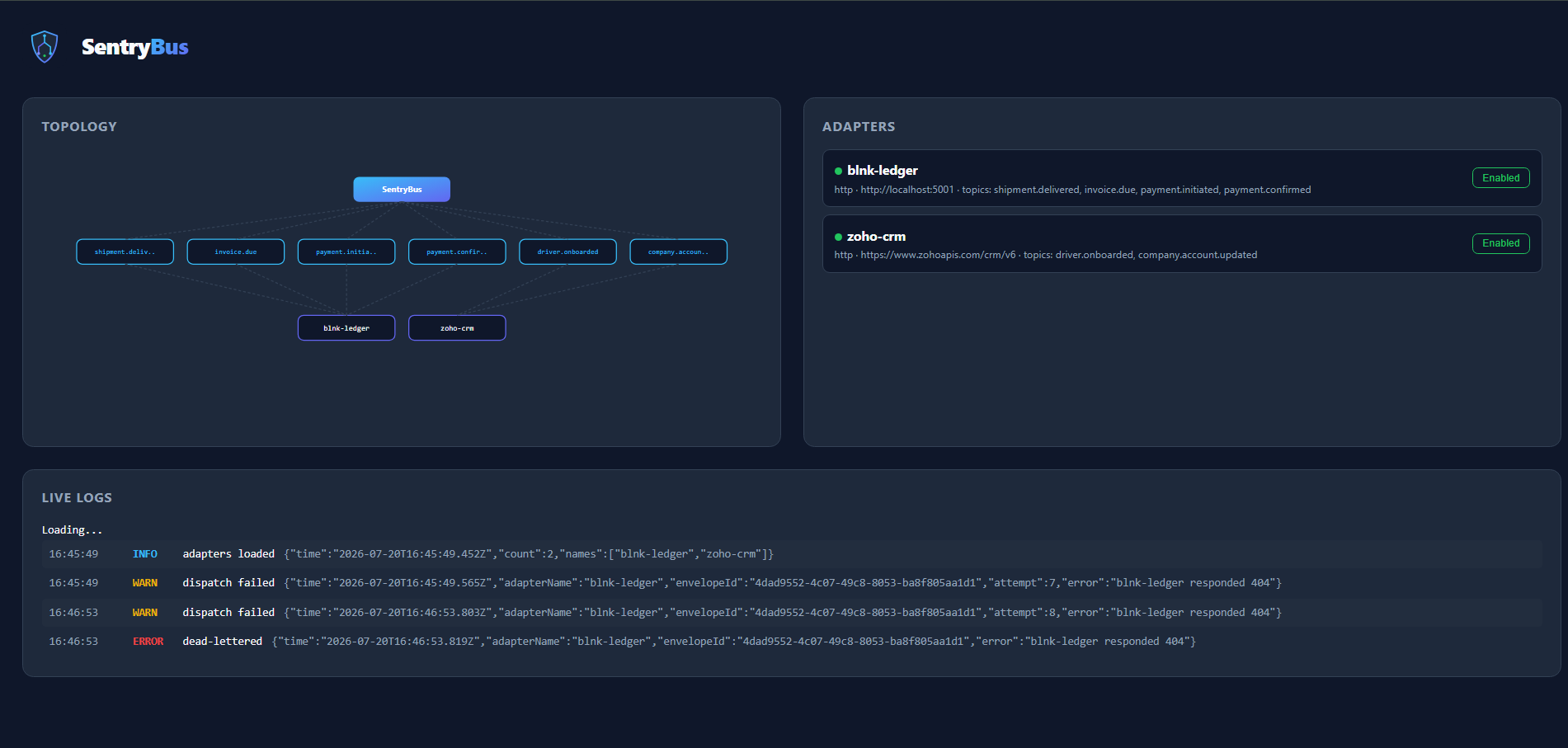
SentryBus ships with a built-in web dashboard at /console. No auth, no setup — just open it in your browser:
http://localhost:8085/console
Features:
- Topology graph — Visual SVG map of how your services connect: bus → topics → adapters. Nodes are color-coded by circuit breaker state (green = closed, yellow = half-open, red = open). Disabled adapters appear faded.
- Adapter controls — Enable/disable any adapter at runtime with a single click. No restart needed.
- Live logs — Real-time structured log stream via Server-Sent Events. Shows dispatch successes, failures, circuit breaker trips, and dead-letters as they happen.
- Auto-refresh — Topology re-fetches every 10 seconds to reflect breaker state changes.
Dashboard API endpoints (used internally by the UI, but available for scripting):
| Endpoint | Method | Description |
|---|---|---|
/console/ |
GET | Dashboard HTML |
/console/api/topology |
GET | JSON graph: nodes (adapters + breaker state) and edges (topic → adapter) |
/console/api/logs |
GET | Last 200 log entries as JSON array |
/console/api/logs/stream |
GET | SSE stream of new log entries |
/console/api/adapters/:name/toggle |
POST | Toggle adapter enabled/disabled at runtime |
Core Concepts
Envelope
Every event flowing through SentryBus is wrapped in a normalized envelope. The producer supplies only the intent (type + payload); the bus stamps bookkeeping fields.
{
  id: "uuid",              // assigned by the bus
  type: "order.created",   // topic
  version: "1.0",          // envelope schema version
  correlationId: "...",    // tracing across systems
  timestamp: "ISO-8601",   // when the bus received it
  payload: { ... }         // your event data
}
Adapters
An adapter represents one external service integration. At boot, SentryBus loads all bus/*.config.toml files (excluding env.config.toml), validates each against the Zod schema, and builds an in-memory registry. Only adapters with enabled = true participate in routing.
Queue & Retry
BullMQ backed by Redis for persistent job queuing:
- Per-adapter jobs — Each adapter gets its own job. A Blnk failure retries independently of Zoho.
- Deduplication — Job ID is
{envelopeId}:{adapterName}. Same event never double-queues. - Custom backoff — Reads each adapter's retry policy directly from config (fixed/linear/exponential + jitter).
- Dead-lettering — After
maxAttemptsexhausted, logged at error level.
Circuit Breaker
In-process, per-adapter state machine:
| State | Behavior |
|---|---|
| Closed | Normal — all dispatches go through |
| Open | Service down — fail fast, no network call |
| Half-open | Cooldown elapsed — one probe allowed |
Middleware
Minimal compose utility for Bun.serve (no framework dependency):
- withRequestLog — method, path, status, duration
- withErrorBoundary — catches unhandled errors, returns clean 500
Scripts
| Command | Description |
|---|---|
bun run dev |
Start with --watch (auto-restart on changes) |
bun run start |
Production start |
bun run build |
Compile to dist/index.js |
bun run bundle |
Compile + minify for distribution |
Extending SentryBus
Adding a New Adapter
- Create
bus/<service-name>.config.tomlwith the required fields. - Set the credential as an environment variable (the value referenced by
credentialKey). - Restart the bus. Done.
No code changes needed for outbound-only integrations.
Bidirectional Adapters (Webhooks)
For services that call back (like Blnk):
- Add
webhookRouteandwebhookSecretto the adapter config. - Implement a route handler that verifies the signature and translates the callback into an internal event.
- Publish it back onto the bus — downstream consumers pick it up.
Design Decisions
| Decision | Rationale |
|---|---|
| TOML config over .env | Validated by Zod at boot. Typed, structured, fails loudly. No silent empty-string bugs. |
| Choreography over orchestration | Bus moves envelopes, not business logic. |
| Redis + BullMQ only | Multi-broker abstraction is a real problem. Commit to one, keep interfaces clean. |
| BullMQ over hand-rolled queues | Atomic state transitions + stalled-job recovery are hard to get right. |
| One file per adapter | Bad edit affects one integration, not all. Clean diffs. |
| Zod as single source of truth | Types derived via z.infer. No drift. |
| Circuit breaker in-process | Correct for single instance. Move to Redis when multi-instance is needed. |
| Bun runtime | Native TOML, fast HTTP, built-in bundler. No extra dependencies for basics. |
Known Gaps
- Adapter dispatch is generic — Currently a plain
POST+Bearerheader. Real adapters need per-service request shaping. - Webhook receiver not implemented — Config supports it, route handler doesn't exist yet.
- Rate limiting not enforced — Config defines token bucket params but the limiter isn't wired in.
- No hot-reload — Config changes require restart. Deliberate for now.
- Single instance only — Circuit breaker is in-memory.
Publishing
SentryBus is published to npm and installable via any package manager:
# Install globally
bun add -g sentrybus
npm install -g sentrybus

# Run without installing
bunx sentrybus
npx sentrybus
Requires Bun runtime (bun.sh) to execute.
License
MIT
Built by Victor Chibuogwu Chukemeka (@emekadefirst)
Contact: emekadefirst@gmail.com