
shotpress
App Store / Google Play screenshot sets from a JSON spec. Framed device mockups on styled backgrounds with headlines, ratings, callouts and badges — rendered headless at exact store pixel sizes.
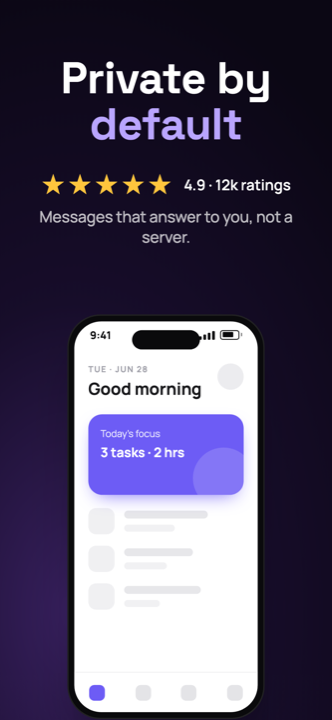
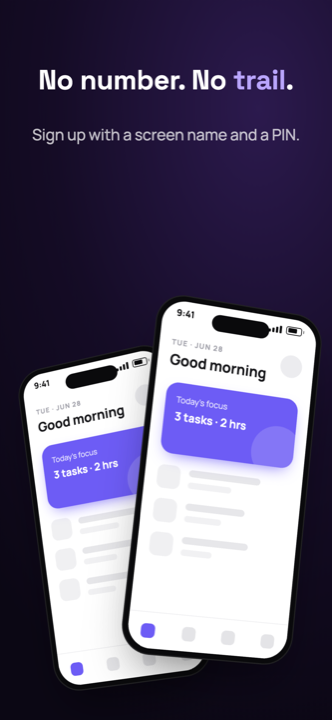
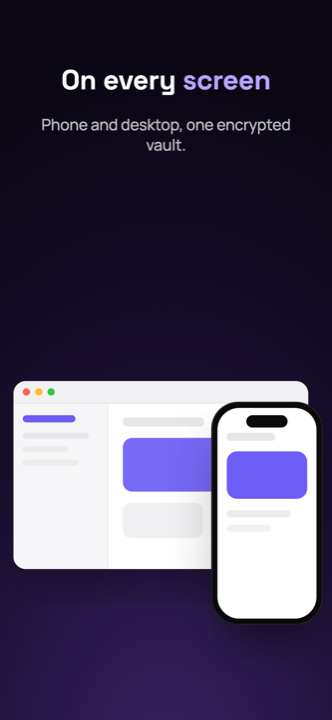
shotpress rendered this set from its own spec — see assets/showcase.json.
npx shotpress new --pack saas --app-name "MyApp" --out project.json
# edit copy, point device layers at your real app screenshots
npx shotpress render-all project.json --stores appstore,play --zip
Commands
| command | what it does |
|---|---|
render <project.json> |
render every screen to PNG/JPEG/SVG (--contact for a whole-set montage; --fonts <dir> for offline custom faces) |
render-all <project.json> |
batch-render at every store size (--stores appstore,play,mac,watch) |
new |
scaffold a project (--pack, --format, --app-name, --accent, --screens, --honest to drop demo social proof, --kitchen-sink for a one-of-every-layer reference) |
capture <url> |
screenshot a live web app at device-correct viewport/DPR (--routes or --discover, --dark, --cookies, --wait-selector) |
simshot <ios|android> |
screenshot the booted simulator/emulator; --flow runs a Maestro flow and collects its takeScreenshot output; --video records instead (with --flow: the whole driven session) |
variants <project.json> |
emit validated, lint-scored A/B variant projects for App Store custom product pages |
edit <project.json> |
open the visual editor in a browser; every change autosaves back to the file |
watch <project.json> |
live board in your browser, synced both ways with the file — watch a set compose as it's edited, hand-tweak it, then hit Export for store-exact PNGs; self-contained/offline (--window for a dedicated Chromium window, --no-open to just print the URL) |
frames [install] |
official Apple bezels, downloaded from Apple's CDN after accepting Apple's terms — never bundled |
lint <project.json> |
design-quality findings: type scale, contrast, social proof, safe zones, composition rhythm, text collisions (--measure for line-count/bbox per layer without rendering, --rules to list every rule + threshold) |
packs / formats |
list options as JSON |
schema |
authoritative layer schema — every type, its fields, enums and defaults (--markdown for a catalogue); pose lists 3D device poses, components lists compound layers |
resolve <project.json> |
expand a project's tokens/styles/decorations/pose design system into concrete layers |
decor [kind] |
generate on-brand SVG depth (aurora mesh, grain, glow, blob, rings, waves, image mask); --json prints a paste-ready bg/layer snippet, --seed keeps a set consistent |
validate <project.json> |
schema check, non-zero exit + JSON errors on failure |
All commands are non-interactive. --json prints a manifest to stdout so the
CLI composes with scripts and agents. Render options: --format, --out,
--type png|jpeg|svg, --scale, --screens 1,3,5, --name, --zip.
Outputs overwrite by filename — give concurrent runs distinct --out dirs.
Formats
iPhone 6.9″/6.5″, iPad 13″/11″, Android phone/tablet, Play feature graphic,
Mac, Apple Watch. shotpress formats prints design and output pixel sizes.
Output is store-exact (1290×2796, 2048×2732, 1024×500, …); Android phone comes
out 1080×2160 to preserve the design aspect, which Play accepts.
Starter packs
Nine themed packs, 10 screens each, with realistic copy to rewrite:
Flow (productivity), Pulse (fitness), Ledger (finance), Circle (social),
Munch (food), Atlas (SaaS), Shelf (e-commerce), Nova (AI), Secure (privacy).
Ready-made specs for each live in templates/.
Community packs are npm packages named shotpress-pack-<id> carrying a
data-only pack.json (see examples/shotpress-pack-sample/); install one and
--pack <id> finds it. Local pack files work too.
RTL sets: render --rtl mirrors the whole layout by coordinate math (Cairo is
vendored for offline Arabic); supply translated copy and RTL app captures.
Project spec
A project is { format, brand, screens[] }; each screen is a background plus
layers (device, text, rating, callout, badge, logo, image, shape, icon,
feature row). Text supports inline markup: *accent*, **highlight**,
~gradient~. Device layers take a kind, bezel, camera cutout, treatment
(plain/bleed/angled/compare/duo/pano/multi) and a free 3D pose (rx3d/ry3d).
image fields accept local paths or data URLs.
Positions are design-space px for the project's format. Rendering with a
different --format reflows the layout deterministically — no manual
re-positioning between iPhone, iPad, Android and feature-graphic sizes.
How it renders
The visual engine (src/engine/) is an HTML editor + renderer; the CLI drives
it in headless Chromium via Playwright: inject the project state, lay all
screens out on the board, then screenshot each one at
deviceScaleFactor = realW / designW. A real browser engine means gradients,
backdrop blurs and 3D device poses come out pixel-perfect.
Renders are hermetic by default: React and the default font families
(Space Grotesk, Manrope, Instrument Serif) ship vendored and are served from a
loopback server, so results don't depend on a CDN being up. Other Google Fonts
families load from the network; a family that can't load fails the render by
name instead of silently swapping in a system font. Set SHOTPRESS_NO_NETWORK=1
to hard-block everything but the loopback (CI determinism).
Browser resolution order: --browser-path, Playwright's cached Chromium,
system Google Chrome. If none exists the error tells you the exact
npx playwright-core install chromium command to run.
Tests: npm test (no browser needed) and npm run test:e2e for the full
render smoke.
fastlane
render-all --fastlane --locale en-US additionally copies the output into the
layout fastlane expects — fastlane/screenshots/<locale>/ for deliver (device
slots are inferred from the store-exact dimensions) and
fastlane/metadata/android/<locale>/images/ for supply, feature graphic
included. Point your Deliverfile/Fastfile at it and upload.
Official device frames
The built-in bezels are CSS-drawn and ship with the package. For Apple's
official product bezels: shotpress frames install --accept-apple-terms
downloads them directly from Apple's CDN (they are licensed for App Store
marketing by Apple Developer Program members and can't be redistributed, so
they are never bundled). Then set "frame": "iphone" on a device layer —
the screenshot is fitted into the bezel's measured screen opening. Apple's
terms require the artwork as-is: lint flags any rotation or 3D pose on a
framed device. macOS only for now (the artwork ships as .dmg).
Design, not just rendering
lint encodes a numeric design doctrine — narrative arc, a 3-tier type scale,
copy word-count caps, WCAG contrast against gradient stops, store-UI safe
zones, composition rhythm — so an agent (or CI) can critique a set before
pixels exist. The full doctrine lives in skills/shotpress/DESIGN.md.
Claude Code plugin
The repo doubles as a Claude Code plugin — a shotpress skill that teaches
the capture → compose → lint → render loop plus the design doctrine, and a
/screenshots command that builds a full store set for the current app.
It hosts its own marketplace:
/plugin marketplace add ibrahimhajjaj/shotpress
/plugin install shotpress@shotpress
License
PolyForm Noncommercial 1.0.0: free for personal, educational, research, and nonprofit use. Commercial use needs a separate license — open a GitHub issue if you want one. Bundled fonts and React keep their own licenses (see NOTICE).