
SpecKit Governance Dashboard
A read-only, Markdown-first visual dashboard for SpecKit projects.
npm package: speckit-governance-dashboard@0.1.1
Project docs: skgd.itseslam.com · Author: Eslam M. Mohamed


Demo screenshots
The images below are generated exclusively from the synthetic full-governance demo. They are safe to publish and illustrate the dashboard’s read-only views.
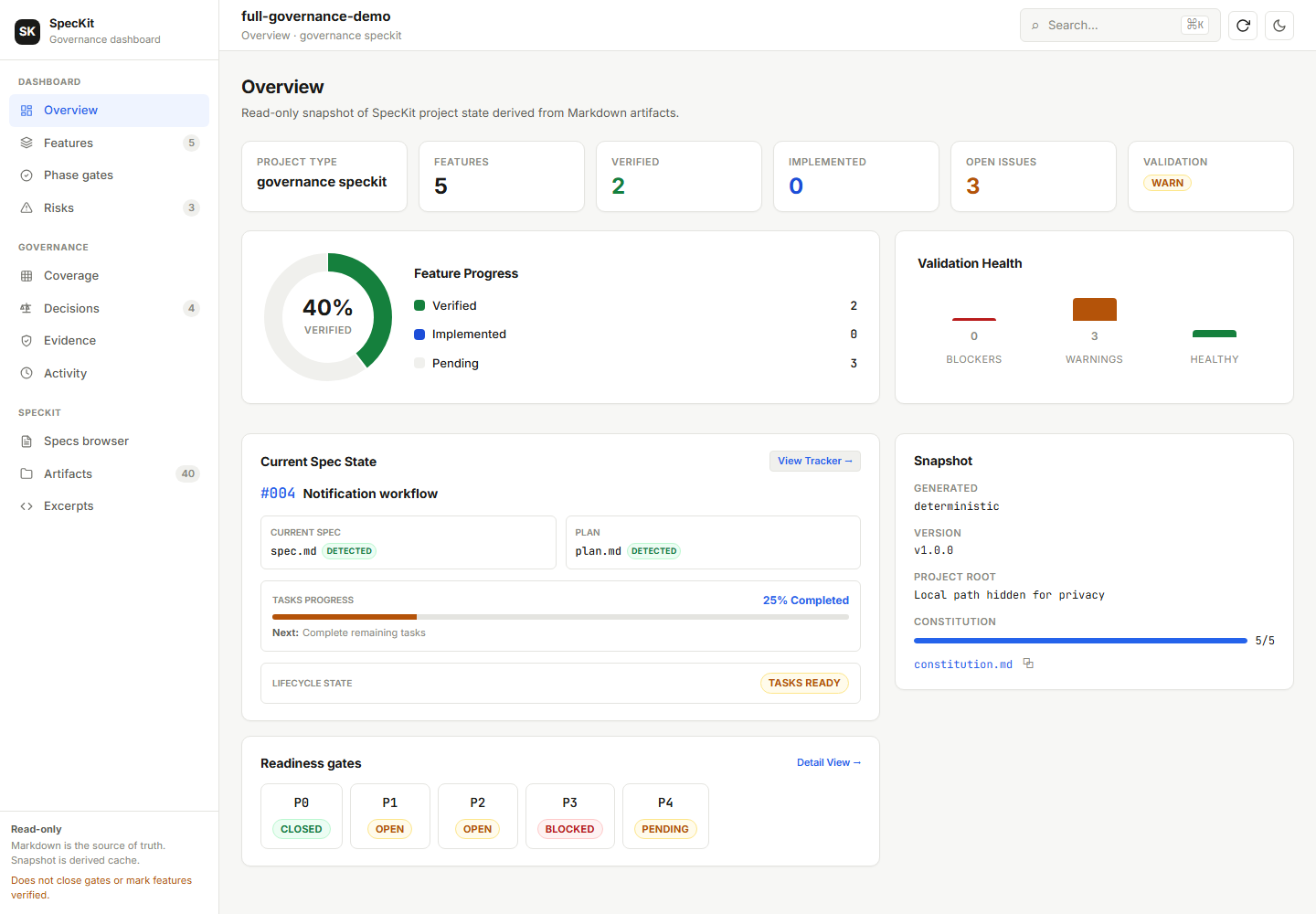
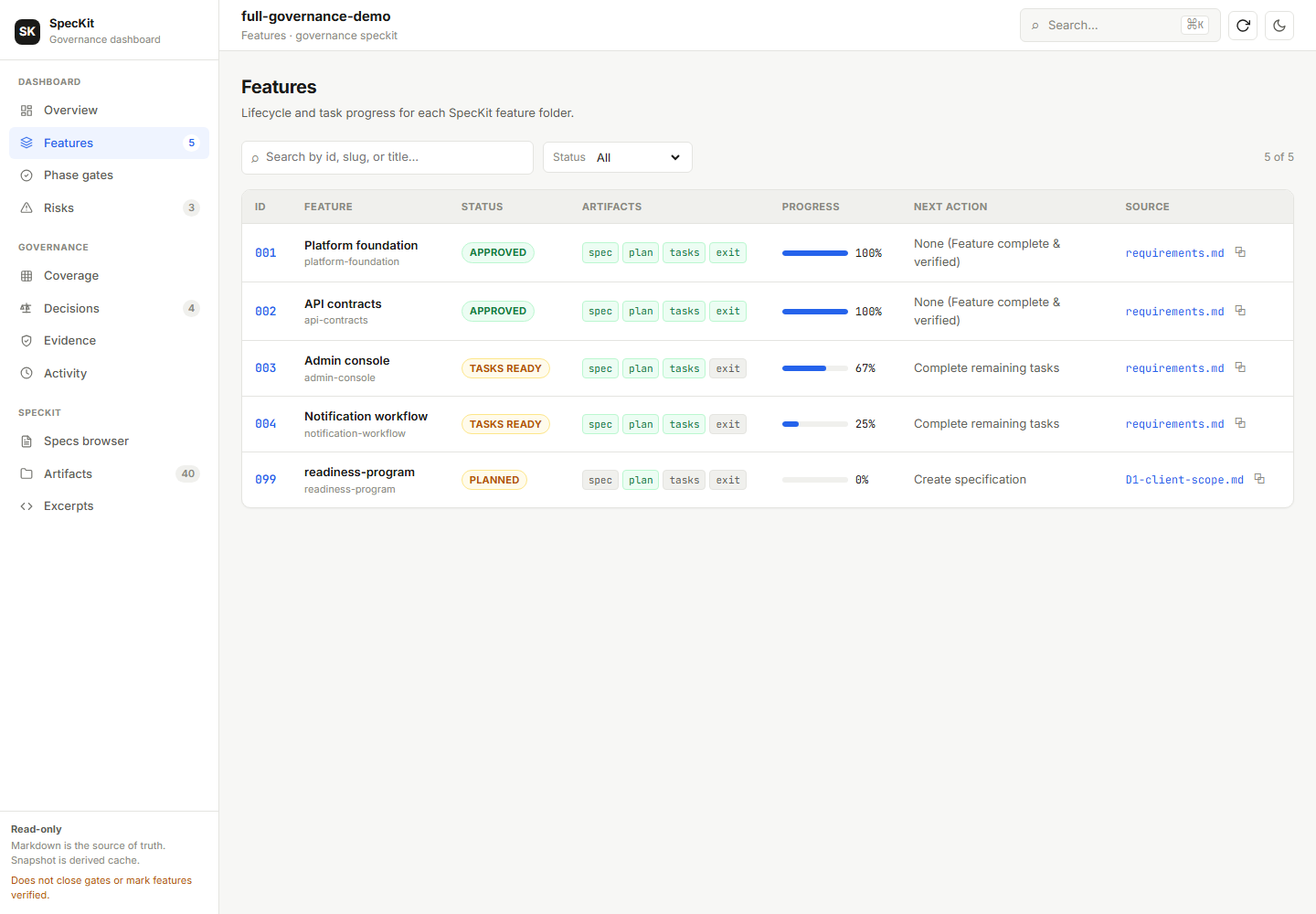
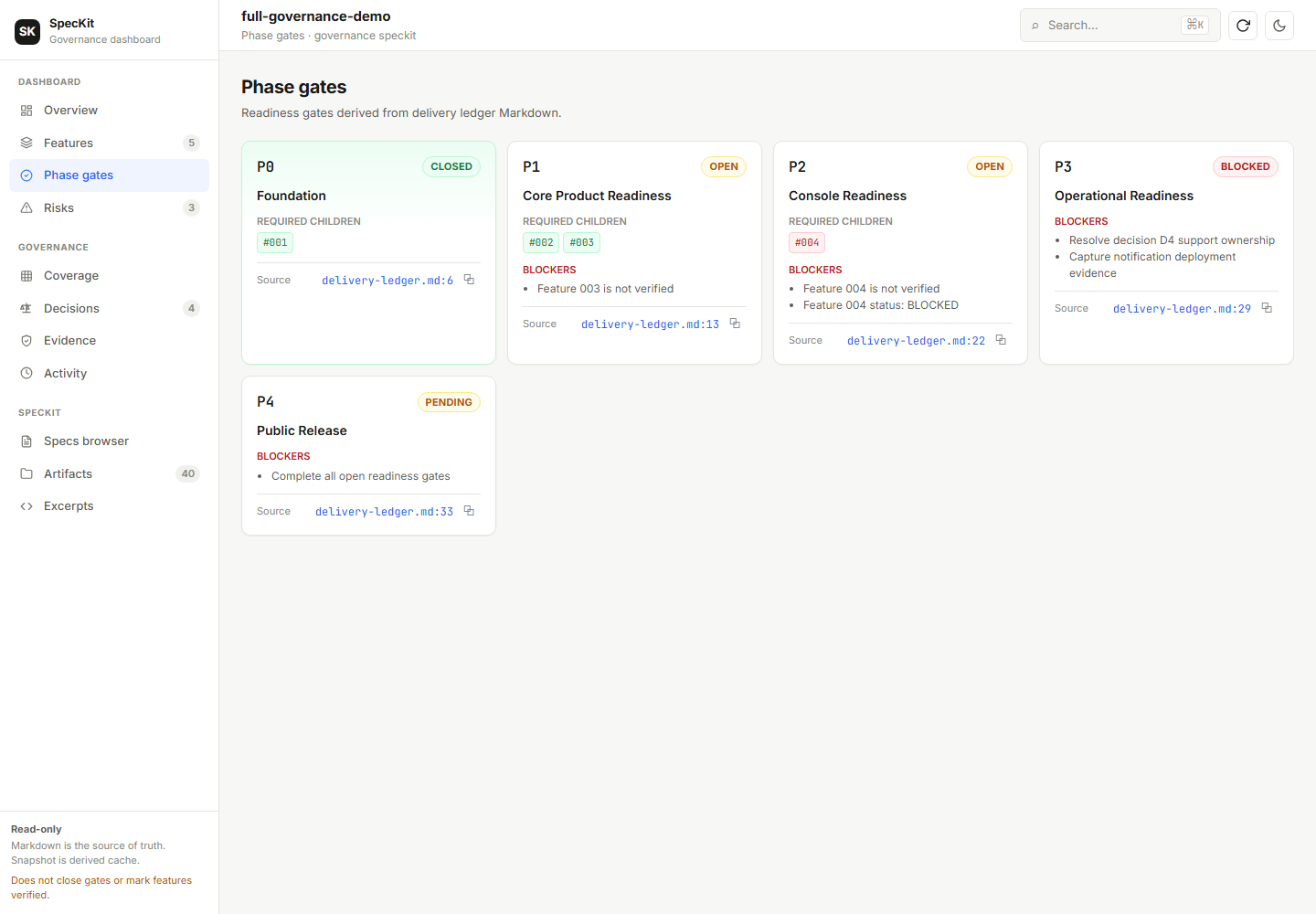
SpecKit Governance Dashboard scans SpecKit Markdown artifacts, contracts, tasks, checklists, evidence, and optional governance ledgers from an external project path, then generates a deterministic read-only snapshot and visual UI.
It is designed for repositories created with or compatible with GitHub Spec Kit. This dashboard is an independent companion project and is not an official GitHub or Spec Kit project.
Markdown remains the source of truth. Generated JSON is derived cache only. The dashboard never writes lifecycle state. The dashboard does not modify the target SpecKit project.
This project is an independent companion dashboard for SpecKit-style repositories. It is not an official GitHub project.
What it is—and is not
It is a local artifact discovery, validation, snapshot, and visualization tool. It is not a project-management backend, database, workflow engine, Markdown editor, or lifecycle mutation tool.
Features
- Read-only external-project scanning with pre/post mutation protection
- Vanilla SpecKit artifact discovery plus optional governance artifacts
- Deterministic JSON snapshots for repeatable CI checks
- Visual UI for overview, features, gates, evidence, decisions, coverage, diagnostics, and artifact inventory
- Contract, checklist, evidence, phase-exit, ledger, and decision detection
- Adapter-based parsing architecture with no default customer-specific rules
Supported artifacts include .specify/feature.json, constitutions, spec.md, plan.md, tasks.md, checklists, contracts, evidence, phase exits, decision records, delivery ledgers, and coverage matrices.
Quick start
The fastest way to use the dashboard is directly via npm.
From npm (Recommended)
Run it without a global installation:
npx speckit-governance-dashboard@0.1.2 doctor --project-root ../my-speckit-project
npx speckit-governance-dashboard@0.1.2 generate --project-root ../my-speckit-project --deterministic
npx speckit-governance-dashboard@0.1.2 serve --project-root ../my-speckit-project
Or install it globally for everyday use (both the full command and the shorter speckit-dashboard alias are available):
npm install --global speckit-governance-dashboard@0.1.2
speckit-dashboard doctor --project-root ../my-speckit-project
speckit-governance-dashboard generate --project-root ../my-speckit-project --deterministic
--project-root must point to the local SpecKit project you want to inspect. The CLI reads that project without modifying its Markdown artifacts or lifecycle state.
From a clone (For development/demos)
If you want to run the dashboard with the synthetic demo examples or develop the project, clone the repository:
git clone https://github.com/essov3/speckit-governance-dashboard.git
cd speckit-governance-dashboard
npm install
npm run build
npm run dashboard:doctor -- --project-root ./examples/vanilla-speckit-demo
npm run dashboard:generate -- --project-root ./examples/vanilla-speckit-demo --deterministic
npm run dashboard:serve -- --project-root ./examples/vanilla-speckit-demo
--project-root is the SpecKit project being analyzed, not the dashboard repository. For another local project:
npm run dashboard:generate -- --project-root ../my-speckit-projectThe commands above assume a cloned checkout, which includes the synthetic examples. The published npm package intentionally contains only the runtime files, not examples/.
CLI
npm run dashboard:doctor -- --project-root <project>
npm run dashboard:generate -- --project-root <project> --deterministic
npm run dashboard:check -- --project-root <project> --deterministic
npm run dashboard:serve -- --project-root <project>
generate writes .dashboard-cache/<project>/project-status.json in the dashboard working directory unless --out is supplied. check validates the live Markdown view and detects stale cache. Use --adapter vanilla or --adapter governance to select discovery behavior.
Demos
examples/vanilla-speckit-demo is a clean synthetic project used by CI. examples/governance-demo demonstrates gates, a pending decision, a contract, and an intentional missing-evidence warning. Generate the clean demo with npm run demo:generate.
Snapshot, privacy, and read-only behavior
Snapshots contain artifact paths, hashes, feature names, diagnostics, and may contain source excerpts supplied by parsers. Do not publish snapshots generated from private repositories unless you have reviewed and sanitized them. No private snapshot is bundled here.
Generated JSON is derived cache only; it is never used to change Markdown or lifecycle state. See the read-only model and snapshot schema.
Architecture and UI
The pipeline is CLI → discovery → adapters → normalization → validators → snapshot → UI. There is no database or backend state store. The UI has executive overview, feature tracking, gate board, coverage, decisions, evidence health, risks, artifacts, and source-excerpt views.
Validation distinguishes errors from warnings; strict mode makes ambiguous parsing fail. Read architecture, validation rules, and adapter guidance.
Configuration and adapters
Optional speckit-dashboard.config.json can provide a project root, output location, and adapter choice. It cannot contain lifecycle or governance state. The default vanilla adapter works with common SpecKit Markdown. Governance support adds generic ledger, coverage, decision, contract, evidence, and phase-exit parsing. See adapters.
Website and development
Run npm run docs:dev for the VitePress docs site and npm run docs:build to produce docs/.vitepress/dist. The intended public docs address is skgd.itseslam.com. It can be deployed to GitHub Pages, Vercel, Netlify, or Cloudflare Pages without a backend; see docs deployment.
For development run npm install, npm run typecheck, npm test, and npm run build.
Generate screenshots locally
npm run screenshots:install
npm run demo:screenshots
Screenshots are saved under docs/assets/screenshots/. The full synthetic demo is intentionally rich enough to make feature, gate, coverage, decision, evidence, risk, activity, and artifact views useful.
Security, roadmap, and contributing
The dashboard reads local files only. Keep private data and secrets out of fixtures, issues, screenshots, and generated snapshots. See SECURITY.md.
The roadmap includes richer adapter documentation, sanitized demo screenshots, and configurable snapshot redaction. Contributions are welcome under the contribution guide and code of conduct.
License
MIT 2026 Eslam M. Mohamed. See LICENSE.