
timeman


A terminal based stopwatch and countdown timer, built with OpenTUI and shipped as standalone binaries — no runtime required.
- CLI interface (default): Lightweight inline mode that lives in your scrollback.
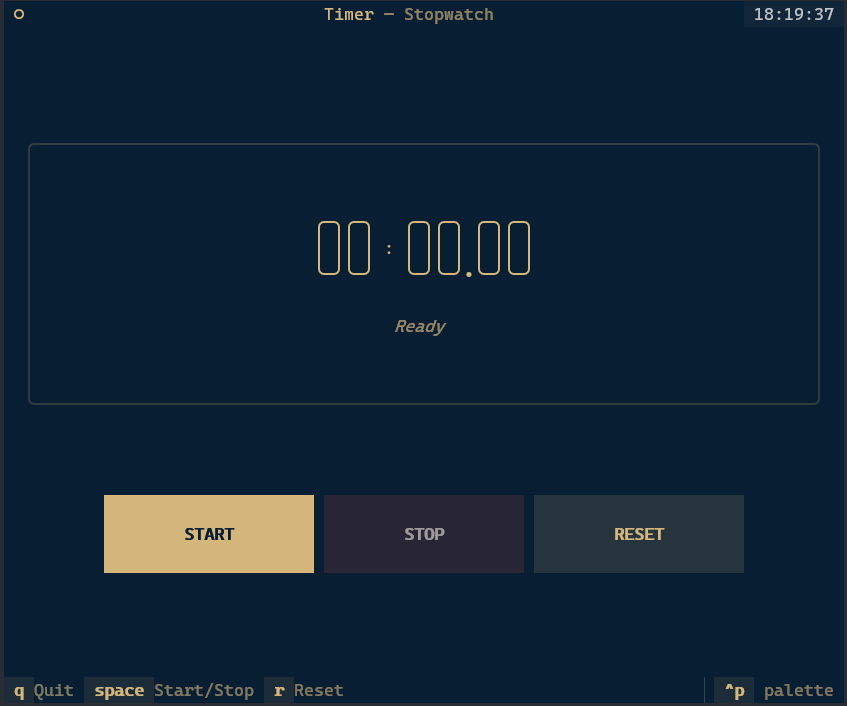
- TUI interface: Full-screen terminal UI via
-i/--interactive. - Notifications: Bell + toast when a countdown completes.
- Session timeline: Stopwatch summary with per-session start/end times in your local time zone.
- Drift-proof timing: Durations use a monotonic clock, so a system clock jump (DST, NTP sync) never corrupts them.
Installation
npm:
npm install -g timeman-clibun:
bun add -g timeman-clipip / uv (same binary, published as time-manager for continuity with the original Python package):
pip install time-manager
# or
uv tool install time-manager
curl (Linux, macOS — downloads the binary from the latest GitHub release):
curl -fsSL https://raw.githubusercontent.com/rehanhaider/time-manager/main/install.sh | bashEvery method installs the tm command. npm/bun also install timeman, pip also installs time-manager, and curl installs just tm.
Supported platforms: Linux x64/arm64 (glibc and musl), macOS x64/arm64, Windows x64 (via npm/bun).
Usage
tm sw              # stopwatch            (also: tm stopwatch)
tm cd 5 m          # 5-minute countdown   (also: tm countdown 5 m)
Stopwatch
tm sw
tm sw -p "Project Alpha"   # name the session for the summary
tm sw -i                   # full-screen TUI
Keys: space start/stop · r reset · q quit.
On exit you get a session timeline — one bar per start/stop run, with total time:
╭──────────────── Project Alpha: 0 hrs 25 mins ────────────────╮
│   Session #1   13:53 ▬▬▬▬▬▬▬▬▬▬▬▬▬▬▬ 14:03 IST  (0 hrs 10 mins) │
│                                                              │
│   Session #2   14:10 ▬▬▬▬▬▬▬▬▬▬▬▬▬▬▬ 14:25 IST  (0 hrs 15 mins) │
╰──────────────────────────────────────────────────────────────╯
Countdown
tm cd 90 s         # units: s/sec/seconds, m/min/minutes, h/hr/hours
tm cd 5            # unit defaults to minutes
tm cd 1 h -i       # full-screen TUI
Keys: space pause/resume · q quit. The display turns yellow under 30 seconds and red under 10; when time is up you get a terminal bell and a toast.
Development
Requires Bun >= 1.3.14.
bun install                      # install dependencies
bun run dev sw                   # run from source
bun test                         # tests
bunx tsc --noEmit                # typecheck
Building distribution artifacts:
bun install --os="*" --cpu="*"   # stage native packages for every platform (one-time)
make build                       # compile binaries for all 7 targets into dist/bin
make package                     # assemble npm packages (dist/npm) + release tarballs (dist/release)
Releasing
Everything publishes locally from this machine — no CI, no secrets on GitHub.
make bump(orTYPE=minor make bump), commit.make package— builds all binaries, npm packages, wheels, and release tarballs.make publish— rehearsal: npm--dry-run+ TestPyPI.PROD=TRUE make publish— the real thing: npm packages, PyPI wheels, and a GitHub releasev<version>with the binaries (which the curl installer downloads).
Credentials: npm token in ~/.npmrc, PyPI tokens in .env (PYPI_PUBLISH_TOKEN, TEST_PYPI_PUBLISH_TOKEN), and an authenticated gh CLI for the release upload.
History
This project was originally written in Python with Textual and published to PyPI as time-manager (last Python release: 0.3.1; the implementation is preserved in git history). From 0.4.0 on, the PyPI package ships the same compiled binary as the npm package — pip install time-manager keeps working with no Python runtime involved.
License
MIT